
ISSN: 1885-5857 Impact factor 2025 4.2
Corrected proofs Journal pre-proofs

Original article
Early changes in pulmonary arterial systolic pressure after transcatheter edge-to-edge mitral valve repair and their association with outcomes

Cambios precoces en la presión arterial pulmonar sistólica tras la reparación mitral percutánea de borde a borde y su asociación con los resultados clínicos

Gaspard Suca◊MyLien Nguyena◊Caroline Chong-NguyenbcdMustafa HabibaJorge NucheefManuel GiráldezeFernando Sarnago-CebadaeIsaac PascualgIria SilvagJean-Michel ParadishJosep Rodés-CabauhGrégory DucrocqaJules MesnieraBernard IungaFabien PrazbdMarina Urenaa
https://doi.org/10.1016/j.rec.2026.08.004
La versión en español de este artículo estará disponible en breve
Supplementary data
Imagen extra
10.1016/j.rec.2026.08.004
Abstract
Introduction and objectives

Transcatheter edge-to-edge repair (TEER) is a treatment for high-surgical-risk patients with severe mitral regurgitation. While pulmonary hypertension (PH) predicts poor outcomes after mitral surgery, its impact after TEER remains uncertain. The aim of this study was to assess early changes in systolic pulmonary arterial pressure (sPAP) after TEER and their association with outcomes.

Methods

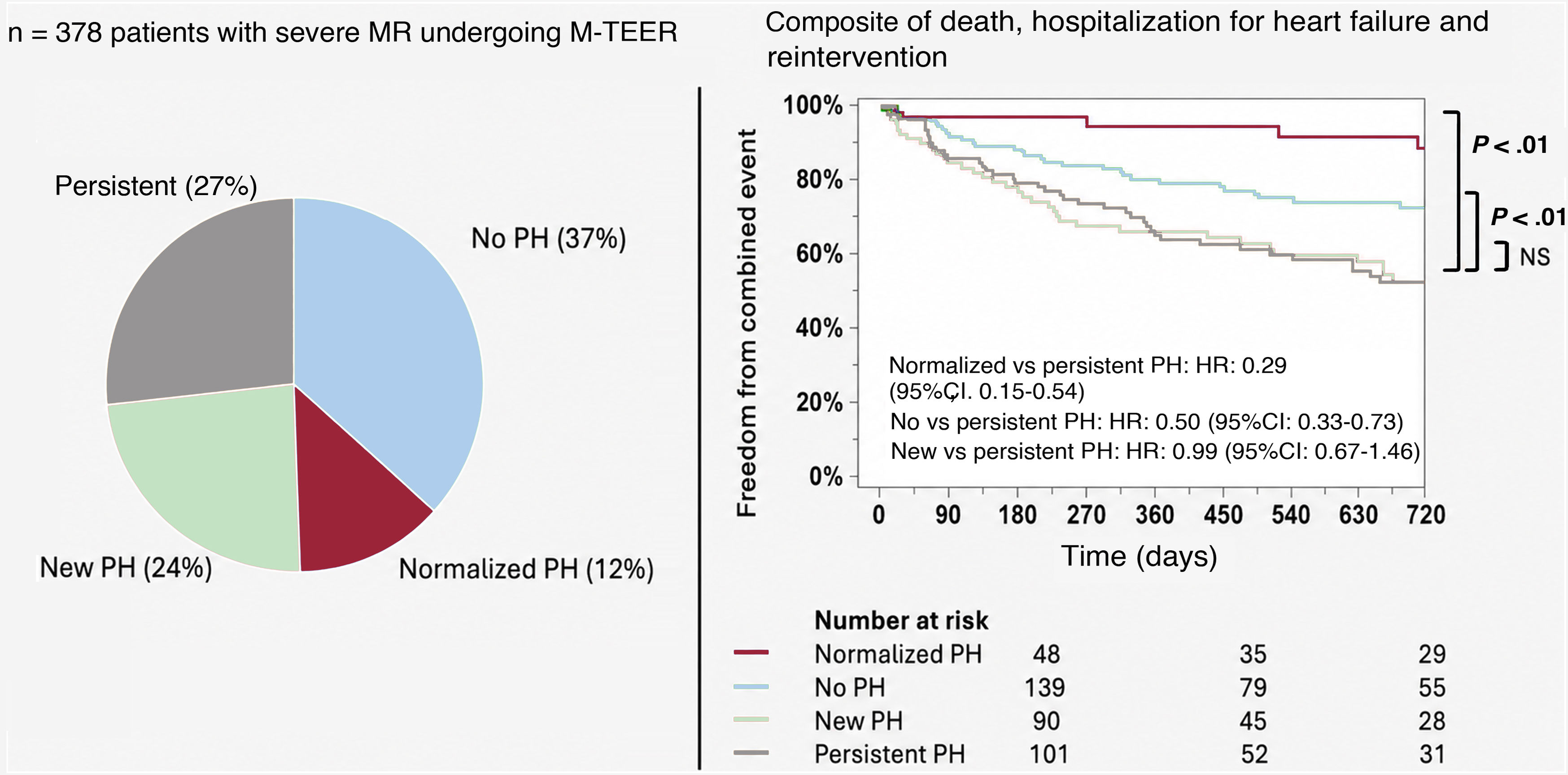
This multicenter, retrospective cohort study included 378 patients undergoing TEER between 2012 and 2023. sPAP was measured by transthoracic echocardiography before the procedure and on day 1. PH was defined as sPAP> 50 mmHg pre-TEER and> 40 mmHg post-TEER. Patients were classified into 4 groups: no PH (no PH before or after TEER), new PH (normal baseline sPAP with postprocedural PH), normalized PH (baseline PH with normalization after TEER), and persistent PH (PH before and after TEER). The primary endpoint was a composite of all-cause mortality, heart failure hospitalization, or mitral valve reintervention at 2 years.

Results

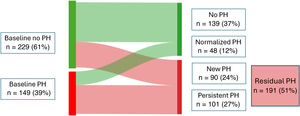
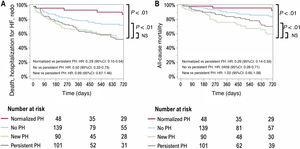
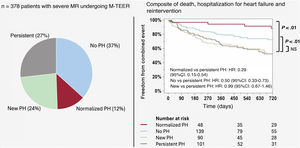
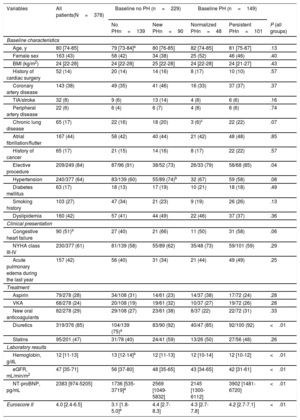
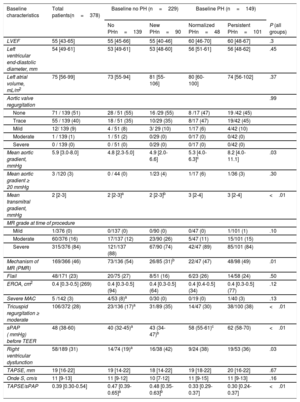
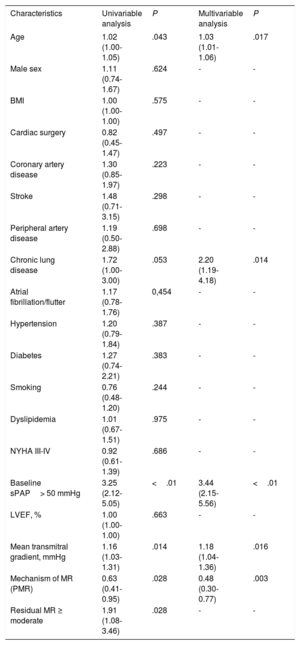
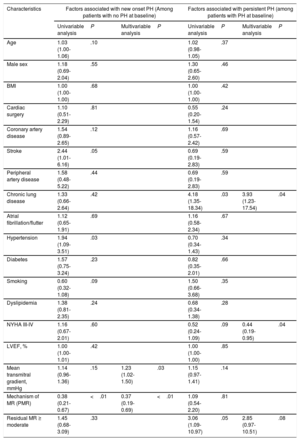
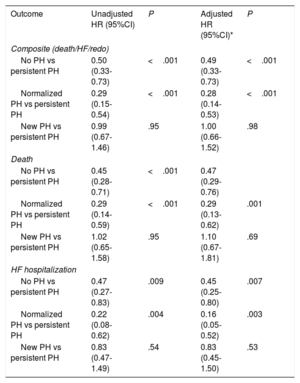
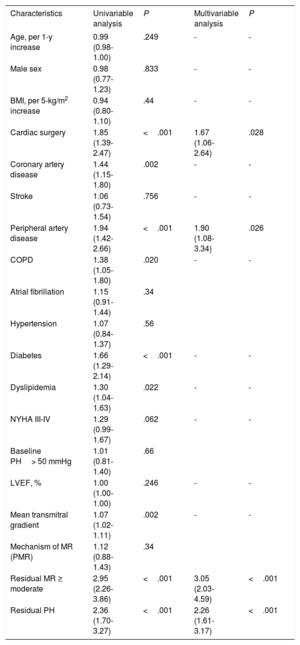
Median age was 80 [interquartile range, 74-85] years, and 43% were women; 39% had baseline PH. Post-TEER, 24% developed new PH and 27% had persistent PH, resulting in residual PH in 51% of patients. Predictors of residual PH included age (aOR, 1.03/y), chronic lung disease (aOR, 2.20), baseline sPAP> 50 mmHg (aOR, 3.44), and higher postprocedural transmitral gradient (aOR, 1.18/mmHg), while primary mitral regurgitation was protective (aOR, 0.48). Unlike baseline PH, residual PH was independently associated with the primary endpoint (aHR, 2.26).

Conclusions

Residual PH is common after TEER and is independently associated with adverse outcomes. Early postprocedural sPAP assessment may refine risk prognostication.

Keywords

Transcatheter edge-to-edge repair
Pulmonary pressure
Echocardiography
Mortality

Abbreviations

MR
PH
PMR
SMR
sPAP
TEER

Identify yourself

Not yet a subscriber to the journal?

Purchase access to the article

By purchasing the article, the PDF of the same can be downloaded

Price: 19,34 €

Phone for incidents

Monday to Friday from 9am to 6pm (GMT+1) except for the months of July and August, which will be from 9am to 3pm

Calls from Spain 932 415 960
Calls from outside Spain +34 932 415 960
References
[1]
C.M. Otto, R.A. Nishimura, R.O. Bonow, et al.
2020 ACC/AHA Guideline for the Management of Patients With Valvular Heart Disease: A Report of the American College of Cardiology/American Heart Association Joint Committee on Clinical Practice Guidelines.
Circulation., (2021), 143 pp. e72-e227
[2]
F. Praz, M.A. Borger, J. Lanz, et al.
2025 ESC/EACTS Guidelines for the management of valvular heart disease.
Eur Heart J., (2025), 46 pp. 4635-4736
[3]
P. Boekstegers, J. Hausleiter, T. Schmitz, et al.
Intraprocedural Residual Mitral Regurgitation and Survival After Transcatheter Edge-to-Edge Repair: Prospective German Multicenter Registry (MITRA-PRO).
JACC Cardiovasc Interv., (2023), 16 pp. 574-585
[4]
S. Ludwig, B. Koell, J. Weimann, et al.
Impact of Intraprocedural Mitral Regurgitation and Gradient Following Transcatheter Edge-to-Edge Repair for Primary Mitral Regurgitation.
JACC Cardiovasc Interv., (2024), 17 pp. 1559-1573
[5]
J. Miyamoto, Y. Ohno, N. Kamioka, et al.
Impact of Periprocedural Pulmonary Hypertension on Outcomes After Transcatheter Aortic Valve Replacement.
J Am Coll Cardiol., (2022), 80 pp. 1601-1613
[6]
M. Tang, X. Liu, C. Lin, et al.
Meta-Analysis of Outcomes and Evolution of Pulmonary Hypertension Before and After Transcatheter Aortic Valve Implantation.
Am J Cardiol., (2017), 119 pp. 91-99
[7]
S. Neppala, H.D. Chigurupati, A. Fath, et al.
Impact of pulmonary hypertension on short and long-term outcome after mitral transcatheter edge-to-edge repair: A meta-analysis.
Cardiovasc Revasc Med., (2025), 78 pp. 88-96
[8]
H. Tsubata, N. Nakanishi, K. Takamatsu, et al.
Residual Pulmonary Hypertension After Transcatheter Edge-to-Edge Repair in Patients With Secondary Mitral Regurgitation.
Circ J., (2026), 90 pp. 1304-1305
[9]
T. Ubben, C. Frerker, B. Fujita, et al.
Association of pulmonary hypertension with the outcome in patients undergoing edge-to-edge mitral valve repair.
[10]
J. Hausleiter, T.J. Stocker, M. Adamo, et al.
Mitral valve transcatheter edge-to-edge repair.
EuroIntervention., (2023), 18 pp. 957-976
[11]
B. Essayagh, G. Benfari, C. Antoine, et al.
Reappraisal of the Concept and Implications of Pulmonary Hypertension in Degenerative Mitral Regurgitation.
JACC Cardiovasc Imaging., (2024), 17 pp. 1149-1163
[12]
M. Humbert, G. Kovacs, M.M. Hoeper, et al.
2022 ESC/ERS Guidelines for the diagnosis and treatment of pulmonary hypertension.
Eur Heart J., (2022), 43 pp. 3618-3731
[13]
S. Briongos Figuero, J.L. Moya Mur, A. Garcia-Lledo, et al.
Predictors of persistent pulmonary hypertension after mitral valve replacement.
Heart Vessels., (2016), 31 pp. 1091-1099
[14]
L.I. Bushari, G.S. Reeder, M.F. Eleid, et al.
Percutaneous Transcatheter Edge-to-Edge MitraClip Technique: A Practical “Step-by-Step” 3-Dimensional Transesophageal Echocardiography Guide.
Mayo Clin Proc., (2019), 94 pp. 89-102
[15]
P. Lancellotti, P. Pibarot, J. Chambers, et al.
Multi-modality imaging assessment of native valvular regurgitation: an EACVI and ESC council of valvular heart disease position paper.
Eur Heart J Cardiovasc Imaging., (2022), 23 pp. e171-e232
[16]
S.F. Nagueh, D.Y. Sanborn, J.K. Oh, et al.
Recommendations for the Evaluation of Left Ventricular Diastolic Function by Echocardiography and for Heart Failure With Preserved Ejection Fraction Diagnosis: An Update From the American Society of Echocardiography.
J Am Soc Echocardiogr., (2025), 38 pp. 537-569
[17]
G.W. Stone, D.H. Adams, W.T. Abraham, et al.
Clinical Trial Design Principles and Endpoint Definitions for Transcatheter Mitral Valve Repair and Replacement: Part 2: Endpoint Definitions: A Consensus Document From the Mitral Valve Academic Research Consortium.
J Am Coll Cardiol., (2015), 66 pp. 308-321
[18]
R. Al-Bawardy, S. Vemulapalli, V.H. Thourani, et al.
Association of Pulmonary Hypertension With Clinical Outcomes of Transcatheter Mitral Valve Repair.
JAMA Cardiol., (2020), 5 pp. 47-56
[19]
O. Ben-Yehuda, B. Shahim, S. Chen, et al.
Pulmonary Hypertension in Transcatheter Mitral Valve Repair for Secondary Mitral Regurgitation: The COAPT Trial.
J Am Coll Cardiol., (2020), 76 pp. 2595-2606
[20]
E. Tigges, S. Blankenberg, R.S. von Bardeleben, et al.
Implication of pulmonary hypertension in patients undergoing MitraClip therapy: results from the German transcatheter mitral valve interventions (TRAMI) registry.
Eur J Heart Fail., (2018), 20 pp. 585-594
[21]
O. Gaemperli, P. Biaggi, R. Gugelmann, et al.
Real-time left ventricular pressure-volume loops during percutaneous mitral valve repair with the MitraClip system.
Circulation., (2013), 127 pp. 1018-1027
[22]
A. Mandurino-Mirizzi, G. Crimi, C. Raineri, et al.
Haemodynamic impact of MitraClip in patients with functional mitral regurgitation and pulmonary hypertension.
Eur J Clin Invest., (2021), 51
[23]
R.J. Siegel, S. Biner, A.M. Rafique, et al.
The acute hemodynamic effects of MitraClip therapy.
J Am Coll Cardiol., (2011), 57 pp. 1658-1665
[24]
J.A. Barbera, I. Blanco.
Management of Pulmonary Hypertension in Patients with Chronic Lung Disease.
Curr Hypertens Rep., (2015), 17 pp. 62
[25]
D. Surder, C. Klersy, R. Corti, et al.
Impact of mitral regurgitation aetiology on MitraClip outcomes: the MitraSwiss registry.
EuroIntervention., (2020), 16 pp. e112-e120
[26]
P.B. Bertrand, T.W. Churchill, E. Yucel, et al.
Prognostic importance of the transmitral pressure gradient in mitral annular calcification with associated mitral valve dysfunction.
Eur Heart J., (2020), 41 pp. 4321-4328
[27]
R.T. Hahn, J. Hausleiter.
Transmitral Gradients Following Transcatheter Edge-to-Edge Repair: Are Mean Gradients Meaningful?.
JACC Cardiovasc Interv., (2022), 15 pp. 946-949
[28]
B. Koell, S. Ludwig, J. Weimann, et al.
Long-Term Outcomes of Patients With Elevated Mitral Valve Pressure Gradient After Mitral Valve Edge-to-Edge Repair.
JACC Cardiovasc Interv., (2022), 15 pp. 922-934
[29]
G. Suc.
Pushing the Limits of Transcatheter Edge-to-Edge Repair: How Small Can the Mitral Valve Area Go?.
Struct Heart., (2026), 10
[30]
H. Tsunamoto, M. Yamamoto, A. Kagase, et al.
Using Transmitral Pressure Gradients and Residual Mitral Regurgitation to Optimize Outcome After Transcatheter Edge-to-Edge Repair.
J Am Coll Cardiol., (2025), 86 pp. 1684-1700
[31]
S.H. Yoon, M. Makar, S. Kar, et al.
Prognostic Value of Increased Mitral Valve Gradient After Transcatheter Edge-to-Edge Repair for Primary Mitral Regurgitation.
JACC Cardiovasc Interv., (2022), 15 pp. 935-945
[32]
S.C. Gooden, H. Hatoum, W. Zhang, et al.
Multiple MitraClips: The balancing act between pressure gradient and regurgitation.
J Thorac Cardiovasc Surg., (2022), 163 pp. 1319-1327
[33]
G. Suc, R. Hadjedj, J. Mesnier, et al.
Transcatheter edge to edge compared with surgery in older patients with degenerative mitral valve regurgitation.
J Cardiothorac Surg., (2025), 20 pp. 65
[34]
J.M. O’Leary, T.R. Assad, M. Xu, et al.
Lack of a Tricuspid Regurgitation Doppler Signal and Pulmonary Hypertension by Invasive Measurement.
J Am Heart Assoc., (2018),
Copyright © 2026. Sociedad Española de Cardiología