
Acute total occlusion of the left main coronary artery (LMCA) is the most catastrophic form of coronary artery disease, often leading to rapid hemodynamic collapse, cardiogenic shock, and sudden cardiac arrest. Even with prompt recognition and urgent intervention, in-hospital mortality remains high. Given the limited available data, this study analyzed a consecutive, real-world cohort of patients with angiographically confirmed acute total LMCA occlusion (Thrombolysis in Myocardial Infarction [TIMI] 0 flow).
Clinical data from a tertiary referral center on all emergent and urgent percutaneous coronary interventions performed between January 2020 and December 2024 (n=2510) were retrospectively reviewed to identify cases of complete occlusion of the unprotected LMCA. Cardiogenic shock was defined as systolic blood pressure <90mmHg or the need for vasoactive support with signs of end-organ hypoperfusion (lactate ≥ 2.0 mmol/L). The study received approval from the Jagiellonian University Medical College Research Ethics Committee, which waived the need for informed consent, and was conducted in accordance with the Declaration of Helsinki. Due to the very small sample size, continuous variables are expressed as median [interquartile range (Q1-Q3)]. Categorical variables are expressed as counts and percentages. Missing data are reported for each variable in the table, and no imputation was performed; analyses were conducted using available cases only. Comparative analyses used the Fisher exact test for categorical variables, with odds ratios calculated with a Mid-P adjustment (due to the small sample size) and the Mann-Whitney U test for continuous variables. For 2 x 4 comparisons, the Fisher-Freeman-Halton exact test was used. A P-value <.05 was considered statistically significant.
Of 2510 analyzed procedures, 15 cases (0.6%) involved total occlusion of the LMCA. A considerable proportion of patients had a history of acute coronary syndrome (33%; n=4) and previous percutaneous coronary intervention (42%; n=5). Most patients presented with cardiogenic shock (67%; n=10) and sudden cardiac arrest (67%; n=10). All patients had right coronary artery dominance. In most patients, at least 1 additional vessel was diseased in addition to the LMCA (87%; n=13), most commonly the left anterior descending coronary artery.
The no-reflow phenomenon occurred in 47% (n=7) of patients, and slow-flow occurred in 20% (n=3) of patients. TIMI flow grade 3 was achieved in only 33% of patients, while TIMI flow grade 2 was observed in 40% (figure 1). In-hospital mortality was 47% (n=7). Among survivors, the median length of stay in the cardiac care unit was 5.5 (3.75-6.25) days.

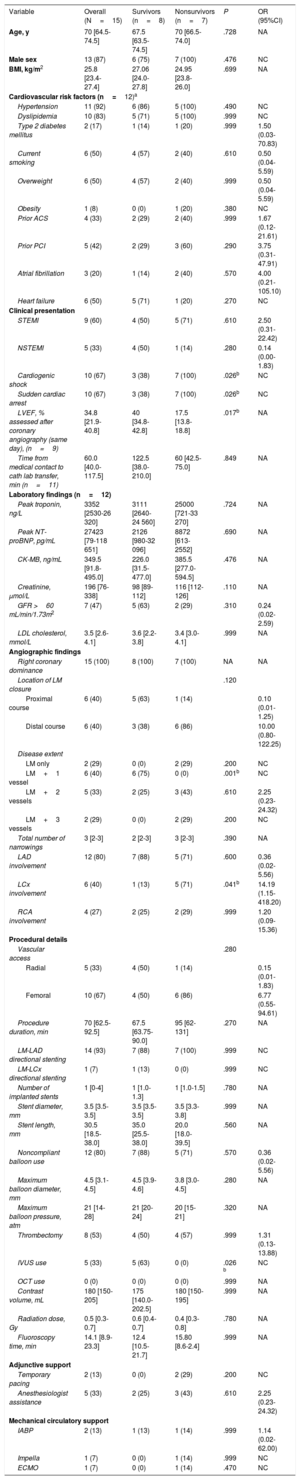
Baseline characteristics were comparable between the groups (table 1). Presentation with ST-segment elevation myocardial infarction (STEMI) was similar in survivors and nonsurvivors (50% vs 71%; P=.608). Cardiogenic shock (survivors, 38% vs nonsurvivors, 100%; P=.026) and sudden cardiac arrest (38% vs 100%; P=.026) were significantly more frequent in nonsurvivors. Distal left main occlusion was also more common among nonsurvivors (86% vs 38%; P=.112), as was left circumflex artery involvement (71% vs 13%; P=.041). Final TIMI flow grade 3 was achieved in 62% of survivors but in none of the nonsurvivors (P=.026).
Clinical, demographic, angiographic, and procedural characteristics
| Variable | Overall (N=15) | Survivors (n=8) | Nonsurvivors (n=7) | P | OR (95%CI) |
|---|---|---|---|---|---|
| Age, y | 70 [64.5-74.5] | 67.5 [63.5-74.5] | 70 [66.5-74.0] | .728 | NA |
| Male sex | 13 (87) | 6 (75) | 7 (100) | .476 | NC |
| BMI, kg/m2 | 25.8 [23.4-27.4] | 27.06 [24.0-27.8] | 24.95 [23.8-26.0] | .699 | NA |
| Cardiovascular risk factors (n=12)a | |||||
| Hypertension | 11 (92) | 6 (86) | 5 (100) | .490 | NC |
| Dyslipidemia | 10 (83) | 5 (71) | 5 (100) | .999 | NC |
| Type 2 diabetes mellitus | 2 (17) | 1 (14) | 1 (20) | .999 | 1.50 (0.03-70.83) |
| Current smoking | 6 (50) | 4 (57) | 2 (40) | .610 | 0.50 (0.04-5.59) |
| Overweight | 6 (50) | 4 (57) | 2 (40) | .999 | 0.50 (0.04-5.59) |
| Obesity | 1 (8) | 0 (0) | 1 (20) | .380 | NC |
| Prior ACS | 4 (33) | 2 (29) | 2 (40) | .999 | 1.67 (0.12-21.61) |
| Prior PCI | 5 (42) | 2 (29) | 3 (60) | .290 | 3.75 (0.31-47.91) |
| Atrial fibrillation | 3 (20) | 1 (14) | 2 (40) | .570 | 4.00 (0.21-105.10) |
| Heart failure | 6 (50) | 5 (71) | 1 (20) | .270 | NC |
| Clinical presentation | |||||
| STEMI | 9 (60) | 4 (50) | 5 (71) | .610 | 2.50 (0.31-22.42) |
| NSTEMI | 5 (33) | 4 (50) | 1 (14) | .280 | 0.14 (0.00-1.83) |
| Cardiogenic shock | 10 (67) | 3 (38) | 7 (100) | .026b | NC |
| Sudden cardiac arrest | 10 (67) | 3 (38) | 7 (100) | .026b | NC |
| LVEF, % assessed after coronary angiography (same day), (n=9) | 34.8 [21.9-40.8] | 40 [34.8-42.8] | 17.5 [13.8-18.8] | .017b | NA |
| Time from medical contact to cath lab transfer, min (n=11) | 60.0 [40.0-117.5] | 122.5 [38.0-210.0] | 60 [42.5-75.0] | .849 | NA |
| Laboratory findings (n=12) | |||||
| Peak troponin, ng/L | 3352 [2530-26 320] | 3111 [2640-24 560] | 25000 [721-33 270] | .724 | NA |
| Peak NT-proBNP, pg/mL | 27423 [79-118 651] | 2126 [980-32 096] | 8872 [613-2552] | .690 | NA |
| CK-MB, ng/mL | 349.5 [91.8-495.0] | 226.0 [31.5-477.0] | 385.5 [277.0-594.5] | .476 | NA |
| Creatinine, μmol/L | 196 [76-338] | 98 [89-112] | 116 [112-126] | .110 | NA |
| GFR >60 mL/min/1.73m2 | 7 (47) | 5 (63) | 2 (29) | .310 | 0.24 (0.02-2.59) |
| LDL cholesterol, mmol/L | 3.5 [2.6-4.1] | 3.6 [2.2-3.8] | 3.4 [3.0-4.1] | .999 | NA |
| Angiographic findings | |||||
| Right coronary dominance | 15 (100) | 8 (100) | 7 (100) | NA | NA |
| Location of LM closure | .120 | ||||
| Proximal course | 6 (40) | 5 (63) | 1 (14) | 0.10 (0.01-1.25) | |
| Distal course | 6 (40) | 3 (38) | 6 (86) | 10.00 (0.80-122.25) | |
| Disease extent | |||||
| LM only | 2 (29) | 0 (0) | 2 (29) | .200 | NC |
| LM+1 vessel | 6 (40) | 6 (75) | 0 (0) | .001b | NC |
| LM+2 vessels | 5 (33) | 2 (25) | 3 (43) | .610 | 2.25 (0.23-24.32) |
| LM+3 vessels | 2 (29) | 0 (0) | 2 (29) | .200 | NC |
| Total number of narrowings | 3 [2-3] | 2 [2-3] | 3 [2-3] | .390 | NA |
| LAD involvement | 12 (80) | 7 (88) | 5 (71) | .600 | 0.36 (0.02-5.56) |
| LCx involvement | 6 (40) | 1 (13) | 5 (71) | .041b | 14.19 (1.15-418.20) |
| RCA involvement | 4 (27) | 2 (25) | 2 (29) | .999 | 1.20 (0.09-15.36) |
| Procedural details | |||||
| Vascular access | .280 | ||||
| Radial | 5 (33) | 4 (50) | 1 (14) | 0.15 (0.01-1.83) | |
| Femoral | 10 (67) | 4 (50) | 6 (86) | 6.77 (0.55-94.61) | |
| Procedure duration, min | 70 [62.5-92.5] | 67.5 [63.75-90.0] | 95 [62-131] | .270 | NA |
| LM-LAD directional stenting | 14 (93) | 7 (88) | 7 (100) | .999 | NC |
| LM-LCx directional stenting | 1 (7) | 1 (13) | 0 (0) | .999 | NC |
| Number of implanted stents | 1 [0-4] | 1 [1.0-1.3] | 1 [1.0-1.5] | .780 | NA |
| Stent diameter, mm | 3.5 [3.5-3.5] | 3.5 [3.5-3.5] | 3.5 [3.3-3.8] | .999 | NA |
| Stent length, mm | 30.5 [18.5-38.0] | 35.0 [25.5-38.0] | 20.0 [18.0-39.5] | .560 | NA |
| Noncompliant balloon use | 12 (80) | 7 (88) | 5 (71) | .570 | 0.36 (0.02-5.56) |
| Maximum balloon diameter, mm | 4.5 [3.1-4.5] | 4.5 [3.9-4.6] | 3.8 [3.0-4.5] | .280 | NA |
| Maximum balloon pressure, atm | 21 [14-28] | 21 [20-24] | 20 [15-21] | .320 | NA |
| Thrombectomy | 8 (53) | 4 (50) | 4 (57) | .999 | 1.31 (0.13-13.88) |
| IVUS use | 5 (33) | 5 (63) | 0 (0) | .026 b | NC |
| OCT use | 0 (0) | 0 (0) | 0 (0) | .999 | NA |
| Contrast volume, mL | 180 [150-205] | 175 [140.0-202.5] | 180 [150-195] | .999 | NA |
| Radiation dose, Gy | 0.5 [0.3-0.7] | 0.6 [0.4-0.7] | 0.4 [0.3-0.8] | .780 | NA |
| Fluoroscopy time, min | 14.1 [8.9-23.3] | 12.4 [10.5-21.7] | 15.80 [8.6-2.4] | .999 | NA |
| Adjunctive support | |||||
| Temporary pacing | 2 (13) | 0 (0) | 2 (29) | .200 | NC |
| Anesthesiologist assistance | 5 (33) | 2 (25) | 3 (43) | .610 | 2.25 (0.23-24.32) |
| Mechanical circulatory support | |||||
| IABP | 2 (13) | 1 (13) | 1 (14) | .999 | 1.14 (0.02-62.00) |
| Impella | 1 (7) | 0 (0) | 1 (14) | .999 | NC |
| ECMO | 1 (7) | 0 (0) | 1 (14) | .470 | NC |
ACS, acute coronary syndrome; BMI, body mass index; CK-MB, creatine kinase-MB; ECMO, extracorporeal membrane oxygenation; GFR, glomerular filtration rate; IABP, intra-aortic balloon pump; IVUS, intravascular ultrasound; LAD, left anterior descending artery; LCx, left circumflex artery; LDL, low-density lipoprotein; LM, left main coronary artery; LVEF, left ventricular ejection fraction; NA, nonapplicable (odds ratio for continuous variables); NC, noncalculable (applied to the dichotomous variables if the odds ratio confidence interval was open-ended due to the small sample size); NSTEMI, non–ST-elevation myocardial infarction; NT-proBNP, N-terminal pro–B-type natriuretic peptide; OCT, optical coherence tomography; PCI, percutaneous coronary intervention; RCA, right coronary artery; STEMI, ST-elevation myocardial infarction.
The data are presented as median [Q1-Q3], or No. (%). Odds ratios refer to predictors of in-hospital mortality.
The observed in-hospital mortality rate of 47% is consistent with historical data, including the ATOLMA registry, which reported mortality rates between 50% and 60% in similar high-risk cohorts.1–3 The persistence of such high mortality despite successful restoration of TIMI flow grade ≥ 2 in 73% of patients indicates that, in this specific subset, recanalization of the infarct-related artery frequently fails to translate into meaningful myocardial salvage.
A defining characteristic of our cohort was the extreme clinical acuity at presentation: 67% of patients presented with sudden cardiac arrest and 67% with cardiogenic shock. These findings should be carefully contextualized in light of the 2024 DanGer Shock trial, which demonstrated a significant survival benefit with microaxial flow pumps (Impella CP, Abiomed, United States) in STEMI-related cardiogenic shock.4 While the DanGer Shock results support routine mechanical ventricular unloading in selected patients, the trial explicitly excluded patients with comatose out-of-hospital cardiac arrest. Our study therefore represents a real-world population frequently excluded from randomized controlled trials. While mechanical circulatory support remains an important therapeutic option, our data suggest that in unselected patients with LMCA occlusion, many of whom present after cardiac arrest, the survival benefit may be attenuated.
Distal LMCA occlusion and the no-reflow phenomenon were associated with in-hospital mortality in this exploratory cohort. Distal occlusion involves the LMCA bifurcation and is usually treated with complex techniques (eg, kissing balloon inflation, 2-stent strategies). However, in hemodynamically unstable patients, the primary goal should be rapid restoration of antegrade flow using simplified techniques, with angiographic optimization deferred to a staged procedure once the patient has stabilized. The simultaneous kissing stent technique reported by Banaś et al.5 combined with Impella CP support demonstrated effective reperfusion and hemodynamic improvement in cardiogenic shock. More critically, no-reflow was observed in 6 out of 7 of nonsurvivors and in 1 out of 8 of survivors (P=.010). This phenomenon, likely driven by distal embolization due to a substantial thrombus burden and ischemic myocardial contracture, may indicate irreversible compromise of microvascular integrity. These findings support the hypothesis that in acute total LMCA occlusion, the window for reversible myocardial injury is considerably shorter than in segmental STEMI. Future therapeutic strategies should investigate ventricular unloading prior to reperfusion as a means of reducing reperfusion injury. However, the neutral results of the STEMI DTU trial highlight the importance of careful patient selection, as these findings were observed in patients without cardiogenic shock, emphasizing the need to better identify those who may benefit most from mechanical circulatory support.6
Moreover, no case of circumflex artery dominance was recorded. Although this may be consistent with previous reports suggesting higher prehospital mortality in such patients,1,2 this observation remains speculative due to the small sample size and requires confirmation in larger studies.
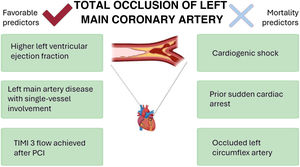
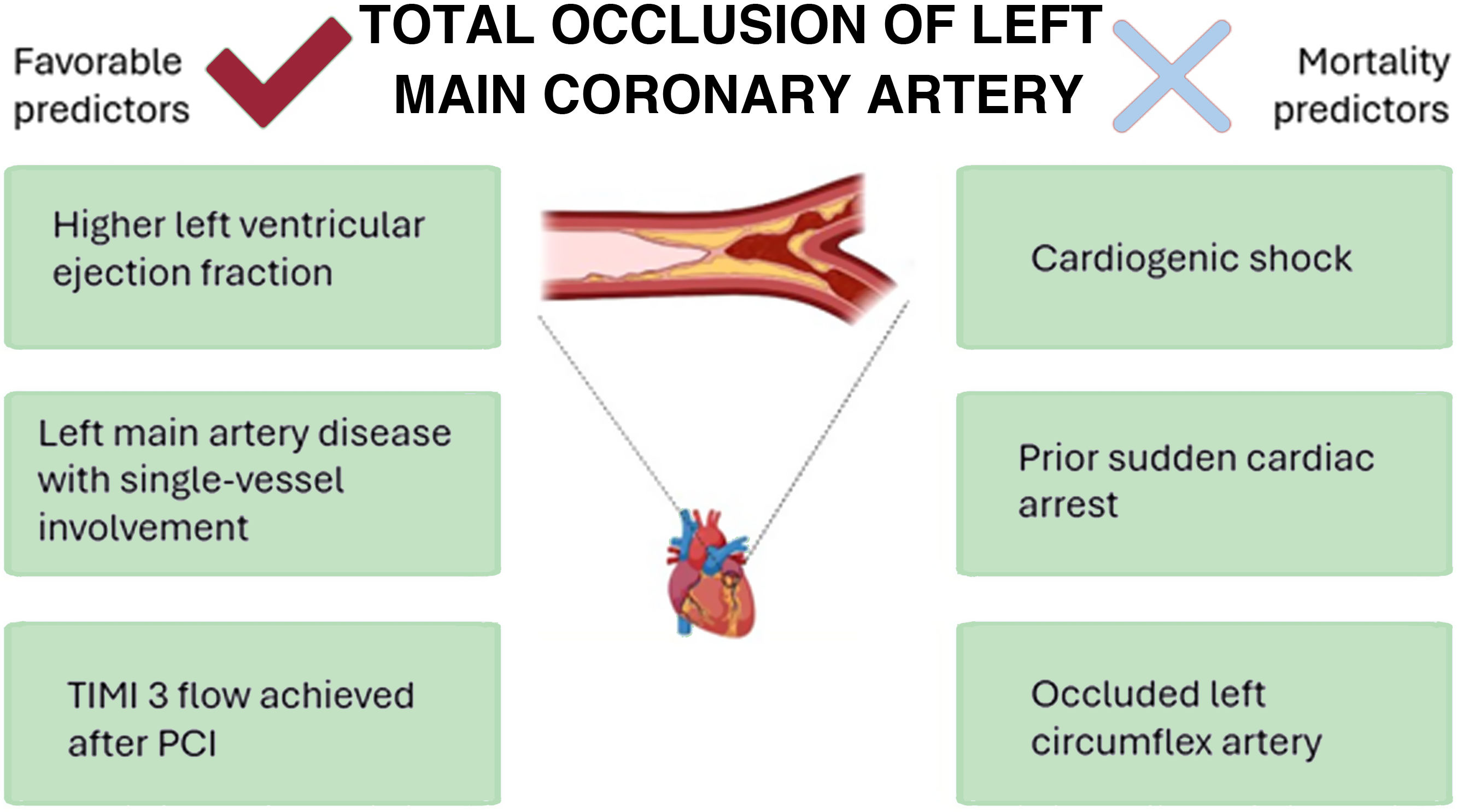
In conclusion, baseline cardiogenic shock and sudden cardiac arrest were associated with in-hospital mortality. Survival was associated with higher left ventricular ejection fraction, less extensive vessel involvement beyond the LMCA, and achievement of TIMI flow grade 3.
This study has several limitations. The rarity of survivable acute LMCA occlusion resulted in a small sample, limiting statistical power and preventing multivariable analysis. All between-group comparisons were exploratory and post hoc and should be interpreted as hypothesis-generating, requiring confirmation in larger prospective studies. In some cases, clinical, laboratory, and procedural data were unavailable. The lack of follow-up precluded evaluation of mid- and long-term outcomes, including functional recovery.
FUNDINGNo funding was received to conduct this study.
ETHICAL CONSIDERATIONSThe study was approved by the Jagiellonian University Medical College Research Ethics Committee (no. 118.0043.1.291.2025). Due to the retrospective nature of the study, the requirement for informed consent was waived. The SAGER guidelines were considered and were not applicable to the aims of this retrospective study.
STATEMENT ON THE USE OF ARTIFICIAL INTELLIGENCEThe authors declare that no generative artificial intelligence or AI-assisted technologies were used in the preparation of this manuscript.
AUTHORS’ CONTRIBUTIONSM. Chyrchel and J. Roczniak provided the concept and design of the study. A. Stanaszek and N. Zabawa collected the data. J. Roczniak conducted the statistical analysis. A. Stanaszek, N. Zabawa, and J. Roczniak prepared the manuscript. M. Chyrchel, A. Dziewierz and S. Bartuś revised the manuscript and supervised the study. All authors read and approved the final version of the manuscript.
CONFLICTS OF INTERESTThe authors have no conflicts of interest to declare.