

Psychological well-being (PWB) is increasingly recognized as a potential protective factor for chronic diseases, including cardiovascular disease (CVD). Nevertheless, prospective evidence linking PWB to specific risk factors such as hypertension and incident CVD remains limited,1 particularly in Mediterranean cohorts, despite hypertension being considered the leading cause of CVD and premature death worldwide.
We examined the association between PWB and incident hypertension and CVD in the SUN cohort, a dynamic prospective study of Spanish university graduates. We focused on the 18-year follow-up questionnaire (Q18), which included the validated 29-item Ryff PWB scale. The study was approved by the University of Navarra Institutional Review Board, and questionnaire return was considered implicit informed consent.
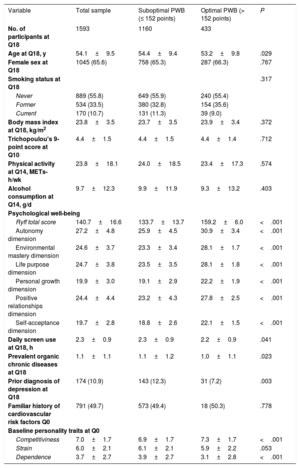
Of the 4888 participants who completed Q18 (up to April 30, 2024), 3138 were traceable at 20 or 22 years. After the exclusion of those with prevalent CVD at Q18 (n=1093), nonrespondents to the PWB questionnaire (n=121) and individuals lost to follow-up (n=331; retention 82.8%), there were 1593 participants. Table 1 shows participant characteristics by PWB status.
Participants’ characteristics according to psychological well-being (PWB) status at 18-year follow-up without prior CVD
| Variable | Total sample | Suboptimal PWB (≤ 152 points) | Optimal PWB (> 152 points) | P |
|---|---|---|---|---|
| No. of participants at Q18 | 1593 | 1160 | 433 | |
| Age at Q18, y | 54.1±9.5 | 54.4±9.4 | 53.2±9.8 | .029 |
| Female sex at Q18 | 1045 (65.6) | 758 (65.3) | 287 (66.3) | .767 |
| Smoking status at Q18 | .317 | |||
| Never | 889 (55.8) | 649 (55.9) | 240 (55.4) | |
| Former | 534 (33.5) | 380 (32.8) | 154 (35.6) | |
| Current | 170 (10.7) | 131 (11.3) | 39 (9.0) | |
| Body mass index at Q18, kg/m2 | 23.8±3.5 | 23.7±3.5 | 23.9±3.4 | .372 |
| Trichopoulou's 9-point score at Q10 | 4.4±1.5 | 4.4±1.5 | 4.4±1.4 | .712 |
| Physical activity at Q14, METs-h/wk | 23.8±18.1 | 24.0±18.5 | 23.4±17.3 | .574 |
| Alcohol consumption at Q14, g/d | 9.7±12.3 | 9.9±11.9 | 9.3±13.2 | .403 |
| Psychological well-being | ||||
| Ryff total score | 140.7±16.6 | 133.7±13.7 | 159.2±6.0 | <.001 |
| Autonomy dimension | 27.2±4.8 | 25.9±4.5 | 30.9±3.4 | <.001 |
| Environmental mastery dimension | 24.6±3.7 | 23.3±3.4 | 28.1±1.7 | <.001 |
| Life purpose dimension | 24.7±3.8 | 23.5±3.5 | 28.1±1.8 | <.001 |
| Personal growth dimension | 19.9±3.0 | 19.1±2.9 | 22.2±1.9 | <.001 |
| Positive relationships dimension | 24.4±4.4 | 23.2±4.3 | 27.8±2.5 | <.001 |
| Self-acceptance dimension | 19.7±2.8 | 18.8±2.6 | 22.1±1.5 | <.001 |
| Daily screen use at Q18, h | 2.3±0.9 | 2.3±0.9 | 2.2±0.9 | .041 |
| Prevalent organic chronic diseases at Q18 | 1.1±1.1 | 1.1±1.2 | 1.0±1.1 | .023 |
| Prior diagnosis of depression at Q18 | 174 (10.9) | 143 (12.3) | 31 (7.2) | .003 |
| Familiar history of cardiovascular risk factors Q0 | 791 (49.7) | 573 (49.4) | 18 (50.3) | .778 |
| Baseline personality traits at Q0 | ||||
| Competitiviness | 7.0±1.7 | 6.9±1.7 | 7.3±1.7 | <.001 |
| Strain | 6.0±2.1 | 6.1±2.1 | 5.9±2.2 | .053 |
| Dependence | 3.7±2.7 | 3.9±2.7 | 3.1±2.8 | <.001 |
The data are expressed as No. (%) or mean±standard deviation.
Qn* indicates years of follow-up since study entry.
PWB scores> 75th percentile were categorized as “optimal”, consistent with previous cohort studies.2 Hypertension was defined by self-reported medical diagnosis, previously validated, or antihypertensive use. CVD outcomes included hypertension, myocardial infarction, angina, coronary artery bypass grafting, atrial fibrillation, aortic aneurysm, thrombosis, heart failure, stroke, and claudication or digoxin/digitalis use. CVD-related deaths were confirmed using ICD-10 codes and official data from the Instituto Nacional de Estadística, Spain. Prevalent hypertension and CVD included cases up to Q18; incident cases occurred after Q18.
During a mean follow-up of 2.6±1.0 years, there were 150 incident hypertension cases (116 suboptimal, 34 optimal PWB) and 167 CVD cases (130 suboptimal, 37 optimal). Self-reported CVD events included hypertension (n=150), myocardial infarction (n=3), angina pectoris (n=3), bypass surgery (n=4), stroke (n=1), intermittent claudication (n=1), atrial fibrillation (n=6), digitalis/digoxin treatment (n=8), heart failure (n=2), aneurysm (n=2), vein thrombosis (n=1), and CVD-related death (n=2). Only the first event per participant was analyzed.
Cox proportional hazards models were used to estimate hazard ratios (HR) and 95% confidence intervals (95%CI) for hypertension and CVD according to PWB status. Follow-up time was measured from Q18 until the occurrence of a CVD/hypertension event or the last follow-up. Models were adjusted for age, sex, smoking status, alcohol intake, Mediterranean dietary pattern, physical activity, body mass index, prevalent chronic diseases, family history of vascular risk factors, depression, and baseline personality traits. Age was used as the underlying time scale, with year of cohort entry as a stratification variable. Robust standard errors were applied. Missing data were imputed using multivariate linear regression for continuous variables and logistic regression for categorical variables.
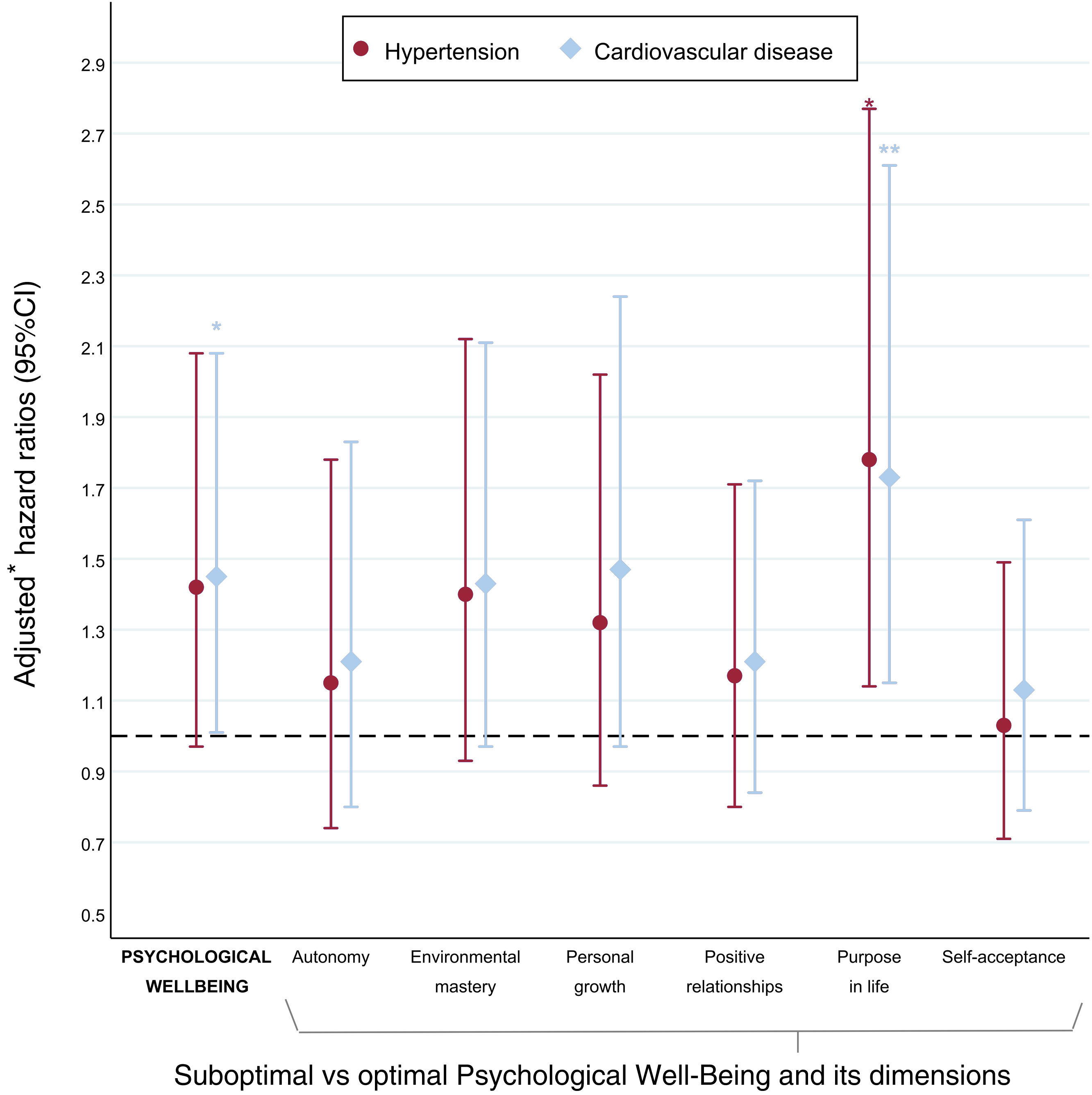
Participants with suboptimal PWB showed a higher risk of incident CVD (HR, 1.45; 95%CI, 1.01-2.08; P=.044), with a nonsignificant trend for hypertension incidence risk (HR, 1.43; 95%CI, 0.98-2.10; P=.067). Among PWB dimensions, suboptimal purpose in life was significantly associated with increased risk of both hypertension (HR, 1.78; 95%CI, 1.15-2.78; P=.010) and CVD (HR, 1.73; 95%CI, 1.15-2.61; P=.008) (figure 1).

Hazard ratios and 95% confidence intervals comparing suboptimal vs optimal scores for PWB and its 6 dimensions for hypertension and cardiovascular disease risk. 95%CI, 95% confidence interval. Statistical significance levels: 1 asterisk indicates P<.05; 2 asterisks indicate P <.01.
* Adjusted for age, sex, smoking status, alcohol intake, Mediterranean dietary pattern, physical activity, body mass index, prevalent chronic diseases, family history of vascular risk factors, depression, and baseline personality traits.
We conducted sensitivity analyses to assess the robustness of the results by excluding incident cases within 6 months of follow-up, excluding extreme energy intake, adjusting for screen use, comparing extreme PWB quartiles, and stratifying by sex and age group (< 65 and ≥ 65 years). Purpose in life remained significantly associated with hypertension and CVD in most models. Notably, purpose in life remained a significant predictor of CVD risk in most sensitivity analyses (HR range: 1.68-1.84), with stronger associations observed in men (hypertension risk HR, 3.05; 95%CI, 1.23-7.55; and CVD risk HR, 2.21; 95%CI, 1.06-4.60) and older participants (hypertension risk HR, 6.19; 95%CI, 1.28-29.95; and CVD risk HR, 3.53; 95%CI, 1.22-10.17).
Our SUN cohort study of highly educated individuals concludes that optimal purpose in life is significantly inversely associated with the incidence of hypertension and CVD. These results suggest that PWB dimensions may impact cardiovascular health differently. While autonomy, positive relationships, and self-acceptance were not significantly associated with outcomes, purpose in life showed a robust and consistent association. This finding agrees with those of previous studies indicating that meaning in life and optimism may influence cardiovascular health.3,4
The limitations of our study include its observational design, which prevents us from ruling out residual confounding due to unmeasured or time-varying variables; reliance on self-reported outcomes, which may be subject to misclassification bias (despite all participants having university studies, with most having studied a health-related degree); the use of a nonstandardized 75th percentile threshold to define optimal PWB (which may limit generalizability); the relatively short follow-up period after PWB assessment; the inclusion of hypertension within the composite cardiovascular outcome; and the highly educated population, which may further limit the generalizability of the findings. Nonetheless, previous validation studies in the SUN cohort support the reliability of self-reports,5 and the homogeneity of the cohort allows greater internal validity.6 Our results reinforce the importance of incorporating psychological constructs, such as purpose in life, in cardiovascular research and prevention strategies. Future studies should explore interventions to promote PWB and assess their effects on cardiovascular risk.
FUNDINGThis work was supported by the Spanish Government-Instituto de Salud Carlos III, Fondo Europeo de Desarrollo Regional (FEDER), cofunded European Union: PI23/01332, PI24/0173, and the Navarra Regional Government (19/2023).
ETHICAL CONSIDERATIONSThe study was approved by the University of Navarre Institutional Review Board, and questionnaire return was considered implicit informed consent. Sex and gender were reported in accordance with SAGER guidelines
STATEMENT ON THE USE OF ARTIFICIAL INTELLIGENCENo generative artificial intelligence was used for content creation, data analysis, or conclusions. ChatGPT-5 was used exclusively for grammar improvement.
AUTHORS’ CONTRIBUTIONSV. Basterra-Gortari: conceptualization, formal analysis, methodology, visualization, writing original draft, writing review and editing. C. Sayón-Orea: supervision, visualization, writing, review, and editing. C. de la Fuente-Arrillaga: data curation, project administration, writing, review, and editing. Miguel Á. Álvarez-Mon: software, writing review, and editing. M. Á.Martínez-González: methodology, funding acquisition, writing, review, and editing. M. Bes-Rastrollo: conceptualization, formal analysis, funding acquisition, methodology, supervision, writing, review, and editing.
CONFLICTS OF INTERESTNone of the authors have any proprietary interests or conflicts of interest related to this submission.