
ISSN: 0300-8932 Factor de impacto 2025 4,2
Vol. 79. Núm. 9.
Páginas 781-791 (Septiembre 2026)

Artículo de revisión
Nuevas perspectivas sobre arritmias ventriculares en la amiloidosis cardiaca: una revisión actualizada

Novel insights on ventricular arrhythmias in cardiac amyloidosis: an updated narrative review

Caterina ButturiniaSimona FortunatoaMartina SettiaHelena Llamas-GómezbMaría Luisa Peña-PeñabAnna PiccoliaLuca TomasiaFlavio RibichiniaGiacomo Mugnaia
https://doi.org/10.1016/j.recesp.2026.03.006

Opciones

Imagen extra
Rev Esp Cardiol. 2026;79:781-91
Resumen

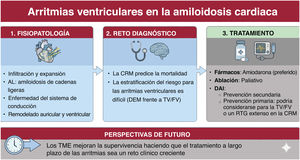
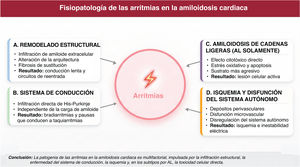
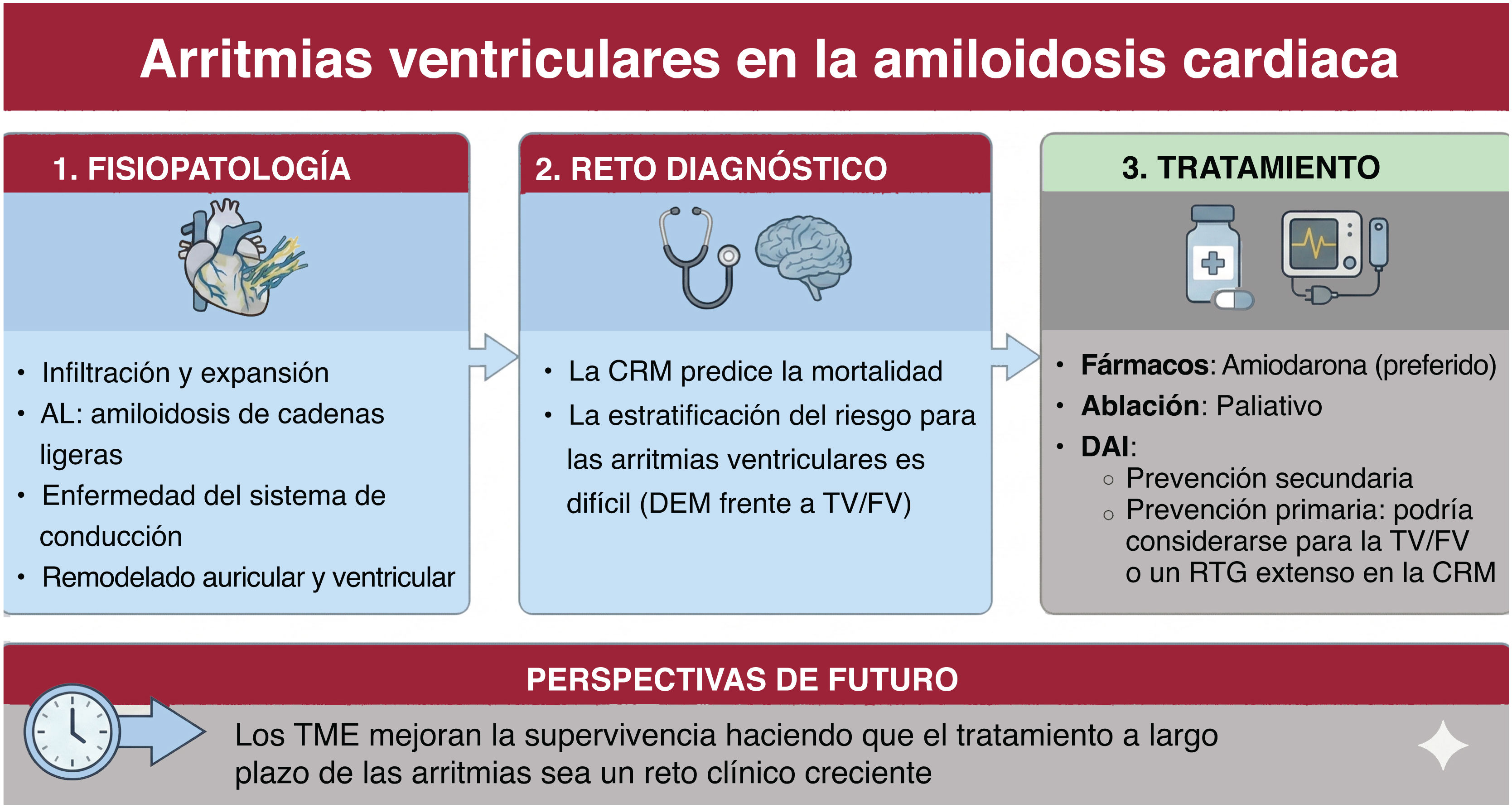
La amiloidosis cardiaca (AC) conlleva un riesgo significativo de arritmias ventriculares y muerte súbita cardiaca. El riesgo arrítmico difiere según el subtipo: la variante de cadenas ligeras suele ser más arritmogénica debido a la toxicidad directa de estas, mientras que, en la forma por transtirretina, predomina la enfermedad del sistema de conducción. Aunque las técnicas de imagen avanzada, particularmente la resonancia magnética cardiaca, predicen con precisión la mortalidad por todas las causas, no distinguen de manera fiable a los pacientes que sufrirán un episodio arrítmico desfibrilable de aquellos que fallecerán por insuficiencia cardiaca progresiva o disociación electromecánica. Esta limitación debilita la evidencia a favor del tratamiento profiláctico con desfibrilador automático implantable, por lo que su papel sigue siendo muy controvertido. En esta revisión, se examina críticamente la evidencia actual sobre la fisiopatología, la estratificación del riesgo y el abordaje de las arritmias ventriculares en la AC; se analizan la utilidad y las limitaciones de las herramientas diagnósticas, y se evalúan las estrategias terapéuticas, incluido el papel emergente de la ablación con catéter. Además, se analizan cómo los tratamientos eficaces modificadores de la enfermedad podrían redefinir el curso de la AC y hacer que la prevención de la muerte súbita cardiaca sea un desafío aún más importante.

Palabras clave

Amiloidosis cardiaca
Arritmias ventriculares
Muerte súbita cardiaca
Desfibrilador automático implantable

Abreviaturas

AC
AL
ATTR
AV
CRM
DAI
MSC
RTG

Identifíquese

¿Aún no es suscriptor de la revista?
Comprar el acceso al artículo

Comprando el artículo el pdf del mismo podrá ser descargado

Precio: 19,34 €

Teléfono para incidencias

De lunes a viernes de 9h a 18h (GMT+1) excepto los meses de julio y agosto que será de 9 a 15h

Llamadas desde España 932 415 960
Llamadas desde fuera de España +34 932 415 960
Bibliografía
[1]
W.J. McKenna, B.J. Maron, G. Thiene.
Classification, epidemiology, and global burden of cardiomyopathies.
Circ Res., (2017), 121 pp. 722-730
[2]
F.L. Ruberg, M. Grogan, M. Hanna, J.W. Kelly, M.S. Maurer.
Transthyretin Amyloid Cardiomyopathy: JACC State-of-the-Art Review.
J Am Coll Cardiol., (2019), 73 pp. 2872-2891
[3]
R.H. Falk, K.M. Alexander, R. Liao, S. Dorbala.
AL (Light-chain) cardiac amyloidosis:a review of diagnosis and therapy.
J Am Coll Cardiol., (2016), 68 pp. 1323-1341
[4]
C.C. Cheung, T.M. Roston, J.G. Andrade, M.T. Bennett, M.K. Davis.
Arrhythmias in cardiac amyloidosis:challenges in risk stratification and treatment.
Can J Cardiol., (2020), 36 pp. 416-423
[5]
N. Laptseva, V.A. Rossi, I. Sudano, et al.
Arrhythmic manifestations of cardiac amyloidosis:challenges in risk stratification and clinical management.
J Clin Med., (2023), 12 pp. 2581
[6]
D’Errico, A. Mazzanti, B. Baldari, A. Maiese, P. Frati, V. Fineschi.
Sudden death in lambda light chain AL cardiac amyloidosis: a review of literature and update for clinicians and pathologists.
Int J Clin Exp Pathol., (2020), 13 pp. 1474-1482
[7]
S. Khanna, P. Lo, K. Cho, R. Subbiah.
Ventricular arrhythmias in cardiac amyloidosis: a review of current literature.
Clin Med Insights Cardiol., (2020), 14
[8]
S. Bukhari, B. Khan.
Prevalence of ventricular arrhythmias and role of implantable cardioverter-defibrillator in cardiac amyloidosis.
J Cardiol., (2023), 81 pp. 429-433
[9]
A. Frustaci, R. Verardo, M.A. Russo, et al.
Infiltration of conduction tissue is a major cause of electrical instability in cardiac amyloidosis.
J Clin Med., (2023), 12 pp. 1798
[10]
Y.Y. Chen, M.J. Kuo, F.P. Chung, et al.
Risks of ventricular tachyarrhythmia and mortality in patients with amyloidosis – A long-term cohort study.
Acta Cardiol Sin., (2022), 38 pp. 464-474
[11]
S.W. Dubrey, K. Cha, J. Anderson, et al.
The clinical features of immunoglobulin light-chain (AL) amyloidosis with heart involvement.
QJM., (1998), 91 pp. 141-157
[12]
S. Bukhari, S.Z. Khan, M. Ghoweba, B. Khan, Z. Bashir.
Arrhythmias and device therapies in cardiac amyloidosis.
J Clin Med., (2024), 13 pp. 1300
[13]
G. Merlini, A. Dispenzieri, V. Sanchorawala, et al.
Systemic immunoglobulin light chain amyloidosis.
Nat Rev Dis Primers., (2018), 4 pp. 38
[14]
R. Hörnsten, U. Wiklund, B.O. Olofsson, S.M. Jensen, O.B. Suhr.
Liver transplantation does not prevent the development of life-threatening arrhythmia in familial amyloidotic polyneuropathy, Portuguese-type (ATTR Val30Met) patients.
Transplantation., (2004), 78 pp. 112-116
[15]
B.C. Varr, S. Zarafshar, T. Coakley, et al.
Implantable cardioverter-defibrillator placement in patients with cardiac amyloidosis.
Heart Rhythm., (2014), 11 pp. 158-162
[16]
O. Sehrawat, W.H. Swain, H.P. Alcantara, et al.
Prognosis of patients with wild-type transthyretin cardiac amyloidosis and non-sustained ventricular tachycardia.
J Cardiovasc Electrophysiol., (2025), 36 pp. 124-134
[17]
A. Liżewska-Springer, G. Slawinski, E. Lewicka.
Arrhythmic sudden cardiac death and the role of implantable cardioverter-defibrillator in patients with cardiac amyloidosis - A narrative literature review.
J Clin Med., (2021), 10
[18]
M. Zampieri, M. Allinovi, I. Olivotto, et al.
Ventricular tachyarrhythmias and sudden cardiac death in light-chain amyloidosis: a clash of cardio-toxicities?.
Br J Haematol., (2021), 193 pp. e27-e31
[19]
S. Thakkar, H.P. Patel, M. Chowdhury, et al.
Impact of arrhythmias on hospitalizations in patients with cardiac amyloidosis.
Am J Cardiol., (2021), 143 pp. 125-130
[20]
A. Halawa, H.G. Woldu, K.G. Kacey, M.A. Alpert.
Effect of ICD implantation on cardiovascular outcomes in patients with cardiac amyloidosis: A systematic review and meta-anaylsis.
J Cardiovasc Electrophysiol., (2020), 31 pp. 1749-1758
[21]
P.L.F. Ng, Y.C. Lim, L.K.M. Evangelista, et al.
Utility and pitfalls of the electrocardiogram in the evaluation of cardiac amyloidosis.
Ann Noninvasive Electrocardiol., (2022), 27
[22]
H. Sun, S. Zheng, W. Liu.
The value of the electrocardiogram in the recognition of cardiac amyloidosis: a systematic meta-analysis.
BMC Cardiovasc Disord., (2024), 24 pp. 488
[23]
L. Teresi, G. Trimarchi, P. Liotta, et al.
Electrocardiographic Patterns and Arrhythmias in Cardiac Amyloidosis: From Diagnosis to Therapeutic Management - A Narrative Review.
J Clin Med., (2024), 13
[24]
N. Martini, G. Sinigiani, L. De Michieli, et al.
Electrocardiographic features and rhythm disorders in cardiac amyloidosis.
Trends Cardiovasc Med., (2024), 34 pp. 257-264
[25]
A. Cipriani, L. De Michieli, A. Porcari, et al.
Low QRS voltages in cardiac amyloidosis: clinical correlates and prognostic value.
JACC CardioOncol., (2022), 4 pp. 458-470
[26]
L. Zhao, J. Li, Z. Tian, Q. Fang.
Clinical correlates and prognostic values of pseudoinfarction in cardiac light-chain amyloidosis.
J Cardiol., (2016), 68 pp. 426-430
[27]
S. Giancaterino, M.A. Urey, D. Darden, J.C. Hsu.
Management of arrhythmias in cardiac amyloidosis.
JACC Clin Electrophysiol., (2020), 6 pp. 351-361
[28]
J.C.L. Rodrigues, A.M. Amadu, A.G. Dastidar, et al.
ECG strain pattern in hypertension is associated with myocardial cellular expansion and diffuse interstitial fibrosis: a multi-parametric cardiac magnetic resonance study.
Eur Heart J Cardiovasc Imaging., (2017), 18 pp. 441-450
[29]
D. Kim, G.Y. Lee, J.O. Choi, K. Kim, S.J. Kim, E.S. Jeon.
Associations of electrocardiographic parameters with left ventricular longitudinal strain and prognosis in cardiac light chain amyloidosis.
Sci Rep., (2019), 9
[30]
P. Garcia-Pavia, C. Rapezzi, Y. Adler, et al.
Diagnosis and treatment of cardiac amyloidosis:a position statement of the ESC Working Group on Myocardial and Pericardial Diseases.
Eur Heart J., (2021), 42 pp. 1554-1568
[31]
G. Palladini, G. Malamani, F. Cò, et al.
Holter monitoring in AL amyloidosis:prognostic implications.
Pacing Clin Electrophysiol., (2001), 24 pp. 1228-1233
[32]
S.L. Bruce, M. Cuomo, H. Yarmohammadi, et al.
Monitoring for arrhythmia in transthyretin cardiac amyloidosis with noninvasive ambulatory patch devices.
Heart Rhythm O2., (2024), 5 pp. 631-638
[33]
R.H. Sayed, D. Rogers, F. Khan, et al.
A study of implanted cardiac rhythm recorders in advanced cardiac AL amyloidosis.
Eur Heart J., (2015), 36 pp. 1098-1105
[34]
S.W. Dubrey, S. Bilazarian, M. LaValley, J. Reisinger, M. Skinner, R.H. Falk.
Signal-averaged electrocardiography in patients with AL (primary) amyloidosis.
Am Heart J., (1997), 134 pp. 994-1001
[35]
M. Orini, A.J. Graham, A. Martinez-Naharro, et al.
Noninvasive mapping of the electrophysiological substrate in cardiac amyloidosis and its relationship to structural abnormalities.
J Am Heart Assoc., (2019), 8
[36]
S.J. Boynton, J.B. Geske, A. Dispenzieri, et al.
LGE Provides Incremental Prognostic Information Over Serum Biomarkers in AL Cardiac Amyloidosis.
JACC Cardiovasc Imaging., (2016), 9 pp. 680-686
[37]
S. Raina, S.Y. Lensing, R.S. Nairooz, et al.
Prognostic Value of Late Gadolinium Enhancement CMR in Systemic Amyloidosis.
JACC Cardiovasc Imaging., (2016), 9 pp. 1267-1277
[38]
P. Boretto, N.H. Patel, K. Patel, et al.
Prognosis prediction in cardiac amyloidosis by cardiac magnetic resonance imaging: a systematic review with meta-analysis.
Eur Heart J Open., (2023), 3
[39]
J. Reisinger, S.W. Dubrey, M. Lavalley, M. Skinner, R.H. Falk.
Electrophysiologic abnormalities in AL (primary) amyloidosis with cardiac involvement.
J Am Coll Cardiol., (1997), 30 pp. 1046-1051
[40]
C.S. Kwok, C.H. Choy, J. Pinney, et al.
Effect of beta-blockade on mortality in patients with cardiac amyloidosis: A systematic review and meta-analysis.
ESC Heart Fail., (2024), 11 pp. 3901-3910
[41]
F. de Frutos, G. Saturi, E. Gonzalez-Lopez, et al.
Incidence and predictors of sudden death in patients with cardiac amyloidosis.
Amyloid., (2024), 31 pp. 334-338
[42]
A. Ioannou, P. Massa, R.K. Patel, et al.
Conventional heart failure therapy in cardiac ATTR amyloidosis.
Eur Heart J., (2023), 44 pp. 2893-2907
[43]
Y. Kang, N. Qu, Z. Zhang, Q. Zhang, X. Chen, M. Fu.
Tolerability and effectiveness of beta-blockers in patients with cardiac amyloidosis: A systematic review and meta-analysis.
Int J Cardiol., (2024), 402
[44]
C. Guenancia, B. Lequeux, W. Amara, et al.
Management of rhythm and conduction disorders in cardiac amyloidosis: a French Nationwide Delphi Study.
Jacc Adv., (2025), 4
[45]
P. Compagnucci, A. Dello Russo, A. Gasperetti, et al.
Substrate characterization and outcomes of ventricular tachycardia ablation in amyloid cardiomyopathy: A multicenter study.
Circ Arrhythm Electrophysiol., (2024), 17
[46]
A. Briasoulis, C. Kourek, A. Papamichail, et al.
Arrhythmias in patients with cardiac amyloidosis: A comprehensive review on clinical management and devices.
J Cardiovasc Dev Dis., (2023), 10 pp. 337
[47]
S.G. Priori, C. Blomström-Lundqvist, A. Mazzanti, et al.
2015 ESC Guidelines for the management of patients with ventricular arrhythmias and the prevention of sudden cardiac death: The Task Force for the Management of Patients with Ventricular Arrhythmias and the Prevention of Sudden Cardiac Death of the European Society of Cardiology (ESC). Endorsed by: Association for European Paediatric and Congenital Cardiology (AEPC).
Eur Heart J., (2015), 36 pp. 2793-2867
[48]
S.M. Al-Khatib, W.G. Stevenson, M.J. Ackerman, et al.
2017 AHA/ACC/HRS Guideline for Management of Patients With Ventricular Arrhythmias and the Prevention of Sudden Cardiac Death.
Circulation., (2018), 138 pp. e272-e391
[49]
J.A. Towbin, W.J. McKenna, D.J. Abrams, et al.
2019 HRS expert consensus statement on evaluation, risk stratification, and management of arrhythmogenic cardiomyopathy.
Heart Rhythm., (2019), 16 pp. e301-e372
[50]
P. Garcia-Pavia, E. Gonzalez-Lopez, L.J. Anderson, et al.
Non-amyloid specific treatment for transthyretin cardiac amyloidosis:a clinical consensus statement of the ESC Heart Failure Association.
Eur Heart J., (2026), 47 pp. 22-36
[51]
R.M. John, D.L. Stern.
Use of implantable electronic devices in patients with cardiac amyloidosis.
Can J Cardiol., (2020), 36 pp. 408-415
[52]
A.V. Kristen, T.J. Dengler, U. Hegenbart, et al.
Prophylactic implantation of cardioverter-defibrillator in patients with severe cardiac amyloidosis and high risk for sudden cardiac death.
Heart Rhythm., (2008), 5 pp. 235-240
[53]
T. Lee, R. Marinchak.
A role for defibrillation threshold testing?. A case of ventricular fibrillation refractory to implantable cardioverter-defibrillator shocks in setting of cardiac amyloidosis.
HeartRhythm Case Rep., (2025), 11 pp. 492-495
[54]
E. Bonvicini, A. Preda, C. Tognola, et al.
Arrhythmic risk stratification in cardiac amyloidosis: a review of the current literature.
J Cardiovasc Dev Dis., (2024), 11 pp. 222
[55]
Y.B. Goldsmith, J. Liu, J. Chou, J. Hoffman, R.L. Comenzo, R.M. Steingart.
Frequencies and types of arrhythmias in patients with systemic light-chain amyloidosis with cardiac involvement undergoing stem cell transplantation on telemetry monitoring.
Am J Cardiol., (2009), 104 pp. 990-994
[56]
M.S. Maurer, J.H. Schwartz, B. Gundapaneni, et al.
Tafamidis treatment for patients with transthyretin amyloid cardiomyopathy.
N Engl J Med., (2018), 379 pp. 1007-1016
[57]
B. Chamling, M. Bietenbeck, D. Korthals, et al.
Therapeutic value of tafamidis in patients with wild-type transthyretin amyloidosis (ATTRwt) with cardiomyopathy based on cardiovascular magnetic resonance (CMR) imaging.
Clin Res Cardiol., (2023), 112 pp. 353-362
[58]
S. Dobner, B. Bernhard, N. Ninck, et al.
Impact of tafamidis on myocardial function and CMR tissue characteristics in transthyretin amyloid cardiomyopathy.
ESC Heart Fail., (2024), 11 pp. 2759-2768
[59]
M. Fontana, A. Martinez-Naharro, L. Chacko, D. Rowczenio, et al.
Reduction in CMR derived extracellular volume with patisiran indicates cardiac amyloid regression.
JACC Cardiovasc Imaging., (2021), 14 pp. 189-199
[60]
M. Fontana, J.L. Berk, J.D. Gillmore, et al.
Vutrisiran in patients with transthyretin amyloidosis with cardiomyopathy.
N Engl J Med., (2025), 392 pp. 33-44
[61]
F. Le Bras, V. Molinier-Frenkel, et al.
Sequential cyclophosphamide-bortezomib-dexamethasone unmasks the harmful cardiac effect of dexamethasone in primary light-chain cardiac amyloidosis.
Eur J Cancer., (2017), 76 pp. 183-187
[62]
C.P. Venner, T. Lane, D. Foard, et al.
Cyclophosphamide, bortezomib, and dexamethasone therapy in AL amyloidosis is associated with high clonal response rates and prolonged progression-free survival.
Blood., (2012), 119 pp. 4387-4390
[63]
T. Coelho, W. Marques Jr., N.R. Dasgupta, et al.
Eplontersen for hereditary transthyretin amyloidosis with polyneuropathy.
JAMA., (2023), 330 pp. 1448-1458
[64]
A. Masri, M.S. Maurer, B.L. Claggett, et al.
Effect of eplontersen on cardiac structure and function in patients with hereditary transthyretin amyloidosis.
J Card Fail., (2024), 30 pp. 973-980
[65]
P. Garcia-Pavia, F. Aus dem Siepen, E. Donal, et al.
Phase 1 trial of antibody NI006 for depletion of cardiac transthyretin amyloid.
N Engl J Med., (2023), 389 pp. 239-250
[66]
C.V. Edwards, N. Rao, D. Bhutani, et al.
Phase 1a/b study of monoclonal antibody CAEL-101(11-1F4) in patients with AL amyloidosis.
Blood., (2021), 138 pp. 2632-2641
[67]
J.M. Griffin, H. Rosenblum, M.S. Maurer.
Pathophysiology and therapeutic approaches to cardiac amyloidosis.
Circ Res., (2021), 128 pp. 1554-1575
[68]
Y. Zhang, C. Shan, X. Zhang, Y. Liu, Y. Xia, Y. Wang.
Cardiovascular adverse events associated with targeted therapies for multiple myeloma: a pharmacovigilance study.
Front Immunol., (2024), 15
Copyright © 2026. Sociedad Española de Cardiología