
For years after its introduction,1 the functional assessment of coronary artery disease was disregarded due to 2 major misgivings about its widespread adoption: a) interventional cardiologists tend to trust their own criteria when making decisions based on angiography alone; and b) there was a reluctance to abandon the use of invasive imaging techniques, largely intracoronary ultrasound, to guide revascularization according to cutoff points for area, diameter, or percentage stenosis. The first misgiving was likely related to aversion to change involving additional learning and modification of established working practices. Both concerns are associated with the dominance of human visual perception over all other senses. Particularly for specialists trained in an imaging techniques, such as coronary angiography, it is difficult to accept that an apparently significant stenosis (and one corroborated by an intracoronary technique) does not actually reduce blood flow or cause symptoms and that no benefit would be obtained from its treatment. Moreover, professionals need a certain level of confidence to abandon a decision-making method in which they have been trained in and believe yields good outcomes.
Together with these 2 basic concerns (particularly the first), other suggested reasons for the negligible adoption of physiological criteria in catheterization laboratories include economic factors, longer procedural times, and the inconvenience associated with adenosine use.
However, multiple studies have reported cost reductions with the widespread use of pressure guidewires, due to fewer unnecessary revascularizations and lower event rates.2,3 In addition, the good outcomes obtained with resting indices should mitigate misgivings about the use of adenosine.4
For years, scientific evidence has supported the use of coronary physiology over angiography to guide the management of coronary artery disease,5–7 with clinical practice guidelines assigning it a class I A recommendation.8 The controversy surrounding the cutoff points obtained with intracoronary imaging was resolved by confirming the impossibility of defining an anatomical criterion indicating coronary revascularization, except in the left main coronary artery.
Four recent clinical trials comparing revascularization strategies based exclusively on angiography vs fractional flow reserve (FFR) have failed to meet their primary endpoints.9–12 A common characteristic of these studies and other clinical trials is that they included coronary lesions with a minimum degree of stenosis (> 30%-50%, including total occlusions, which were assigned a fixed FFR value) rather than the ambiguous or intermediate lesions that are usually studied in observational studies and encountered in the daily routine of catheterization laboratories. These trials examined the use of intracoronary pressure guidewires not as a complementary diagnostic tool to compensate for the limitations of angiography but as a substitute for systematic decision-making. The value of physiology remains low for clearly stenotic lesions (which are mostly functionally significant) and for clearly mild nonstenotic lesions (which are mostly functionally nonsignificant). Moreover, the trials included patients with acute coronary syndrome (ACS) with clinical or angiographic characteristics that perhaps should have prompted a morphological study of the lesion (with intracoronary imaging) rather than functional assessment.
In contrast, observational studies have been based on routine clinical practice, with coronary physiology used as a complementary tool for clinical decision-making and in addition to angiography. These studies have predominantly included ambiguous and intermediate lesions.
Despite the above, all published studies, even those recently considered negative, concur that the use of coronary physiology can avoid revascularization in up to 25% of cases, with a reduction in the number of stent implants and with lower or equal numbers of long-term events. Coronary physiology would thus be useful to avoid unnecessary treatments safely and, at times, even beneficially.
The study by Mangiacapra et al.,13 recently published in Revista Española de Cardiología, reaffirms these notions. Their work comprised a meta-analysis of 11 clinical trials and 19 observational studies and is an up-to-date, exhaustive, and elegant analysis of the existing evidence comparing outcomes depending on whether revascularization was based solely on angiography or FFR. The authors excluded studies based on resting indices and separately analyzed the sources of the wide heterogeneity: the study design (observational vs clinical trial). Of the 5936 patients in clinical trials, only 229 (3.8%) were included using the criterion of moderate stenosis (40%-70%). In contrast, in observational studies, 17 402 of the 20 973 patients (83%) in the FFR arm were included due to intermediate lesions or routine clinical practice (probably intermediate or ambiguous lesions. While caution must be exercised when interpreting the conclusions of observational studies, it is noteworthy that the practical application of FFR in these descriptive studies demonstrated benefits in terms of event reduction, including major events. This was not the case in the meta-analysis of the randomized trials conducted to assess the systematic use of FFR, as almost the sole decisive element, for coronary revascularization. Significantly, in the clinical trials, the number of revascularized lesions guided by the functional score was 30% less (56% vs 87%) than when guided by angiography alone. Given the absence of differences in major clinical events, 30% of systematic angioplasties guided exclusively by angiography could be considered inadequate or lacking in clinical benefit.
The systematic use of an FFR value to guide the revascularization of coronary artery lesions could lead to the same error as the exclusive use of angiography. ACS is perhaps the setting generating the greatest doubts about the usefulness of the pressure guidewire. Understanding of its systemic nature, beyond whether the atheromatous plaques act as the focal cause of the symptoms, necessitates a more detailed assessment than the mere obstructive or nonobstructive character of the lesions under evaluation. Few doubts remain about when to revascularize functionally significant lesions in ACS. However, uncertainty remains when it is not possible to definitely identify the cause of a lesion (which is not always that with functional impact), the existence of multiple culprit lesions or the presence nonculprit but unstable lesions that may someday become acute coronary events. The meta-analysis by Mangiacapra et al.13 found an inverse relationship between the percentage of patients with ACS included in the studies and the reduction in events with the use of a FFR threshold vs angiography. For the first time, the clinical trials also exhibited greater inclusion of patients with ACS than observational studies of routine clinical practice.
Studies such as the Spanish VULNERABLE clinical trial (NCT05599061), currently in the enrollment phase, may alter the study of nonculprit lesions in ACS by integrating clinical outcomes, angiography, physiology, and intracoronary imaging.
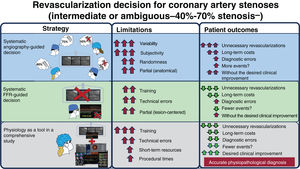
Despite the above, the new European guidelines on ACS14 are surprisingly specific in recommending angiography to guide the revascularization of nonculprit lesions in patients with ST-segment elevation ACS. Clinical trials have failed to demonstrate fewer events with systematic pressure guidewire use but have shown equal numbers of these events with fewer revascularizations. These results do not override the existing evidence concerning the superiority of the invasive functional assessment of angiographically ambiguous lesions but actually support the findings. Because of the variability in visual assessment of the degree of stenosis and its weak relationship with functional effects in moderate lesions, particularly in the presence of certain characteristics,15 use of a diagnostic medium (ie, invasive functional study) is needed to aid decision-making (figure 1).
Due to advances in both material and technique, coronary interventions can be performed with ever-increasing safety and tend to nullify the differences among clinical trials, even when one of the subgroups undergoes a considerable number of unnecessary treatments. This safety aspect is what will determine whether certain unstable atheromatous plaques could be preventively treated, pending the results of ongoing studies.
Even so, there will still be specific lesions and patients whose complexity is associated with worse outcomes and that will require a more accurate outcome prediction impossible with mere visual angiographic estimation. The previous large clinical trials did not include guidewire withdrawal studies or complete functional studies assessing the microvascular involvement or coronary flow reserve in patients who would potentially not benefit from the intervention due to the presence of diffuse disease, microvascular involvement, or high-flow lesions with a low FFR whose percutaneous or surgical revascularization will not improve symptoms or prognosis.
The repeated call to generalize the use of physiology in catheterization laboratories is not intended to apply to 100% of the procedures represented in the functional assessment-guided arms of clinical trials but rather to have it as an option in the many cases where angiography is insufficient for decision-making. These functional studies should probably go beyond merely obtaining a cutoff value to guide management.
FUNDINGThis work has not received any funding.
CONFLICTS OF INTERESTThere are no conflicts of interest to declare.