
We report herein the case of an 82 year-old male patient with a past history of heart failure (HF) with mildly reduced ejection fraction (EF) and permanent atrial fibrillation, anticoagulated with a vitamin K antagonist. He was referred for evaluation because of New York Heart Association (NYHA) class III HF. The echocardiogram showed marked left atrium dilatation (left atrium volume index 56.8mL/m2) and severe degenerative mitral regurgitation (DMR), Carpentier type II mechanism, and the EF was 44%. Transesophageal ultrasound highlighted a significant prolapse of the P2 segment due to chordae tendineae rupture (width 14mm, gap height 7mm). The regurgitant jet was eccentric, originating in the P2-P3 area, with a vena contracta of 11 by 6mm and an effective orifice regurgitant area of 0.41cm2 (videos 1, 2, and 3 of the supplementary data). The posterior and anterior mitral valve leaflets were 14 and 28mm in length, respectively. Pulmonary veins systolic flow reversal was also present. Invasive coronary angiography excluded obstructive epicardial artery disease.
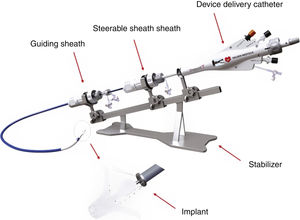
Although the patient had low surgical risk scores (Society of Thoracic Surgeons score for mortality, 2.76%; EuroSCORE II, 2.08%), after discussion among multidisciplinary heart team, he was not considered an optimal candidate for surgery due to his advanced age and frailty (clinical frailty scale score of 4). He was referred for percutaneous mitral transcatheter edge-to-edge repair (M-TEER). The chosen device was the DragonFly system (Valgen Medtech Co, Ltd, China) and the patient was included in the DragonFly EU Pivotal study (NCT05927441) (figure 1). The decision to select this device was based on its intrinsic characteristics, including its active closure mechanism, cobalt-chromium arms, and the presence of a nitinol spacer, making it particularly interesting for this anatomy.
After transeptal puncture, the DragonFly guiding catheter was advanced into the left atrium, and the steerable sheath was used to deliver a first device of wide and large arm length (XW0612) in the A2P2 central-medial position, chosen because of the significant width of the prolapse. Although a significant reduction in mitral regurgitation (MR) to grade 2+was obtained, to achieve an optimal result, a second device of the same size, parallel to the previous and more lateral, was deployed, completely eliminating the prolapse of the P2 region and reducing the MR to a trivial grade. The residual mean transmitral gradient was 3mmHg, and normalized pulmonary vein systolic flow was noted.
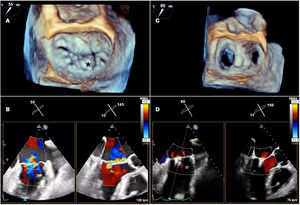
After the procedure, the patient had a favorable clinical course, and was discharged uneventfully 3 days later. A follow-up transthoracic echocardiogram showed adequate positioning of the 2 centrally implanted devices with a persisting optimal MR result (trivial MR) (figure 2; videos 4 and 5 of the supplementary data). At the 1-month follow-up, the patient was in NYHA class I and the follow-up transthoracic echocardiogram showed trivial MR.
A: 3-dimensional transesophageal echocardiography (TEE) surgeon's view of the mitral valve showing significant prolapse of the P2-P3 segment (star). B: mitral valve x-plane with color-Doppler in the bicommissural view and the corresponding orthogonal long-axis view, showing eccentric severe mitral regurgitation (MR). C: 3-dimensional-TEE surgeon's view of the mitral valve post-implantation of the second DragonFly device, placed parallel and lateral to the first device. D: final result of the mitral transcatheter edge-to-edge repair procedure with MR reduced to a trivial grade.
The DragonFly trancatheter valve repair device is a dedicated M-TEER system first reported by Liu X et al.1 in 2022 in a patient with severe degenerative MR and prohibitive surgical risk. This device combines features of the 2 devices most commonly used in clinical practice, the PASCAL Precision System (Edward Lifesciences, United States) and the MitraClip device (Abbott, United States), together with other unique specificities.
Like the PASCAL Precision System, this DragonFly has a central nitinol filler between the grasping arms, which can be compressed by the device arms. This ensures secure leaflet grasping without excessively tensioning the clipping areas, which is particularly important in specific anatomical scenarios such as a small mitral valve orifice area or short and frail leaflets. It allows for independent leaflet grasping, enabling fine-tuning of leaflet insertion and reducing the possibility of incomplete leaflet capture. In addition, the arms of this device can be mechanically locked at a range of angles, further decreasing the tension on the 2 leaflets after device implantation.
Similar to the MitraClip, DragonFly comes in 4 different sizes, with width and length ranges from 4 to 6mm and 9 to 12mm (SN0409, XN0412, SW0609, XW0612), respectively. This is important for tailoring the best device size for the appropriate anatomy, considering leaflet length, jet width, orifice area, and the targeted scallops.2
The delivery system has a 24-Fr caliber, which is advanced through the femoral vein. It includes a guide catheter and a steerable sleeve with readable unique calibration markers on each handle to facilitate accurate positioning of the clip. These features seem to be associated with a shorter learning curve and procedural time. Another specific feature of this system is the metal stabilizer, which has a gear design on the rail and bracket knobs, allowing reliable and smooth forward and backward control of the DragonFly delivery system.
The first-in-human prospective study was reported by Liu X et al.,2 who reported its good feasibility and safety, with all patients achieving success criteria (residual MR δ 2+at discharge).
Larger data is still limited to the nonrandomized trial DRAGONFLY-DMR, a prospective, single-arm, multicentric study of 120 patients with prohibitive surgical risk and symptomatic DMR ¿; 3+. This study showed clinical success in 87.5% of patients, with 92% having MR δ 2+at the 1-year follow-up and a low mean transmittal inflow gradient of 3.2±1.4mmHg. Interestingly, 65.5% of the patients achieved MR δ 1+at 1 month, and 91.2% of these maintained the optimal result at 1 year.3
Mitral TEER is a mature, safe, and effective technique for MR treatment in patients with high surgical risk. As shown in the case reported herein, this new DragonFly system device, which was first implanted in China 2 years previously, adds to the therapeutic arsenal for M-TEER. Its specific features, such as the active lock mechanism, cobalt-chromium arms, nitinol spacer, calibration markers on the guide catheter, and the gear design and bracket knobs of the metal stabilizer can be useful for optimizing the percutaneous treatment of DMR in the quest for an optimized tailored approach, ensuring the optimal match between device and patient anatomy.
FUNDINGNo funding was received for this manuscript.
ETHICAL CONSIDERATIONSInformed consent was obtained from the patient, and the ethics committee of our hospital approved the manuscript. The SAGER guidelines were followed to address and minimize any potential sex-gender bias.
STATEMENT ON THE USE OF ARTIFICIAL INTELLIGENCENo artificial Intelligence was used in the preparation of this manuscript.
AUTHORS’ CONTRIBUTIONSAll authors contributed substantially to this manuscript. C.E. Guerreiro and R. Estévez-Loureiro conceived and designed the idea. C.E. Guerreiro, M. Barreiro-Pérez and R. González-Ferreiro collected the data. C.E. Guerreiro, R. Estévez-Loureiro, J.A. Baz wrote the manuscript. A. Íñiguez-Romo corrected the manuscript. All authors approved the final version.
CONFLICTS OF INTERESTC.E. Guerreiro received a grant from the EAPCI. R. Estévez-Loureiro is a consultant for Abbott Vascular, Edwards Lifesciences, Boston Scientific, Venus Medtech and Jenscare. M. Barreiro-Pérez is a consultant for Abbott Vascular, Edwards Lifesciences and Venus Medtech. The remaining authors have nothing to disclose.
Supplementary data associated with this article can be found in the online version, at https://doi.org/10.1016/j.rec.2024.07.007