

Acute myocardial infarction (AMI) is one of the leading causes of morbidity and mortality worldwide. Its occurrence in a patient with normal coronary arteries, however, poses significant diagnostic and therapeutic challenges. We report a rare and clinically relevant case of ST-segment elevation myocardial infarction triggered by a scorpion sting.
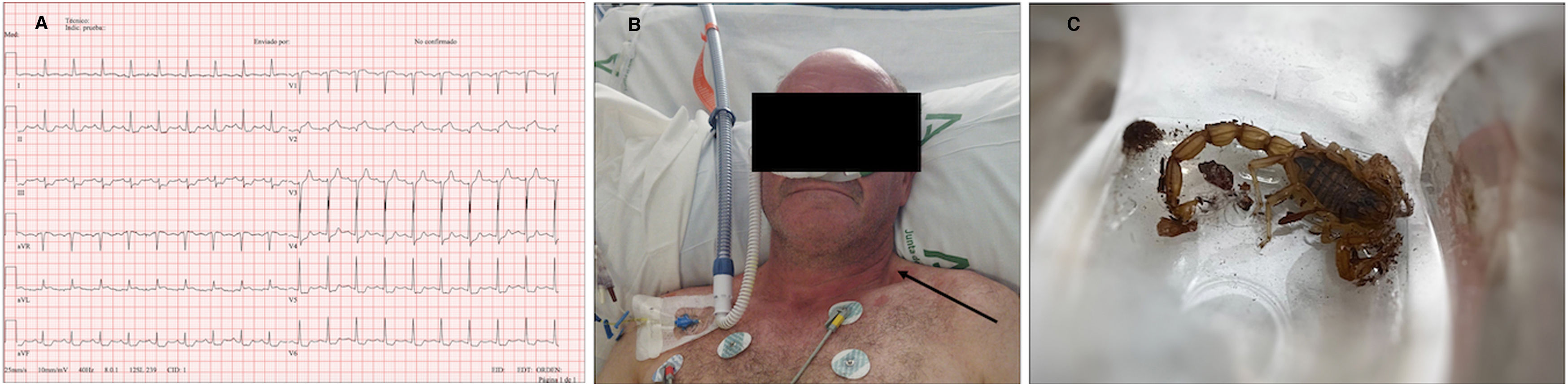
The patient, a 55-year-old man with no prior medical history, was referred to our hospital with acute pulmonary edema after AMI Code activation due to central chest pain and ST-segment elevation on electrocardiography (figure 1A).

Notably, the man reported a scorpion sting on the lower left limb 10hours earlier; he had experienced intense localized pain at the sting site in addition to abdominal pain, vomiting, sweating, but no erythema.
Emergency coronary angiography revealed a lesion involving 30% to 40% of the distal left anterior descending artery; there were no signs of complication, but intravascular imaging was not performed. A subsequent ventriculogram (video 1 of the supplementary data) showed a reduced left ventricular ejection fraction (LVEF) with anterior akinesia and inferolateral hypokinesia. Blood tests on admission indicated acute kidney injury (creatinine, 1.79mg/dL), markedly elevated high-sensitivity troponin I (peak, 22 340pg/mL), leukocytosis (30 770/μL) with neutrophilia, and increased lactate levels (9.6mmol/L). C-reactive protein, eosinophil, and tryptase levels were within normal limits.
Severe ventricular dysfunction was confirmed by echocardiography and the patient was started on positive inotropic support and noninvasive mechanical ventilation for respiratory failure. Blood pressure was also elevated.
Some clinical improvement was noted in the following hours, but the patient remained in a hyperadrenergic state for the first few days. This state was characterized by hyperthermia, sustained hypertension with self-limiting hypertensive crises, refractory hyperglycemia, sinus tachycardia with ventricular extrasystoles, profuse sweating, and facial flushing (figure 1B). Serial echocardiograms showed significant improvements in LVEF, while the semi-invasive FloTrac/Vigileo monitoring system (Edwards Lifesciences, Switzerland) showed elevated cardiac output (8-10L/min) and cardiac index (4.17L/min/m2).
Once stabilized, the patient was transferred to the general ward on day 5. Echocardiography (video 2 of the supplementary data) showed a nondilated, hyperrefringent left ventricle with anterior akinesia, a slightly reduced LVEF, and decreased global longitudinal strain (-14.5%). Hyperadrenergic symptoms persisted, and, despite the evident improvement in ventricular function, serial blood tests continued to show elevated high-sensitivity troponin I and N-terminal pro-B-type natriuretic peptide levels. In view of these findings and the information provided by the patient on the type of scorpion that had stung him, scorpion envenomation was considered as a possible cause. The offending scorpion was identified as Buthus occitanus (figure 1C). The patient was started on doxazosin, which led to improved blood pressure within hours and progressive resolution of other signs and symptoms over the following days.
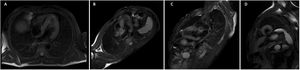
On day 10 of admission, the assessment was completed with vasoreactivity and microvascular function tests (both negative) and cardiac magnetic resonance imaging (MRI). The MRI showed improved LVEF (60%) with mid-apical anterior hypokinesia and no gadolinium uptake (video 3 of the supplementary data). Nonetheless, diffuse patchy edema predominantly affecting the anterior and anteroseptal regions was observed in the T2-weighted double inversion recovery sequences with prolonged T2 times (figure 2).

Cardiac magnetic resonance imaging (1.5T) in different views. A, Apical 4-chamber view; B, Apical 3-chamber view; C, Apical 2-chamber view; D, Short-axis view. Diffuse patchy edema primarily affecting the anterior and anteroseptal regions in T2-weighted double inversion recovery sequences.
The patient's clinical condition continued to improve, allowing for gradual tapering of α- and β-blocker therapy. He was discharged in excellent condition on day 12 of admission.
Millions of scorpion stings are reported worldwide each year.1 In Spain, scorpion envenomation is rare and cases are usually mild, with localized pain and minimal systemic involvement.
Scorpion envenomation results from the injection of toxins which, depending on the offending species, can trigger autonomic, neuromuscular, and cardiovascular symptoms. Scorpion α-toxins pose the greatest threat to humans, as they induce a massive release of catecholamines and vasoactive peptides, leading to severe cardiovascular effects. These can result in cardiogenic shock and acute pulmonary edema through various mechanisms, such as coronary vasoconstriction and myocardial ischemia and catecholamine-induced cardiomyopathy and myocarditis.2–4
Members of the Buthus genus are the species most often reported in association with scorpion envenomation in North Africa and Spain. The predominant species in the Iberian Peninsula is B occitanus, which has been linked to severe cases of envenomation characterized by autonomic hyperstimulation, cardiogenic shock, acute pulmonary edema, and generally mild neuromuscular symptoms.5
The echocardiographic findings in the current case were not consistent with Takotsubo syndrome, and the coronary angiogram showed a nonobstructive lesion with no apparent complications (although intracoronary imaging during the acute phase could have confirmed this). Given the limited familiarity with scorpion stings in our region, the initial working diagnosis was Kounis syndrome. From the outset, however, the clinical course closely followed the typical pattern of scorpion envenomation: cholinergic symptoms in the first few hours, rapid progression to hypertensive acute pulmonary edema with severe dysfunction, and a predominant hyperadrenergic state lasting for 8 to 10 days. Cardiac MRI is essential for distinguishing between potential diagnoses in such cases and it played a key role in this one.
Supportive care and α-blockers are essential in the management of scorpion envenomation due to the profound adrenergic hyperstimulation induced, primarily by α-toxins. Use of a specific antidote that binds to these toxins, accelerating their clearance and preventing their interaction with ion channels, could be considered within the first few hours or days in suspected cases of severe systemic envenomation.6
In conclusion, although severe scorpion envenomation is rare in Spain, its incidence could increase in the coming decades as a result of changes in the geographic distribution of scorpions driven by climate change. We believe that case reports such as ours will help raise clinical awareness and suspicion.
FUNDINGNone.
ETHICAL CONSIDERATIONSPersonal data have been anonymized and part of the patient's face has been blacked out to prevent his identification but still show the facial flushing. The patient provided written informed consent to the possible publication of this case report. The study adhered to the Sex and Gender Equity in Research guidelines.
USE OF ARTIFICIAL INTELLIGENCEArtificial intelligence was not used.
AUTHORS’ CONTRIBUTIONSAll the authors participated in the design, writing, and review of the final manuscript.
CONFLICTS OF INTERESTThe authors have no conflicts of interest in relation to this manuscript.