
ISSN: 1885-5857 Impact factor 2025 4.2
Vol. 78. Num. 3.
Pages 286-287 (March 2025)

Letter to the editor
Black hole-type electronic health records. Enough is enough!

Historia clínica electrónica modelo agujero negro. ¡Basta ya!

Héctor Buenoabcd
https://doi.org/10.1016/j.rec.2024.11.013

Options

Imagen extra
Rev Esp Cardiol. 2025;78:286-7
To the Editor,

Digitalization is one of the greatest revolutions in medical history, and electronic health records (EHRs) one of the greatest milestones. The introduction of EHRs radically reshaped clinical practice. In a shift that has had a profound impact on the doctor-patient relationship, many of today's practitioners spend more time on their computers than directly interacting with patients.

Initial resistance to EHRs among some practitioners was accompanied by high expectations for significant improvements in the management of patient data.1 Many of these expectations, however, were not met. On the contrary, dissatisfaction is growing, as clinicians, now reliant on EHRs for practically everything, feel that they receive little in return for the time spent feeding and managing these systems. As a result, stress and burnout are on the rise.1

EHRs are clearly the path forward. They offer numerous advantages, such as centralized data management, streamlined access to key information, better and safer data preservation, and freeing up of office space previously taken up by paper files. The management of EHR data for clinical purposes, however, leaves much to be desired. EHR systems were supposed to produce better clinical reports—that was one of their main functions—but in many cases, the opposite is true. Today's reports consist of “copy and paste” clinical notes, lists of laboratory results, and full test reports with minimal editing due to “EHR fatigue”. Compared with the short, focused reports of the predigital era, digital reports are longer and more difficult to read and interpret.

Several critical issues need to be addressed if EHR systems are to improve. The first is interoperability. Hospitals, primary care centers, and regions cannot effectively share information if their systems are incompatible, whether because of technical shortcomings or political-administrative decisions. Other pressing issues include the risk of operational collapse due to power outages or internet downtime, cybersecurity, the need for greater involvement of end users in EHR design, and mechanisms for granting patients access to their health care data. These issues aside, several factors have contributed to the gap between the potential and actual value of EHRs in clinical practice. EHR systems have been designed and implemented from the top down, often without input from the practitioners using them. As a result, systems are neither user friendly nor intuitive, and many are devoid of tools and functionalities that could offer true clinical value. Integration with other health care tools, such as monitoring systems, telemedicine platforms, and various diagnostic and therapeutic tests, is often incomplete. EHRs also frequently contain text or images that have not been fully converted into an editable digital format (“pseudodigitalization”), resulting in large quantities of unstructured data of clinical value. Finally, EHR systems now incorporate numerous administrative features. This has led to the unintended (?) transfer of multiple administrative tasks traditionally handled by office staff to health care providers, increasing their undue burden of nonspecialized work.

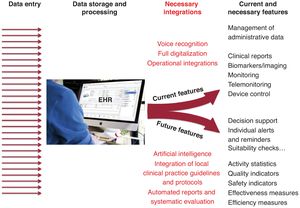
Several factors must be considered when designing new EHR systems (figure 1), including simpler and faster data entry systems; full digital conversion of all information possible; automation of processes; and improved connectivity, both internally (among all devices within a given health care setting) and externally (among different health care settings). Many of today's EHR models will need to be redesigned to advance towards full digitalization and integration with enabling technologies, such as voice recognition and processing software. Standardized data models will also need to be adopted to facilitate this integration.2

Figure 1.

The present and future of electronic health records (EHRs).

(0.34MB).

New-generation EHR systems must be capable of providing immediate, tangible outputs, such as reports, order forms, and prescriptions, in addition to key features, such as alerts for patient-specific treatments, decision-support tools, and customizable statistics. These functionalities will require the effective, systematic integration of AI tools built on local clinical practice guidelines and protocols.

“Black hole” EHR models, which absorb large amounts of data but return almost nothing, must be replaced as soon as possible with truly functional EHR systems equipped with multiple automated processes, decision-support tools, and services of clinical value. These systems must also be capable of generating statistics and reports and providing systematic evaluations of quality, safety, efficiency, and effectiveness indicators.

EHR manufacturers and vendors must commit to integrating better and more effective user feedback throughout the design stage. Purchasers, in turn, must insist on the inclusion of essential features from the outset. By doing so, they will avoid being charged extra for functionalities that should be there in the first place.

FUNDING

No organization funded this article.

STATEMENT ON THE USE OF ARTIFICIAL INTELLIGENCE

Artificial intelligence was not used to prepare this article.

References
[1]
F. Alobayli, S. O’Connor, A. Holloway, K. Cresswell.
Electronic Health Record Stress and Burnout Among Clinicians in Hospital Settings: A Systematic Review.
Digit Health., (2023), 9
[2]
N. Rosillo, H. Bueno.
Data source integration: a key tool for optimizing resources and prioritizing areas for improvement in clinical practice and epidemiology.
Rev Esp Cardiol., (2024), 77 pp. 459-461
Copyright © 2024. Sociedad Española de Cardiología