
Oxidation of low-density lipoprotein (ox-LDL) particles plays a key role in the pathogenesis of atherosclerosis.1 Physical activity (PA) is a protective factor against cardiovascular disease.2 However, the mechanisms by which PA exerts its beneficial health effects are not fully understood. In addition, the dose-response pattern of PA and biomarkers of oxidative stress has not been properly analyzed. The aim of this cross-sectional population-based study was to determine the dose-response relationship between PA and serum ox-LDL levels, considering PA intensity in our analysis.
The methodology has been previously described.3 In summary, 2 population-based cross-sectional studies were designed within the framework of the REGICOR study:3 1748 individuals were recruited from 1994 to 1996, and 3056 were recruited from 1999 to 2002. A random subsample of 3070 participants was selected, and serum ox-LDL levels were determined using a sandwich ELISA procedure (Mercodia AB, Sweden).
Leisure time PA (LTPA) was measured using the Minnesota Leisure-Time Physical Activity Questionnaire, which has been validated for the Spanish adult population. Total energy expenditure in PA was estimated in metabolic equivalent of task (MET)-min/wk and was further classified as energy expenditure in light-intensity PA (EE light PA) if PA required ≤ 4 METs (such as low-paced walking); in moderate-intensity (EE moderate PA) if PA required 4.5 to 5.5 METs (such as brisk walking); and vigorous-intensity (EE vigorous PA) if PA required ≥ 6 METs (such as jogging). Out of the initial random subsample, data on LTPA were available for 2908 participants. Other cardiovascular risk factors were determined using standardized and validated questionnaires and measurement methods.3
Total energy expenditure in PA was higher in men than in women (mean±standard deviation, 2146±1831 vs 1444±1314 MET-min/wk], especially in moderate (684±1071 vs 366±686) and vigorous PA (796±1291 vs 520±889). To assess the linear and nonlinear dose-response pattern of the association between PA and serum ox-LDL, we used generalized additive models. These models included the variables of light, moderate, and vigorous-intensity PA as smooth terms in the predictors of ox-LDL. The analyses were additionally stratified by sex to explore potential differences between men and women.
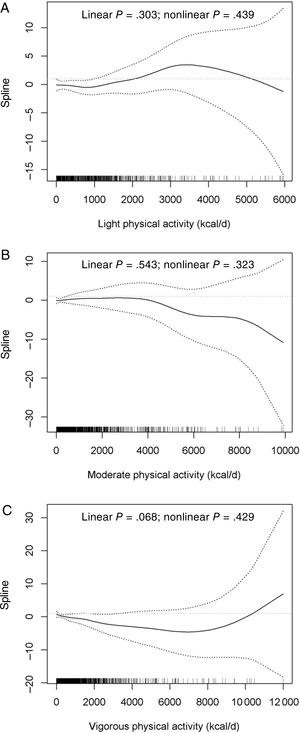
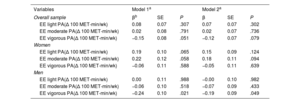
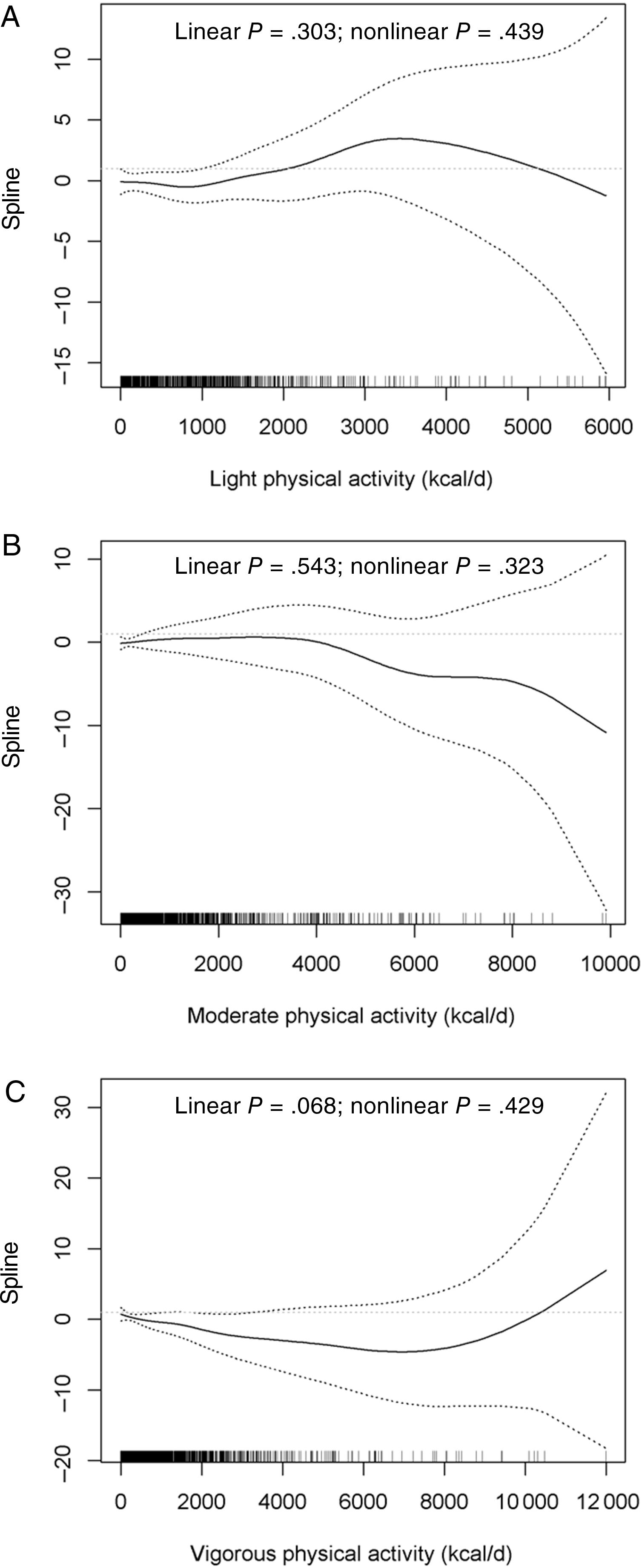
In the bivariate Spearman correlation, EE light PA was directly associated with serum ox-LDL (P=.045). Conversely, EE vigorous PA was inversely associated with serum ox-LDL (P=.068), while EE moderate PA showed no association with ox-LDL. Figure 1 shows the results of the general additive model, which included EE in light, moderate and vigorous PA. Since no significant nonlinear relationship between EE PA and ox-LDL levels was observed, ordinary multiple linear regression analyses were performed (table 1): model 1, adjusted for age and sex; and model 2, adjusted for age, sex, low-density lipoprotein cholesterol, high-density lipoprotein cholesterol, smoking and personal history of diabetes. In the first model, an inverse association between vigorous activity and serum ox-LDL was observed. In the second model, no significant associations were observed. When we stratified the analyses by sex, no associations were found in women. In men, a significant negative association between vigorous PA and ox-LDL was observed. In the fully adjusted model, each 100 MET-min/wk increase in vigorous PA was associated with a decrease in ox-LDL of 0.19 U/L (95% confidence interval, 0.01-0.37). In a sensitivity analysis, this association was also observed when PA was categorized in quartiles (data not shown).
Dose-response association pattern for energy expenditure in physical activity and oxidation of low-density lipoprotein. Panels A, B, and C represent the relationship with energy expenditure in light-intensity, moderate-intensity, and vigorous-intensity physical activity, respectively.
Multiple linear regression models of the association between energy expenditure in light-intensity, moderate-intensity, and vigorous-intensity physical activity and oxidized low-density lipoprotein levels
| Variables | Model 1a | Model 2a | ||||
|---|---|---|---|---|---|---|
| Overall sample | βb | SE | P | β | SE | P |
| EE light PA(Δ 100 MET-min/wk) | 0.08 | 0.07 | .307 | 0.07 | 0.07 | .302 |
| EE moderate PA(Δ 100 MET-min/wk) | 0.02 | 0.08 | .791 | 0.02 | 0.07 | .736 |
| EE vigorous PA(Δ 100 MET-min/wk) | −0.15 | 0.08 | .051 | −0.12 | 0.07 | .079 |
| Women | ||||||
| EE light PA(Δ 100 MET-min/wk) | 0.19 | 0.10 | .065 | 0.15 | 0.09 | .124 |
| EE moderate PA(Δ 100 MET-min/wk) | 0.22 | 0.12 | .058 | 0.18 | 0.11 | .094 |
| EE vigorous PA(Δ 100 MET-min/wk) | −0.06 | 0.11 | .588 | −0.05 | 0.11 | .639 |
| Men | ||||||
| EE light PA(Δ 100 MET-min/wk) | 0.00 | 0.11 | .988 | −0.00 | 0.10 | .982 |
| EE moderate PA(Δ 100 MET-min/wk) | −0.06 | 0.10 | .518 | −0.07 | 0.09 | .433 |
| EE vigorous PA(Δ 100 MET-min/wk) | −0.24 | 0.10 | .021 | −0.19 | 0.09 | .049 |
EE light PA, energy expenditure in light-intensity physical activities (2-4 METs); EE moderate PA, energy expenditure in moderate-intensity physical activities (4.5-5.5 METs); EE vigorous PA, energy expenditure in vigorous-intensity physical activities (6-12 METs); SE, standard error.
Our results are consistent with those observed in previous experimental4 and observational studies5 that have reported a significant association between PA and ox-LDL levels. However, most of these studies included a small sample size, did not analyze the dose-response pattern, and did not consider PA intensities.
A notable finding of our study is the significant negative association between vigorous PA and ox-LDL levels, exclusively observed in men. These results are consistent with studies showing sex differences in the impact of PA on lipid profile.6 This sex difference may be attributed to hormonal differences between men and women, with estrogen potentially conferring a protective effect against lipid oxidation. Alternatively, this difference could be explained by other factors, such as differences in body composition or metabolic responses to exercise. Moreover, vigorous PA levels were lower and with less variability in women than in men, which reduced the statistical power to detect associations in women.
Regarding the intensity of PA, while vigorous-intensity PA may initially result in a temporary increase in oxidative stress markers, regular engagement in vigorous PA can lead to adaptations of the antioxidant defense system, as observed in previous studies.4 Several mechanisms could explain the reduction in ox-LDL levels associated with vigorous PA. First, there may be a reduction in the levels of LDL particles themselves, although this relationship was independent of LDL cholesterol levels. In addition, vigorous PA may enhance the resistance of LDL particles to oxidation4 and promote the upregulation of endogenous antioxidant mechanisms.4
Our study has several limitations. First, the design was cross-sectional, and therefore we cannot infer causality from the reported association. Second, PA was assessed using a questionnaire, which may introduce information bias due to recall errors or social desirability bias. Despite these limitations, several strengths are worth noting. First, our study used a population-based approach, enhancing the generalizability of our findings. Furthermore, the sample size of the study was robust, allowing meaningful analyses. In addition, our study analyzed the dose-response pattern of the association between PA and serum ox-LDL levels, considering both the amount of PA and its intensity.
Our results support an inverse and linear relationship between vigorous PA and ox-LDL, particularly observed in men. This finding suggests that lowering ox-LDL levels could be one of the mechanisms underlying the beneficial effects of PA on cardiovascular health.
FUNDINGThis work was supported by the Carlos III Health Institute and European Regional Development Fund (CIBERCV-CIBEROBN) Agència de Gestió d’Ajuts Universitaris i de Recerca (SLT002/16/00088), and the Government of Catalonia through the Agency for Management of University and Research Grants (2017SGR946).
ETHICAL CONSIDERATIONSThis study was approved by the local ethics committee. All included participants were duly informed and signed a written consent form. Possible sex/gender biases have been taken into account in the preparation of this article. A stratified analysis by sex was carried out.
STATEMENT ON THE USE OF ARTIFICAL INTELLIGENCENo artificial intelligence tools were used in the preparation of this work.
AUTHORS’ CONTRIBUTIONSM. Fitó, J. Marrugat, and R. Elosua made substantial contributions to the conception or design of the work and the acquisition of data. R. Benet-Pozo, I. Subirana, and R. Elosua substantially contributed to data analysis. R. Benet-Pozo, M. Fitó, J. Marrugat, C. García-García, I. Subirana, and R. Elosua contributed to data interpretation. R. Benet-Pozo and R. Elosua drafted the work, and M. Fitó, J. Marrugat, C. García-García, and I. Subirana critically reviewed it for important intellectual content. The final version for publication was approved by R. Benet-Pozo, M. Fitó, J. Marrugat, C. García-García, I. Subirana, and R. Elosua, who also agreed to be accountable for all aspects of the work, ensuring that any questions related to accuracy or integrity were appropriately investigated and resolved.
CONFLICTS OF INTERESTNone.