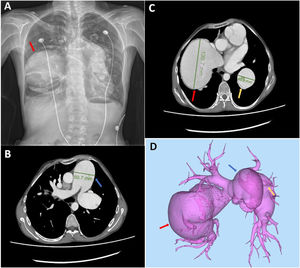

A 40-year-old man with a 20-year history of dyspnea and cough was admitted to our hospital. He had been diagnosed with a ventricular septal defect and Eisenmenger syndrome (ES) the previous year. Physical examination revealed a grade 2/6 systolic murmur over the left 3rd/4th intercostal space. A chest X-ray revealed a large, round mass (97×120mm) in the right hemithorax (figure 1A, red arrow). Computed tomography angiography showed a main pulmonary artery aneurysm (PAA) measuring 50.7mm (figure 1B, blue arrow), a giant PAA measuring 130.7 mm with thrombus formation in the middle and lower lobe of the right lung, and left lower pulmonary artery dilation (45.9 mm) with limited dissection formation (figure 1C,D, yellow arrow; and video 1 of the supplementary data). Hemodynamic data showed that pulmonary artery pressure was 103/47/68mmHg, Qp/Qs was 1.17, and pulmonary vascular resistance was 7.88 Wood units. Pulmonary artery angiography confirmed the giant PAA (video 2 of the supplementary data). Informed consent was obtained.
PAA is a very rare lesion, usually associated with congenital heart disease, vasculitis, pulmonary hypertension, trauma, or infection. Most PAAs are located in the main pulmonary artery, with only 11% occurring in the pulmonary branches. To reduce the risk of fatal rupture, various strategies have been proposed for the treatment of giant PAA, including lobectomy, pulmonary artery repair, endovascular approaches, and even conservative management with reasonably good long-term survival. Lung or combined heart-lung transplantation is considered the last resort for patients with ES. This patient declined heart-lung transplantation. After unsuccessful attempts to occlude the PAA, his symptoms were managed with diuretics, macitentan, and sildenafil, providing relief at the 3-year follow-up.
FUNDINGThis work was supported by the National Natural Science Foundation of China (82060018, 81700438) and Yunnan Fundamental Research Projects (202301AY070001-300, 202101AS070043, 202102AA310003-7, and 202105AF150019).
ETHICAL CONSIDERATIONSThe patient provided informed consent for the publication of this report. Sex and gender are reported in accordance with the SAGER guidelines.
DECLARATION ON THE USE OF ARTIFICIAL INTELLIGENCENo artificial intelligence was used in the preparation of this article.
AUTHORS’ CONTRIBUTIONSX-T. Lu and Y-B. Lu were in charge of writing and visualization. H-L. Dai was responsible of conceptualization, supervision, validation, and writing.
CONFLICTS OF INTERESTThere are no conflicts of interest.
Supplementary data associated with this article can be found in the online version, available at https://doi.org/10.1016/j.rec.2024.08.001