





In recent years, several cases of hereditary transthyretin amyloidosis (ATTRv) due to the p.Val142Ile variant have been described in patients without African ancestry. The aim of this study was to analyze the impact of ATTRv caused by p.Val142Ile in Spain, focusing on its phenotypic characteristics and its population frequency.
MethodsPatients diagnosed with ATTRv caused by p.Val142Ile, as well as carriers irrespective of their phenotype, were recruited from 16 centers in Spain. Baseline characteristics and events during follow-up were retrieved. Population frequency was assessed using data from the Spanish National DNA Bank (N=3569) and the Catalan Health Databank (N=790).
ResultsThe cohort included 164 participants: 75 probands (45.7%) and 89 relatives (54.3%). Among the probands, the mean age was 73.9±8.5 years, and 47 (62.7%) were male. Sixty-seven probands (89.3%) reported European ancestry, while only 6 (8%) reported African ancestry. Cardiac symptoms were the most frequent reason for ATTRv diagnosis (n=64; 85.3%). The median follow-up was 2.6 years [Interquartile range, 1.5-4.1]. Overall penetrance at ages 65, 75, and 85 years was 12.8%, 44.3%, and 94.2%, respectively. Tafamidis was initiated during follow-up in 38 patients: after 1 year of treatment, 14 patients (38.9%) met the combined endpoint (12 experienced disease progression and 2 died from cardiovascular causes). Population frequency was estimated to range between 0.0% and 0.12%, based on data from the Spanish and Catalan databases, respectively.
ConclusionsATTRv caused by p.Val142Ile has a significant prevalence in Spain. Its phenotypic features are characterized by late onset, male predominance, and cardiac involvement.
Keywords
Transthyretin amyloidosis (ATTR) is a systemic disease characterized by the abnormal deposition of transthyretin protein fragments (TTR) in the extracellular matrix of various organs, with special affinity for peripheral nerves and the myocardium.1 ATTR is classified into 2 forms: a nonhereditary form, known as ATTR wildtype (ATTRwt), and a hereditary form with an autosomal dominant inheritance pattern (ATTRv).2
In recent decades, more than 100 pathogenic gene variants have been identified. One of the most common is the p.Val142Ile variant, previously reported as p.Val122Ile,3 (NM_000371.4(TTR):c.424G >A), which has a prevalence of 3% to 3.5% in the African-American population of the United States and up to 10% in countries along the Gulf of Guinea. Consequently, it is one of the most frequent causes of ATTRv globally.4,5 Phenotypic features of this variant include relatively late disease onset, incomplete penetrance, and a predominance of cardiac involvement over polyneuropathy.6 However, certain aspects remain poorly understood, such as the frequency of ophthalmologic involvement, the rate of response to disease-modifying drugs, and its prevalence in populations without known African ancestry.
In recent years, several cases of ATTRv caused by p.Val142Ile have been reported in patients without African ancestry in countries such as Japan, Portugal, Spain, and Italy.7–11 Notably, a recent study by Mazzarotto et al.12 identified a new endemic cluster in Tuscany (Italy) caused by a founder effect and demonstrated the absence of significant African ancestry. This growing body of evidence suggests that p.Val142Ile may be more prevalent than previously estimated on a global scale.
The aim of this study was to establish a multicenter cohort of patients with ATTRv caused by p.Val142Ile in Spain to comprehensively characterize its phenotypic features, explore potential endemic geographic clusters, and determine the population frequency of this variant in Spain.
METHODSPopulationSpanish centers following up patients with ATTRv amyloidosis were invited to participate in this longitudinal cohort study. The inclusion criteria included patients diagnosed with ATTRv amyloidosis who were confirmed carriers of the p.Val142Ile TTR variant. Relatives carrying the same variant were identified through cascade screening and were also included, regardless of their phenotype. Genetic analysis was conducted either at the participating centers or at accredited genetic laboratories, using next-generation sequencing or Sanger sequencing techniques. The study complies with the ethical principles outlined in the Declaration of Helsinki and was approved by the ethics committee of Hospital Universitari de Bellvitge (PR115/23). Written informed consent was waived by the committee.
The authors from each participating center ensured the integrity and accuracy of the data collected.
Data acquisitionData were retrieved from medical records and anonymized by each participating center. The dataset included demographics and family history, with a particular focus on participants’ birthplaces and the geographical origins of their ancestors. Signs and symptoms related to ATTRv amyloidosis were recorded at both the initial and final evaluations, with an emphasis on cardiac, neurological, and ophthalmologic features.
The onset of cardiac involvement was defined as the first documentation of left ventricular hypertrophy (maximal wall thickness ≥ 12mm) or grade 2 or 3 cardiac uptake on bone scintigraphy. Neurological involvement was defined as the appearance of signs or symptoms related to ATTRv amyloidosis, along with abnormal neurological test results (nerve conduction study or sympathetic skin response) and associated signs. Ophthalmologic involvement was defined as vitreous opacities, as previously described.13 Data from complementary tests, such as electrocardiograms (ECGs), laboratory tests, bone scintigraphy, echocardiography, and nerve conduction studies, were also included when available. Information on the initiation of disease-modifying therapies for ATTRv amyloidosis was also collected. Clinical events recorded during follow-up included stroke or transient ischemic attacks, pacemaker or implantable cardioverter-defibrillator implantation, atrial fibrillation (AF), heart failure (HF) hospitalizations, heart transplantation, liver transplantation, or death.
Study clinical endpointsPenetrance from birth was estimated based on the phenotypic expression of cardiac or neurological involvement and was compared according to sex. Overall mortality was analyzed from the time of ATTRv diagnosis. Disease progression at 1 year was defined as a significant increase in N-terminal pro-B-type natriuretic peptide (NT-proBNP) (absolute increase >700 ng/L and relative percentage increase >30.0%) or outpatient diuretic intensification, as outlined in a recently validated progression assessment tool published by Ioannou et al.14 A combined endpoint of cardiovascular-related death or disease progression was analyzed among patients who initiated treatment with Tafamidis. A post hoc analysis was conducted to compare new cases diagnosed with p.Val50Met and p.Val142Ile during the periods 2010 to 2014 and 2015 to 2019 in Spain. This analysis was based on data previously published from a multicenter Spanish registry to identify temporal trends.11
Population frequency analysisThe population allele frequency in Spain was analyzed by accessing 2 population databases. First, the Spanish National DNA Bank-Carlos III, which contains 3400 samples from healthy individuals representative of the Spanish population, analyzed using 2 different chips: the Infinium Global Screening Array (Illumina Platform) (n=1000) and the Axiom Spanish BioBank array (Affymetrix Platform, Thermo Fisher Scientific) (n=3400). Second, the Catalan Biobank GCAT, which includes samples from 19 267 volunteers aged between 40 and 65 years old, recruited between 2014 and 2017 in Catalonia. Of these, 790 samples have undergone whole-genome sequencing at an overall coverage of 30 X, using paired-end sequencing by synthesis on a HiSeq 4000 sequencer (Illumina, USA).15 In addition, the birth province of probands was described and adjusted based on the current population born in Spain for each province, as extracted from the 2022 Spanish National Statistics Institute (Instituto Nacional de Estadística, INE).
Statistical analysisData for quantitative variables are presented as mean±standard deviation or as median [P25-P75] for variables with a nonnormal distribution, as assessed by the Shapiro-Wilk test. Qualitative variables are presented as No. (%). The Student t-test was used to compare continuous variables with a normal distribution, while the nonparametric Wilcoxon (Mann-Whitney) rank-sum test was applied to variables that did not follow a normal distribution. For categorical variables, comparisons between groups were made using either the parametric chi-square test or the nonparametric Fisher exact test, depending on the data characteristics. Kaplan-Meier survival analysis was used to describe penetrance and survival.
All analyses were performed using STATA software version 15.1 (StataCorp, College Station, USA). A 2-tailed P value <.05 was considered statistically significant.
RESULTSStudy participantsInformation was collected from 177 participants with the p.Val142Ile TTR variant at 16 Spanish centers. Two referral centers for ATTRv located in Northwest Spain (Complexo Hospitalario Universitario de A Coruña and Hospital Universitario Central Asturias) were contacted but reported no cases. Patients included by each participating center and additional investigators are listed in supplementary data 1 and 2.
Among the 177 participants, 4 cases were excluded due to insufficient data to establish phenotypic involvement, and 9 cases were excluded due to duplicate inclusion by 2 centers. The final cohort comprised 164 participants, including 75 probands (45.7%) and 89 relatives (54.3%) (supplementary data 3). All patients were heterozygous, except for one case who was homozygous for the p.Val142Ile variant. Notably, the parents of this homozygous individual were nonconsanguineous and originated from different provinces.
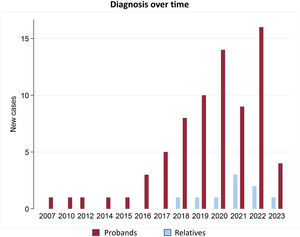
The most frequent reason leading to ATTRv diagnosis was cardiac symptoms (n=64; 85.3%), followed by incidental findings (n=8; 10.7%) and neurological symptoms (n=3; 4.0%). Figure 1 shows the number of new cases diagnosed over time, with a significant increase (P<.001) in recent years, in most cases as probands. This finding was further supported by data extracted from a previous Spanish registry, showing a 5.88% increase in the diagnosis of p.Val50Met between 2015 and 2019 compared with the 2010 to 2014 period, in contrast with a 466.67% increase in p.Val142Ile in the same period (supplementary data 4).

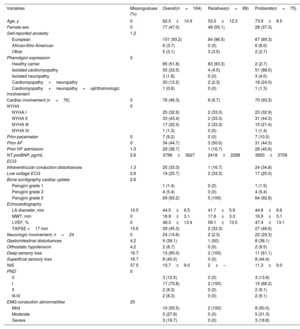
The main characteristics of all individuals at the initial evaluation are listed in table 1. Among probands, the mean age at diagnosis was 73.9±8.5 years (median, 76.0 [IQR 68.8-78.9]) and 47 (62.7%) were male. A total of 67 probands (89.3%) self-reported having European ancestry, while only 6 individuals (8%) reported African or Afro-American ancestry. Isolated cardiomyopathy was observed in 68.0% (n=51) of probands, followed by 24.0% (n=18) of participants with mixed neurological and cardiac involvement. Three probands (4.0%) had isolated neuropathy at disease onset.
Baseline clinical characteristics of p.Val142Ile variant carriers (n=164)
| Variables | Missingvalues (%) | Overall(n=164) | Relatives(n=89) | Probands(n=75) |
|---|---|---|---|---|
| Age, y | 0 | 62.5±14.9 | 53.0±12.3 | 73.9±8.5 |
| Female sex | 0 | 77 (47.0) | 49 (55.1) | 28 (37.3) |
| Self-reported ancestry | 1.2 | |||
| European | 151 (93.2) | 84 (96.5) | 67 (89.3) | |
| African/Afro-American | 6 (3.7) | 0 (0) | 6 (8.0) | |
| Other | 5 (3.1) | 3 (3.5) | 2 (2.7) | |
| Phenotypic expression | 0 | |||
| Healthy carrier | 85 (51.8) | 83 (93.3) | 2 (2.7) | |
| Isolated cardiomyopathy | 55 (33.5) | 4 (4.5) | 51 (68.0) | |
| Isolated neuropathy | 3 (1.8) | 0 (0) | 3 (4.0) | |
| Cardiomyopathy+neuropathy | 20 (12.2) | 2 (2.3) | 18 (24.0) | |
| Cardiomyopathy+neuropathy+ophthalmologic involvement | 1 (0.6) | 0 (0) | 1 (1.3) | |
| Cardiac involvement (n=76) | 0 | 76 (46.3) | 6 (6.7) | 70 (93.3) |
| NYHA | 0 | |||
| NYHA I | 25 (32.9) | 2 (33.3) | 23 (32.9) | |
| NYHA II | 33 (43.4) | 2 (33.3) | 31 (44.3) | |
| NYHA III | 17 (22.4) | 2 (33.3) | 15 (21.4) | |
| NYHA IV | 1 (1.3) | 0 (0) | 1 (1.4) | |
| Prior pacemaker | 0 | 7 (9.2) | 0 (0) | 7 (10.0) |
| Prior AF | 0 | 34 (44.7) | 3 (50.0) | 31 (44.3) |
| Prior HF admission | 1.3 | 29 (38.7) | 1 (16.7) | 28 (40.6) |
| NT-proBNP, pg/mL | 2.6 | 3798±3627 | 2418±2288 | 3920±3709 |
| ECG | ||||
| Intraventricular conduction disturbances | 1.3 | 25 (33.3) | 1 (16.7) | 24 (34.8) |
| Low voltage ECG | 2.6 | 19 (25.7) | 2 (33.3) | 17 (25.0) |
| Bone scintigraphy cardiac uptake | 2.6 | |||
| Perugini grade 1 | 1 (1.4) | 0 (0) | 1 (1.5) | |
| Perugini grade 2 | 4 (5.4) | 0 (0) | 4 (5.4) | |
| Perugini grade 3 | 69 (93.2) | 5 (100) | 64 (92.8) | |
| Echocardiography | ||||
| LA diameter, mm | 10.5 | 44.5±6.5 | 41.7±5.9 | 44.8±6.6 |
| MWT, mm | 0 | 16.9±3.1 | 17.8±3.3 | 16.9±3.1 |
| LVEF, % | 0 | 48.3±13.4 | 59.1±13.0 | 47.4±13.1 |
| TAPSE <17 mm | 15.6 | 29 (45.3) | 2 (33.3) | 27 (46.6) |
| Neurologic involvement, n=24 | 0 | 24 (14.6) | 2 (2.3) | 22 (29.3) |
| Gastrointestinal disturbances | 4.2 | 9 (39.1) | 1 (50) | 8 (38.1) |
| Orthostatic hypotension | 4.2 | 2 (8.7) | 0 (0) | 2 (9.5) |
| Deep sensory loss | 16.7 | 13 (65.0) | 2 (100) | 11 (61.1) |
| Superficial sensory loss | 16.7 | 8 (40.0) | 0 (0) | 8 (44.4) |
| NIS | 37.5 | 10.7±9.0 | 2±– | 11.3±9.0 |
| PND | 0 | |||
| 0 | 3 (12.5) | 0 (0) | 3 (13.6) | |
| I | 17 (70.8) | 2 (100) | 15 (68.2) | |
| II | 2 (8.3) | 0 (0) | 2 (9.1) | |
| III-IV | 2 (8.3) | 0 (0) | 2 (9.1) | |
| EMG conduction abnormalities | 25 | |||
| Mild | 10 (55.5) | 2 (100) | 8 (50.0) | |
| Moderate | 5 (27.8) | 0 (0) | 5 (31.3) | |
| Severe | 3 (16.7) | 0 (0) | 3 (18.8) |
AF, atrial fibrillation; EMG, electromyogram; HF, heart failure; LA, left atrium; LVEF, left ventricular ejection fraction; MWT, maximal wall thickness; NIS, nerve impairment score; NT-proBNP, N-terminal pro-B-type natriuretic peptide; NYHA, New York Heart Association; PND, polyneuropathy disability; TAPSE, tricuspid annular plane systolic excursion.
Unless otherwise indicated, the data are expressed as No. (%) or mean±standard deviation.
Relatives identified through cascade screening had a mean age of 53.0±12.3 years, and 49 (55.1%) were female. After evaluation, 93.3% of relatives (n=83) were defined as healthy carriers, whereas 4.5% (N=4) had isolated cardiomyopathy and 2.3% (n=2) had mixed neurological and cardiac involvement. Overall, cardiomyopathy was characterized by advanced New York Heart Association (II or higher) in 67.1% (n=51) of cases. The mean NT-proBNP level was 3798±3627 pg/mL, and high cardiac uptake at scintigraphy (Perugini Grade 3) was observed in 93.2% of cases (n=69). Among patients with neurological involvement, 70.8% (n=17) had a polyneuropathy disability score of I, and the mean nerve impairment score was 10.7±9.0.
Follow-up and phenotypic expressionThe median follow-up was 2.6 years [IQR 1.5-4.1] from the first evaluation in all individuals, while 2 patients (1.2%) were lost to follow-up or were evaluated only once at participating centers. figure 2A displays the overall penetrance from birth, estimated at 11.9%, 43.8%, and 94.1% at ages 65, 75, and 85 years, respectively. Women had a later age of onset compared with men (log-rank test P=.03), as shown in figure 2B. Penetrance at 75 years was estimated at 48.5% for males and 36.9% for females. At final assessment, 41 cases (25.0%) had evidence of neuropathy, with a mean nerve impairment score of 9.1±10.4. Ophthalmologic involvement was observed in 3 cases (1.8%) at the last follow-up, with vitreous deposits identified in 2 of these cases.
Clinical outcomes, disease-modifying and advanced therapies
At the last follow-up, 30 individuals (18.5%) had died. The most frequent causes were HF (n=14; 46.7%), noncardiovascular causes (n=10; 33.3%), and sudden death (n=5; 16.7%). The median survival from diagnosis was estimated at 5.37 years (figure 3), and the median age of deceased individuals was 78.7 [72.9-83.6] years. Relevant clinical events are summarized in table 2. Notably, 31 carriers (19.1%) had a HF admission during follow-up. One patient underwent sequential heart and liver transplantation in 2011 at the age of 67 years.

Clinical events
| Events | Overall(N=162) | Median age[interquartile range] |
|---|---|---|
| Heart failure admission | 31 (19.1%) | 77.3 [71.7-81.2] |
| Stroke | 4 (2.5%) | 76.3 [74.4-76.9] |
| New-onset atrial fibrillation | 10 (7.9%) | 76.4 [72.0-79.0] |
| Pacemaker implantation | 9 (6.3%) | 76.2 [72.9-80.5] |
| Heart and liver transplantation | 1 (0.6%) | 67 [-] |
| Death | 30 (18.5%) | 78.7 [72.9 -83.6] |
| Heart failure | 14 (46.7%) | |
| Noncardiovascular causes | 10 (33.3%) | |
| Sudden death | 5 (16.7%) | |
| Transplant complications | 1 (4.2%) |
Among patients with cardiac involvement and available data to assess disease progression at 1 year from diagnosis (n=52), 31 patients (59.6%) showed disease progression. The most frequent cause was isolated diuretic intensification (n=12, 23.1%), followed by a combination of diuretic intensification and NT-proBNP increase (n=11, 21.2%) and isolated NT-proBNP increase (n=8, 15.4%).
Tafamidis was initiated in 38 patients during follow-up, with 28 patients (73.7%) receiving 20mg and 10 patients (26.3%) receiving 61mg, due to neurologic or cardiac/mixed involvement. After 1 year of treatment, 14 patients (38.9%) met the combined endpoint, with 12 cases attributed to disease progression and 2 cases to cardiovascular death. One patient died due to extracardiac causes (meningitis), and another had insufficient information about disease progression; both were excluded from the analysis.
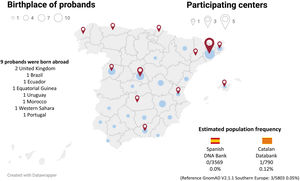
Geographical distribution and population frequencyThe birthplace of probands and participating centers is displayed in figure 4. Only 9 probands (12%) were born outside of Spain, while the remaining 66 probands (88%) were born in Spain. The province of birth of 1 participant born in Spain was unknown due to adoption. The overall prevalence of cases was 0.16 per 100 000 inhabitants in Spain, with significant differences between provinces (supplementary data 5 and 6). The prevalence reached 2.3 cases per 100 000 inhabitants in provinces like Cuenca and Salamanca. In contrast, no cases were reported in provinces of the Cantabrian basin (northwestern Spain), despite the participation of 3 centers from this region.

A query to the Spanish National DNA Bank returned no cases among the 3400 participants (prevalence 0.0%), whereas 1 case was identified among 790 participants in the Catalan Biobank GCAT (prevalence 0.12%). This case involved a 64-year-old woman with no previous history of ATTRv.
DISCUSSIONTo our knowledge, this study represents the largest cohort of patients with Val142Ile ATTRv with European ancestry and provides valuable evidence to enhance our current understanding of this disease (figure 5).

Central illustration. Transthyretin amyloidosis with an autosomal dominant inheritance pattern caused by the p.Val142Ile variant has a significant prevalence in Spain, with an increasing number of diagnoses in recent years, mostly in the Mediterranean basin and in patients with European ancestry. Phenotypic features are characterized by late onset, male predominance, and cardiac involvement, although a significant proportion of patients develop neuropathy. CV, cardiovascular; IQR, interquartile range.
First, 66 probands born in Spain were identified, illustrating that the prevalence of Val142Ile ATTRv is significantly higher than previously reported.11,16Figure 1 shows that this is a relatively recent phenomenon, with a marked exponential increase in newly identified cases in recent years. A plausible explanation for this trend is heightened clinical awareness and improved diagnostic tools and algorithms for identifying ATTR cardiomyopathy, which is the predominant phenotype of Val142Ile ATTRv.1,17 If this trend continues in the coming years, it could narrow the gap with p.Val50Met as the most frequent cause of ATTRv in Spain.
Our results also suggest that the prevalence of the variant in the general population ranges between 0.0% and 0.12%, which is in line with previously reported prevalence rates in southern European populations (0.05%, 3/5803) as extracted from GnomAD v2.1.1. As shown in figure 4, the distribution of cases in Spain was not homogeneous. No cases were reported in the Cantabrian basin, whereas most were identified in the Mediterranean basin, suggesting wide regional differences in population frequency.
Regarding the ancestral origin of this variant in the Spanish population, the scattered distribution pattern of probands suggests that the admixture of the current Spanish population is a more plausible explanation than a recent founder effect, which typically clusters in specific regions. Notably, North-West African ancestry in the Spanish population is estimated to reach up to 11% in some regions, mostly due to North African contributions and, to a lesser extent, Sub-Saharan contributions.18,19 Furthermore, the identification of a homozygous, nonconsanguineous proband in our cohort supports the existence of a nonnegligible background population frequency of this variant. This finding may have broader implications for other Mediterranean European countries with known African admixture.19 In addition, a recent study by Aung et al.20 reported a prevalence of 0.02% for this variant in British participants of European ancestry in the UK Biobank cohort (105/444 243), suggesting that its prevalence should not be overlooked in other European countries.
From a clinical perspective, the phenotypic characteristics observed in our cohort were similar to those reported in patients of African ancestry in previous studies. A hallmark of the disease is its late onset, with a median age of onset of 76.0 years [IQR 68.8-78.9] in our cohort, comparable to the median age of 76 [IQR 70-79] reported by Albenque et al.21 Cardiac involvement predominated over neurological involvement, as only one-third of probands had neuropathy at baseline, in agreement with previous findings from the THAOS registry.22
Our study also provides the first evidence of ophthalmologic involvement in this condition, although it was very rare, even with systematic assessment performed in most centers. Regarding clinical prognosis, the follow-up period was marked by a high rate of HF admissions and a median survival of 5 years from diagnosis. This suggests that, despite its late onset, ATTRv Val142Ile cardiomyopathy follows an aggressive course. These findings are consistent with recent work by Chacko et al.,23 which demonstrated more pronounced progression of echocardiographic parameters in these cases compared with wild-type ATTR and ATTRv Thr80Ala subgroups.
Lastly, disease stabilization with Tafamidis was not observed in nearly 40% of cases in our cohort. However, it is notable that most patients were treated with the 20mg dose, as Tafamidis 61mg was not approved in Spain until 2023. At present, Tafamidis 61mg remains the only disease-modifying therapy available for patients with ATTRv cardiomyopathy. However, whether gene silencing therapy should be initiated as a first-line treatment in patients with mixed phenotypes remains a matter of ongoing debate.24
Clinical implicationsThe findings of this study could translate into practical clinical recommendations. First, given that phenotypic expression was almost absent before the age of 50 years, reducing the screening frequency for heterozygous carriers of the Val142Ile variant until the age of 45 years might be advisable, particularly to minimize the use of costly or invasive tests. Furthermore, our findings suggest that the screening for ophthalmologic involvement in these cases has a very low diagnostic yield, supporting its omission unless symptoms appear.
LimitationsThis study has several limitations. As with all retrospective and observational studies, it is prone to selection bias. Additionally, diagnostic procedures and follow-up protocols may vary among participating centers. The ancestral origin of our cohort was inferred from birthplace and self-reported information provided by patients and treating physicians; however, no genetic testing was performed to confirm ancestry. Lastly, the assessment of response to disease-modifying therapies was constrained by the relatively short follow-up period.
CONCLUSIONSOur data demonstrate that ATTRv caused by the p.Val142Ile variant has a notable prevalence in Spain, mostly in the Mediterranean basin and among individuals of European ancestry. The phenotypic characteristics are marked by late onset, male predominance, and cardiac involvement, although a significant proportion of patients also develop neuropathy.
FUNDINGThis work was supported by the William J. McKenna grant for research projects related to cardiovascular genetics by the Spanish Society of Cardiology (SECSCFG-INV-CFG 23/03 to F. de Frutos).
ETHICAL CONSIDERATIONSThe study complies with the ethical principles of the Helsinki Declaration and was approved by the Hospital Universitari de Bellvitge ethics committee (PR115/23). Written informed consent was waived by the committee. Sex and gender have been taken into account in accordance with the SAGER guidelines.
STATEMENT ON THE USE OF ARTIFICIAL INTELLIGENCENo artificial intelligence was used in the preparation of this study.
AUTHORS’ CONTRIBUTIONSF. de Frutos contributed to the study design, funding acquisition, data retrieval, and drafting of the initial manuscript. The remaining authors participated in data collection, reviewed the manuscript, approved the final version, and ensured the integrity of the data.
CONFLICTS OF INTERESTF. de Frutos reports receiving speaking fees from Pfizer and Alnylam. J. González-Costello reports speaking fees from Pfizer, Alnylam, and AstraZeneca. E. González-López reports speaking fees from Pfizer, Eidos, and Alnylam; consulting fees from Pfizer, Akcea, Novo Nordisk, Alnylam, AstraZeneca, and Proclara; and research/educational support to her institution from Pfizer, Eidos, and Alnylam. P. García-Pavía, associate editor of Revista Española de Cardiología, confirms that the journal's editorial procedures to ensure impartial processing of the manuscript have been followed. He reports speaking fees from Pfizer, BridgeBio, Ionis Pharmaceuticals, AstraZeneca, Novo Nordisk, Intellia, and Alnylam Pharmaceuticals; consulting fees from Pfizer, BridgeBio, Bayer, Neuroimmune, Alnylam Pharmaceuticals, AstraZeneca, Novo Nordisk, ATTRalus, Intellia, General Electric, and Alexion; and research/educational support to his institution from Pfizer, BridgeBio, Novo Nordisk, AstraZeneca, Intellia, and Alnylam Pharmaceuticals. E. Villacorta reports speaking fees from Pfizer. C. Tirón reports speaking fees from Pfizer. R. Eiros reports speaking fees from Pfizer, Alnylam, and AstraZeneca. A. García-Álvarez reports speaking fees from Pfizer, Alnylam, and AstraZeneca. T. Ripoll-Vera reports speaking fees from Pfizer and Alnylam, grants from Pfizer, and consultancy fees from Pfizer, Alnylam, and AstraZeneca. S. Ruiz-Bustillo reports speaking fees from Pfizer and AstraZeneca. J. Piqueras-Flores reports speaking fees from Pfizer, AstraZeneca, and Alnylam, and consulting fees from Pfizer. The remaining authors declare no conflicts of interest relevant to the content of this manuscript.
ACKNOWLEDGEMENTSWe thank the CERCA Program/Generalitat de Catalunya for institutional support. We also extend our gratitude to the Spanish National DNA Bank-Carlos III and the Catalan Biobank GCAT for providing access to their databases. We are grateful to Roberto Barriales-Vila and José María Larrañaga from the Complexo Hospitalario Universitario de A Coruña and Rebeca Lorca from the Hospital Universitario Central de Asturias for reviewing their databases. Special thanks to Francesco Mazzarotto from the University of Brescia and Íñigo Olalde from Universidad del País Vasco for their valuable advice regarding ancestry analysis. Additionally, we acknowledge Biobanco La Fe for providing part of the DNA samples from patients included in this study at their hospital. These samples (B.0000723) were processed following standard operating procedures with appropriate approval from the Ethics and Scientific Committees.
- -
ATTRv caused by the p.Val142Ile variant has been widely described in patients with African-American ancestry.
- -
In recent years, several cases of ATTRv due to p.Val142Ile have been described in patients without African ancestry.
- -
This emerging evidence suggests that the p.Val142Ile variant may have a higher global prevalence than previously believed.
- -
Our data show that ATTRv caused by the p.Val142Ile variant has a significant prevalence in Spain, mostly in the Mediterranean basin and in patients of European ancestry.
- -
The phenotypic features are characterized by late onset, a male predominance, and cardiac involvement, although a significant proportion develop neuropathy.