
ISSN: 1885-5857 Impact factor 2025 4.2
Vol. 78. Num. 8.
Pages 707-716 (August 2025)

Original article
Machine learning prediction of in-hospital mortality and external validation in patients with cardiogenic shock: the RESCUE score

Predicción de la mortalidad intrahospitalaria mediante aprendizaje automático y validación externa en pacientes con shock cardiogénico: la escala RESCUE

Ji Hyun ChaaKi Hong ChoibChul-Min AhncCheol Woong YudIk Hyun ParkeWoo Jin JangfHyun-Joong KimgJang-Whan BaehSung Uk KwoniHyun-Jong LeejWang Soo LeekJin-Ok JeonglSang-Don ParkmTaek Kyu ParkbJoo Myung LeebYoung Bin SongbJoo-Yong HahnbSeung-Hyuk ChoibHyeon-Cheol GwonbJeong Hoon Yangab
https://doi.org/10.1016/j.rec.2025.01.003

Options

Supplementary data
Imagen extra
Rev Esp Cardiol. 2025;78:707-16
Abstract
Introduction and objectives

Despite advances in mechanical circulatory support, mortality rates in cardiogenic shock (CS) remain high. A reliable risk stratification system could serve as a valuable guide in the clinical management of patients with CS. This study aimed to develop and externally validate a risk prediction model for in-hospital mortality in CS patients using machine learning (ML) algorithms.

Methods

Data from 1247 patients with all-cause CS in the RESCUE registry (January 2014-December 2018) were analyzed. Key predictive variables were identified using 4 ML algorithms. A risk prediction model, the RESCUE score, was developed using logistic regression based on the selected variables. Internal validation was conducted within the RESCUE registry, and external validation was performed using an independent CS registry of 750 patients.

Results

The 4 ML models identified 7 predictors: age, vasoactive inotropic score, left ventricular ejection fraction, lactic acid level, in-hospital cardiac arrest at presentation, need for continuous renal replacement therapy, and mechanical ventilation. The RESCUE score demonstrated strong predictive performance, with an AUC of 0.86 (95%CI, 0.83-0.88) for in-hospital mortality. Ten-fold internal cross-validation yielded an AUC of 0.86 (95%CI, 0.77-0.95). External validation showed an AUC of 0.80 (95%CI, 0.76-0.84).

Conclusions

Our ML-based risk-scoring system, the RESCUE score, demonstrated excellent predictive performance for in-hospital mortality in all patients with CS, regardless of cause. The system could be a useful and reliable tool to estimate risk stratification of CS in everyday clinical practice. Clinical trial registration: NCT02985008.

Keywords

Cardiogenic shock
Risk stratification
Machine learning
Prognosis
INTRODUCTION

Cardiogenic shock (CS) is a critical condition characterized by severely impaired systemic perfusion due to cardiac pump failure, often leading to multiple organ failure. Despite medical advancements, such as the introduction of various mechanical circulatory support devices, the short-term mortality of CS remains high, ranging from 35% to 40%.1–4 Consequently, effective risk stratification is essential to optimize the use of limited resources and facilities and to improve the prognosis of patients with CS.5,6

Several risk-scoring systems have been developed for CS.7–13 For instance, clinical presentations, management strategies, and biochemical variables were analyzed in the CardShock study and IABP-SHOCK II trial registry, resulting in the creation of the CardShock risk score and the IABP-SHOCK II risk score. While the CardShock risk score was not limited by CS etiology, its applicability was constrained by the small sample size of only 219 CS patients.7 Equally, the IABP-SHOCK II risk score was only applicable to acute myocardial infarction patients and required coronary angiogram results, which were difficult to obtain upon patient arrival.9

Recently, a risk-scoring system was developed and externally validated using data from an all-cause CS cohort in a single-center registry. However, the external validation cohort was outdated, with data collected between 2007 and 2015, and was limited by its reliance on ICD-10-based coding. Additionally, its predictive performance for 30-day mortality was suboptimal.11

Therefore, we aimed to develop a novel risk prediction system with variables extracted by various machine learning (ML) algorithms for in-hospital mortality in all-cause CS patients from a multicenter CS-dedicated registry. Furthermore, we sought to perform internal and external validation in another CS cohort.

METHODSStudy design and patient selection

The RESCUE registry is a multicenter registry of all-cause CS. This registry was used for the development of a novel risk prediction system, the RESCUE score. Patients were enrolled between January 2014 and December 2018. The study design and main results, including clinical characteristics and predictors of in-hospital mortality, have been published previously.14 The inclusion criteria were as follows: a) systolic blood pressure below 90mmHg for 30minutes or the need for inotropes or vasopressors to attain a systolic blood pressure of 90mmHg or above, and b) the presence of pulmonary congestion and signs of organ dysfunction due to malperfusion (altered mental status, cold periphery, oliguria <0.5mL/kg per hour for the previous 6hours, or blood lactate levels above 2 mmol/L).

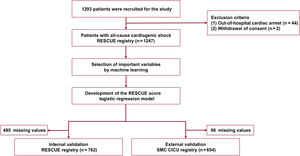
Exclusion criteria consisted of out-of-hospital cardiac arrest and evidence of septic or hypovolemic shock. More detailed information regarding participating centers and prospective and retrospective enrollments in this trial is listed in table 1 of the supplementary data. We also included 750 CS patients who were admitted to the cardiac intensive care unit of Samsung Medical Center (SMC) between January 2011 and December 2020 for external validation. The inclusion and exclusion criteria of the cohort for external validation were the same as those of the RESCUE registry (figure 1).

Figure 1.

Study design flow chart. LASSO, least absolute shrinkage and selection operator analysis; SMC, Samsung Medical Center.

(0.2MB).
Data collection and outcomes

Data were collected using a web-based case record form, with additional information retrieved from medical records or through telephone contact when necessary. Clinical characteristics, laboratory findings, vital signs, and in-hospital management were analyzed as potential predictors. The worst values for left ventricular ejection fraction and lactic acid levels at the time of the index CS event were recorded.

The inotropic score and vasoactive inotropic score were calculated based on the maximal use of vasoactive agents during the first 48hours of shock. These included norepinephrine, milrinone, vasopressin, dopamine, dobutamine, and epinephrine, using the formula proposed by Gaies et al.15 Coronary angiography, percutaneous coronary intervention, mechanical circulatory support, continuous renal replacement therapy, and intubation with mechanical ventilation were performed promptly, based on the patient's condition and at the physician's discretion. The primary outcome of the study was in-hospital mortality.

The RESCUE registry was registered with ClinicalTrials.gov (Retrospective and Prospective Observational Study to Investigate Clinical Outcomes and Efficacy of Left Ventricular Assist Device for Korean Patients With CS, the RESCUE registry, NCT02985008). Ethics approval for the study protocol was obtained from the institutional review board of Samsung Medical Center (No. 2016-03-130, April 6, 2016), with additional approval from each participating hospital. The name and number of the institutional review boards of all participating hospitals and the approval dates are listed in table 2 of the supplementary data. The requirement for written informed consent was waived for retrospectively enrolled patients. However, written informed consent was obtained from prospectively enrolled patients or their legal representatives. All procedures adhered to the ethical standards of the responsible institutional review committees and the principles outlined in the Helsinki Declaration of 1975.

Statistical analysis

Baseline patient characteristics are summarized as numbers and proportions for categorical variables, and as means with standard deviations or medians with interquartile ranges (IQR, 25th–75th percentiles) for continuous variables. Comparisons between survivors and nonsurvivors were conducted using the chi-square or Fisher exact test for categorical variables and the Student t-test for continuous variables.

To develop the RESCUE scoring system, multivariable logistic regression analysis was performed with the variables consistently ranked highly for in-hospital mortality by 4 ML algorithms: a) least absolute shrinkage and selection operator (LASSO) analysis, b) support vector machine, c) random forest classifier, and d) extreme gradient boosting. The RESCUE score was constructed using a regression coefficient-based scoring method that incorporated both linear and polynomial regression models. Since the coefficients represent the log odds of each variable, all variables were standardized to a common scale. Logarithmic transformations were applied to normalize disproportionately distributed variables. After constructing the scoring system, the inverse logit transformation was applied to convert the risk scores from the logistic regression model into predicted probabilities of death.

For internal validation, the study population was randomly divided into 2 groups (training and testing sets) at a ratio of 7:3. Ten-fold cross-validation was performed, while external validation was conducted using an independent CS-dedicated cohort. The discriminative performance of the RESCUE score for predicting in-hospital mortality was evaluated using the area under the curve (AUC) of receiver operating characteristic (ROC) analysis. Calibration plots were used to assess the agreement between predictions of in-hospital mortality and the observed outcome rate for a given predicted risk.

To assess the usefulness of the RESCUE score, conventional univariable and multivariable logistic regression analyses with backward stepwise selection were also performed. The net reclassification index (NRI) was used to compare the AUCs of the RESCUE score and conventional logistic models. Additionally, decision curve analysis was conducted to evaluate the clinical implications of the prediction models.

To handle missing data, the ML models used exclusion, median imputation, κ-nearest neighbor imputation, and bag imputation. In the 4 ML algorithms, there was no difference in the performance of the risk prediction models based on the techniques used for handling missing data, even after repeating the process 10 times. Therefore, we decided to exclude missing data in the development and validation of the scoring system. Data were analyzed using IBM SPSS Statistics for Windows version 20.0 (IBM Corp., United States) and R version 4.2.0 (R Foundation for Statistical Computing, Austria), and P values <.05 were considered statistically significant.

RESULTSStudy population

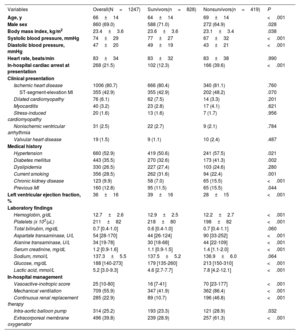
A total of 1247 patients from 12 tertiary centers in Korea were enrolled between January 2014 and December 2018. Of these, 954 patients were retrospectively enrolled, while 293 patients were prospectively enrolled. The baseline clinical and laboratory characteristics of the patients are summarized in table 1. A total of 860 patients (69.0%) were men, the mean age was 66 years, and 419 patients (33.6%) died during the index hospitalization. The primary causes of CS included ischemic heart disease (80.1%), followed by dilated cardiomyopathy (6.1%), myocarditis (3.2%), and arrhythmia (2.5%). Comparison of baseline characteristics stratified by in-hospital mortality revealed that nonsurvivors were older (mean age 69 vs 64 years; P <.001), had lower left ventricular ejection fraction (mean 28% vs 39%; P <.001) and had higher lactic acid levels (mean 7.8 mmol/L vs 4.6 mmol/L; P <.001) and vasoactive inotropic scores (mean 70 vs 16; P <.001). There were no significant differences in the primary causes of CS between survivors and nonsurvivors. Nonsurvivors were more likely to have comorbidities, present with in-hospital cardiac arrest (39.6% vs 12.3%; P <.001), require continuous renal replacement therapy (46.8% vs 10.7%; P <.001), and need mechanical ventilation (86.4% vs 41.9%; P <.001).

Table 1.

Baseline characteristics

Variables  Overall(N=1247)  Survivors(n=828)  Nonsurvivors(n=419)  P 
Age, y  66±14  64±14  69±14  <.001 
Male sex  860 (69.0)  588 (71.0)  272 (64.9)  .028 
Body mass index, kg/m2  23.4±3.6  23.6±3.6  23.1±3.4  .038 
Systolic blood pressure, mmHg  74±29  77±27  67±32  <.001 
Diastolic blood pressure, mmHg  47±20  49±19  43±21  <.001 
Heart rate, beats/min  83±34  83±32  83±38  .990 
In-hospital cardiac arrest at presentation  268 (21.5)  102 (12.3)  166 (39.6)  <.001 
Clinical presentation
Ischemic heart disease  1006 (80.7)  666 (80.4)  340 (81.1)  .760 
ST-segment-elevation MI  355 (42.9)  355 (42.9)  202 (48.2)  .070 
Dilated cardiomyopathy  76 (6.1)  62 (7.5)  14 (3.3)  .201 
Myocarditis  40 (3.2)  23 (2.8)  17 (4.1)  .621 
Stress-induced cardiomyopathy  20 (1.6)  13 (1.6)  7 (1.7)  .956 
Nonischemic ventricular arrhythmia  31 (2.5)  22 (2.7)  9 (2.1)  .784 
Valvular heart disease  19 (1.5)  9 (1.1)  10 (2.4)  .487 
Medical history
Hypertension  660 (52.9)  419 (50.6)  241 (57.5)  .021 
Diabetes mellitus  443 (35.5)  270 (32.6)  173 (41.3)  .002 
Dyslipidemia  330 (26.5)  227 (27.4)  103 (24.6)  .280 
Current smoking  356 (28.5)  262 (31.6)  94 (22.4)  .001 
Chronic kidney disease  123 (9.9)  58 (7.0)  65 (15.5)  <.001 
Previous MI  160 (12.8)  95 (11.5)  65 (15.5)  .044 
Left ventricular ejection fraction, %  36±16  39±16  28±15  <.001 
Laboratory findings
Hemoglobin, g/dL  12.7±2.6  12.9±2.5  12.2±2.7  <.001 
Platelets (x 103/μL)  211±82  218±80  198±82  <.001 
Total bilirubin, mg/dL  0.7 [0.4-1.0]  0.6 [0.4-1.0]  0.7 [0.4-1.1]  .060 
Aspartate transaminase, U/L  54 [28-170]  44 [26-124]  90 [33-252]  <.001 
Alanine transaminase, U/L  34 [19-78]  30 [18-68]  44 [22-109]  <.001 
Serum creatinine, mg/dL  1.2 [0.9-1.6]  1.1 [0.9-1.5]  1.4 [1.1-2.0]  <.001 
Sodium, mmol/L  137.3±5.5  137.5±5.2  136.9±6.0  .064 
Glucose, mg/dL  188 [140-273]  179 [135-260]  213 [150-310]  <.001 
Lactic acid, mmol/L  5.2 [3.0-9.3]  4.6 [2.7-7.7]  7.8 [4.2-12.1]  <.001 
In-hospital management
Vasoactive-inotropic score  25 [10-80]  16 [7-41]  70 [23-177]  <.001 
Mechanical ventilation  709 (55.9)  347 (41.9)  362 (86.4)  <.001 
Continuous renal replacement therapy  285 (22.9)  89 (10.7)  196 (46.8)  <.001 
Intra-aortic balloon pump  314 (25.2)  193 (23.3)  121 (28.9)  .032 
Extracorporeal membrane oxygenator  496 (39.8)  239 (28.9)  257 (61.3)  <.001 

The data are presented as mean±standard deviation, median [Q1-Q3], or as No. (%). MI, myocardial infarction.

Selection of important variables and derivation of the RESCUE score

All the variables listed in table 1 were considered potential predictors. These variables were ranked in order of relative importance by each risk prediction model of the 4 ML algorithms, and the results are shown in figure 1 of the supplementary data. Model performance among the ML algorithms is summarized in figure 2 of the supplementary data. The risk prediction models developed using the ML algorithms demonstrated good predictive performance for in-hospital mortality: the LASSO analysis had an AUC of 0.84 (95% confidence interval [95%CI], 0.81-0.87], the support vector machine an AUC of 0.90 (95%CI, 0.87-0.92), random forest an AUC of 0.98 (95%CI, 0.97-0.99), and extreme gradient boosting an AUC of 0.87 (95%CI, 0.85-0.90).

Among the possible predictors, variables ranked in the top 7 in importance by at least 3 ML models were selected for the final model. The 7 selected variables associated with in-hospital mortality were age, vasoactive inotropic score, left ventricular ejection fraction, lactic acid level, in-hospital cardiac arrest at presentation, continuous renal replacement therapy, and mechanical ventilation.

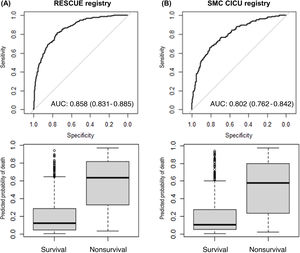
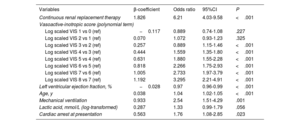
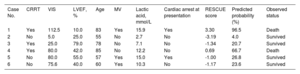
The final multivariable logistic regression model, the RESCUE score, was derived using these selected variables. A detailed description of the model, including the calculation formula, is provided in table 2. Table 3 provides examples of the estimated predictive probabilities of in-hospital mortality derived from the RESCUE score, as well as the observed outcomes in the study population. The RESCUE score showed excellent predictive performance with an AUC of 0.86 (95%CI, 0.83-0.88) for in-hospital mortality, and the box plot showed excellent discrimination power (figure 2).

Table 2.

The RESCUE score derived from multivariate logistic analysis with selected variables using ML algorithms

Variables  β-coefficient  Odds ratio  95%CI  P 
Continuous renal replacement therapy  1.826  6.21  4.03-9.58  <.001 
Vasoactive-inotropic score (polynomial term)
Log scaled VIS 1 vs 0 (ref)  0.117  0.889  0.74-1.08  .227 
Log scaled VIS 2 vs 1 (ref)  0.070  1.072  0.93-1.23  .325 
Log scaled VIS 3 vs 2 (ref)  0.257  0.889  1.15-1.46  <.001 
Log scaled VIS 4 vs 3 (ref)  0.444  1.559  1.35-1.80  <.001 
Log scaled VIS 5 vs 4 (ref)  0.631  1.880  1.55-2.28  <.001 
Log scaled VIS 6 vs 5 (ref)  0.818  2.266  1.75-2.93  <.001 
Log scaled VIS 7 vs 6 (ref)  1.005  2.733  1.97-3.79  <.001 
Log scaled VIS 8 vs 7 (ref)  1.192  3.295  2.21-4.91  <.001 
Left ventricular ejection fraction, %  0.028  0.97  0.96-0.99  <.001 
Age, y  0.038  1.04  1.02-1.05  <.001 
Mechanical ventilation  0.933  2.54  1.51-4.29  .001 
Lactic acid, mmol/L (log-transformed)  0.287  1.33  0.99-1.79  .056 
Cardiac arrest at presentation  0.563  1.76  1.08-2.85  .023 

CI, confidence interval; CPR, in-hospital cardiac arrest at presentation; CRRT, continuous renal replacement therapy; LVEF, left ventricular ejection fraction; ML, machine learning; VIS, vasoactive-inotropic score.

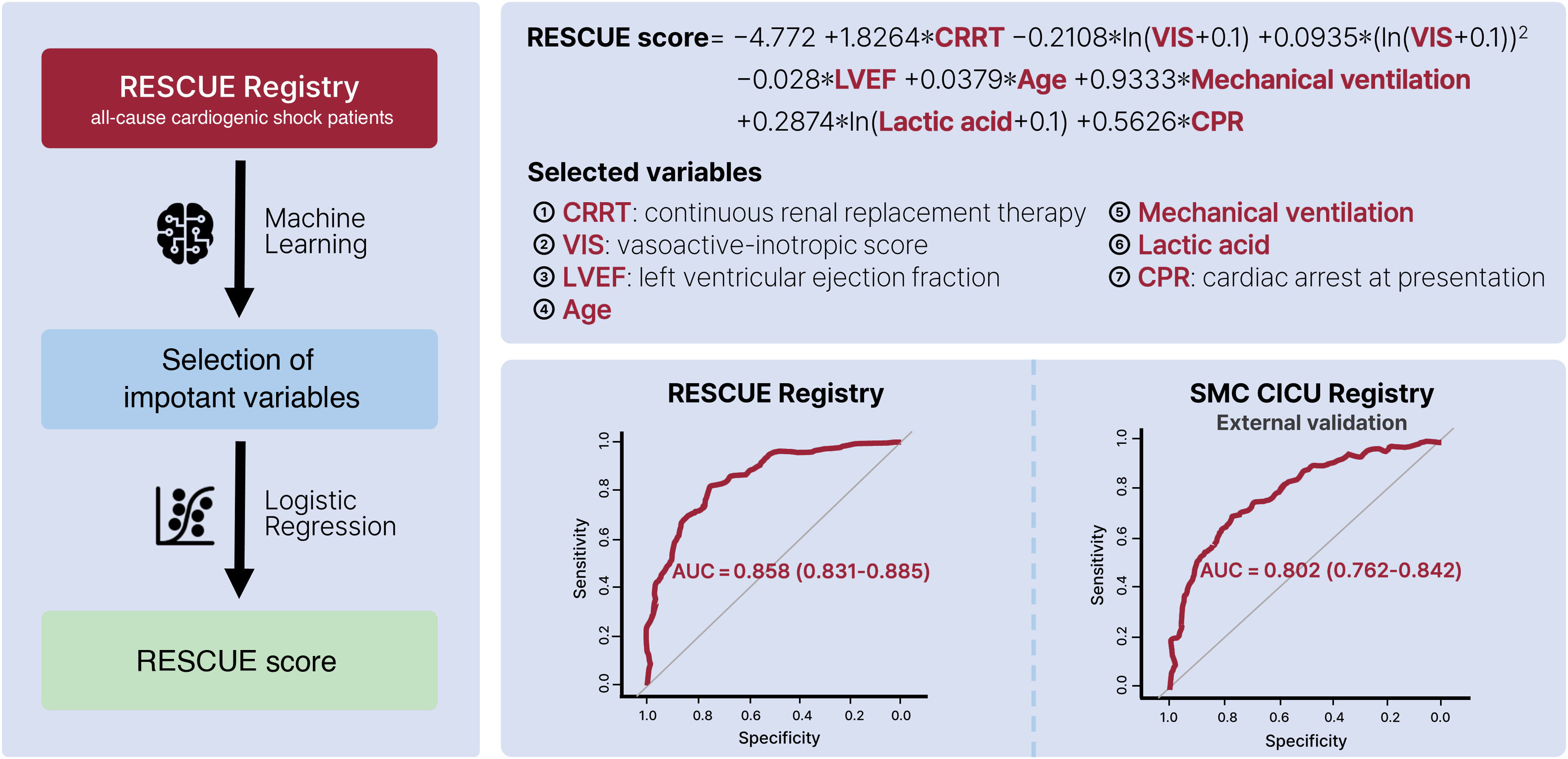
Formula: RESCUE score=-4.772+1.8264*CRRT-0.2108*ln(VIS+0.1)+0.0935*(ln(VIS+0.1))2

−0.028*LVEF+0.0379*Age+0.9333*Mechanical ventilation+0.2874*ln(Lactic acid+0.1)+0.5626*CPR

Predicted probability of death=exp(RESCUE score)/1+exp(RESCUE score).

Table 3.

Estimated predicted probability from the RESCUE score and the observed status from the sample study population

Case No.  CRRT  VIS  LVEF, %  Age  MV  Lactic acid, mmol/L  Cardiac arrest at presentation  RESCUE score  Predicted probability (%)  Observed status 
Yes  112.5  10.0  83  Yes  15.9  Yes  3.30  96.5  Death 
No  5.0  25.0  55  No  2.7  No  -3.19  4.0  Survived 
Yes  25.0  79.0  78  No  7.1  No  -1.34  20.7  Survived 
Yes  80.0  42.0  85  No  12.2  No  0.69  66.7  Death 
No  80.0  55.0  57  Yes  15.0  Yes  -1.00  26.8  Survived 
No  75.6  40.0  60  Yes  10.3  No  -1.17  23.6  Survived 

CRRT, continuous renal replacement therapy; LVEF, left ventricular ejection fraction; MV, mechanical ventilation; VIS, vasoactive-inotropic score.

Figure 2.

The predictive power of the RESCUE score in the RESCUE registry and the SMC CICU registry. The area under the receiver operating characteristic curves and the box plots of the RESCUE score in the RESCUE registry (A) and the Samsung Medical Center (SMC) CICU registry (B).

(0.33MB).

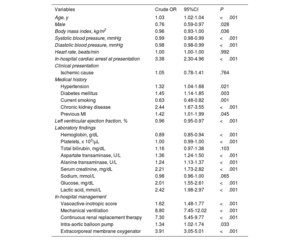
After univariable logistic regression was performed to assess crude odds ratios (table 4), multivariable logistic regression models were developed using 2 approaches. First, a conventional multivariable logistic regression model using backward stepwise selection was performed, constructed with 10 variables, which was more complex than the RESCUE score (figure 3 of the supplementary data). Next, another multivariable logistic regression model was created, limiting the number of variables to match those of the RESCUE score (figure 4 of the supplementary data). The RESCUE score outperformed the secondary logistic regression model, with an NRI of 0.13 (95%CI, 0.05-0.21; P=.002) in the training set and 0.18 (95%CI, 0.08-0.29; P <.001) in the external validation set.

Table 4.

Univariable logistic regression of potential in-hospital mortality predictors

Variables  Crude OR  95%CI  P 
Age, y  1.03  1.02-1.04  <.001 
Male  0.76  0.59-0.97  .028 
Body mass index, kg/m2  0.96  0.93-1.00  .036 
Systolic blood pressure, mmHg  0.99  0.98-0.99  <.001 
Diastolic blood pressure, mmHg  0.98  0.98-0.99  <.001 
Heart rate, beats/min  1.00  1.00-1.00  .992 
In-hospital cardiac arrest at presentation  3.38  2.30-4.96  <.001 
Clinical presentation
Ischemic cause  1.05  0.78-1.41  .764 
Medical history
Hypertension  1.32  1.04-1.68  .021 
Diabetes mellitus  1.45  1.14-1.85  .003 
Current smoking  0.63  0.48-0.82  .001 
Chronic kidney disease  2.44  1.67-3.55  <.001 
Previous MI  1.42  1.01-1.99  .045 
Left ventricular ejection fraction, %  0.96  0.95-0.97  <.001 
Laboratory findings
Hemoglobin, g/dL  0.89  0.85-0.94  <.001 
Platelets, x 103/μL  1.00  0.99-1.00  <.001 
Total bilirubin, mg/dL  1.16  0.97-1.38  .103 
Aspartate transaminase, U/L  1.36  1.24-1.50  <.001 
Alanine transaminase, U/L  1.24  1.13-1.37  <.001 
Serum creatinine, mg/dL  2.21  1.73-2.82  <.001 
Sodium, mmol/L  0.98  0.96-1.00  .065 
Glucose, mg/dL  2.01  1.55-2.61  <.001 
Lactic acid, mmol/L  2.42  1.98-2.97  <.001 
In-hospital management
Vasoactive-inotropic score  1.62  1.48-1.77  <.001 
Mechanical ventilation  8.80  7.45-12.02  <.001 
Continuous renal replacement therapy  7.30  5.45-9.77  <.001 
Intra-aortic balloon pump  1.34  1.02-1.74  .033 
Extracorporeal membrane oxygenator  3.91  3.05-5.01  <.001 

OR, odds ratio; CI, confidence interval; MI, myocardial infarction.

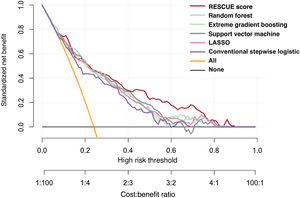
To assess whether the risk prediction models were not only sensitive and accurate but also clinically appropriate, decision curve analysis was performed for all models. The RESCUE score yielded comparable net clinical benefits within a broad range of risk thresholds compared with the other derived prediction models (figure 3), including both ML-derived risk models and the conventional multivariable logistic regression model.

Figure 3.

Decision curves comparing the net benefit of risk prediction models. Decision curves of all models derived in this study. The RESCUE score yielded comparable net clinical benefits among a broad range of risk thresholds to the other derived prediction models. LASSO, least absolute shrinkage and selection operator analysis.

(0.19MB).
Internal and external validation of the RESCUE score

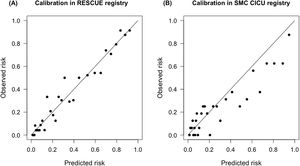
Among the patients in the RESCUE registry, 762 had complete data and served as the internal validation cohort. In this group, the RESCUE score showed good predictive performance, with a 10-fold cross-validated AUC of 0.86 (95%CI, 0.77-0.95). A total of 650 patients with complete data were included in the external validation cohort. External validation also showed excellent predictive performance, with an AUC of 0.80 (95%CI, 0.76-0.84; figure 2). The final model was well calibrated in both the development and external validation cohorts, as evidenced by the calibration plots shown in figure 4. Additionally, we analyzed the predictive power of the RESCUE score in both the training and external validation sets. Subgroups analyses were conducted based on clinical parameters indicative of CS severity, such as the use of extracorporeal membrane oxygenation and the presence of cardiac arrest, as well as the etiology of CS. The overall results were comparable (figure 5 of the supplementary data).

Figure 4.

Calibration plots of the RESCUE score for predicting in-hospital mortality. Calibration plots showing the agreement between the predicted risk of in-hospital mortality and the observed outcome rate for a given predicted risk in the RESCUE registry (A) and the Samsung Medical Center (SMC) CICU registry (B).

(0.17MB).
Figure 5.

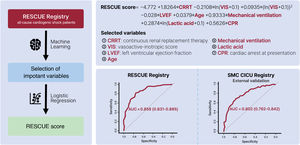
Central illustration. Development and validation of the RESCUE score. The RESCUE score for predicting in-hospital mortality from all-cause cardiogenic shock patients. Variables were extracted by machine learning algorithms and the score demonstrated excellent predictive performance. It was well-validated both internally and externally. SMC, Samsung Medical Center.

(0.42MB).
DISCUSSION

In the present study, we developed a novel risk prediction scoring system for all-cause CS: the RESCUE score. This system was derived from a dedicated CS registry, representing one of the largest multicenter studies on patients with CS, regardless of etiology, and reflects a contemporary CS cohort.14 Clinical variables identified as important predictors of in-hospital all-cause mortality were preselected using several ML algorithms. These variables comprised age, left ventricular ejection fraction, lactic acid level, vasoactive inotropic score, and the need for noncardiac organ support. These factors have been demonstrated as indicators of worse clinical outcomes in previous reports.7,14,16–20 The RESCUE score was constructed using a multivariable logistic regression model incorporating these 7 selected variables. The score demonstrated excellent predictive performance for in-hospital mortality. Furthermore, it was validated both internally and externally using an independent CS-dedicated cohort.

CS is a low cardiac output state that leads to in hypoxia and hypoperfusion and can progress to irreversible multiorgan failure. Despite various attempts to manage CS, including the identification of optimal candidates and timing for the use of mechanical circulatory support devices,3,4 CS remains a life-threatening condition with persistently high mortality rates. It is also resource-intensive, resulting in considerable health care costs.1,21 The Mayo CICU Admission Risk Score (M-CARS) was the first cardiac intensive care unit (CICU)-specific risk score for predicting in-hospital mortality.22,23 Developed using a stepwise backward logistic regression model, M-CARS identified 7 predictors: admission Braden skin score, red blood cell distribution width, blood urea nitrogen, serum anion gap, and the diagnoses of cardiac arrest, shock, and respiratory failure. Although M-CARS demonstrated excellent predictive power, it was designed for all CICU admissions, regardless of whether patients were in shock or the specific etiology of the shock. Furthermore, some of the variables included in M-CARS posed challenges for bedside assessment and routine clinical use.

Several risk stratification tools for CS patients have been proposed. Most existing risk-scoring models,5,6,9 such as the IABP-SHOCK II and the CLIP scores,24 focus on patients with acute myocardial infarction complicated by CS. Both scores also include variables that are not easily obtainable upon a patient's arrival, such as post-percutaneous coronary intervention thrombolysis in myocardial infarction flow and blood biomarkers like cystatin-C and interleukin-6. The CardShock risk score, which included both acute myocardial infarction and nonacute myocardial infarction patients, was derived from a relatively small cohort, limiting its generalizability.7 In addition, the most recent Cardiogenic Shock score has the inherent limitation of an ICD-10 coding-based external validation cohort.11 For patients with advanced CS who required venoarterial extracorporeal membrane oxygenation, the ENCOURAGE score for patients with acute myocardial infarction and the SAVE and PREDICT VA-ECMO scores for all-cause CS patients have been introduced.8,12,13 However, these scores are difficult to apply at all stages of CS and have limited reliability due to inadequate validation.

In this context, we developed the RESCUE score—a novel risk-scoring system for in-hospital mortality applicable to CS patients regardless of etiology. Using logistic regression and variables selected through ML algorithms, the RESCUE score demonstrated excellent predictive performance in both the derivation and external validation cohorts. With its robust explanatory power and generalizability, the RESCUE score may represent a practical tool for risk stratification in all-cause CS patients in clinical practice.

The RESCUE score comprises 7 clinical variables to predict in-hospital mortality. Among these, age, serum lactate level, left ventricular ejection fraction, and in-hospital cardiac arrest at presentation were identified in previous risk-scoring systems and were associated with clinical outcomes.7,9,11 Indicators of acute renal failure, such as creatinine level or glomerular filtration rate, were included in the IABP-SHOCK II and CardShock risk scores and are included as a requirement for continuous renal replacement therapy in the RESCUE score. Several prior studies have consistently demonstrated the association between continuous renal replacement therapy use for acute renal failure and worsening clinical outcomes in CS patients,25–27 and it accounted for the largest beta coefficient in the RESCUE score.

The vasoactive inotropic score of the RESCUE score was a newly selected variable for this CS risk-scoring system. It may have been overlooked as a candidate variable previously due to calculation challenges. Nevertheless, contemporary studies have highlighted that it could be one of the most important prognostic factors in CS patients.14,17,28 Furthermore, the most recent data suggest that a high vasoactive inotropic score is associated with significantly higher in-hospital mortality in CS patients and may indicate an increased risk of mortality.29 Therefore, the inclusion of the vasoactive inotropic score in our model is in agreement with the findings of these prior studies.

Our novel risk-scoring system, characterized by high predictive performance and ease of application, has unique methodological strengths. The risk-scoring scheme of the conventional logistic model was composed of 10 variables, including platelet count and aspartate transaminase levels, but demonstrated only moderate discriminative power in external validation. By contrast, the RESCUE score outperformed the secondary backward stepwise regression model, which used only 7 variables—the same number of variables as the RESCUE score—in predictive power. Previous risk prediction models derived from ML algorithms showed good predictive performance; however, because of the “black box” problem of ML techniques, there was difficulty in understanding how the models process data and generate clinical predictions. In addition, these ML models required numerous variables.30

To overcome these limitations, the BOS,MA2 score used a specialized ML technique, known as the Risk-Calibrated Supersparse Linear Integer Model, which allowed bedside calculation with only 6 variables.31 Unfortunately, it showed only moderate discriminative power in the validation set, and a penalized logistic regression model using the same variables achieved a higher AUC. In this study, we aimed to develop a novel risk prediction scoring system that is not only more efficient than traditional logistic regression models, but also more intuitive and easier to interpret than ML-based models. We used advanced ML techniques solely to prioritize the selection of variables and then constructed the risk prediction model using a traditional logistic regression approach with the selected variables. This approach allowed the RESCUE score to incorporate a relatively small number of variables compared with traditional logistic models, while maintaining competitive predictive power compared with both traditional and ML learning-derived models. Consequently, clinicians can readily calculate the RESCUE score and predict patient risk in real time.

Limitations

There are several limitations to our study. First, most patients in the developmental cohort were enrolled retrospectively. Although the large sample size used to derive the RESCUE score and its external validation enhance its robustness, the possibility of unmeasured confounding factors remains. Second, the etiology of most CS patients in the developmental cohort was ischemic heart disease, with patients with nonischemic causes representing a heterogeneous group, potentially limiting the applicability of the score to these subpopulations. Third, both the developmental and validation cohorts consisted exclusively of East Asian patients, which may limit the generalizability of the findings to other ethnic populations. Fourth, Impella (Abiomed Inc, United States), a mechanical circulatory support device, was not included in this study due to its unavailability in South Korea.

Fifth, despite the recent decrease in in-hospital mortality from all-cause CS,1 the mortality rate in the RESCUE registry is relatively low. This may be partly explained by the potential for selection bias due to difficulties in obtaining informed consent during prospective enrollment, which could contribute to the relatively lower observed mortality rate. Sixth, the observed risk in the validation set appeared slightly lower than the predicted risk among high-risk patients. As the validation cohort was derived from a single center, institutional differences and unmeasured confounding factors may have contributed to the discrepancy in observed in-hospital mortality. Lastly, the RESCUE score was developed using variables collected at the time of hospitalization, making it challenging to account for the dynamic nature of CS and the changing risk of mortality over time. The recently updated SCAI SHOCK stage emphasizes the dynamic progress of CS, in which patients progress or recover over time.32 Future studies are needed to evaluate temporal trends in the RESCUE score through a large-scale, prospective, protocol-based CS registry.

CONCLUSIONS

Our ML-based risk-scoring system, the RESCUE score, demonstrated excellent predictive performance for in-hospital mortality in all-cause CS patients and may be a useful and reliable tool for risk stratification of CS in routine clinical practice.

WHAT IS KNOWN ABOUT THE TOPIC?

  • We analyzed 1247 patients with all-cause cardiogenic shock from the RESCUE registry.

  • Machine learning algorithms identified 7 predictors of in-hospital mortality: age, vasoactive inotropic score, left ventricular ejection fraction, lactic acid level, in-hospital cardiac arrest at presentation, continuous renal replacement therapy, and mechanical ventilation.

  • The RESCUE score demonstrated excellent predictive performance in both internal and external validation cohorts.

WHAT DOES THIS STUDY ADD?

  • The RESCUE score offers notable methodological strengths compared with previous studies.

  • We used advanced machine learning techniques exclusively to prioritize variable selection and then constructed the risk prediction model using a traditional logistic regression approach with the selected variables.

  • This approach allowed the RESCUE score to have fewer variables while maintaining competitive predictive power, enabling clinicians to calculate the score and predict risk in real-time in routine clinical practice.

  • A key distinction is that external validation was performed with a dedicated CS cohort, in which the RESCUE score maintained excellent predictive power.

FUNDING

This work was supported by the Young Medical Scientist Research Grant through the Seokchunnanum Foundation (Project number: SCY2209P).

Ethical considerations

Ethics approval of the study protocol was obtained from the institutional review board of Samsung Medical Center (No. 2016-03-130, April 6, 2016), with additional approval from each participating hospital. Prospectively enrolled patients or their legal representatives gave written informed consent. Procedures were in accordance with the ethical standards of the responsible committee on human experimentation (institutional) and with the Helsinki Declaration of 1975.

STATEMENT ON THE USE OF ARTIFICIAL INTELLIGENCE

None.

AUTHORS’ CONTRIBUTIONS

J. Hyun Cha contributed to the conception, design, analysis, and drafting of the manuscript. J.Hoon Yang contributed to the conception, design, and critical revision of the manuscript. All the other authors contributed to data acquisition, interpretation, and revision. All authors have read and approved the final manuscript.

CONFLICTS OF INTEREST

The authors declare that they have no competing interests.

Acknowledgments

We would like to thank Joong Hyun Ahn, the statistics professional from the Biomedical Statistics Center, Institute of Future Medicine, Samsung Medical Center, Sungkyunkwan University School of Medicine for supporting the statistical analyses.

APPENDIX. SUPPLEMENTARY DATA

Supplementary data associated with this article can be found in the online version, at https://doi.org/10.1016/j.rec.2025.01.003

References
[1]
M. Osman, M. Syed, S. Patibandla, et al.
Fifteen-Year Trends in Incidence of Cardiogenic Shock Hospitalization and In-Hospital Mortality in the United States.
J Am Heart Assoc., (2021), 10 pp. e021061
[2]
I. Taleb, A.G. Koliopoulou, A. Tandar, et al.
Shock Team Approach in Refractory Cardiogenic Shock Requiring Short-Term Mechanical Circulatory Support: A Proof of Concept.
Circulation., (2019), 140 pp. 98-100
[3]
S. van Diepen, J.N. Katz, N.M. Albert, et al.
Contemporary Management of Cardiogenic Shock: A Scientific Statement From the American Heart Association.
Circulation., (2017), 136 pp. e232-e268
[4]
O. Chioncel, J. Parissis, A. Mebazaa, et al.
Epidemiology, pathophysiology and contemporary management of cardiogenic shock - a position statement from the Heart Failure Association of the European Society of Cardiology.
Eur J Heart Fail., (2020), 22 pp. 1315-1341
[5]
A.G. Bhat, S. van Diepen, J.N. Katz, et al.
A Comprehensive Appraisal of Risk Prediction Models for Cardiogenic Shock.
[6]
S. Kalra, L.S. Ranard, S. Memon, et al.
Risk Prediction in Cardiogenic Shock: Current State of Knowledge, Challenges and Opportunities.
J Card Fail., (2021), 27 pp. 1099-1110
[7]
V.P. Harjola, J. Lassus, A. Sionis, et al.
Clinical picture and risk prediction of short-term mortality in cardiogenic shock.
Eur J Heart Fail., (2015), 17 pp. 501-509
[8]
M. Schmidt, A. Burrell, L. Roberts, et al.
Predicting survival after ECMO for refractory cardiogenic shock: the survival after veno-arterial-ECMO (SAVE)-score.
Eur Heart J., (2015), 36 pp. 2246-2256
[9]
J. Poss, J. Koster, G. Fuernau, et al.
Risk Stratification for Patients in Cardiogenic Shock After Acute Myocardial Infarction.
J Am Coll Cardiol., (2017), 69 pp. 1913-1920
[10]
K.H. Choi, J.H. Yang, T.K. Park, et al.
Risk Prediction Model of In-hospital Mortality in Patients With Myocardial Infarction Treated With Venoarterial Extracorporeal Membrane Oxygenation.
Rev Esp Cardiol., (2019), 72 pp. 724-731
[11]
B.N. Beer, J.C. Jentzer, J. Weimann, et al.
Early risk stratification in patients with cardiogenic shock irrespective of the underlying cause - the Cardiogenic Shock Score.
Eur J Heart Fail., (2022), 24 pp. 657-667
[12]
G. Muller, E. Flecher, G. Lebreton, et al.
The ENCOURAGE mortality risk score and analysis of long-term outcomes after VA-ECMO for acute myocardial infarction with cardiogenic shock.
Intensive Care Med., (2016), 42 pp. 370-378
[13]
T. Wengenmayer, D. Duerschmied, E. Graf, et al.
Development and validation of a prognostic model for survival in patients treated with venoarterial extracorporeal membrane oxygenation: the PREDICT VA-ECMO score.
Eur Heart J Acute Cardiovasc Care., (2019), 8 pp. 350-359
[14]
J.H. Yang, K.H. Choi, Y.G. Ko, et al.
Clinical Characteristics and Predictors of In-Hospital Mortality in Patients With Cardiogenic Shock: Results From the RESCUE Registry.
Circ Heart Fail., (2021), 14
[15]
M.G. Gaies, J.G. Gurney, A.H. Yen, et al.
Vasoactive-inotropic score as a predictor of morbidity and mortality in infants after cardiopulmonary bypass.
Pediatr Crit Care Med., (2010), 11 pp. 234-238
[16]
Y. Ueki, M. Mohri, T. Matoba, et al.
Characteristics and Predictors of Mortality in Patients With Cardiovascular Shock in Japan - Results From the Japanese Circulation Society Cardiovascular Shock Registry.
Circ J., (2016), 80 pp. 852-859
[17]
S.J. Na, C.R. Chung, Y.H. Cho, et al.
Vasoactive Inotropic Score as a Predictor of Mortality in Adult Patients With Cardiogenic Shock: Medical Therapy Versus ECMO.
Rev Esp Cardiol., (2019), 72 pp. 40-47
[18]
M. Padkins, T. Breen, N. Anavekar, et al.
Age and shock severity predict mortality in cardiac intensive care unit patients with and without heart failure.
ESC Heart Fail., (2020), 7 pp. 3971-3982
[19]
J.C. Jentzer, B.M. Wiley, N.S. Anavekar, et al.
Noninvasive Hemodynamic Assessment of Shock Severity and Mortality Risk Prediction in the Cardiac Intensive Care Unit.
JACC Cardiovasc Imaging., (2021), 14 pp. 321-332
[20]
M. Padkins, T. Breen, S. Van Diepen, G. Barsness, K. Kashani, J.C. Jentzer.
Incidence and outcomes of acute kidney injury stratified by cardiogenic shock severity.
Catheter Cardiovasc Interv., (2021), 98 pp. 330-340
[21]
S. Vallabhajosyula, S.R. Payne, J.C. Jentzer, et al.
Long-Term Outcomes of Acute Myocardial Infarction With Concomitant Cardiogenic Shock and Cardiac Arrest.
Am J Cardiol., (2020), 133 pp. 15-22
[22]
J.C. Jentzer, N.S. Anavekar, C. Bennett, et al.
Derivation and Validation of a Novel Cardiac Intensive Care Unit Admission Risk Score for Mortality.
J Am Heart Assoc., (2019), 8 pp. e013675
[23]
J.C. Jentzer, X. Rossello.
Past, present, and future of mortality risk scores in the contemporary cardiac intensive care unit.
Eur Heart J Acute Cardiovasc Care., (2021), 10 pp. 940-946
[24]
U. Ceglarek, P. Schellong, M. Rosolowski, et al.
The novel cystatin C, lactate, interleukin-6, and N-terminal pro-B-type natriuretic peptide (CLIP)-based mortality risk score in cardiogenic shock after acute myocardial infarction.
Eur Heart J., (2021), 42 pp. 2344-2352
[25]
M.D. Lauridsen, H. Gammelager, M. Schmidt, et al.
Acute kidney injury treated with renal replacement therapy and 5-year mortality after myocardial infarction-related cardiogenic shock: a nationwide population-based cohort study.
Crit Care., (2015), 19 pp. 452
[26]
A.I. Abadeer, P. Kurlansky, C. Chiuzan, et al.
Importance of stratifying acute kidney injury in cardiogenic shock resuscitated with mechanical circulatory support therapy.
J Thorac Cardiovasc Surg., (2017), 154 pp. 856-864
[27]
O. Adegbala, C. Inampudi, A. Adejumo, et al.
Characteristics and Outcomes of Patients With Cardiogenic Shock Utilizing Hemodialysis for Acute Kidney Injury.
Am J Cardiol., (2019), 123 pp. 1816-1821
[28]
K.H. Choi, J.H. Yang, T.K. Park, et al.
Differential Prognostic Implications of Vasoactive Inotropic Score for Patients With Acute Myocardial Infarction Complicated by Cardiogenic Shock According to Use of Mechanical Circulatory Support.
Crit Care Med., (2021), 49 pp. 770-780
[29]
J.C. Jentzer, P.C. Patel, S. Van Diepen, D.A. Morrow, G.W. Barsness, K.B. Kashani.
Changes in Vasoactive Drug Requirements and Mortality in Cardiac Intensive Care Unit Patients.
[30]
F. Rong, H. Xiang, L. Qian, Y. Xue, K. Ji, R. Yin.
Machine Learning for Prediction of Outcomes in Cardiogenic Shock.
Front Cardiovasc Med., (2022), 9 pp. 849688
[31]
E. Yamga, S. Mantena, D. Rosen, et al.
Optimized Risk Score to Predict Mortality in Patients With Cardiogenic Shock in the Cardiac Intensive Care Unit.
J Am Heart Assoc., (2023), 12 pp. e029232
[32]
S.S. Naidu, D.A. Baran, J.C. Jentzer, et al.
SCAI SHOCK Stage Classification Expert Consensus Update: A Review and Incorporation of Validation Studies.
J Am Coll Cardiol., (2022), 79 pp. 933-946
Copyright © 2025. Sociedad Española de Cardiología