
ISSN: 1885-5857 Impact factor 2024 4.9
Vol. 77. Num. 10.
Pages 878 (October 2024)

Image in cardiology
Rare cause of pulmonary artery obstruction

Causa infrecuente de obstrucción de la arteria pulmonar

Adriana ReptovaFilip KlaucoMonika Kaldararova
https://doi.org/10.1016/j.rec.2024.03.008

Options

Imagen extra
Rev Esp Cardiol. 2024;77:878

A 51-year-old man with weight loss and progressive dyspnea was diagnosed with acute but hemodynamically stable pulmonary embolism (PE), right ventricular (RV) pressure overload, and a thrombus in the proximal main pulmonary artery (PA) on computed tomography (CT) at a regional hospital. After undergoing a standard 3-month anticoagulation protocol, he was admitted to our department with suspicion of chronic thromboembolic pulmonary hypertension.

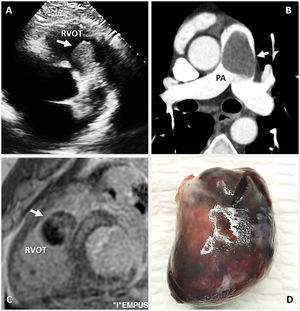
Echocardiography confirmed severe RV pressure overload and dysfunction, and revealed a pedunculated, highly mobile mass (34 x 38 x 53 mm) in the RV outflow tract (RVOT), which prolapsed into the PA during systole, causing severe obstruction (figure 1A, arrow). CT pulmonary angiography ruled out PE/chronic thromboembolic pulmonary hypertension but identified a homogenous structure with well-defined borders, which was mobile between RVOT and PA (figure 1B, arrow). Magnetic resonance imaging confirmed the localization, stalk insertion, and functional impact, identifing the mass as a soft-tissue tumor with myxoma characteristics (low signal on T1-weighted sequences, higher signal intensity on T2, limited enhancement on first-pass perfusion sequences, and heterogeneous enhancement on late gadolinium enhancement sequences [figure 1C, arrow]), allowing us to rule out thrombus. The patient underwent urgent surgical tumor extirpation (figure 1D). Histological analysis confirmed myxoma. After surgery, the patient's symptoms resolved.

Figure 1
(0.44MB).

Cardiac myxoma is the most frequent benign cardiac tumor, although RVOT/PA localization is extremely rare. Typical triad findings include constitutional symptoms, embolic events, and obstruction. RVOT/PA localization can mimic PE or cause pulmonary stenosis, as was the case with our patient. Malignant tumors (sarcomas) are more common in this localization, but CT and magnetic resonance imaging did not suggest malignancy in this case; therefore, we did not perform a positron emission tomography scan. Echocardiography is usually the first-line modality in detecting cardiac masses but can sometimes lead to misdiagnosis. Multimodality imaging greatly aids in the differential diagnosis.

FUNDING

None.

ETHICAL CONSIDERATIONS

Informed consent was obtained from the patient for publication of this case.

STATEMENT ON THE USE OF ARTIFICIAL INTELLIGENCE

No artificial intelligence was used in the preparation of this article.

AUTHORS’ CONTRIBUTIONS

The corresponding author confirms that all authors made a substantial contribution to the presented work and authors agree with this statement.

CONFLICTS OF INTEREST

None.

Copyright © 2024. Sociedad Española de Cardiología
Are you a healthcare professional authorized to prescribe or dispense medications?