
ISSN: 1885-5857 Impact factor 2025 4.2
Vol. 78. Num. 7.
Pages 655-657 (July 2025)

Scientific letter
Recurrent chronic thromboembolic pulmonary hypertension following balloon pulmonary angioplasty

Hipertensión pulmonar tromboembólica crónica recurrente tras angioplastia pulmonar con balón

Claudio M. Rivadulla VarelaaIgnacio Fernández HerreroaNicolás Maneiro MelónaFernando Sarnago CebadaaPilar Escribano SubíasabMaite Velázquez Martínab
https://doi.org/10.1016/j.rec.2024.11.019

Options

Imagen extra
Rev Esp Cardiol. 2025;78:655-7
To the Editor,

Approximately 2% to 3% of patients who experience acute pulmonary thromboembolism develop chronic thromboembolic pulmonary hypertension (CTEPH) within the following 2 years.1 The prevalence of CTEPH is estimated at 26 to 38 cases per million population. The prognosis of this condition depends on clinical, analytic, hemodynamic, and imaging parameters, with a 1-year mortality rate of >20% in high-risk patients.1 Pulmonary balloon angioplasty (PBA) is a key treatment in patients who are not candidates for surgery.2 This intervention provides a demonstrated hemodynamic and functional improvement, which, according to some studies, is maintained over medium- and long-term follow-up.3 However, certain clinical situations may predispose to recurrence of the disease despite initially successful PBA. This report describes 2 patients with CTEPH and severe pulmonary hypertension (PH) who underwent successful PBA but experienced disease recurrence with severe resting PH several years after completing treatment.

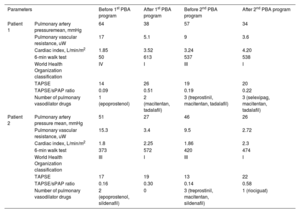
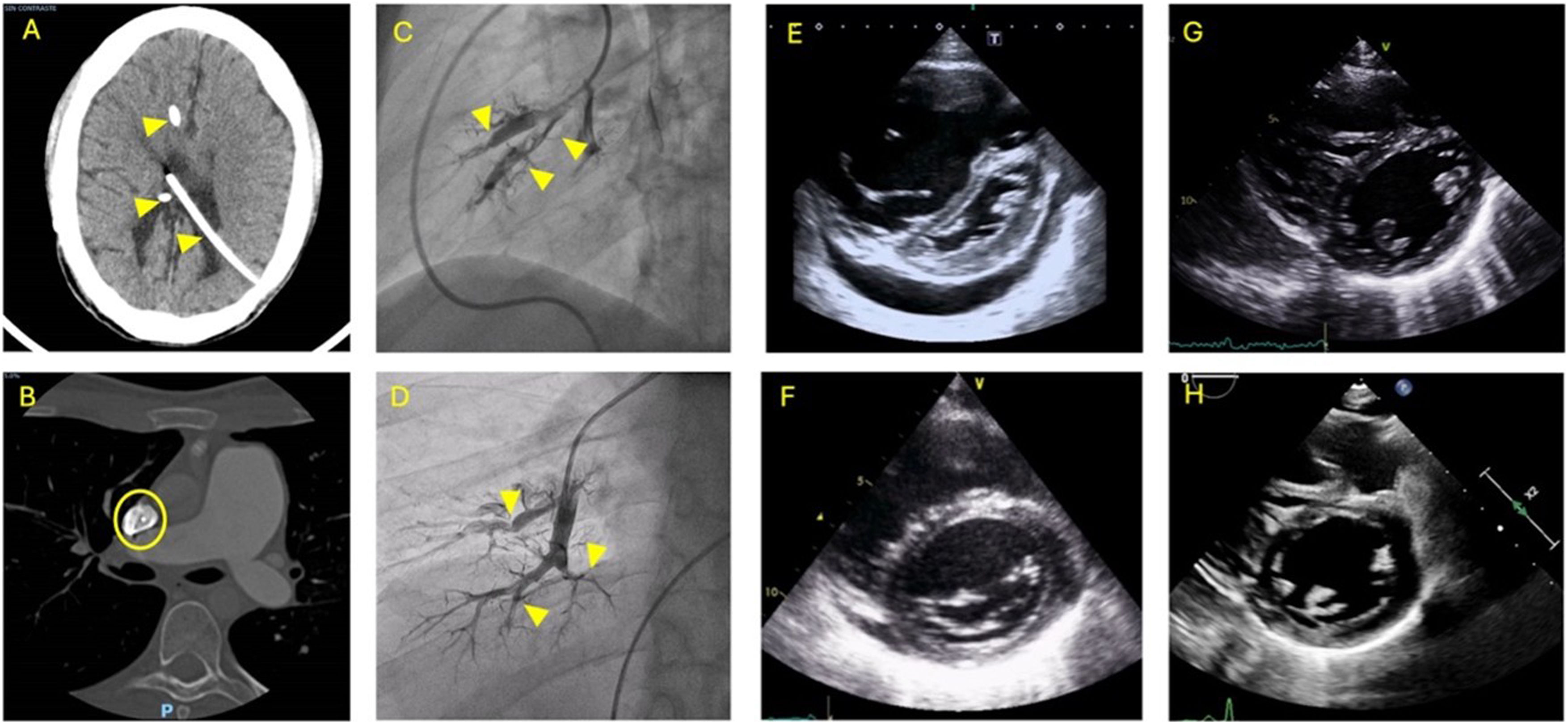
The first case involves a patient with congenital hydrocephalus secondary to stenosis of the aqueduct of Silvius, initially managed with a ventriculoperitoneal shunt, and later with 2 ventriculoatrial shunts (VAS). At the age of 19 years the patient was diagnosed with inoperable CTEPH and underwent 9 PBA procedures, which resulted in a pronounced clinical and hemodynamic improvement (table 1). Three years later, following suboptimal adherence to acenocoumarol anticoagulation therapy, the patient experienced clinical deterioration. Cardiopulmonary exercise testing revealed findings indicative of a poor prognosis: reduced peak VO2 (14.2mL/kg/min, 28% of predicted) and elevated VE/VCO2 ratio (62.7). Pulmonary angiography confirmed rethrombosis of the pulmonary arteries and severe PH (table 1). The case was discussed in a multidisciplinary session. The group decided to repeat PBA and switch from acenocoumarol to edoxaban to ensure proper anticoagulation. The neurosurgery team ruled out the possibility of removing the VAS, the potential embolic source; hence, aspirin was added to the patient's therapy. The improvements achieved after 4 additional PBA procedures are shown in table 1 and figure 1.

Table 1.

Changes in clinical and hemodynamic parameters

ParametersBefore 1st PBA program  After 1st PBA program  Before 2nd PBA program  After 2nd PBA program 
Patient 1Pulmonary artery pressuremean, mmHg  64  38  57  34 
Pulmonary vascular resistance, uW  17  5.1  3.6 
Cardiac index, L/min/m2  1.85  3.52  3.24  4.20 
6-min walk test  50  613  537  538 
World Health Organization classification  IV  III 
TAPSE  14  26  19  20 
TAPSE/sPAP ratio  0.09  0.51  0.19  0.22 
Number of pulmonary vasodilator drugs  1 (epoprostenol)  2 (macitentan, tadalafil)  3 (treprostinil, macitentan, tadalafil)  3 (selexipag, macitentan, tadalafil) 
Patient 2Pulmonary artery pressure mean, mmHg  51  27  46  26 
Pulmonary vascular resistance, uW  15.3  3.4  9.5  2.72 
Cardiac index, L/min/m2  1.8  2.25  1.86  2.3 
6-min walk test  373  572  420  474 
World Health Organization classification  III  III 
TAPSE  17  19  13  22 
TAPSE/sPAP ratio  0.16  0.30  0.14  0.58 
Number of pulmonary vasodilator drugs  2 (epoprostenol, sildenafil)  3 (treprostinil, macitentan, sildenafil)  1 (riociguat) 

PBA, pulmonary balloon angioplasty; sPAP, systolic pulmonary artery pressure; TAPSE, tricuspid annular plane systolic excursion

Figure 1.

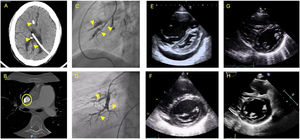
Patient 1. A and B: ventriculoatrial shunt (arrows). C: baseline pulmonary angiography showing distal thrombotic involvement in the middle lobe. D: pulmonary rethrombosis in right lower lobe branches 6 years after PBA. Changes in the right ventricle: baseline echocardiogram (E), after the first PBA program (F), before the second PBA program (G), and after completing the second PBA program (H). PBA, pulmonary balloon angioplasty.

(0.42MB).

The second patient had a posterior fossa brain tumor, which led to the development of hydrocephalus. Surgery and VAS implantation were carried out in infancy. At the age of 27 years, the patient experienced bilateral pulmonary thromboembolism and later developed inoperable CTEPH. Six PBA procedures were performed, resulting in a marked improvement (table 1), and he was discharged with acenocoumarol therapy. Six years later, the patient was reassessed due to clinical deterioration. Recurrence of severe HP was detected (table 1), as well as evidence of pulmonary rethrombosis despite adequate coagulation. Five new PBA sessions were carried out and the neurosurgery team removed the VAS.

Although it has been reported that the hemodynamic and functional results of PBA persist over time,3 the true rate of recurrent CTEPH after PBA is unknown. We present 2 patients with inoperable CTEPH who experienced recurrence years after successful PBA, possibly related to persistent emboli resulting from the VAS. In a recent report,4 13 of 200 patients (6%) who underwent PBA experienced recurrent CTEPH, and 9 of them were treated with new PBA procedures. No predisposing factors were identified. In our experience, the incidence of recurrent HP due to rethrombosis is lower, affecting only 2 of the 197 patients treated with PBA in our center.5

The presence of permanent catheters in the right heart chambers is a known risk factor for CTEPH. In addition, inconsistent anticoagulation may promote rethrombosis, although other factors are usually involved, as it does not occur in all patients with inadequate anticoagulation. While there are no clinical trials comparing direct-acting anticoagulants with non-vitamin K antagonists in CTEPH, the former seem to be linked to higher rates of venous rethrombosis.1 Studies have shown that the combination of low-dose aspirin and vitamin K antagonists (international normalized ratio, 2-3) reduces rethrombosis without increasing major bleeding events in patients with antiphospholipid syndrome.6 This strategy is also used in CTEPH patients with rethrombosis to mitigate the bleeding risk associated with more aggressive anticoagulation regimens. In any case, long-term studies are needed to determine the true recurrence rate of this complication after BPA and precisely identify any predisposing factors. Considering the possibility that VAS could be a risk factor, we recommend close monitoring of patients undergoing this treatment to enable early detection of recurrent CTEPH.

FUNDING

This study did not receive funding from any organization.

ETHICAL CONSIDERATIONS

This study was conducted in accordance with international recommendations for clinical research and was approved by the ethics committee of our center. Informed consent was obtained from the patients and archived. Possible sex and gender biases were not analyzed due to the small sample size.

STATEMENT ON THE USE OF ARTIFICIAL INTELLIGENCE

Artificial intelligence was not used.

AUTHORS’ CONTRIBUTIONS

C.M. Rivadulla Varela contributed to manuscript drafting and data collection. I. Fernández Herrero, N. Maneiro Melón, and F. Sarnago Cebada participated in data collection. P. Escribano Subías contributed to the conception of the manuscript. M. Velázquez Martín contributed to the conception and design of the manuscript. All authors have conducted a critical review of the intellectual content of the manuscript and have given their final approval to the published version. All authors agree to assume responsibility for all aspects of the article and to investigate and resolve any issues related to the accuracy and truthfulness of any part of the study.

CONFLICTS OF INTEREST

None declared.

References
[1]
M. Humbert, G. Kovacs, M.M. Hoeper, et al.
2022 ESC/ERS Guidelines for the Diagnosis and Treatment of Pulmonary Hypertension Developed by the Task Force for the Diagnosis and Treatment of (ESC) and the European Respiratory Society (ERS).
Eur Heart J., (2022), 43 pp. 3618-3731
[2]
M. Velázquez, A. Albarrán, I. Hernández, et al.
Balloon pulmonary angioplasty for inoperable patients with chronic thromboembolic pulmonary hypertension. observational study in a referral unit.
Rev Esp Cardiol., (2019), 72 pp. 224-232
[3]
I.M. Lang, A.K. Andreassen, A. Andersen, et al.
Balloon pulmonary angioplasty for chronic thromboembolic pulmonary hypertension: a clinical consensus statement of the ESC working group on pulmonary circulation and right ventricular function.
Eur Heart J., (2023), 44 pp. 2659-2671
[4]
T.C. Umei, Y. Kishino, T. Kawakami.
Recurrent pulmonary thrombosis after balloon pulmonary angioplasty in chronic thromboembolic pulmonary hypertension.
Eur Heart J., (2022), 43 pp. 3593
[5]
M. Velázquez Martín, A. Gómez Menchero, R. González Ferreiro, A. Andrés Morist, N. Maneiro Melón, P. Escribano Subias.
Expert center and balloon pulmonary angioplasty network program in chronic thromboembolic pulmonary hypertension: safety and effectiveness of a pioneering experience.
Rev Esp Cardiol., (2024), 77 pp. 490-493
[6]
W.G. Jackson, C. Oromendia, O. Unlu, D. Erkan, M.T. DeSancho.
Recurrent thrombosis in patients with antiphospholipid antibodies and arterial thrombosis on antithrombotic therapy.
Blood Adv., (2017), 1 pp. 2320-2324
Copyright © 2024. Sociedad Española de Cardiología