
ISSN: 1885-5857 Impact factor 2025 4.2
Vol. 78. Num. 7.
Pages 580-589 (July 2025)

Original article
Safety and efficacy of antiplatelet therapy in patients with intermediate coronary artery stenosis and deferred revascularization

Seguridad y eficacia del tratamiento antiplaquetario en pacientes con estenosis coronaria intermedia y revascularización diferida

David HongaSeung Hun LeebJihye HeocdDoosup ShineJuhee ChocdEliseo GuallarfHyun Sung JohgHyun Kuk KimhJunho HaaKi Hong ChoiaTaek Kyu ParkaJeong Hoon YangaYoung Bin SongaJoo-Yong HahnaSeung-Hyuk ChoiaHyeon-Cheol GwonaDanbee KangcdJoo Myung Leea
Rev Esp Cardiol. 2025;78:590-110.1016/j.rec.2025.01.019
Jose Antonio Esteban-Chapel, Juan Antonio Franco-Peláez, Alvaro Aceña
https://doi.org/10.1016/j.rec.2024.11.001

Options

Supplementary data
Imagen extra
Rev Esp Cardiol. 2025;78:580-9
Abstract
Introduction and objectives

This study investigated the safety and efficacy of antiplatelet therapy in patients with intermediate coronary artery stenosis who underwent deferred revascularization due to their fractional flow reserve (FFR).

Methods

A nationwide cohort study was conducted using the Korean National Health Insurance Service database. A total of 4657 patients with intermediate coronary artery stenosis who underwent deferred revascularization due to their FFR were identified from 2013 to 2020. FFR was indicated in patients with no prior evidence of myocardial ischemia and intermediate coronary artery stenosis (50%-70%) as determined by quantitative coronary angiography. Patients were classified according to whether antiplatelet therapy was initiated after the index procedure. The primary efficacy outcome was major adverse cardiac and cerebrovascular events (MACCE), a composite of all-cause death, myocardial infarction, unplanned revascularization, and stroke, during a 5-year follow-up period. The primary safety outcome was any gastrointestinal bleeding.

Results

After propensity score matching, there were 1634 patients in the antiplatelet therapy group and 1634 in the nonantiplatelet therapy group. The risk of MACCE was similar between the 2 groups (24.8% vs 24.7%; adjusted HR, 0.97; 95%CI, 0.84-1.13; P=0.745). The risk of gastrointestinal bleeding was higher in the antiplatelet therapy group than in the nonantiplatelet therapy group (2.2% vs 1.2%; aHR, 2.07; 95%CI, 1.08-4.00). These results were similar in subgroup analyses.

Conclusions

In patients with intermediate coronary artery stenosis who underwent deferred revascularization due to their FFR, antiplatelet therapy may increase the risk of gastrointestinal bleeding without reducing the risk of future ischemic events.

Keywords

Intermediate coronary artery stenosis
Antiplatelet therapy
Fractional flow reserve
Prognosis
INTRODUCTION

Guidelines support the use of fractional flow reserve (FFR) to guide the revascularization of intermediate coronary artery stenosis as a Class IA recommendation.1,2 After revascularization, guideline-directed medical treatment with antiplatelet agents is essential for secondary prevention.3 However, it is unclear whether antiplatelet therapy is required after deferral of revascularization based on FFR in patients with intermediate coronary artery stenosis.1–3These patients have similar anatomic disease severity and a nonnegligible risk of ischemic events compared with those who undergo revascularization. In the Fractional Flow Reserve versus Angiography for Multivessel Evaluation 2 (FAME 2) trial, the cumulative incidence of death, myocardial infarction (MI), and unplanned revascularization was approximately 6.8% at 1 year and 15.7% at 5 years in patients with deferred revascularization based on negative FFR.4,5 Similarly, patients with anatomically or functionally nonobstructive coronary artery disease (CAD) have a higher incidence of death, MI, and revascularization than those without apparent CAD.6,7

Although previous trials have shown a limited net clinical benefit of aspirin therapy for primary prevention in patients of older age, with diabetes mellitus, or at moderate risk of cardiovascular disease,8–10 these trials selected eligible patients based on clinical risk factors, and it is unclear whether these results can be applied to patients with established CAD but deferred revascularization. Therefore, using a nationwide cohort, we aimed to evaluate the safety and efficacy of antiplatelet therapy in patients with intermediate coronary artery stenosis whose revascularization was deferred based on FFR.

METHODSStudy design and data sources

This study was a nationwide cohort study using the National Health Claims database, established by the National Health Insurance Service (NHIS) of Korea. The NHIS database represents the entire population of South Korea,11 and all citizens are consecutively enrolled unless they are ineligible due to emigration or death. This database contains comprehensive information on health care utilization in Korea, including diagnoses, prescriptions, and surgical procedures. Therefore, it provides detailed data on personal characteristics and health care utilization based on reimbursed claims for inpatient, outpatient, and emergency department visits. This study was approved by the Institutional Review Board of Samsung Medical Center. Informed consent was waived as deidentified data were used.

Study participants

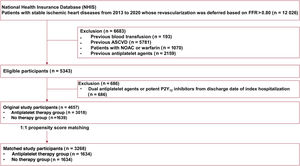
From 2013 to 2020, the use of FFR was reimbursed by NHIS if the patients met the following criteria: a) 50%-70% intermediate stenosis on quantitative coronary angiography in a vessel greater than 2.5mm in diameter and b) no prior evidence of inducible myocardial ischemia on noninvasive tests. The current study included participants in whom FFR use was reimbursed based on these criteria, but whose revascularization was deferred between 2013 and 2020 (n=12 026). To include only patients with intermediate coronary artery stenosis, we excluded cases reimbursed after the 2021 expansion of the criteria from 50%-70% to 50%-90% stenosis. Exclusion criteria consisted of patients with a prior history of any bleeding requiring blood transfusion (n=193), atherosclerotic cardiovascular disease (ASCVD, n=5781), or those already on nonvitamin K antagonist oral anticoagulants (NOAC) or warfarin (n=1070), and patients taking any antiplatelet agents between 30 days and 365 days before the index admission (n=2159). Since participants could meet more than 1 exclusion criterion, we excluded 6683 patients. Among the remaining patients, those who received dual antiplatelet agents or potent P2Y12 inhibitors at discharge (n=686) were also excluded.

Consequently, the final analysis included 4,657 patients. Patients prescribed any antiplatelet agents from discharge and who maintained use for more than 365 days were classified into the antiplatelet therapy group, while the remaining patients comprised the no-therapy group (figure 1).

Figure 1.

Study Flow. This study was a nationwide cohort study of the National Health Claims database established by the National Health Insurance Service (NHIS) of Korea. The NHIS database represents the entire population of South Korea, and all citizens are consecutively enrolled unless they are ineligible due to emigration or death. Among the 4657 eligible patients, 3018 were prescribed antiplatelet agents from the discharge date of the index hospitalization and 1639 were not. After propensity score matching, a total of 3268 patients were included in the current analysis (1634 pairs according to the use of antiplatelet agents). ASCVD, atherosclerotic cardiovascular disease; FFR, fractional flow reserve; NOAC, nonvitamin K antagonist oral anticoagulants; NHIS, National Health Insurance Database.

(0.33MB).
Data collection and measurements

The NHIS database contains data on diagnoses, procedures, length of hospitalization, and prescribed medications, including prescription duration, dosage, route of administration, and costs. All procedures and prescriptions are coded using the Anatomical Therapeutic Chemical Classification system and domestic codes. Diagnoses are coded according to the Korean Standard Classification of Diseases, 7th revision, and a modified version of the International Classification of Diseases, 10th revision (ICD-10). The NHIS routinely audits claims data, which is considered reliable and has been used in multiple previous publications.12,13

Baseline characteristics included age, sex, health behaviors, and comorbidities. Data on income at the time of the first screening examination were obtained from the insurance eligibility database, with income levels categorized as medical aid or not. Residential area at the first screening examination was classified as metropolitan or rural. Health behaviors and laboratory tests were obtained from the national health screening examination database, reflecting the most recent data within 4 years prior to the index hospitalization with FFR measurement. Information on smoking, drinking frequency, and alcohol consumption was also collected via self-administered questionnaires during the national health screening examination. Current alcohol intake (g/d) was calculated based on the frequency of drinking (times per week) and amount of alcohol per occasion, as reported in self-administered questionnairesat the health screening examinations. Heavy alcohol consumption was defined as ≥40g/d in women and ≥60g/d in men.

Comorbidities—including hypertension, diabetes mellitus, dyslipidemia, chronic kidney disease, liver cirrhosis, cancer, and anemia—were identified by diagnosis codes, prescription records, and inpatient and/or outpatient visits within 1 year before the index hospitalization with FFR measurement (table 1 of the supplementary data). Concomitant medications included nonsteroidal anti-inflammatory drugs (NSAIDs), steroids, proton pump inhibitors, and H2 blockers. Long-term use of NSAIDs and steroids was defined as prescription of these medications for at least 90 and 30 days, respectively, between 180 days prior to and 14 days after the index hospitalization. Concomitant use of proton pump inhibitors and H2 blockers was defined as prescription as discharge medication.

Clinical outcomes

The primary efficacy outcome was major adverse cardiac and cerebrovascular events (MACCE), defined as a composite of all-cause death, MI, unplanned revascularization, and stroke. Vital status and cause of death were obtained from death certificates collected by Statistics Korea at the Ministry of Strategy and Finance of South Korea.12 The diagnosis of MI was made if patients were hospitalized with primary diagnostic codes related to MI (ICD-10 I21, I22) during the follow-up period. A previous validation study found that the accuracy of MI diagnosis in NHIS data was 93%.14 Unplanned revascularization was defined as the presence of procedure codes for percutaneous coronary intervention (PCI) or coronary artery bypass grafting (CABG) following the index hospitalization. Stroke was defined based on ICD codes for ischemic stroke (ICD-10 I63, I64) or intracranial hemorrhage (ICD-10 I60-62), in conjunction with codes for diagnostic brain imaging, such as magnetic resonance imaging or perfusion computed tomography. The secondary efficacy outcomes consisted of individual components of MACCE and major adverse cardiac event (MACE), a composite of all-cause death, MI, and unplanned revascularization.

The primary safety outcome was any gastrointestinal bleeding, regardless of the need for transfusion. Secondary safety outcomes were major bleeding, defined as a composite of intracranial bleeding or gastrointestinal bleeding with documented transfusion, gastrointestinal bleeding necessitating hospitalization without documented transfusion, and intracranial hemorrhage. The diagnostic codes in the primary position during hospitalization showed a positive predictive value of 92% for gastrointestinal bleeding and 81.4% for intracranial bleeding, as documented by diagnostic brain imaging.15

Statistical analysis

Baseline characteristics of the exposed and comparator groups are expressed as frequencies with proportions for categorical variables and as means with standard deviations for continuous variables. The propensity score was estimated for each emulated cohort to minimize systematic differences in baseline characteristics between the 2 groups. All covariates, including age, sex, income, medical aid, residential area, comorbidities, and long-term NSAID or steroid use, were included in the logistic regression model to estimate the probability of receiving treatment, conditional on these covariates. To further minimize bias, we implemented a 1:1 propensity score nearest-neighbor matching with a caliper of 0.2 on the propensity score scale.16 Differences in baseline covariates between the 2 groups were evaluated before and after propensity score matching using an absolute standardized difference, with a value of >0.2 indicating a significant difference.16 In addition, an inverse probability treatment weighting was performed using all eligible participants in the current study as a sensitivity analysis.

An intention-to-treat approach was implemented to investigate the efficacy of the randomly assigned treatment, regardless of treatment adherence. To mimic this approach, patients were followed up from the discharge date of the index hospitalization until the occurrence of a clinical outcome or a prespecified time interval (1 year and 5 years). Within the matched cohort, the 1- and 5-year cumulative incidence of each clinical outcome was estimated using the Kaplan-Meier method, with log-rank tests used to evaluate differences between groups. We calculated hazard ratios (HRs) with 95% confidence intervals (95%CIs) for the incidence of clinical outcomes using the Cox regression model, adjusting for discharge medications, including proton pump inhibitor/H2 blockers. When comparing 3 groups according to the use of antiplatelet agents (none, aspirin, or clopidogrel), all baseline covariates and discharge medications were adjusted. The proportional hazards assumption was evaluated using plots of the log-log survival function and Schoenfeld residuals.

To adjust for possible allocation bias, subgroup analyses were conducted by age (age <75 vs ≥75 years), sex, hypertension, diabetes, dyslipidemia, use of statins, high bleeding risk (defined according to the Academic Research Consortium for High Bleeding Risk [ARC-HBR]),17 and type of hospital. There were no missing variables in any of the analyses. All analyses were conducted using SAS Enterprise Guide (version 7.1; SAS Institute Inc., Cary, USA) and R (version 4.1.2; R Foundation for Statistical Computing, Vienna, Austria). A 2-tailed P value <.05 was considered statistically significant.

RESULTSPatient population

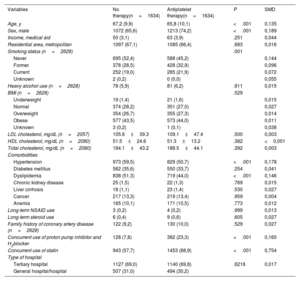
Baseline characteristics, including comorbidities, medication history, and procedural information for the study cohorts before and after propensity score matching, are presented in table 2 of the supplementary data and table 1, respectively. Of the 4657 eligible patients, 3018 were prescribed antiplatelet agents at discharge (antiplatelet therapy group), while 1639 were not (no therapy group). After propensity score matching, 3268 patients were included in the analysis (1634 in each group). Among those receiving antiplatelet therapy, 1281 were treated with aspirin and 353 with clopidogrel (table 3 of the supplementary data).

Table 1.

Baseline characteristics of the study population after propensity score matching

Variables  No therapy(n=1634)  Antiplatelet therapy(n=1634)  P  SMD 
Age, y  67,2 (9,9)  65,8 (10,1)  <.001  0,135 
Sex, male  1072 (65,6)  1213 (74,2)  <.001  0,189 
Income, medical aid  50 (3,1)  63 (3,9)  .251  0,044 
Residential area, metropolitan  1097 (67,1)  1085 (66,4)  .683  0,016 
Smoking status (n=2628)      .001   
Never  695 (52,4)  588 (45,2)    0,144 
Former  378 (28,5)  428 (32,9)    0,096 
Current  252 (19,0)  285 (21,9)    0,072 
Unknown  2 (0,2)  0 (0,0)    0,055 
Heavy alcohol use (n=2628)  78 (5,9)  81 (6,2)  .811  0,015 
BMI (n=2628)      .529   
Underweight  19 (1,4)  21 (1,6)    0,015 
Normal  374 (28,2)  351 (27,0)    0,027 
Overweight  354 (26,7)  355 (27,3)    0,014 
Obese  577 (43,5)  573 (44,0)    0,011 
Unknown  3 (0,2)  1 (0,1)    0,038 
LDL cholesterol, mg/dL (n=2057)  105.6±39.3  109.1±47.4  .500  0,003 
HDL cholesterol, mg/dL (n=2080)  51.5±24.6  51.3±13.2  .382  <0,001 
Total cholesterol, mg/dL (n=2080)  184.1±43.2  188.5±44.1  .392  0,003 
Comorbidities         
Hypertension  973 (59,5)  829 (50,7)  <.001  0,178 
Diabetes mellitus  582 (35,6)  550 (33,7)  .254  0,041 
Dyslipidemia  838 (51,3)  719 (44,0)  <.001  0,146 
Chronic kidney disease  25 (1,5)  22 (1,3)  .769  0,015 
Liver cirrhosis  18 (1,1)  23 (1,4)  .530  0,027 
Cancer  217 (13,3)  219 (13,4)  .959  0,004 
Anemia  165 (10,1)  171 (10,5)  .773  0,012 
Long-term NSAID use  3 (0,2)  4 (0,2)  .999  0,013 
Long-term steroid use  6 (0,4)  9 (0,6)  .605  0,027 
Family history of coronary artery disease (n=2628)  122 (9,2)  130 (10,0)  .529  0,027 
Concurrent use of proton pump inhibitor and H2blocker  128 (7,8)  382 (23,3)  <.001  0,160 
Concurrent use of statin  943 (57,7)  1453 (88,9)  <.001  0,754 
Type of hospital         
Tertiary hospital  1127 (69,0)  1140 (69,8)  .6218  0,017 
General hospital/hospital  507 (31,0)  494 (30,2)     

BMI, body mass index; HDL, high density lipoprotein; LDL, low density lipoprotein; NSAID, nonsteroidal anti-inflammatory drug; SMD, standardized mean difference.

Values were presented No. (%) or mean±standard deviation.

No significant differences were found in baseline characteristics, comorbidities, or medication history between the antiplatelet therapy and no therapy groups (all standardized mean differences <0.2) (table 1 and table 2 of the supplementary data). Likewise, no significant differences were found in baseline characteristics among the aspirin, clopidogrel, and no therapy groups (table 3 of the supplementary data). The average treatment duration was 458.2 days in antiplatelet therapy group.

Efficacy outcomes

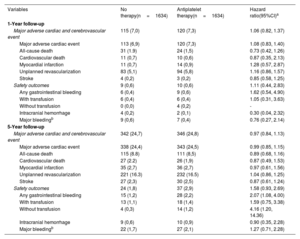
During the 1-year follow-up, 235 MACCE events occurred: 115 in the no therapy group and 120 in the antiplatelet therapy group, with incidence rates of 7.0% and 7.3%, respectively (HR, 1.06; 95%CI, 0.82-1.37) (table 2).

Table 2.

Comparisons of clinical outcomes

Variables  No therapy(n=1634)  Antiplatelet therapy(n=1634)  Hazard ratio(95%CI)a 
1-Year follow-up       
Major adverse cardiac and cerebrovascular event  115 (7,0)  120 (7,3)  1.06 (0.82, 1.37) 
Major adverse cardiac event  113 (6,9)  120 (7,3)  1.08 (0.83, 1.40) 
All-cause death  31 (1.9)  24 (1,5)  0.73 (0.42, 1.26) 
Cardiovascular death  11 (0,7)  10 (0,6)  0.87 (0.35, 2.13) 
Myocardial infarction  11 (0,7)  14 (0,9)  1.28 (0.57, 2.87) 
Unplanned revascularization  83 (5,1)  94 (5,8)  1.16 (0.86, 1.57) 
Stroke  4 (0,2)  3 (0,2)  0.85 (0.58, 1.25) 
Safety outcomes  9 (0,6)  10 (0,6)  1.11 (0.44, 2.83) 
Any gastrointestinal bleeding  6 (0,4)  9 (0,6)  1.62 (0.54, 4.90) 
With transfusion  6 (0,4)  6 (0,4)  1.05 (0.31, 3.63) 
Without transfusion  0 (0,0)  4 (0,2) 
Intracranial hemorrhage  4 (0,2)  2 (0,1)  0.30 (0.04, 2.32) 
Major bleedingb  9 (0,6)  7 (0,4)  0.76 (0.27, 2.14) 
5-Year follow-up       
Major adverse cardiac and cerebrovascular event  342 (24,7)  346 (24,8)  0.97 (0.84, 1.13) 
Major adverse cardiac event  338 (24,4)  343 (24,5)  0.99 (0.85, 1.15) 
All-cause death  115 (8.8)  111 (8,5)  0.89 (0.68, 1.16) 
Cardiovascular death  27 (2.2)  26 (1,9)  0.87 (0.49, 1.53) 
Myocardial infarction  35 (2,7)  36 (2,7)  0.97 (0.61, 1.56) 
Unplanned revascularization  221 (16.3)  232 (16.5)  1.04 (0.86, 1.25) 
Stroke  27 (2,3)  30 (2,5)  0.87 (0.61, 1.24) 
Safety outcomes  24 (1,8)  37 (2,9)  1.58 (0.93, 2.69) 
Any gastrointestinal bleeding  15 (1,2)  28 (2,2)  2.07 (1.08, 4.00) 
With transfusion  13 (1,1)  18 (1,4)  1.59 (0.75, 3.38) 
Without transfusion  4 (0,3)  14 (1,2)  4.16 (1.20, 14.36) 
Intracranial hemorrhage  9 (0,6)  10 (0,9)  0.90 (0.35, 2.28) 
Major bleedingb  22 (1,7)  27 (2,1)  1.27 (0.71, 2.28) 

95%CI, 95% confidence interval.

Cumulative incidence of clinical outcomes presented as event number and Kaplan-Meier estimates from the index procedure.

a

Adjusted for discharge medication of proton pump inhibitor/H2 blocker and statin.

b

Major bleeding was defined as a composite of intracranial or gastrointestinal bleeding with documented transfusion.

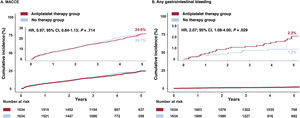
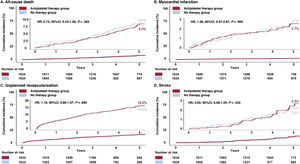
During the 5 years of follow-up, MACCE occurred in 342 patients in the no therapy group and in 346 patients in the antiplatelet therapy group with similar incidence rates of 24.7% and 24.8%, respectively (HR, 0.97; 95%CI, 0.84-1.13) (table 2 and figure 2). No significant differences were observed between groups in the incidence rates of all-cause death (8.8% vs 8.5%; HR, 0.89; 95%CI, 0.68-1.16), cardiovascular death (2.2% vs 1.9%; HR=0.87; 95%CI, 0.49-1.53), MI (2.7% vs 2.7%; HR, 0.97; 95%CI, 0.61-1.56), unplanned revascularization (16.3% vs 16.5%; HR, 1.04; 95%CI, 0.86-1.25), or stroke (2.3% vs 2.5%; HR, 0.87; 95%CI, 0.61-1.24) (table 2 and figure 3). The results from the inverse probability treatment weighting analysis were similar to those from the propensity score matched analysis (table 4 of the supplementary data).

Figure 2.

Cumulative incidence of primary efficacy and safety outcomes. The primary efficacy end point was MACCE which was defined as a composite of all-cause death, myocardial infarction, unplanned revascularization, and stroke. The primary safety outcome was any gastrointestinal bleeding. Hazard ratios were adjusted for discharge medication consisting of proton pump inhibitor/H2 blocker. 95%CI, 95% confidence interval; HR, hazard ratio; MACCE, major adverse cardiac and cerebrovascular events.

(0.28MB).
Figure 3.

Cumulative incidence of secondary efficacy outcomes. Kaplan-Meier curves and cumulative incidences of secondary efficacy outcomes between the none vs antiplatelet agent group regarding (A) all-cause death, (B) myocardial infarction, (C) unplanned revascularization, and (D) stroke (including both ischemic and hemorrhagic stroke). Hazard ratios were adjusted for discharge medication consisting of proton pump inhibitor/H2 blocker. 95%CI, 95% confidence interval; HR, hazard ratio.

(0.48MB).

Compared with the no therapy group, neither the aspirin (HR, 0.94; 95%CI, 0.80-1.11) nor the clopidogrel (HR, 0.99; 95%CI, 0.77-1.27) groups showed significant difference in the cumulative incidence of MACCE during the 5 years of follow-up (table 5 of the supplementary data and figure 1 of the supplementary data).

Safety outcomes

At 1 year, the risk of any bleeding was similar between the antiplatelet therapy and no therapy groups (0.6% vs. 0.6%; HR, 1.11; 95% CI, 0.44-2.83) (table 2), with comparable rates in the aspirin (HR, 1.01; 95% CI, 0.39-2.64) and clopidogrel groups (HR, 0.91; 95%CI, 0.20-4.14) (table 5 of the supplementary data).

However, at 5 years, the antiplatelet therapy group had a significantly higher incidence of gastrointestinal bleeding compared with the no therapy group (1.2% vs 2.2%; HR, 2.07; 95%CI, 1.08-4.00) (table 2 and figure 2). Both the aspirin (HR, 2.03; 95%CI, 1.02-4.05) and clopidogrel groups (HR, 2.56; 95%CI, 0.99-6.64) showed a higher cumulative incidences of gastrointestinal bleeding at 5 years (table 5 of the supplementary data and figure 1 of the supplementary data).

Subgroup analyses

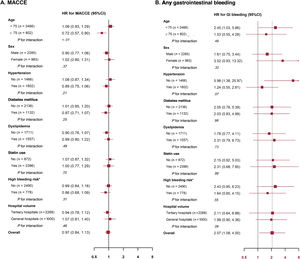
Subgroup analyses showed no apparent trends, except age, favoring the use of antiplatelet agents to prevent MACCE during the 5 years of follow-up. In patients aged ≥75 years, antiplatelet therapy reduced the risk of MACCE compared with no therapy (HR, 0.72; 95%CI, 0.57-0.90), while no benefit was observed in those aged <75 years (HR, 1.09; 95%CI, 0.93-1.29), with a significant interaction (P for interaction <.01) (figure 4). In terms of safety outcomes, the antiplatelet therapy group consistently showed a higher risk of gastrointestinal bleeding among all subgroups (figure 4).

Figure 4.

Subgroup analyses for primary efficacy and safety outcomes at 5 years. Subgroup analyses are shown for (A) MACCE and (B) any gastrointestinal bleeding at 5 years of follow-up. GI, gastrointestinal; HR, hazard ratio; MACCE, major adverse cardiac and cerebrovascular events. *High bleeding risk was defined according to the Academic Research Consortium for High Bleeding Risk (ARC-HBR).

(0.66MB).
DISCUSSION

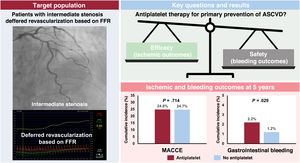
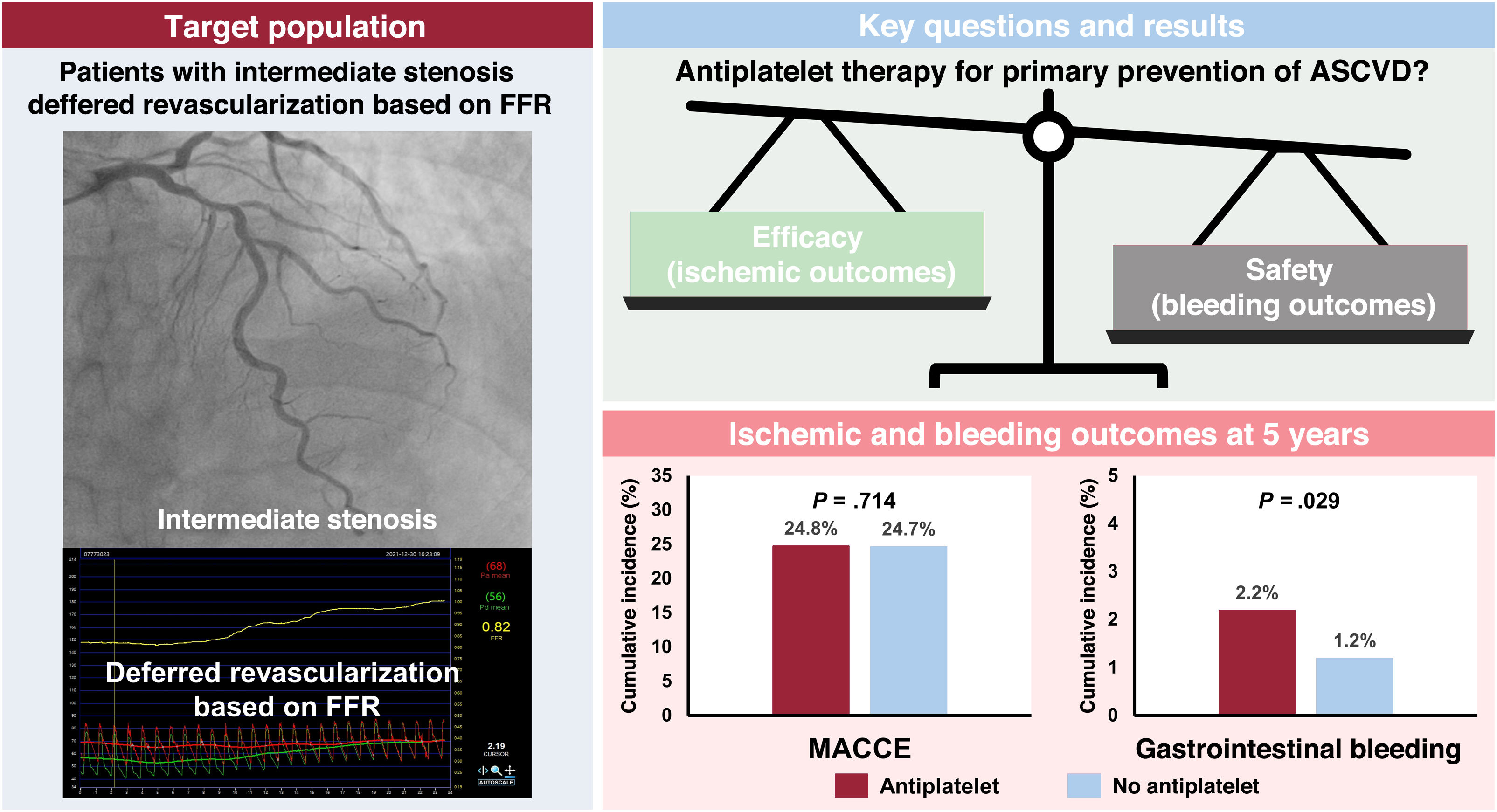
Using a nationwide cohort, the current study investigated whether antiplatelet therapy could be beneficial and safe for patients with intermediate coronary artery stenosis (50%-70%) after deferral of revascularization based on invasive functional testing. In these patients, antiplatelet therapy (either aspirin or clopidogrel) was not associated with a reduced risk of MACCE but was associated with a 2-fold increased risk of gastrointestinal bleeding (figure 5). These results were largely consistent among the various subgroups.

Figure 5.

Central illustration. Antiplatelet agents in patients with intermediate coronary artery stenosis and deferred revascularization. The current study investigated the safety and efficacy of antiplatelet therapy in patients with intermediate coronary artery stenosis whose revascularization was deferred based on FFR. The risk of MACCE was similar between the 2 groups. However, the risk of any gastrointestinal bleeding was higher in the antiplatelet therapy group than in the no therapy group. ASCVD, atherosclerotic cardiovascular disease; FFR, fractional flow reserve; MACCE, major adverse cardiac and cerebrovascular events.

(0.52MB).
Efficacy of antiplatelet agents in preventing ischemic events

Antiplatelet agents have been widely used as part of guideline-directed medical treatment for secondary prevention in patients with established ASCVD.18 In patients undergoing PCI with stent implantation, antiplatelet agents play a pivotal role in preventing stent thrombosis caused by exposed foreign material within the coronary artery until the stent strut is fully re-endothelialized.19 Based on multiple trials showing the benefits of dual antiplatelet therapy immediately after PCI,1–3,20,21 several guidelines recommend it for 6 to 12 months depending on clinical presentation and risk of bleeding, followed by lifelong single antiplatelet therapy.1–3Given that the key pathophysiology of acute coronary syndrome is thrombus formation after plaque rupture, it was expected that antiplatelet therapy would also be effective for primary prevention, especially in patients with cardiovascular risk factors.22 Against this background, numerous trials have been conducted to identify appropriate indications for aspirin in primary prevention. Three representative randomized clinical trials have been published: ASCEND (A Study of Cardiovascular Events in Diabetes), ASPREE (Aspirin in Reducing Events in the Elderly), and ARRIVE (Aspirin to Reduce Risk of Initial Vascular Events). These trials enrolled a total of approximately 47 000 patients with diabetes mellitus, advanced age, or intermediate risk of future ASCVD.8–10 Of these trials, only the ASCEND trial, which enrolled patients with diabetes mellitus, demonstrated a significantly reduced risk of serious vascular events with aspirin compared with placebo. However, in all three trials, including ASCEND, the potential benefits of aspirin were offset by an increased risk of bleeding. Current guidelines, therefore, do not recommend routine aspirin use for primary prevention, advising it only for selected high-ASCVD-risk patients without an excessive bleeding risk.23

Similarly, there have been no specific trials that support the routine use of clopidogrel for primary prevention, although a few studies have evaluated its role as standalone therapy or in combination with aspirin to reduce the risk of ischemic events in different patient populations. In the CAPRIE (Clopidogrel versus Aspirin in Patients at Risk of Ischaemic Events) trial, which enrolled more than 19 000 patients with atherothrombotic events, including recent ischemic stroke, MI, or symptomatic peripheral arterial disease, clopidogrel monotherapy for secondary prevention was superior to aspirin monotherapy in reducing the risk of ischemic events.24 Similar results were also shown by the HOST-EXAM (Aspirin versus clopidogrel for chronic maintenance monotherapy after percutaneous coronary intervention) trial in patients treated with PCI and drug-eluting stent implantation who completed dual antiplatelet therapy for 6 to 18 months after PCI.25 In contrast, the CHARISMA (Clopidogrel for High Atherothrombotic Risk and Ischemic Stabilization, Management, and Avoidance) trial failed to show a benefit of adding clopidogrel to aspirin monotherapy in patients with either clinically evident cardiovascular disease or multiple risk factors.26 In fact, there was a suggestion of harm when the combination therapy was used for primary prevention in high-risk patients with multiple risk factors. These results demonstrate the importance of balancing the potential benefits and harms related to antiplatelet therapy.

Gap of evidence in the management of patients with negative FFR

The DEFER (Deferral versus performance of percutaneous coronary intervention) trial showed that deferring PCI was superior to performing PCI in patients with functionally insignificant stenosis with FFR >0.75.27 However, this result does not mean that patients with FFR-negative lesions are free from future events. In the FAME 2 trial, the cumulative incidence of death, MI, and any revascularization among patients whose revascularization was deferred based on negative FFR was 4.2%, 8.4%, and 17.5%, respectively, suggesting that these patients do not have a benign prognosis.4 Therefore, they may benefit from aggressive medical treatment. However, current guidelines do not specify how to medically treat these patients with deferred revascularization based on FFR, beyond advising against PCI.1–3In this regard, the current study evaluated the benefits of antiplatelet therapy after deferral of revascularization in patients with established CAD. Despite the presence of intermediate coronary stenosis (50%-70%) on invasive coronary angiography, antiplatelet therapy with either aspirin or clopidogrel did not reduce the risk of death or ischemic outcomes but did increase the risk of gastrointestinal bleeding. These results were consistent among the various subgroups, indicating that they can be generalized to the entire population, regardless of sex, comorbidities, or bleeding risk. A significant interaction was only observed in the subgroup analysis by age: a potential benefit of antiplatelet therapy in patients aged 75 or older may suggest that these patients are probably at an even higher risk of future ischemic events, but this should only be regarded as hypothesis-generating and warrants further study. Overall, the results of the current study suggest that antiplatelet agents should not be routinely prescribed in patients with intermediate coronary artery stenosis after deferral of revascularization based on FFR. Rather, an individualized approach based on the patient's ischemic and bleeding risk should be employed.

Future directions

The above findings notwithstanding, continued efforts should focus on reducing the risk of future ischemic events in this high-risk population with established CAD. Statins have already been proven to be effective in lowering clinical events in both primary and secondary prevention.28–30 Their protective effect is further supported by imaging studies showing plaque regression and favorable compositional changes with statin therapy.31 Nevertheless, the optimal dosage of lipid-lowering agents in this population remains unclear. In addition, the ongoing HOST-PREVENTION (Harmonizing Optimal Strategy for Treatment of Coronary Artery Stenosis- CloPidogREl for Primary prevention, NCT05845489) trial will further evaluate the role of clopidogrel monotherapy in patients with clinically insignificant coronary artery stenosis. Future studies should also clarify whether identifying high-risk plaque characteristics by invasive or noninvasive imaging could help to stratify patients who would benefit from more aggressive medical treatment, including antiplatelet therapy.

Limitations

Several limitations of this study should be acknowledged. First, detailed lesion characteristics could not be assessed as the study used an administrative claims database. However, FFR procedures are reimbursed under strict insurance criteria and are routinely audited by the NHIS, providing reasonable assurance that the study population had corresponding lesions and that PCI was not performed in these cases. Second, actual FFR values were unavailable, and we assumed that deferred cases were based on negative FFR. Given that previous multicenter prospective registries in Korea reported deferral rates despite positive FFR of approximately 5.7% (FFR ≤0.75)32 and 9.5% (FFR ≤0.80),7 the influence of deferred revascularization despite positive FFR on these results is likely minimal. Third, although we used propensity score matching, inherent confounding and selection bias could not be completely ruled out. Fourth, despite the large sample size and nationwide cohort data involving over 3000 patients, this study may have been underpowered to detect potential benefits of antiplatelet therapy. Fifth, FFR testing decisions in patients with intermediate stenosis were at the discretion of the treating physician, which could have introduced selection bias.

CONCLUSIONS

In patients with intermediate coronary artery stenosis in whom revascularization was deferred based on FFR, the current data suggest that antiplatelet therapy may not reduce the risk of future ischemic events but is associated with an increased risk of gastrointestinal bleeding. These findings warrant validation in randomized controlled trials.

FUNDING

This study was supported by an unrestricted research grant from the Korean Society of Interventional Cardiology (PHO0221891). The funder had no role in the study design, conduct, data analysis or manuscript preparation.

ETHICAL CONSIDERATIONS

This study was approved by the Institutional Review Board of Samsung Medical Center. Informed consent was waived as deidentified data were used. In addition, we have included statements in the discussion section to clarify that the findings of this study are likely generalizable to both male and female populations.

STATEMENT ON THE USE OF ARTIFICIAL INTELLIGENCE

No artificial intelligence was used in the preparation of this paper.

AUTHORS’ CONTRIBUTIONS

D. Hong, S. Hun Lee, and J. Heo contributed equally as first authors. D. Hong was responsible for the conception and design of the study, data acquisition, data interpretation, and drafting of the manuscript. S.H. Lee contributed to data interpretation and critically revised the manuscript. J. Heo conducted data analysis. D. Kang contributed to data analysis, drafting, and critical revision of the manuscript. J.M. Lee was involved in data interpretation, drafting, and critical revision of the manuscript. All other authors contributed to data interpretation and critical revision of the manuscript. All authors approved the final version for publication.

The guarantors, D. Kang and J.M. Lee, accept full responsibility for the work, study conduct, data access, and decision to publish. The corresponding authors, D. Kang and J.M. Lee, confirm that all listed authors meet the authorship criteria, and no eligible authors have been omitted.

CONFLICTS OF INTEREST

J. Myung Lee received Institutional Research Grants from Abbott Vascular, Boston Scientific, Philips Volcano, Terumo Corporation, Zoll Medical, Donga-ST, the Korean Society of Interventional Cardiology, and Yuhan Pharmaceutical. S. Hun Lee received Institutional Research Grants from Abbott Vascular and the Korean Cardiac Research Foundation. J.-Y. Hahn received an Institutional Research Grant from National Evidence-based Healthcare Collaborating Agency, Ministry of Health & Welfare, Korea, Abbott Vascular, Biosensors, Boston Scientific, Daiichi Sankyo, Donga-ST, Hanmi Pharmaceutical, and Medtronic Inc. H.-C. Gwon received Institutional Research Grants from Boston Scientific, Genoss, and Medtronic Inc. All other authors declare no competing interests.

DATA SHARING

Data sharing is not possible because of Korean government legislation.

WHAT IS KNOWN ABOUT THE TOPIC?

Guidelines strongly support the use of FFR to guide revascularization for intermediate coronary artery stenosis, assigning it a Class IA recommendation. Following revascularization, guideline-directed medical therapy with antiplatelet agents is essential for secondary prevention. However, the need for antiplatelet therapy remains uncertain when revascularization is deferred based on FFR in patients with intermediate coronary artery stenosis.

WHAT DOES THIS STUDY ADD?

This nationwide cohort study investigated the potential benefits and safety of antiplatelet therapy for patients with intermediate coronary artery stenosis (50%–70%) following deferral of revascularization based on invasive functional testing. In this population, antiplatelet therapy was not associated with a reduced risk of ischemic events but was related to an increased risk of gastrointestinal bleeding.

References
[1]
J.S. Lawton, J.E. Tamis-Holland, S. Bangalore, et al.
2021 ACC/AHA/SCAI Guideline for Coronary Artery Revascularization: A Report of the American College of Cardiology/American Heart Association Joint Committee on Clinical Practice Guidelines.
Circulation., (2022), 145 pp. e18-e114
[2]
F.J. Neumann, M. Sousa-Uva, A. Ahlsson, et al.
2018 ESC/EACTS Guidelines on myocardial revascularization.
Eur Heart J., (2019), 40 pp. 87-165
[3]
J. Knuuti, W. Wijns, A. Saraste, et al.
2019 ESC Guidelines for the diagnosis and management of chronic coronary syndromes.
Eur Heart J., (2020), 41 pp. 407-477
[4]
P. Xaplanteris, S. Fournier, N.H.J. Pijls, et al.
Five-Year Outcomes with PCI Guided by Fractional Flow Reserve.
N Engl J Med., (2018), 379 pp. 250-259
[5]
R.V. Parikh, G. Liu, M.E. Plomondon, et al.
Utilization and Outcomes of Measuring Fractional Flow Reserve in Patients With Stable Ischemic Heart Disease.
J Am Coll Cardiol., (2020), 75 pp. 409-419
[6]
T.M. Maddox, M.A. Stanislawski, G.K. Grunwald, et al.
Nonobstructive coronary artery disease and risk of myocardial infarction.
Jama., (2014), 312 pp. 1754-1763
[7]
J.M. Lee, B.K. Koo, E.S. Shin, et al.
Clinical implications of three-vessel fractional flow reserve measurement in patients with coronary artery disease.
Eur Heart J., (2018), 39 pp. 945-951
[8]
L. Bowman, M. Mafham, K. Wallendszus, et al.
Effects of Aspirin for Primary Prevention in Persons with Diabetes Mellitus.
N Engl J Med., (2018), 379 pp. 1529-1539
[9]
J.M. Gaziano, C. Brotons, R. Coppolecchia, et al.
Use of aspirin to reduce risk of initial vascular events in patients at moderate risk of cardiovascular disease (ARRIVE): a randomised, double-blind, placebo-controlled trial.
Lancet., (2018), 392 pp. 1036-1046
[10]
J.J. McNeil, R. Wolfe, R.L. Woods, et al.
Effect of Aspirin on Cardiovascular Events and Bleeding in the Healthy Elderly.
N Engl J Med., (2018), 379 pp. 1509-1518
[11]
D. Kim, Yang propensity score, S.C. You, et al.
Treatment timing and the effects of rhythm control strategy in patients with atrial fibrillation: nationwide cohort study.
BMJ., (2021), 373 pp. n991
[12]
J. Lee, J.S. Lee, S.H. Park, S.A. Shin, K. Kim.
Cohort Profile: The National Health Insurance Service-National Sample Cohort (NHIS-NSC), South Korea.
Int J Epidemiol., (2017), 46 pp. e15
[13]
D.W. Shin, B. Cho, E. Guallar.
Korean National Health Insurance Database.
JAMA Intern Med., (2016), 176 pp. 138
[14]
H. Kim.
Validity of the diagnosis of acute myocardial infarction in Korean national medical health insurance claims data: the Korean Heart Study.
Korean Circ J., (2012), 42 pp. 10-15
[15]
J. Park, S. Kwon, E.-K. Choi, et al.
Validation of diagnostic codes of major clinical outcomes in a National Health Insurance database.
Int J Arrhythmia., (2019), 20 pp. 5
[16]
P.C. Austin.
Optimal caliper widths for propensity-score matching when estimating differences in means and differences in proportions in observational studies.
Pharm Stat., (2011), 10 pp. 150-161
[17]
P. Urban, R. Mehran, R. Colleran, et al.
Defining High Bleeding Risk in Patients Undergoing Percutaneous Coronary Intervention.
Circulation., (2019), 140 pp. 240-261
[18]
G. Marquis-Gravel, M.T. Roe, R.A. Harrington, D. Muñoz, A.F. Hernandez, W.S. Jones.
Revisiting the Role of Aspirin for the Primary Prevention of Cardiovascular Disease.
Circulation., (2019), 140 pp. 1115-1124
[19]
J. Torrado, L. Buckley, A. Durán, et al.
Restenosis, Stent Thrombosis, and Bleeding Complications: Navigating Between Scylla and Charybdis.
J Am Coll Cardiol., (2018), 71 pp. 1676-1695
[20]
S.R. Steinhubl, P.B. Berger, J.T. Mann, 3rd, et al.
Early and sustained dual oral antiplatelet therapy following percutaneous coronary intervention: a randomized controlled trial.
JAMA., (2002), 288 pp. 2411-2420
[21]
H.C. Gwon, J.Y. Hahn, K.W. Park, et al.
Six-month versus 12-month dual antiplatelet therapy after implantation of drug-eluting stents: the Efficacy of Xience/Promus Versus Cypher to Reduce Late Loss After Stenting (EXCELLENT) randomized, multicenter study.
Circulation., (2012), 125 pp. 505-513
[22]
P. Libby.
Mechanisms of acute coronary syndromes and their implications for therapy.
N Engl J Med., (2013), 368 pp. 2004-2013
[23]
D.K. Arnett, R.S. Blumenthal, M.A. Albert, et al.
2019 ACC/AHA Guideline on the Primary Prevention of Cardiovascular Disease: A Report of the American College of Cardiology/American Heart Association Task Force on Clinical Practice Guidelines.
Circulation., (2019), 140 pp. e596-e646
[24]
A randomised, blinded, trial of clopidogrel versus aspirin in patients at risk of ischaemic events (CAPRIE). CAPRIE Steering Committee. Lancet. 1996;348:1329-1339.
[25]
B.K. Koo, J. Kang, K.W. Park, et al.
Aspirin versus clopidogrel for chronic maintenance monotherapy after percutaneous coronary intervention (HOST-EXAM): an investigator-initiated, prospective, randomised, open-label, multicentre trial.
Lancet., (2021), 397 pp. 2487-2496
[26]
D.L. Bhatt, K.A. Fox, W. Hacke, et al.
Clopidogrel and aspirin versus aspirin alone for the prevention of atherothrombotic events.
N Engl J Med., (2006), 354 pp. 1706-1717
[27]
F.M. Zimmermann, A. Ferrara, N.P. Johnson, et al.
Deferral vs performance of percutaneous coronary intervention of functionally non-significant coronary stenosis: 15-year follow-up of the DEFER trial.
Eur Heart J., (2015), 36 pp. 3182-3188
[28]
C.P. Cannon, E. Braunwald, C.H. McCabe, et al.
Intensive versus moderate lipid lowering with statins after acute coronary syndromes.
N Engl J Med., (2004), 350 pp. 1495-1504
[29]
J.C. LaRosa, S.M. Grundy, D.D. Waters, et al.
Intensive lipid lowering with atorvastatin in patients with stable coronary disease.
N Engl J Med., (2005), 352 pp. 1425-1435
[30]
J.J. Brugts, T. Yetgin, S.E. Hoeks, et al.
The benefits of statins in people without established cardiovascular disease but with cardiovascular risk factors: meta-analysis of randomised controlled trials.
BMJ., (2009), 338 pp. b2376
[31]
L.P. Dawson, M. Lum, N. Nerleker, S.J. Nicholls, J. Layland.
Coronary Atherosclerotic Plaque Regression: JACC State-of-the-Art Review.
J Am Coll Cardiol., (2022), 79 pp. 66-82
[32]
J.M. Ahn, D.W. Park, E.S. Shin, et al.
Fractional Flow Reserve and Cardiac Events in Coronary Artery Disease: Data From a Prospective IRIS-FFR Registry (Interventional Cardiology Research Incooperation Society Fractional Flow Reserve).
Circulation., (2017), 135 pp. 2241-2251

D. Hong, S. H. Lee, and J. Heo contributed equally as the first authors.

Copyright © 2024. Sociedad Española de Cardiología