

This report presents updated data on heart transplants in Spain, including procedures carried out in 2024. It reviews trends over the past decade (2015-2024) in donor and recipient characteristics, surgical techniques, immunosuppression strategies, and survival rates.
MethodsData were drawn from the Spanish heart transplant registry, which is updated annually. The analysis includes 347 transplants performed in 2024, as well as procedures from 2015 to 2023 (n=2721).
ResultsIn 2024, the number of heart transplants increased by 6.8% compared with 2023. There were no significant changes in recipient age or sex, but the proportion of urgent transplants rose to 47.0%. Use of circulatory support devices increased, particularly extracorporeal membrane oxygenation. The average donor age showed a slight increase in 2024, although the long-term trend remained downward. Donation after circulatory death accounted for 29.1% of transplants in 2024. One-year survival rates improved, reaching 85.2% for transplants performed between 2021 and 2023.
ConclusionsThe number of heart transplants continued to grow, nearing historic highs, largely due to the expansion of donation after circulatory death. Improved 1-year survival reflects the maturity of transplant programs, advances in surgical and medical management, and better pretransplant conditions in recipients.
Keywords
As has been customary since 1991, the current report presents updated information on the characteristics and outcomes of heart transplant activity in Spain. The document provides data on the procedures performed in 2024 and mainly analyzes the changes over the last 10 years (2015-2024) in the demographic and clinical characteristics of recipients and donors, surgical procedures, immunosuppression strategies, and survival rates.
METHODSPatients and proceduresThe structure and organization of the Spanish heart transplant registry have been summarized in previous reports.1 Participation in this registry requires an obligatory annual report, dated December 31, for the preceding year. This report includes all transplant recipients since the last update and an update on the vital status of all patients in the historic series up to this date, as well as the most relevant clinical events encoded in the database.
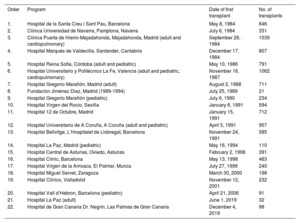
The centers with heart transplant programs are summarized in table 1. One center performs pediatric transplantation alone, while 5 centers conduct both pediatric and adult transplantation. Two centers are accredited to perform cardiopulmonary transplantation. The most recent center was incorporated into the heart transplant program in 2019, and 2 centers have already completed more than 1000 procedures.
Programs participating in the Spanish heart transplant registry from 1984 to 2024 (by order of first transplant performed)
| Order | Program | Date of first transplant | No. of transplants |
|---|---|---|---|
| 1. | Hospital de la Santa Creu i Sant Pau, Barcelona | May 8, 1984 | 646 |
| 2. | Clínica Universidad de Navarra, Pamplona, Navarra | July 6, 1984 | 331 |
| 3. | Clínica Puerta de Hierro-Majadahonda, Majadahonda, Madrid (adult and cardiopulmonary) | September 28, 1984 | 1039 |
| 4. | Hospital Marqués de Valdecilla, Santander, Cantabria | December 17, 1984 | 807 |
| 5. | Hospital Reina Sofía, Córdoba (adult and pediatric) | May 10, 1986 | 791 |
| 6. | Hospital Universitario y Politécnico La Fe, Valencia (adult and pediatric, cardiopulmonary) | November 16, 1987 | 1062 |
| 7. | Hospital Gregorio Marañón, Madrid (adult) | August 2, 1988 | 711 |
| 8. | Fundación Jiménez Díaz, Madrid (1989-1994) | July 25, 1989 | 21 |
| 9. | Hospital Gregorio Marañón (pediatric) | July 6, 1990 | 234 |
| 10. | Hospital Virgen del Rocío, Sevilla | January 6, 1991 | 594 |
| 11. | Hospital 12 de Octubre, Madrid | January 15, 1991 | 712 |
| 12. | Hospital Universitario de A Coruña, A Coruña (adult and pediatric) | April 5, 1991 | 957 |
| 13. | Hospital Bellvitge, L’Hospitalet de Llobregat, Barcelona | November 24, 1991 | 585 |
| 14. | Hospital La Paz, Madrid (pediatric) | May 16, 1994 | 110 |
| 15. | Hospital Central de Asturias, Oviedo, Asturias | February 2, 1998 | 391 |
| 16. | Hospital Clínic, Barcelona | May 13, 1998 | 463 |
| 17. | Hospital Virgen de la Arrixaca, El Palmar, Murcia | July 27, 1999 | 240 |
| 18. | Hospital Miguel Servet, Zaragoza | March 30, 2000 | 198 |
| 19. | Hospital Clínico, Valladolid | November 12, 2001 | 232 |
| 20. | Hospital Vall d’Hebron, Barcelona (pediatric) | April 21, 2006 | 91 |
| 21. | Hospital La Paz (adult) | June 1, 2019 | 32 |
| 22. | Hospital de Gran Canaria Dr. Negrín, Las Palmas de Gran Canaria | December 4, 2019 | 98 |
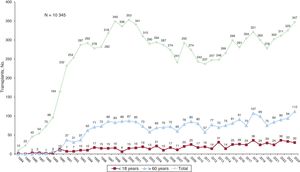
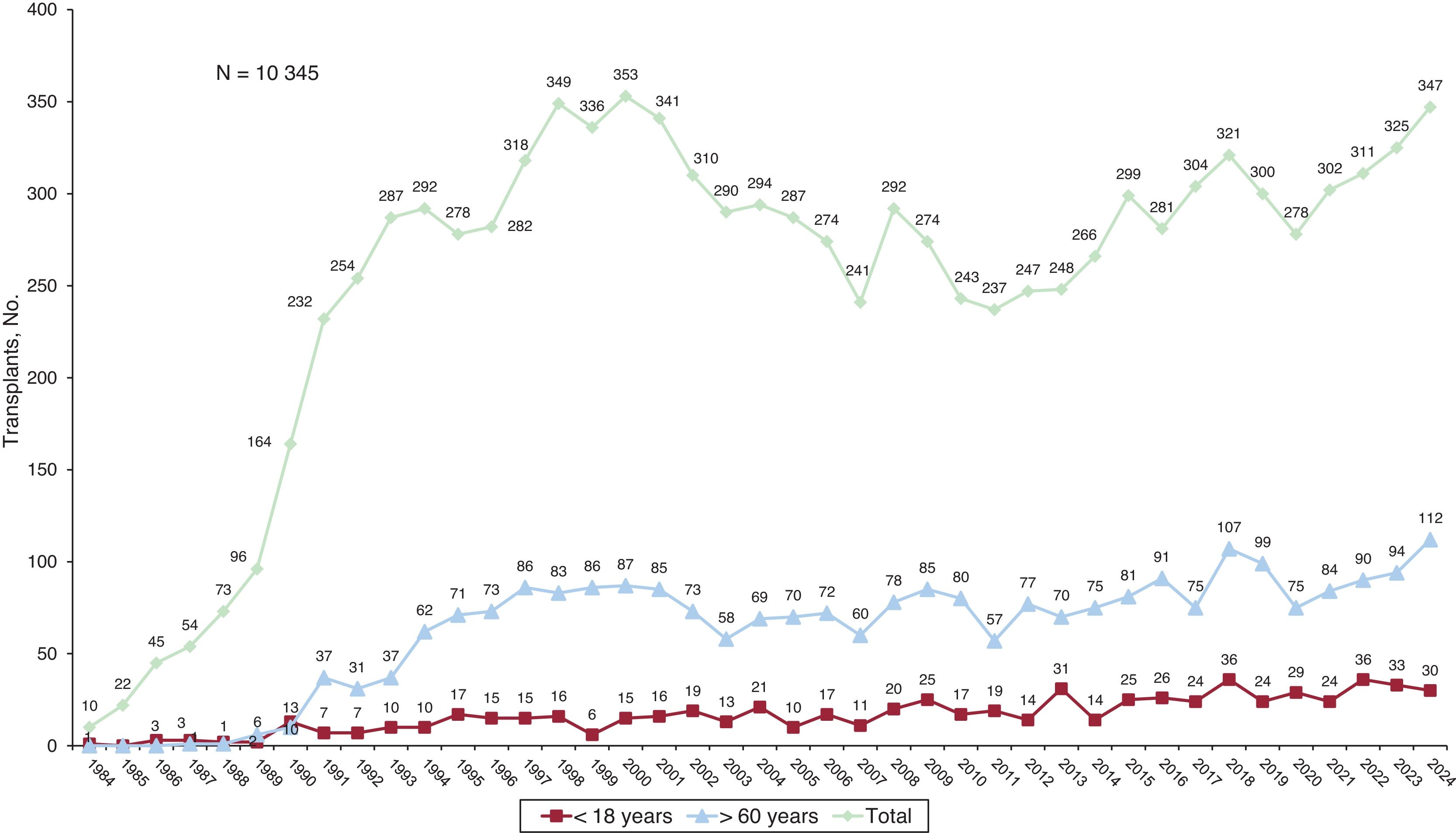
In 2024, 347 procedures were performed, of which 30 (8.6%) were in recipients younger than 18 years, and 112 (32.3%) were in recipients older than 60 years (figure 1). From 1984 to 2024, 10 345 transplants were conducted, including 250 retransplants (2.4%) and 212 multiorgan transplants (2.0%), mainly pulmonary or renal (92 patients each) (table 2). The main analysis focuses on transplants performed in the last 10 years (2015-2024). The trends for the main recipient, donor, surgical procedure, immunosuppression, and survival characteristics have been studied in trienniums (2015-2017, 2018-2020, and 2021-2023).
Spanish heart transplant registry (1984-2024). Type of procedure
| Procedure | 2024 | 1984-2023 |
|---|---|---|
| De novo heart transplant | 331 | 9908 |
| Heart retransplant alone | 7 | 235 |
| Combined heart retransplant | 0 | 8* |
| Combined de novo heart transplant | 9 | 195 |
| Heart-lung | 2 | 92 |
| Heart-kidney | 4 | 84 |
| Heart-liver | 3 | 19 |
| Total | 347 | 9998 |
Continuous variables are expressed as the mean ± standard deviation, and categorical variables as percentages. The nonparametric Kendall tau test and the Wilcoxon test for trends were used to assess temporal trends in the categorical and quantitative variables, respectively. Cumulative survival was estimated using the Kaplan-Meier method, and differences between groups were determined using the log-rank test. Hazard ratios with 95% confidence intervals for the nonadjusted relationship of selected variables with mortality were determined using Cox regression. Differences were considered statistically significant at a 2-tailed P<.05.
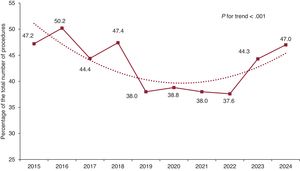
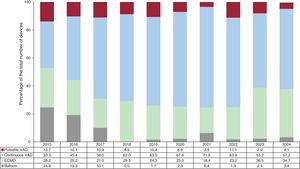
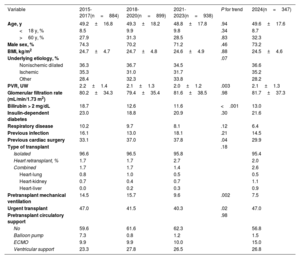
RESULTSRecipient characteristicsIn 2024, 347 transplants were performed, marking a 6.8% increase from 2023 and a 24.8% rise compared with 5 years earlier (2020). In the last 10 years, there has been no significant change in recipient age or sex. However, this has led to a gradual increase in recipients with etiologies other than standard dilated cardiomyopathy, both ischemic and nonischemic, although no such increase was observed in 2024. Statistically significant trends show a progressively more favorable recipient profile, evidenced by a lower proportion of transplants performed in patients who had received prior mechanical ventilation (P=.002), as well as lower pulmonary vascular resistance (P<.003) and fewer recipients with elevated pretransplant serum bilirubin levels (P<.001). In contrast, and as noted in the previous report,1 there was an increase in the percentage of urgent transplants (47.0% in 2024), 6.1% more than in 2023 and 25.0% more than in 2022 (figure 2). This trend parallels the increased use of circulatory assist devices (figure 3), because transplant urgency in Spain is linked to the need for circulatory support, which grew from 37.7% in the 2021 to 2023 triennium to 43.2% in 2024 (table 3). This increase was primarily due to greater use of extracorporeal membrane oxygenation, which rose from 23.2% in 2022 to 36.5% in 2023 and 34.7% in 2024 (figure 3).
Recipient characteristics in the Spanish heart transplant registry (2015-2024)
| Variable | 2015-2017(n=884) | 2018-2020(n=899) | 2021-2023(n=938) | P for trend | 2024(n=347) |
|---|---|---|---|---|---|
| Age, y | 49.2±16.8 | 49.3±18.2 | 48.8±17.8 | .94 | 49.6±17.6 |
| <18 y, % | 8.5 | 9.9 | 9.8 | .34 | 8.7 |
| >60 y, % | 27.9 | 31.3 | 28.5 | .83 | 32.3 |
| Male sex, % | 74.3 | 70.2 | 71.2 | .46 | 73.2 |
| BMI, kg/m2 | 24.7±4.7 | 24.7±4.8 | 24.6±4.9 | .88 | 24.5±4.6 |
| Underlying etiology, % | .07 | ||||
| Nonischemic dilated | 36.3 | 36.7 | 34.5 | 36.6 | |
| Ischemic | 35.3 | 31.0 | 31.7 | 35.2 | |
| Other | 28.4 | 32.3 | 33.8 | 28.2 | |
| PVR, UW | 2.2±1.4 | 2.1±1.3 | 2.0±1.2 | .003 | 2.1±1.3 |
| Glomerular filtration rate (mL/min/1.73 m2) | 80.2±34.3 | 79.4±35.4 | 81.6±38.5 | .98 | 81.7±37.3 |
| Bilirubin > 2 mg/dL | 18.7 | 12.6 | 11.6 | <.001 | 13.0 |
| Insulin-dependent diabetes | 23.0 | 18.8 | 20.9 | .30 | 21.6 |
| Respiratory disease | 10.2 | 9.7 | 8.1 | .12 | 6.4 |
| Previous infection | 16.1 | 13.0 | 18.1 | .21 | 14.5 |
| Previous cardiac surgery | 33.1 | 37.0 | 37.8 | .04 | 29.9 |
| Type of transplant | .18 | ||||
| Isolated | 96.6 | 96.5 | 95.8 | 95.4 | |
| Heart retransplant, % | 1.7 | 1.7 | 2.7 | 2.0 | |
| Combined | 1.7 | 1.7 | 1.4 | 2.6 | |
| Heart-lung | 0.8 | 1.0 | 0.5 | 0.5 | |
| Heart-kidney | 0.7 | 0.4 | 0.7 | 1.1 | |
| Heart-liver | 0.0 | 0.2 | 0.3 | 0.9 | |
| Pretransplant mechanical ventilation | 14.5 | 15.7 | 9.6 | .002 | 7.5 |
| Urgent transplant | 47.0 | 41.5 | 40.3 | .02 | 47.0 |
| Pretransplant circulatory support | .98 | ||||
| No | 59.6 | 61.6 | 62.3 | 56.8 | |
| Balloon pump | 7.3 | 0.8 | 1.2 | 1.5 | |
| ECMO | 9.9 | 9.9 | 10.0 | 15.0 | |
| Ventricular support | 23.3 | 27.8 | 26.5 | 26.8 |
BMI, body mass index; ECMO, extracorporeal membrane oxygenation; PVR, pulmonary vascular resistance.
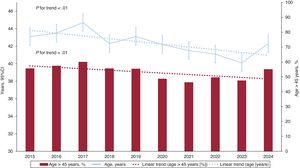
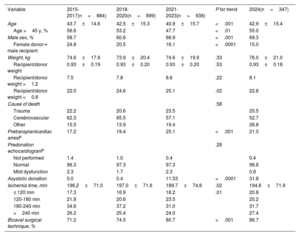
In 2024, there was a slight uptick in the average donor age and in the proportion of suboptimal donors (> 45 years) (table 4). However, this increase did not alter the significant downward trends observed in the last decade for both variables (figure 4). The proportion of male donors rose again (69.3% in 2024), with a highly significant trend in the last decade (P<.001). This has produced a corresponding decrease in the percentage of transplants performed with a donor-recipient sex mismatch (male recipient, female donor). Up to a fifth of donors in 2024 experienced cardiac arrest during the donation process, reflecting an upward trend in the last decade (table 4). In addition, compared with the significant trend toward shorter ischemia times in previous years, a slight increase was detected in 2024 vs the most recent 3-year period.
Donor characteristics and procedure times in the Spanish heart transplant registry (2015-2024)
| Variable | 2015-2017(n=884) | 2018-2020(n=899) | 2021-2023(n=938) | P for trend | 2024(n=347) |
|---|---|---|---|---|---|
| Age | 43.7±14.6 | 42.5±15.3 | 40.9±15.7 | <.001 | 42.9±15.4 |
| Age >45 y, % | 56.6 | 53.2 | 47.7 | <.01 | 55.0 |
| Male sex, % | 58.7 | 60.6 | 66.9 | <.001 | 69.3 |
| Female donor→ male recipient | 24.8 | 20.5 | 16.1 | <.0001 | 15.0 |
| Weight, kg | 74.6±17.9 | 73.9±20.4 | 74.6±19.9 | .33 | 76.0±21.0 |
| Recipient/donor weight | 0.93±0.19 | 0.93±0.20 | 0.93±0.20 | .53 | 0.93±0.18 |
| Recipient/donor weight >1.2 | 7.5 | 7.8 | 8.6 | .22 | 8.1 |
| Recipient/donor weight <0.8 | 22.0 | 24.6 | 25.1 | .02 | 22.8 |
| Cause of death | .58 | ||||
| Trauma | 22.2 | 20.6 | 23.5 | 20.5 | |
| Cerebrovascular | 62.3 | 65.5 | 57.1 | 52.7 | |
| Other | 15.5 | 13.9 | 19.4 | 26.8 | |
| Pretransplantcardiac arresta | 17.2 | 19.4 | 25.1 | <.001 | 21.0 |
| Predonation echocardiogramb | .28 | ||||
| Not performed | 1.4 | 1.0 | 0.4 | 0.4 | |
| Normal | 96.3 | 97.3 | 97.3 | 98.8 | |
| Mild dysfunction | 2.3 | 1.7 | 2.3 | 0.8 | |
| Asystolic donation | 0.0 | 0.4 | 11.53 | <.0001 | 31.8 |
| Ischemia time, min | 196.2±71.0 | 197.0±71.6 | 189.7±74.8 | .02 | 194.6±71.9 |
| ≤ 120 min | 17.3 | 16.9 | 18.2 | .01 | 20.8 |
| 120-180 min | 21.8 | 20.6 | 23.5 | 20.2 | |
| 180-240 min | 34.6 | 37.2 | 31.0 | 31.7 | |
| >240 min | 26.2 | 25.4 | 24.0 | 27.4 | |
| Bicaval surgical technique, % | 71.2 | 74.5 | 80.7 | <.001 | 86.7 |
Values are expressed as percentage or mean ± standard deviation.
Annual changes in donor age (continuous blue line) and percentage of donors older than 45 years (red bars) (2015-2024). The dotted lines indicate the linear adjustment lines of the temporal trend. This figure is shown in color in the online version of this article. 95%CI, 95% confidence interval.
The current analysis definitively confirms the trend observed in the previous report toward a highly marked increase in transplants performed using donation after circulatory death (asystole). In 2024, 101 procedures were conducted with this type of donation (29.1% of all transplants in Spain and 38.7% of procedures in centers with active circulatory death donation programs). Overall, 211 transplants using this type of donation have already been performed, representing 13.9% of all procedures since 2020.
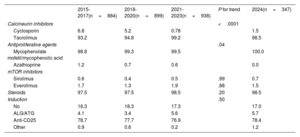
ImmunosuppressionThe immunosuppression strategies used during the study period are summarized in table 5. In 4 out of 5 patients, the induction immunosuppression comprised basiliximab, while the maintenance immunosuppression consisted of standard triple therapy with tacrolimus, mycophenolate, and steroids. mTOR inhibitors were rarely used.
Induction immunosuppression in the Spanish heart transplant registry (2015-2024)
| 2015-2017(n=884) | 2018-2020(n=899) | 2021-2023(n=938) | P for trend | 2024(n=347) | |
|---|---|---|---|---|---|
| Calcineurin inhibitors | <.0001 | ||||
| Cyclosporin | 6.8 | 5.2 | 0.78 | 1.5 | |
| Tacrolimus | 93.2 | 94.8 | 99.2 | 98.5 | |
| Antiproliferative agents | .04 | ||||
| Mycophenolate mofetil/mycophenolic acid | 98.8 | 99.3 | 99.5 | 100.0 | |
| Azathioprine | 1.2 | 0.7 | 0.6 | 0.0 | |
| mTOR inhibitors | |||||
| Sirolimus | 0.6 | 0.4 | 0.5 | .99 | 0.7 |
| Everolimus | 1.7 | 1.3 | 1.9 | .88 | 1.5 |
| Steroids | 97.5 | 97.5 | 98.5 | .20 | 98.5 |
| Induction | .50 | ||||
| No | 16.3 | 18.3 | 17.3 | 17.0 | |
| ALG/ATG | 4.1 | 3.4 | 5.6 | 5.7 | |
| Anti-CD25 | 78.7 | 77.7 | 76.9 | 78.4 | |
| Other | 0.9 | 0.6 | 0.2 | 1.2 |
ALG, antilymphocyte globulin; anti-CD25, basiliximab, daclizumab; ATG, antithymocyte globulin.
Values express percentages.
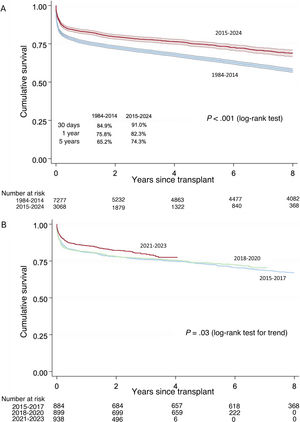
Survival increased once again compared with previous years. In the last decade, 1- and 5-year posttransplant survival rates were 82.4% and 74.3%, respectively. These figures are significantly higher than those for the entire previous period (75.8% and 65.2%) (figure 5A). In the last 10 years, 1-year survival increased from 80.7% in the 2015 to 2017 triennium to 85.2% from 2021 to 2023 (P=.008) (figure 5B).
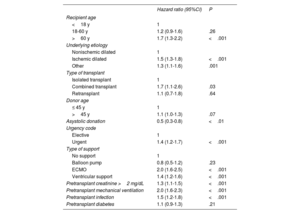
Table 6 summarizes the unadjusted determinants of survival in the 2015 to 2024 period. Mortality was associated with complex procedures such as urgent transplants, multiorgan transplants, the need for pretransplant mechanical circulatory support, and vulnerable recipients (older age, nondilated etiologies, need for mechanical ventilation, or a history of infection). Notably, transplants performed using donation after circulatory death showed higher crude survival rates.
Univariable analysis of survival by baseline characteristics of the recipient, donor, and procedure (2015-2024)
| Hazard ratio (95%CI) | P | |
|---|---|---|
| Recipient age | ||
| <18 y | 1 | |
| 18-60 y | 1.2 (0.9-1.6) | .26 |
| >60 y | 1.7 (1.3-2.2) | <.001 |
| Underlying etiology | ||
| Nonischemic dilated | 1 | |
| Ischemic dilated | 1.5 (1.3-1.8) | <.001 |
| Other | 1.3 (1.1-1.6) | .001 |
| Type of transplant | ||
| Isolated transplant | 1 | |
| Combined transplant | 1.7 (1.1-2.6) | .03 |
| Retransplant | 1.1 (0.7-1.8) | .64 |
| Donor age | ||
| ≤ 45 y | 1 | |
| >45 y | 1.1 (1.0-1.3) | .07 |
| Asystolic donation | 0.5 (0.3-0.8) | <.01 |
| Urgency code | ||
| Elective | 1 | |
| Urgent | 1.4 (1.2-1.7) | <.001 |
| Type of support | ||
| No support | 1 | |
| Balloon pump | 0.8 (0.5-1.2) | .23 |
| ECMO | 2.0 (1.6-2.5) | <.001 |
| Ventricular support | 1.4 (1.2-1.6) | <.001 |
| Pretransplant creatinine >2 mg/dL | 1.3 (1.1-1.5) | <.001 |
| Pretransplant mechanical ventilation | 2.0 (1.6-2.3) | <.001 |
| Pretransplant infection | 1.5 (1.2-1.8) | <.001 |
| Pretransplant diabetes | 1.1 (0.9-1.3) | .21 |
95%CI, 95% confidence interval; ECMO, extracorporeal membrane oxygenation.
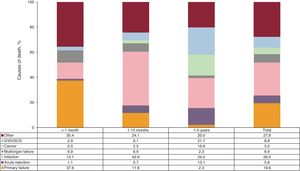
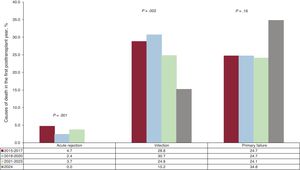
The causes of death (figure 6) in the first 5 posttransplant years remained unchanged and were dominated by primary graft failure and infection in the first posttransplant year. Acute rejection was a less frequent cause of death during this period. In the last decade, mortality in the first year due to acute rejection and infection has shown a significant downward trend, while the proportion of deaths due to primary graft failure has remained stable (figure 7).
One of the most notable observations from the latest report is the confirmation of an increase in the number of transplants performed in Spain over the last 5 years, approaching the historical peak recorded in 2000. Although the granularity of the data in the Spanish heart transplant registry does not permit an exhaustive analysis that would fully explain this result, it is clear that a major factor is the exponential rise in procedures using donation after circulatory death, which greatly expands the donor pool. In addition, due to the characteristics of the Spanish protocol, these new donors are particularly ideal2 (mainly comprising local transplants, young donors, and the use of strict procedural controls). It is hoped that this trend will not only continue but also strengthen as these programs expand to more transplant centers and increase remote organ procurement.
The percentage of urgent transplants rose in 2023 and 2024 after appearing to have stabilized at lower rates in the 2019 to 2022 period. These variations are directly related to the 2023 changes in allocation criteria for urgent transplants.3 These new criteria also explain the changing trend in the use of extracorporeal membrane oxygenation as pretransplant circulatory support, which has been prioritized since 2023, as well as the near elimination of balloon pumps as a support technique, whose priority had already declined in 2018.
Improved survival has been a consistent finding in recent years. Indeed, the 1-year survival rate in the latest 3-year period was nearly 90%, similar to the results reported in international registries.4 This progressive improvement reflects the maturity of Spanish heart transplant programs, despite the growing clinical complexity. A summary analysis of our data indicates better recipient health status at transplantation, with a reduced need for mechanical ventilation, fewer signs of organ failure (eg, lower serum bilirubin levels), and less pulmonary hypertension. Similarly, cold ischemia times are gradually improving, and bicaval techniques are now almost always used for graft implantation. Donation after circulatory death is not only helping to increase the number of available donors but is also influencing outcomes by allowing the use of younger donors, a more controlled donation process, and shorter cold ischemia times due to predominantly local procurement.5
CONCLUSIONSThe results from 2024 confirm the increase in the number of transplants performed in Spain, with numbers nearing the historical peaks, likely due to the expansion of donation after circulatory death. Despite the increased procedural complexity, progressive improvements in survival are being achieved.
FUNDINGThis work did not receive funding.
ETHICAL CONSIDERATIONSThe present registry was approved by the Biomedical Research Ethics Committee of Hospital Universitario La Fe (Valencia, Spain) and was conducted with the recipients’ informed consent. The report considers donor and recipient sex to be possible predictive variables, as indicted in the descriptive tables of the manuscript.
STATEMENT ON THE USE OF ARTIFICIAL INTELLIGENCENo artificial intelligence was used in the preparation of this article.
AUTHORS’ CONTRIBUTIONSF. González-Vílchez drafted the manuscript. All authors contributed to the data collection, critically revised the manuscript, and approved its publication in its current form.
CONFLICTS OF INTERESTNone.
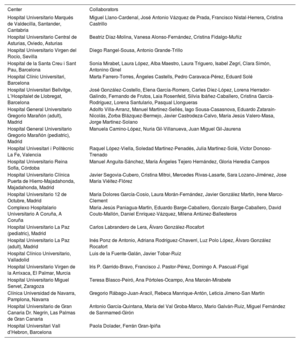
| Center | Collaborators |
|---|---|
| Hospital Universitario Marqués de Valdecilla, Santander, Cantabria | Miguel Llano-Cardenal, José Antonio Vázquez de Prada, Francisco Nistal-Herrera, Cristina Castrillo |
| Hospital Universitario Central de Asturias, Oviedo, Asturias | Beatriz Díaz-Molina, Vanesa Alonso-Fernández, Cristina Fidalgo-Muñiz |
| Hospital Universitario Virgen del Rocío, Sevilla | Diego Rangel-Sousa, Antonio Grande-Trillo |
| Hospital de la Santa Creu i Sant Pau, Barcelona | Sonia Mirabet, Laura López, Alba Maestro, Laura Triguero, Isabel Zegrí, Clara Simón, Antonino Ginel |
| Hospital Clínic Universitari, Barcelona | Marta Farrero-Torres, Ángeles Castells, Pedro Caravaca-Pérez, Eduard Solé |
| Hospital Universitari Bellvitge, L’Hospitalet de Llobregat, Barcelona | José González-Costello, Elena García-Romero, Carles Díez-López, Lorena Herrador-Galindo, Fernando de Frutos, Laia Rosenfeld, Silvia Ibáñez-Caballero, Cristina García-Rodríguez, Lorena Santulario, Pasqual Llongueras |
| Hospital General Universitario Gregorio Marañón (adult), Madrid | Adolfo Villa-Arranz, Manuel Martínez-Sellés, Iago Sousa-Casasnova, Eduardo Zataraín-Nicolás, Zorba Blázquez-Bermejo, Javier Castrodeza-Calvo, María Jesús Valero-Masa, Jorge Martínez-Solano |
| Hospital General Universitario Gregorio Marañón (pediatric), Madrid | Manuela Camino-López, Nuria Gil-Villanueva, Juan Miguel Gil-Jaurena |
| Hospital Univesitari i Politècnic La Fe, Valencia | Raquel López-Viella, Soledad Martínez-Penadés, Julia Martínez-Solé, Víctor Donoso-Trenado |
| Hospital Universitario Reina Sofía, Córdoba | Manuel Anguita-Sánchez, María Ángeles Tejero Hernández, Gloria Heredia Campos |
| Hospital Universitario Clínica Puerta de Hierro-Majadahonda, Majadahonda, Madrid | Javier Segovia-Cubero, Cristina Mitroi, Mercedes Rivas-Lasarte, Sara Lozano-Jiménez, Jose María Viéitez-Flórez |
| Hospital Universitario 12 de Octubre, Madrid | María Dolores García-Cosío, Laura Morán-Fernández, Javier González Martín, Irene Marco-Clement |
| Complexo Hospitalario Universitario A Coruña, A Coruña | Maria Jesús Paniagua-Martín, Eduardo Barge-Caballero, Gonzalo Barge-Caballero, David Couto-Mallón, Daniel Enríquez-Vázquez, Milena Antúnez-Ballesteros |
| Hospital Universitario La Paz (pediatric), Madrid | Carlos Labrandero de Lera, Álvaro González-Rocafort |
| Hospital Universitario La Paz (adult), Madrid | Inés Ponz de Antonio, Adriana Rodríguez-Chaverri, Luz Polo López, Álvaro González Rocafort |
| Hospital Clínico Universitario, Valladolid | Luis de la Fuente-Galán, Javier Tobar-Ruiz |
| Hospital Universitario Virgen de la Arrixaca, El Palmar, Murcia | Iris P. Garrido-Bravo, Francisco J. Pastor-Pérez, Domingo A. Pascual-Figal |
| Hospital Universitario Miguel Servet, Zaragoza | Teresa Blasco-Peiró, Ana Pórtoles-Ocampo, Ana Marcén-Mirabete |
| Clínica Universidad de Navarra, Pamplona, Navarra | Gregorio Rábago-Juan-Aracil, Rebeca Manrique-Antón, Leticia Jimeno-San Martín |
| Hospital Universitario de Gran Canaria Dr. Negrín, Las Palmas de Gran Canaria | Antonio García-Quintana, María del Val Groba-Marco, Mario Galván-Ruiz, Miguel Fernández de Sanmamed-Girón |
| Hospital Universitari Vall d’Hebron, Barcelona | Paola Dolader, Ferrán Gran-Ipiña |