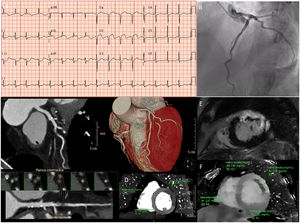

A 61-year-old man with a history of dyslipidemia and diabetes mellitus was referred to our hospital after 24hours of persistent angina and electrocardiographic signs of anterior ST-segment elevation (figure 1A). Urgent coronary angiography failed to identify any evident occluded artery (figure 1B), although there was a high suspicion of a missing secondary branch. The use of intravascular imaging limited to the left anterior descending artery also failed to detect any complicated plaque, vessel stump or collateral circulation. A spectral computed tomography (CT) was scheduled for the following day to reassess both the coronary anatomy and the injured myocardium. Noninvasive angiography revealed an occluded branch of the ramus intermedius (figure 1C; RHA: relative heart area). Analysis of the iodine density map depicted a clear first-pass perfusion defect in the mid to distal anterior and anterolateral wall segments (figure 1D). Late-iodine enhancement CT images revealed a hypodense region within the transmural infarct, indicative of an area of microvascular obstruction (figure 1E). Excellent correlation was observed with late gadolinium enhancement sequences provided by cardiac magnetic resonance imaging, which was performed the day after (figure 1F). The patient evolved uneventfully and was discharged without developing any complications.
Currently, the role of coronary CT angiography is not fully established in the noninvasive workup of myocardial infarction with nonobstructive coronary arteries (MINOCA). In this regard, spectral CT is emerging as a promising tool to exclude clinically overlooked coronary obstructive disease in patients with suspected MINOCA. Moreover, when coupled with late-iodine enhancement images, spectral CT offers not only a detailed second insight into the coronary tree but also myocardial tissue characterization comparable to cardiac magnetic resonance.
FUNDINGThis work was supported by research grants from the Regional Health Management of Castilla y León, projects GRS 2621/A/22 and INT/M/10/23. C. Herrera was a beneficiary of a Río Hortega grant from the Instituto de Salud Carlos III (CM23/00238).
ETHICAL CONSIDERATIONSThe authors confirm that written consent for publication of this case report was properly obtained and stored. The authors accept full responsibility for its content as defined by the International Committee of Medical Journal Editors. Possible sex/gender biases have been taken into account in the preparation of this article.
STATEMENT ON THE USE OF ARTIFICIAL INTELLIGENCENo artificial intelligence tool was used to prepare this article.
AUTHORS’ CONTRIBUTIONSAll authors contributed equally to the preparation of the article.
CONFLICTS OF INTERESTThe authors declare that they have no relevant conflicts of interest to disclosure in relation to the article.