

The multiparametric implantable cardioverter-defibrillator HeartLogic index has proven to be a sensitive and timely predictor of impending heart failure (HF) decompensation. We evaluated the impact of a standardized follow-up protocol implemented by nursing staff and based on remote management of alerts.
MethodsThe algorithm was activated in HF patients at 19 Spanish centers. Transmitted data were analyzed remotely, and patients were contacted by telephone if alerts were issued. Clinical actions were implemented remotely or through outpatient visits. The primary endpoint consisted of HF hospitalizations or death. Secondary endpoints were HF outpatient visits. We compared the 12-month periods before and after the adoption of the protocol.
ResultsWe analyzed 392 patients (aged 69±10 years, 76% male, 50% ischemic cardiomyopathy) with implantable cardioverter-defibrillators (20%) or cardiac resynchronization therapy defibrillators (80%). The primary endpoint occurred 151 times in 86 (22%) patients during the 12 months before the adoption of the protocol, and 69 times in 45 (11%) patients (P<.001) during the 12 months after its adoption. The mean number of hospitalizations per patient was 0.39±0.89 pre- and 0.18±0.57 postadoption (P<.001). There were 185 outpatient visits for HF in 96 (24%) patients before adoption and 64 in 48 (12%) patients after adoption (P<.001). The mean number of visits per patient was 0.47±1.11 pre- and 0.16±0.51 postadoption (P<.001).
ConclusionsA standardized follow-up protocol based on remote management of HeartLogic alerts enabled effective remote management of HF patients. After its adoption, we observed a significant reduction in HF hospitalizations and outpatient visits.
Keywords
Implantable cardioverter-defibrillators (ICD) and defibrillators for resynchronization therapy (cardiac resynchronization therapy defibrillators [CRT-D]) are recommended for some heart failure (HF) patients with reduced ejection fraction (HFrEF).1 Many studies have investigated the ability of ICD diagnostic algorithms to identify patients at risk of HF events.2–4 Recent studies have shown that the combination of multiple diagnostic parameters from the ICD allows for better HF risk stratification and management.5,6 The MultiSENSE study7 demonstrated the ability of the HeartLogic index (Boston Scientific, United States), which combines physiological data from multiple ICD-based sensors, to predict HF events. The algorithm has also been shown to enable dynamic assessment of HF, identifying periods when patients are at significantly increased risk of worsening HF.8
The Registro Español de HeartLogic (RE-HEART) registry is a large study of HeartLogic in clinical practice. The first analysis of the registry found a good association between the HeartLogic alert status and HF decompensation events, and a low rate of unexplained alerts.9 The data from this real-life experience of a multicenter Spanish group also indicated that HF decompensation is highly unlikely outside alert states and that most alerts can be efficiently resolved remotely.
Data on the prognostic effect of implementing HeartLogic in clinical practice are still lacking, apart from small observational studies, which have suggested that the alerts reduce HF hospitalizations.10 The aim of this analysis was therefore to evaluate the impact of a standardized follow-up protocol, implemented by nursing staff and based on remote management of HeartLogic alerts, on the clinical outcomes of ICD and CRT-D patients in terms of hospital admissions for HF decompensation.
METHODSThe RE-HEART is an observational, prospective study conducted in consecutive HFrEF patients, conducted at 19 study centers. Each patient acted as his or her own historical control. HeartLogic was activated in all HF patients (ejection fraction ≤ 35% at the time of implantation) who had received a HeartLogic-enabled ICD or CRT-D device (RESONATE family, Boston Scientific, United States) in accordance with standard indications,1 and who were enrolled in the LATITUDE (Boston Scientific, United States) remote monitoring platform.
The study was approved by the Hospital Universitario 12 de Octubre ethics committee (approval number, 19/327), conformed to the principles of the Helsinki Declaration, and all patients provided written informed consent for study participation. Patients were followed up in accordance with the standardized management protocol. For the present analysis, we performed a comparison between the 12-month period after the adoption of the RE-HEART management protocol and the previous 12 months, within each patient.
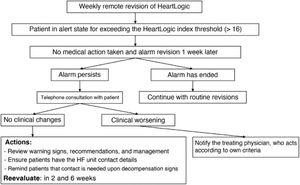
RE-HEART management protocolThe standardized protocol used by all centers is shown in figure 1. Remote data reviews were conducted by a trained nurse at each study center upon issue of HeartLogic alerts (when the index crossed the programmed threshold value of 16). Transmitted device data were analyzed to identify potentially critical issues, and the patient was contacted by telephone if alert states persisted for more than 1 week (first realert). The telephone consultation included verification of worsening HF symptoms or signs, changes in HF or non-HF therapy, and the occurrence of clinical events. In the absence of symptoms or signs of clinical deterioration of HF, patients were provided with education on treatment adherence and lifestyle advice, and a new remote evaluation in 2 weeks was scheduled. If signs or symptoms or HF were present, the nurse discussed the case with the treating cardiologist. Possible clinical actions included enhancing adherence, changing current HF medications, adding a new class of HF medications or changing medications within an HF class, device reprogramming, and cardioversion. In-office examinations were performed if deemed necessary to assess the patient's decompensation status through in-person clinical examination or to implement specific therapeutic actions.
HeartLogic index
The details of the HeartLogic algorithm have been previously reported.7 Briefly, the algorithm combines data from multiple sensors: accelerometer-based first and third heart sounds, intrathoracic impedance, respiration rate, the ratio of respiration rate to tidal volume, night heart rate, and patient activity. Each day, the device calculates the degree of worsening in sensors from their moving baseline and computes a composite index. An alert is issued when the index crosses a programmable threshold (nominal value 16). When the index enters an alert state, the device performs weekly data transmissions, and the “exit alert” threshold is automatically dropped to a recovery value (nominal value 6).
Study endpointsThe primary endpoint consisted of all hospitalizations with a primary or secondary diagnosis of HF requiring at least 1 overnight stay, unscheduled visits involving intravenous treatment, or all deaths (deaths only apply to the postprotocol period). The secondary endpoint was HF decompensations requiring adjustment of oral HF therapy in an outpatient setting. For the primary analysis, we compared the endpoints occurring in the 12-month period after the adoption of the RE-HEART management protocol with those occurring in the previous 12 months. Elective hospitalization for device implantation was not included. We compared the total number of endpoints, the number of patients with endpoints, and the mean number of endpoints per patient. In addition, we reported the time from the adoption of the RE-HEART management protocol to the first primary and secondary endpoint during the entire follow-up period of the study population.
In a patient receiving a CRT-D, clinical improvement is expected in the first months after implantation. To account for this potential bias, we repeated the analysis in a subgroup of patients who received a non-CRT ICD and in patients with a CRT-D implanted for at least 12 months. Assuming that the patient has reached a stable condition after the first few months, any effects observed after the adoption of the RE-HEART management protocol should not be attributed to the start of CRT. Furthermore, to assess the risk of HF events and to evaluate the performance of the index for detecting follow-up periods of significantly increased HF risk, we calculated the clinical event rates separately during IN and OUT alert states. Moreover, to describe the performance of the HeartLogic index in terms of the proportion of alerts deemed clinically meaningful and actionable and that of unexplained alerts, we considered not only major hospitalizations but also initial signs or symptoms of HF and the corrective therapies delivered to prevent more severe events.
Statistical analysisDescriptive statistics are reported as means±standard deviation for normally distributed continuous variables or as medians with 25th to 75th percentiles for skewed distribution. Normality of distribution was assessed using the nonparametric Kolmogorov–Smirnov test. Categorical data are expressed as percentages. Clinical event rates were calculated as the ratio between the total count of events occurring in each state and the respective patient follow-up durations, and are expressed as events per patient-year. Differences between mean data were compared using a t-test for Gaussian variables, and the F-test was used to assess the hypothesis of equality of variance. The Wilcoxon nonparametric test was used to compare non-Gaussian variables. Differences in paired proportions were compared by means of the McNemar test. The Kaplan-Meier method was used to compute time-to-event curves. All statistical analyses were performed using R: a language and environment for statistical computing (R Foundation for Statistical Computing, Austria).
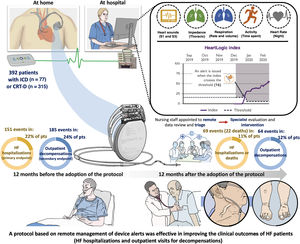
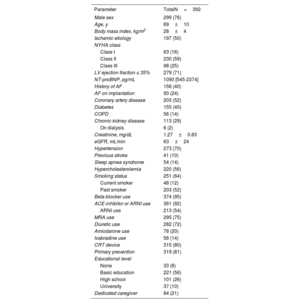
RESULTSFrom September 2019 to September 2021, 392 patients who had received a HeartLogic-enabled ICD or CRT-D were enrolled in the registry. The main study findings are summarized in figure 2. Of the 315 CRT-D patients, 156 had had the device for at least 12 months. The baseline clinical characteristics of the study population are shown in table 1.

Central illustration. Summary of the key findings of the study, including comparison of HF events during the 12 months before and after the adoption of the RE-HEART management protocol. CRT-D, cardiac resynchronization therapy defibrillator; HF, heart failure; ICD, implantable cardioverter-defibrillator; S, sound.
Demographics and baseline parameters of the study population.
| Parameter | TotalN=392 |
|---|---|
| Male sex | 299 (76) |
| Age, y | 69±10 |
| Body mass index, kg/m2 | 28±4 |
| Ischemic etiology | 197 (50) |
| NYHA class | |
| Class I | 63 (16) |
| Class II | 230 (59) |
| Class III | 98 (25) |
| LV ejection fraction ≤ 35% | 279 (71) |
| NT-proBNP, pg/mL | 1090 [545-2374] |
| History of AF | 156 (40) |
| AF on implantation | 93 (24) |
| Coronary artery disease | 203 (52) |
| Diabetes | 155 (40) |
| COPD | 56 (14) |
| Chronic kidney disease | 113 (29) |
| On dialysis | 6 (2) |
| Creatinine, mg/dL | 1.27±0.83 |
| eGFR, mL/min | 63±24 |
| Hypertension | 273 (70) |
| Previous stroke | 41 (10) |
| Sleep apnea syndrome | 54 (14) |
| Hypercholesterolemia | 220 (56) |
| Smoking status | 251 (64) |
| Current smoker | 48 (12) |
| Past smoker | 203 (52) |
| Beta-blocker use | 374 (95) |
| ACE-inhibitor or ARNI use | 361 (92) |
| ARNI use | 213 (54) |
| MRA use | 295 (75) |
| Diuretic use | 282 (72) |
| Amiodarone use | 78 (20) |
| Ivabradine use | 56 (14) |
| CRT device | 315 (80) |
| Primary prevention | 319 (81) |
| Educational level | |
| None | 33 (8) |
| Basic education | 221 (56) |
| High school | 101 (26) |
| University | 37 (10) |
| Dedicated caregiver | 84 (21) |
ACE, angiotensin-converting enzyme; AF, atrial fibrillation; ARNI, angiontensin receptor neprilysin inhibitor; COPD, chronic obstructive pulmonary disease; CRT, cardiac resynchronization therapy; eGFR, estimated glomerular filtration rate; LV, left ventricular; MRA, mineralocorticoid receptor antagonists; NT-proBNP, N-terminal pro-B-type natriuretic peptide; NYHA, New York Heart Association.
The data are expressed as No. (%) or mean±standard deviation.
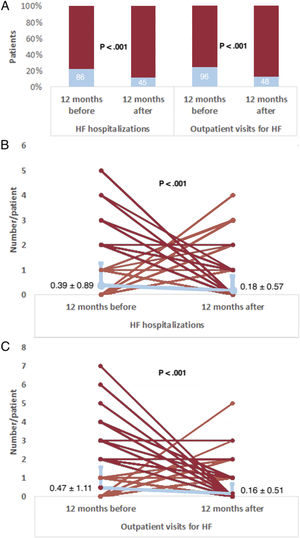
The total number of HF hospitalizations or unscheduled visits involving intravenous treatment during the 12 months before the adoption of the management protocol was 151 in 86 (22%) patients. During the first 12 postadoption months, 22 patients died. Sixty-nine combined primary endpoints of HF hospitalizations (n=47) or death (n=22; both hospitalization and death occurred in 8 patients) occurred in 45 (11%) patients (P<.001). The mean number of events per patient was 0.39±0.89 pre- and 0.18±0.57 postadoption (P<.001). The number of HF hospitalizations or unscheduled visits only (ie, excluding deaths from the calculation of the endpoint) was 47 occurring in 31 (8%) patients (P<.001) during the postprotocol period. The mean number of HF hospitalizations or unscheduled visits per patient was 0.12±0.48 postadoption (P<.001). The total number of outpatient visits with adjustment of the oral HF therapy was 185 in 96 (24%) patients pre-adoption and 64 in 48 (12%) patients postadoption (P<.001). The mean number of visits per patient was 0.47±1.11 pre- and 0.16±0.51 postadoption (P<.001). Comparisons are reported in figure 3. The analysis was repeated in the 233 patients who had received an ICD or who had had a CRT-D for at least 12 months. The total number of primary endpoints was 69 in 41 (18%) patients before the adoption of the management protocol and 49 in 32 (14%) patients (P=.039) after the adoption. The total number of secondary endpoints was 93 in 48 (21%) patients before the adoption and 39 in 28 (12%) patients after the adoption (P=.004). Comparisons are reported in figure 1 of the supplementary data.
Association between heart failure events and HeartLogic alerts
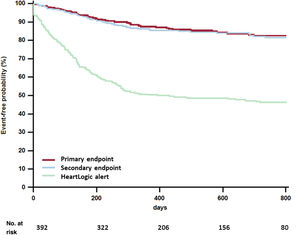
The patients were followed up at the study centers according to the standardized intervention algorithm for a median observation period of 17 [25th-75th percentile: 10-27] months. During the observation period, 36 (9.2%) patients died (14 HF-related and 22 of other causes); 38 (9.7%) patients experienced 66 HF hospitalizations requiring at least 1 overnight stay or unscheduled visits involving intravenous treatment; 58 (14.8%) patients experienced 98 HF decompensations requiring adjustment of oral HF therapy in an outpatient setting. Figure 4 shows the Kaplan-Meier analysis of time to the first primary and secondary endpoint. Figure 2 of the supplementary data shows the time to events in the subgroup of patients who received an ICD, or a CRT-D implanted for at least 12 months (n=233). The HeartLogic index crossed the threshold value 436 times (0.78 alerts/patient-year) in 195 patients. The time to the first HeartLogic alert is decpited in figure 4. Overall, the time spent in the alert state was 10% of the total observation period. The rate of HF hospitalizations or death in the HeartLogic alert state was 1.39 events/patient-year and the rate out of the alert state was 0.05 events/patient-year (P<.001). The rate of HF decompensations in the outpatient setting was 1.54 events/patient-year in the HeartLogic alert state and 0.02 events/patient-year out of the alert state (P<.001). The total number of telephone contacts for the management of alerts was 622, and the median number of contacts per alert period was 1 [25th-75th percentile: 1-3]. Overall, 242 (56%) HeartLogic alerts were deemed clinically meaningful, being associated with HF events, signs or symptoms of HF and the corrective therapies delivered or other conditions (eg, hospital admissions for non-HF conditions, arrhythmia onset, changes in drug or dietary regimen). Of these, 141 specifically led to clinical actions aimed at managing the HF condition, and most frequently consisted of diuretic dosage increase (115 out of 141 [82%]). The remaining 194 (44%) alerts were unexplained (0.34 alerts/patient-year).

Kaplan-Meier estimates of time from the adoption of the RE-HEART management protocol to first primary endpoint (hospitalization with a primary or secondary diagnosis of HF requiring at least 1 overnight stay, unscheduled visit involving intravenous treatment, or death), secondary endpoint (HF decompensation requiring adjustment of oral HF therapy in an outpatient setting), HeartLogic alert. HF, heart failure.
This analysis demonstrates the effectiveness of a standardized follow-up protocol implemented by nursing staff and based on remote management of multiparameter ICD alerts in improving patient prognosis. The adoption of this protocol significantly improved the clinical outcomes of HF patients who had received a remotely monitored ICD or CRT-D device. Specifically, the protocol was associated with fewer hospital admissions and outpatient visits for HF decompensation in the 12-month period after its adoption.
Heart failure hospitalizations are associated with high mortality and impaired quality of life.1,11 Preventing hospitalizations through the effective management of HF can help improve patients’ prognosis and quality of life. Consequently, in clinical trials and studies on HF, hospitalization is frequently used as an endpoint to measure the effectiveness of treatments and as a surrogate endpoint for more serious outcomes, such as death. Nonetheless, in our study, we included all-cause death in the combined primary endpoint within the 12-month period after the adoption of the protocol.
Hospitalizations for HF are also associated with high costs, including both direct medical expenses and indirect costs such as lost productivity.12 The burden of HF hospitalizations also extends to the health care system as a whole, as a large proportion of hospital resources are allocated to the care of these patients.13 The use of HF management programs, which enable patients to receive an accurate diagnosis, appropriate evidence-based therapy, education and suitable follow-up, is recommended by current guidelines,1 since many studies have reported favorable outcomes following their adoption.14 Heart failure management programs vary in terms of their components and can apply different service models, such as clinic- or home-based approaches, with or without the use of telemonitoring.
Telemonitoring enables patients to remotely provide digital health information to support and optimize their care, adjust treatment, or seek further advice. A systematic review of relevant trials of telemonitoring found that this approach was associated with a 20% reduction in all-cause mortality and a 37% decrease in HF hospitalizations.15 Modern cardiac devices can provide, wirelessly and remotely, information on the patient's physiology, thus potentially providing early warning of changes in clinical status.
Studies that have investigated the ability of single-sensor ICD diagnostics to identify patients at risk of HF events have yielded contradictory results and no impact on outcomes.2–4,16 This can probably be attributed to the poor diagnostic accuracy of the algorithms, or to the lack of an effective standardized follow-up protocol.
In the present study, we adopted a system that combines physiological data from multiple ICD-based sensors. The HeartLogic algorithm showed its ability to predict HF events and to risk stratify patients for worsening HF in the context of the validation study,7,8 in previous experiences in clinical practice17,18 and in our first analysis from this registry.9 In particular, the algorithm was shown to be associated with a low rate of unexplained alerts, which were probably responsible for the increase in hospital admissions observed in a previous study involving another system.16
In our study, we also adopted a structured protocol to guide the nursing staff in the management of ICD alerts. This was designed to allow prompt intervention in the case of suspected worsening HF, while promoting the remote management of alert conditions (ie, remote consultation with the patient) so as not to increase the number of hospital admissions.
Our analysis showed a reduction in all hospitalizations with a diagnosis of HF requiring an overnight stay. Moreover, the proportion of patients who had at least 1 primary event was also lower in the second period (22% vs 11%). This result demonstrates the positive impact of remote HF management on the progression of the disease, with the prognostic implications mentioned above. In addition, outpatient visits for HF decompensation were also reduced after the adoption of the follow-up protocol. Therefore, our management approach did not merely shift some HF-related care to the outpatient setting, as occurred in the past with failed programs originally designed to reduce readmissions.19–21 Moreover, we did not observe an increase in hospital access for the management of alerts, which has typically been reported in studies on remote ICD monitoring.16,22 Indeed, the rate of unexplained alerts was similar to that reported in a previous analysis17 and compared favorably with the rate reported in the MultiSENSE study (ie, 1.47 per patient-year).7 The reduction in outpatient visits for HF is even more important in the light of the scientific community's recent interest in disassociating worsening HF from the clinical setting where care is delivered to better capture the magnitude of worsening HF events.23 Indeed, it has been reported that, although a low proportion of outpatient encounters meet the diagnostic criteria for worsening HF, these events cumulatively account for more than one-quarter of worsening HF events, given their sheer absolute number.24 The degree of reduction in HF hospitalizations obtained in this analysis is comparable to that reported in a previous smaller study on HeartLogic with a similar design of preactivation and postactivation comparison.10 However, the reduction in HF outpatient visits observed in our study has not been described previously, probably due to a different management strategy of alert conditions.
Obviously, in a remote management model like that tested in this study, the time spent conducting remote data review and telephone consultation with patients would to some degree offset the in-office visits saved. In our experience, however, this activity did not constitute a significant burden for the centers. Indeed, the volume of alerts remotely reviewed was reasonable (less than 1 alert/patient-year), as was the number of telephone contacts for their management, which is in line with previous experiences.17 Moreover, the significantly increased risk of HF events in the alert state and the short time in alert may optimize the use of health care resources for the management of HF patients, as also suggested by previous studies.8,18
Current guidelines suggest that HF management programs should be patient-centered and take a holistic approach to the patient, rather than focusing solely on HF; indeed, the management of comorbid conditions, such as arrhythmias, improves patient well-being and self-management, leading to better outcomes.1,25 The model applied in this study is not far from this concept. Indeed, the nursing staff appointed to implement remote data review and triage could send the patient toward the most appropriate specialist evaluation and intervention, as suggested by current guidelines. Device diagnostics can identify conditions that may require pharmacological interventions to be managed by the HF clinical team, such as volume control, enhancement of guideline-directed medical therapy,26 or conditions such as the onset of arrhythmias or the need for pacing therapy optimization, which require the intervention of the arrhythmia team.
In our analysis, the 12-month period after the adoption of the RE-HEART management protocol was compared with the previous 12 months. In patients who receive a CRT-D device, a potential bias may arise from the clinical improvement obtained following the initiation of biventricular pacing. However, we confirmed the findings obtained in the overall population by repeating the analysis in a subgroup of patients who had received a non-CRT ICD and in patients with a CRT-D implanted for at least 12 months. The confirmation of a clinical improvement in a population with stable treatment conditions is reassuring, especially in the context of a progressive disease such as HF. Indeed, for these patients, even the maintenance of clinical stability, ie, nonprogression of disease, can be considered a favorable outcome.27 Nonetheless, although this study provides further support to the value of a standardized follow-up protocol based on remote management of device alerts in improving the clinical outcomes of ICD patients, and, to the best of our knowledge, represents the largest study with this objective to date, determination of the prognostic impact of remote management requires analysis of a larger sample and assessment of the results of targeted clinical trials.
LimitationsThe main limitation of this study is its observational nonrandomized design. Although the observational nature of the analysis may have introduced some biases, the consecutive enrollment should have reduced their magnitude. Indeed, the assignment of a HeartLogic-enabled device was not guided by the patients’ characteristics. Moreover, although the standardized follow-up protocol adopted in the participating centers included a flowchart for the management of alerts and data review guidelines indicating actions to consider after the review of device data and subject assessment, no predetermined actions were prescribed in response to alerts. We cannot exclude the possibility that the observed results were, at least in part, influenced by a more intensive telephone follow-up, which must be taken into account. Nevertheless, telephone follow-up contacts were initiated exclusively in response to alerts, in accordance with the proposed management protocol (when to make the phone call is the clue and this is what HeartLogic can offer), and their frequency was limited (slightly more than 1 telephone call per patient-year seems to be cost-efficient). Nonetheless, these results justify the search for solutions to improve the efficiency of the protocol, such as the use of mobile technologies aimed at HF self-management and symptom monitoring.28
In addition, although the primary combined endpoint included both HF hospitalizations and deaths, this only applied to the second period, as the analysis was conducted in patients who were alive at the time of protocol adoption, ie, only patients at lower risk were included. Death was included in the endpoint for 2 reasons: first, to avoid potential bias from censoring patients at the time of death,29 and second, to properly describe the impact of the management strategy on prognosis. Nevertheless, the results were also confirmed by comparing HF hospitalizations only, excluding deaths occurring during the postprotocol period from the calculation of the endpoint.
Finally, these results were obtained in selected patients who had an ICD or CRT-D device equipped with a specific algorithm. Nonetheless, the high number of participating centers and patients reflects a broad spectrum of the HF population in Spain.
CONCLUSIONSA standardized follow-up protocol implemented by nursing staff and based on remote management of multiparameter ICD alerts proved effective in improving the clinical outcomes of HF patients. Indeed, the protocol was associated with a reduction in hospital admissions and outpatient visits for HF decompensation in the 12-month period after its adoption.
- •
ICD diagnostic algorithms are able to identify patients at risk of HF events.
- •
Multiple ICD diagnostics enable dynamic assessment of HF, identifying periods when patients are at significantly increased risk of worsening HF.
- •
An algorithm that combines physiological data from multiple ICD-based sensors could improve HF risk stratification and management.
- •
A standardized follow-up protocol implemented by nursing staff and based on remote management of multiparameter ICD alerts improved the clinical outcomes of HF patients.
- •
The adoption of the protocol was associated with a reduction in hospital admissions and outpatient visits for HF decompensation.
- •
The adoption of the protocol did not constitute a significant burden for the centers. Indeed, the volume of alerts remotely reviewed was reasonable, as was the number of telephone contacts for their management.
This was an investigator-initiated study and did not receive any financial support.
ETHICAL CONSIDERATIONSThe study was approved by the Hospital Universitario 12 de Octubre ethics committee (approval number, 19/327), conformed to the principles of the Helsinki Declaration, and all patients provided written informed consent to participate in the study.
In this work, possible sex and gender variables have been taken into account in accordance with the SAGER guidelines.
STATEMENT ON THE USE OF ARTIFICIAL INTELLIGENCENo artificial intelligence tools were used to prepare this manuscript.
AUTHORS’ CONTRIBUTIONSAll authors contributed to the collection of data, analysis, manuscript drafting, and its critical review.
CONFLICTS OF INTERESTJ. de Juan Bagudá declares fees from Boston Scientific for consultancy work and presentations. R. Cózar León declares fees for consultancy work from Boston Scientific. N. Rivas Gándara declares fees for consultancy work from Abbott, Medtronic, Biosense-Johnson and Johnson; payment or honoraria for lectures, presentations, speakers bureaus, manuscript writing and educational events from Abbott and Medtronic; support for attending meetings and/or travel from Abbott, Boston, Biosense-Johnson and Johnson. J. Álvarez-García declares having received grants from Novartis and Bayer; fees from Novartis, Rovi, AstraZeneca, Boehringher, Bayer, Vifor, Sensible Medical and Abbott for lectures; participation in a Data Safety Monitoring Board or Advisory Board from Vifor; is associate editor for JACC Spanish, Journal of Cardiac Failure and Revista Interamericana de Cardiología. C. Aguilera Agudo declares having received a grant from Boston Scientific. J. Ramos Maqueda declares fees for consultancy work from Boston Scientific and Medtronic; payment or honoraria for lectures, presentations, speakers bureaus, manuscript writing or educational events from Boston Scientific; participation in a Data Safety Monitoring Board or Advisory Board from Boston Scientific. I. García Bolao declares fees for consultancy work, lectures and Advisory Boards from Boston Scientific. E. Díaz Infante declares fees for consultancy work and presentations from Boston Scientific, Medtronic and Abbott; support for attending meetings and/or travel from Boston Scientific, Medtronic and Abbott; participation in a Data Safety Monitoring Board or Advisory Board from Boston Scientific, Medtronic, Abbott and Biotronik. M. Campari and S. Valsecchi work at Boston Scientific. F. Arribas Ynsaurriaga declares fees for consultancy work and presentations from Boston Scientific, Medtronic, and Abbott. R. Salguero Bodes declares fees for lectures and presentations from Daichii-Sankyo and support for attending meetings and/or travel from Daichii-Sankyo, Medtronic and Boston Scientific. The remaining authors have no conflicts of interest to declare.
The authors thank Noelia de la Torre and Carlos Briz for their help in the study design, data interpretation, and critical revision of the article.