
ISSN: 1885-5857 Impact factor 2024 4.9
Vol. 77. Num. 12.
Pages 1018-1025 (December 2024)

Original article
Usefulness of biomarkers to predict prognosis after heart transplant

Utilidad de los biomarcadores en el trasplante cardiaco para predecir el pronóstico

Raquel López-VilellaabJulia Martínez SolébSara Huélamo MontorobVíctor Donoso TrenadoabIgnacio Sánchez-LázaroabcIratxe Zarragoikoetxea JaureguidPaula Carmona GarcíadManuel Pérez GuilléneCarlos Domínguez MassaeLuis Martínez DolzbcLuis Almenar Bonetabc
https://doi.org/10.1016/j.rec.2024.04.019

Options

Imagen extra
Rev Esp Cardiol. 2024;77:1018-25
Abstract
Introduction and objectives

Heart transplant (HT) represents a major physiological stress, resulting in elevated levels of analytical biomarkers. This study aimed to determine whether changes in biomarker levels after HT can identify patients with a poor prognosis.

Methods

A prospective longitudinal noninterventional study was conducted in 149 consecutive patients undergoing HT from July 2017 to July 2023. Biomarkers were assessed before HT and at 6, 24, 48, 72, and 96hours after HT. The biomarkers analyzed were high-sensitivity troponin T, N-terminal pro-B-type natriuretic peptide (NT-proBNP), creatinine, and lactic acid. The primary outcome was a composite of death and severe primary graft failure (PGF).

Results

NT-proBNP and troponin levels remained highly elevated throughout the period and stabilized from the first 24hours post-HT. Lactate levels stabilized after the first 24hours, and creatinine from the second day onward. Exitus occurred in 23 (15%) of the patients, and severe PGF in 26 (17%). All biomarkers were significantly associated with the incidence of the combined event (P <.0001). Receiver operating characteristic curve analysis at 24hours showed significant areas under the curve (P=.0001). The greatest discriminatory power was observed for the NT-proBNP curve. A value of 10 000 pg/mL had a sensitivity of 90% and specificity of 80%.

Conclusions

A significant elevation of post-HT analytical biomarkers was associated with mortality and/or severe PGF. Among the biomarkers analyzed, NT-proBNP was the most accurate in classifying patients.

Keywords

Heart transplant
Analytical biomarkers
Death
Primary graft failure
INTRODUCTION

Heart transplantation (HT) is the treatment of choice for advanced heart failure in patients without contraindications and who are not candidates for other established treatments.1–3 The physical stress of surgery causes an elevation in both cardiac and noncardiac biomarkers, which normalize once clinical stability is achieved. The most widely used and available biomarkers in this context are high-sensitivity troponin T (for myocardial necrosis), N-terminal pro-B-type natriuretic peptide (NT-proBNP) (for myocardial stress), creatinine (for renal dysfunction), and lactate (for tissue perfusion).4 The international literature lacks clear definitions of “normal” biomarker levels and cutoff points for identifying patients at risk of severe complications in the early post-HT period. We hypothesized that by building standard curves for various biomarkers, we might be able to predict severe complications (death or severe primary graft failure [PGF]) following HT. We also believed that these curves might help identify cutoff points to better discriminate between patients with favorable and poor prognoses.

The aim of this study, therefore, was to determine whether consecutive measurements of certain biomarkers in patients with advanced heart failure undergoing HT can predict poor outcomes and if these biomarkers have sufficient discriminatory power to reliably identify patients with a poor prognosis.

METHODS

This was a prospective longitudinal noninterventional study of consecutive patients undergoing HT between July 2017 and July 2023. Exclusion criteria were age < 16 years, multiorgan transplantation, and retransplantation.

Serial biomarker measurements were obtained before HT and at 6, 24, 48, 72, and 96hours post-HT. The markers chosen are used to assess myocardial necrosis (high-sensitivity troponin T [ng/mL]), myocardial stress (NT-proBNP [ng/mL]), renal dysfunction (serum creatinine [mg/dL]), and tissue perfusion (lactic acid [mg/dL]). Following the identification of a compatible donor, the biomarkers were measured within 6hours of transplant in all cases, while awaiting definitive confirmation of the feasibility of the procedure and explantation. For the discriminatory analysis, the biomarkers were measured at 24hours.

The primary composite outcome was death or severe primary graft failure (PGF). Death was defined as in-hospital mortality (patients who died while hospitalized for HT). PGF was defined as heart failure occurring in the first 24hours after HT and categorized as mild, moderate, or severe according to the definitions in the 2014 Consensus Conference guidelines.5 Severe PGF was characterized by the need for mechanical circulatory support, including venoarterial extracorporeal membrane oxygenation (VA-ECMO). Patients who died while on circulatory support were included in the death category not the PGF category.

The study was approved by the Biomedical Research Ethics Committee of Instituto de Investigación Sanitaria La Fe and adhered to the ethical principles outlined in the Declaration of Helsinki for medical research involving humans.

Statistical analysis

Categorical variables are expressed as number and percentage, while continuous quantitative variables are expressed as median [interquartile range (IQR)]. Nonnormal distribution was confirmed by the Kolmogorov-Smirnov test. For between-group comparisons, the Mann-Whitney U test was used for quantitative variables and the chi-square test for categorical variables. Statistical significance was set at P < .05; all tests were 2-tailed.

Associations between blood levels of the various biomarkers and the final event were analyzed using a joint model, which fits parameters describing the relationship between changing biomarker levels and time to the event. Changes in biomarker levels were modeled using a linear trajectory model (mixed-effects linear model) with a random slope and intercept. Exponential distributions and proportional hazards were used to model survival. These analyses were performed using the SPTM (Shared Parameter Joint Models) package designed for Stata.6 Both the linear and survival models were adjusted for pretransplant biomarker levels and the degree of HT urgency, a well-known prognostic factor encompassing many elements closely linked to prognosis in the immediate post-HT period.

The discriminatory analysis of biomarker levels and values was conducted using receiver operating characteristic (ROC) curves, with the application of the Youden index to select the optimal cutoff point for each biomarker.

Statistical analyses were conducted using SPSS Statistics Version 27 and Stata Statistics/Data Analysis 16.1 (StataCorp LLC, College Station, USA).

RESULTSGeneral characteristics

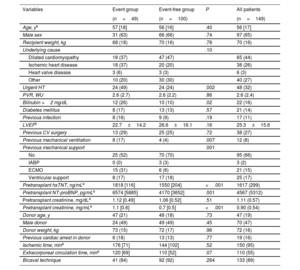
In total, 149 patients were included in the study. Of the initial 172 patients, 4 were excluded due to cardiopulmonary transplantation, 6 due to retransplantation, and 13 due to age < 16 years. The typical baseline profile was that of a middle-aged man (median age, 56 years) undergoing HT due to dilated or ischemic cardiomyopathy. One-third of the patients were listed as urgent status. Ischemic and extracorporeal circulation times were relatively short. The baseline values and characteristics of the 149 patients are shown in table 1. The median length of stay in the resuscitation room was 5 days for the event-free group and 9.5 days for the event (death/severe PGF) group (P < .001).

Table 1.

Baseline characteristics

Variables  Event group  Event-free group  P  All patients 
  (n=49)  (n=100)    (n=149) 
Age, ya  57 [18]  56 [16]  .40  56 [17] 
Male sex  31 (63)  66 (66)  .74  97 (65) 
Recipient weight, kg  68 (18)  70 (16)  .78  70 (16) 
Underlying cause      .10   
Dilated cardiomyopathy  18 (37)  47 (47)    65 (44) 
Ischemic heart disease  18 (37)  20 (20)    38 (26) 
Heart valve disease  3 (6)  3 (3)    6 (3) 
Other  10 (20)  30 (30)    40 (27) 
Urgent HT  24 (49)  24 (24)  .002  48 (32) 
PVR, WU  2.6 (2.7)  2.6 (2.2)  .86  2.6 (2.4) 
Bilirubin >2 mg/dL  12 (26)  10 (10)  .02  22 (16) 
Diabetes mellitus  8 (17)  13 (13)  .57  21 (14) 
Previous infection  8 (16)  9 (9)  .19  17 (11) 
LVEFb  22.7±14.2  26.6±16.1  .16  25.3±15.6 
Previous CV surgery  13 (29)  25 (25)  .72  38 (27) 
Previous mechanical ventilation  8 (17)  4 (4)  .007  12 (8) 
Previous mechanical support      .001   
No  25 (52)  70 (70)    95 (66) 
IABP  0 (0)  3 (3)    3 (2) 
ECMO  15 (31)  6 (6)    21 (15) 
Ventricular support  8 (17)  17 (18)    25 (17) 
Pretransplant hsTNT, ng/mLa  1818 [116]  1550 [204]  <.001  1617 (299) 
Pretransplant NT-proBNP, pg/mLa  6574 [5885]  4170 [3652]  .001  4567 (5312) 
Pretransplant creatinine, mg/dLa  1.12 [0.49]  1.06 [0.52]  .51  1.11 (0.57) 
Pretransplant creatinine, mg/mLa  1.1 [0.6]  0.7 [0.5]  <.001  0.90 (0.54) 
Donor age, y  47 (21)  48 (18)  .73  47 (19) 
Male donor  24 (49)  49 (49)  .45  70 (47) 
Donor weight, kg  73 (15)  72 (17)  .96  72 (16) 
Previous cardiac arrest in donor  6 (18)  13 (13)  .77  19 (16) 
Ischemic time, mina  176 [71]  144 [102]  .52  150 (95) 
Extracorporeal circulation time, mina  120 [69]  110 [52]  .07  110 (55) 
Bicaval technique  41 (84)  92 (92)  .264  133 (89) 

CV, cardiovascular; ECMO, extracorporeal membrane oxygenation; hsTNT, high-sensitive troponin T; HT, heart transplantation; IABP, intra-aortic balloon pump; LVEF, left ventricular fraction; NT-proBNP, N-terminal pro-B-type natriuretic peptide; PVR, pulmonary vascular resistance; WU, Wood units.

a

Median [interquartile range].

b

Need for ECMO or IABP after surgery.

Twenty-three patients (15%) died and 26 (17%) developed severe PGF. Specifically, 23 (15.4%) of the 149 patients died in hospital, 5 after experiencing severe PGF. Twenty-six patients (17.4%) experienced severe PGF but survived. All patients with severe PGF were treated with VA-ECMO. The median time to death was 8 days [IQR, 15 days]. Five patients died within the first 24hours post-HT, 1 within the first 48hours, 1 within the first 72hours, and 1 within the first 96hours.

Changes in biomarkers and association with prognosis

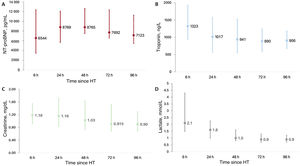
Crude biomarker levels are summarized in figure 1. NT-proBNP and troponin levels remained very high throughout the post-HT observation period. In both cases, levels more or less stabilized after the first 24hours, at a value of approximately 8000 pg/mL for NT-proBNP (figure 1A) and 1000 ng/mL for troponin (figure 1B). Creatinine levels stabilized between 0.9 and 1.0mg/dL after 48hours post-HT (figure 1C), while lactate levels stabilized at a level of < 2 mmol/L after 24hours post-HT (figure 1D).

Figure 1.

Post-HT changes in blood levels of N-terminal pro-B-type natriuretic peptide (NT-proBNP) (A), troponin (B), creatinine (C), and lactate (D). Values are expressed as median (circle) and interquartile range (error bars). HT, heart transplantation.

(0.2MB).

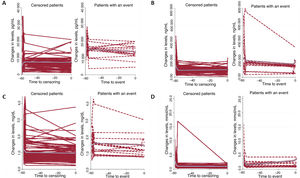
Biomarker trajectories in patients who died or developed severe PGF vs those who did not (censored group) are shown in figure 2. NT-proBNP, troponin, and creatinine trajectories remained stable in both groups, but they were consistently higher in patients who experienced an event (figure 2A-C). There was a trend towards increasing lactate levels before in-hospital mortality or severe PGF; this trend was not observed in the event-free group.

Figure 2.

Trajectories of blood levels of N-terminal pro-B-type natriuretic peptide (A), troponin (B), creatinine (C), and lactate (D) in the period before severe primary graft failure (PGF) or in-hospital death (primary composite outcome) and before the end of follow-up (censored patients in the event-free group).

(0.6MB).

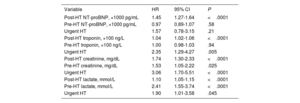
Associations between biomarker levels and time to the event are summarized in table 2. All biomarkers were strongly associated with the primary composite outcome (severe PGF/in-hospital mortality) (P < .0001). The cumulative incidence of the primary outcome increased by 45% for each 1000-pg/mL increase in NT-proBNP levels, by 4% for each 100-ng/mL increase in troponin levels, by 74% for each 1-mg/dL increase in creatinine levels, and by 10% for each 1-mmol/L increase in lactate levels. Pre-HT biomarker levels were significantly associated with the primary outcome for creatinine and lactate only. Urgent HT was significantly associated with death or severe PGF in models featuring troponin, creatinine, and lactate, but not NT-proBNP (table 2).

Table 2.

Association between post-HT blood biomarker levels and primary composite outcome of primary graft failure or in-hospital mortality (joint model adjusted for pretransplant blood levels and urgent HT)

Variable  HR  95% CI  P 
Post-HT NT-proBNP, ×1000 pg/mL  1.45  1.27-1.64  <.0001 
Pre-HT NT-proBNP, ×1000 pg/mL  0.97  0.89-1.07  .58 
Urgent HT  1.57  0.78-3.15  .21 
Post-HT troponin, ×100 ng/L  1.04  1.02-1.06  <.0001 
Pre-HT troponin, ×100 ng/L  1.00  0.98-1.03  .94 
Urgent HT  2.35  1.29-4.27  .005 
Post-HT creatinine, mg/dL  1.74  1.30-2.33  <.0001 
Pre-HT creatinine, mg/dL  1.53  1.05-2.22  .025 
Urgent HT  3.06  1.70-5.51  <.0001 
Post-HT lactate, mmol/L  1.10  1.05-1.15  <.0001 
Pre-HT lactate, mmol/L  2.41  1.55-3.74  <.0001 
Urgent HT  1.90  1.01-3.58  .045 

HR, hazard ratio; HT, heart transplantation; NT-proBNP, N-terminal pro-B-type natriuretic peptide.

Comparison of ROC curves

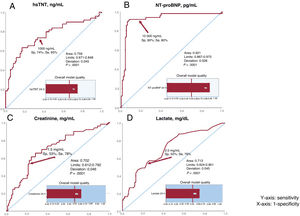
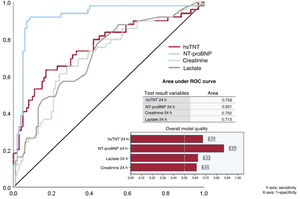
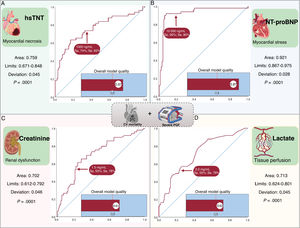
The ROC curve analysis for biomarker levels at 24hours showed significant areas under the curve (P = .0001), with values ranging from 0.702 for creatinine to 0.921 for NT-proBNP. The overall model quality exceeded 50% in all cases. ROC curves depicting sensitivity and specificity cutoff points for some of the reference values are shown in figure 3. The cutoff of 10 000 pg/mL observed for NT-proBNP is particularly relevant from a clinical perspective, as it predicted the primary composite outcome with a sensitivity of 90% and a specificity of 80%. The ROC curves for all the biomarkers were significant and showed similar patterns, except for the NT-proBNP curve, which more effectively identified patients at risk of death or severe PGF in the first 24hours post-HT. The curves are compared in figures 4 and 5.

Figure 3.

Receiver operating characteristic curves for severe primary graft failure or in-hospital mortality for blood levels measured 24hours after heart transplantation: troponin (A), NT-proBNP (B), creatinine (C), and lactate (D). hsTNT, high-sensitivity troponin T; NT-proBNP, N-terminal pro-B-type natriuretic peptide; Se, sensitivity; Sp, specificity.

(0.38MB).
Figure 4.

Comparison of receiver operating characteristic curves. hsTNT, high-sensitivity troponin; NT-proBNP, N-terminal pro-B-type natriuretic peptide.

(0.19MB).
Figure 5.

Central illustration. Graphic summary of biomarker cutoff points for predicting prognosis. CV, cardiovascular; hsTNT, high-sensitivity troponin T; NT-proBNP, N-terminal pro-B-type natriuretic peptide; PGF, primary graft failure; Se, sensitivity; Sp, specificity.

(0.59MB).
DISCUSSION

HT is a well-established treatment for advanced heart failure. Despite standardized surgical techniques, the procedure remains highly complex.1–3 One of the most serious complications in the immediate posttransplantation period is PGF.7,8 As with other forms of heart surgery, HT induces hemodynamic and functional alterations detectable in blood tests, such as elevations in humoral markers of myocardial stress,9 cardiac necrosis,10 kidney dysfunction,11 and tissue perfusion.12 The aim of this study was to assess increased serum levels of these biomarkers in patients undergoing HT and analyze changes following the procedure, particularly in patients who subsequently developed severe complications (death or severe PGF). We also sought to identify cutoff points for biomarkers measured at 24hours post-HT that could predict favorable or poor outcomes. We found that NT-proBNP and troponin levels remained very high throughout the posttransplant observation period and then stabilized after the first 24hours post-HT. Creatinine stabilized after 48hours and lactate after 24hours. All biomarkers were strongly associated with the primary composite outcome of severe PGF or in-hospital mortality (P < .0001). NT-proBNP had the strongest discriminatory power, with a value of 10 000 pg/mL at 24hours post-HT predicting a severe complication with a sensitivity of 90% and a specificity of 80%.

The baseline characteristics of the patients in this study are similar to those reported in other national and international HT series.8,13 Based on data for Spain, HT patients in 2022 were predominantly men (71%) and, with a mean age of 48 years, were younger than the patients in our series. In 37% of cases, HT was performed as an urgent procedure. Since 2018, the percentage of urgent HTs in Spain has fallen to levels similar to that observed in the current series (33%). The ischemic time in our study was 164minutes, which is shorter than the 240-minute threshold beyond which the risk of complications increases. This shorter time confirms the trend towards reduced ischemic times observed in recent years.8,14 Length of stay in the resuscitation unit was shorter than that reported in other series, probably reflecting the recipient profile. The ASIS-TC study analyzing the use of short-term mechanical circulatory support devices as a bridge to urgent HT in Spain reported a median ICU stay of 18 days posttransplantation.15

In relation to the use of biomarkers in HT, it is important to recognize that there has been a need to identify donor and recipient characteristics linked to PGF since the early days of HT. The RADIAL16 and PREDICTA17 models emerged in recent years to predict PGF after HT, but neither of them uses blood or serum biomarker levels in their risk calculations. Although biomarkers have been used as noninvasive tools for predicting organ rejection8,19 and recipient responses according to levels observed in donors,20,21 our study is the first to analyze the ability of biomarkers to predict PGF. The 4 biomarkers selected are closely aligned with clinical practice and can be quickly and easily measured in practically any setting. Measurements were taken at 6, 24, 48, 72, and 96hours post-HT. We believed that levels at 24hours after transplantation would provide the most reliable predictions of severe PGF or death, as PGF typically occurs within the first few hours.5

NT-proBNP and troponin levels were very high throughout the posttransplant observation period and then more or less stabilized after the first 24hours. The most likely explanation is the interruption of ischemia-induced heart damage and destruction of cardiac cells following the removal of the diseased heart. In addition, a decrease in NT-proBNP and troponin levels would be expected after transplantation as a notable percentage of HT recipients have a history of acute coronary syndrome.8,15 Creatinine levels stabilized after 48hours posttransplant, while lactate levels stabilized after 24hours. In both cases, the change was probably linked to the effects of extracorporeal circulation on kidney function22,23; these effects can also increase NT-proBNP levels.24 Elevated lactate levels, reflecting anabolic metabolism, indicate tissue hypoperfusion due to an imbalance between oxygen supply and demand.25 Studies similar to ours have reported a correlation between lactate levels and mortality in patients placed on mechanical circulatory support prior to urgent transplantation.26

All 4 biomarkers were strongly associated with the primary composite outcome of severe PGF or in-hospital mortality (P < .0001). The cumulative incidence of this outcome, for example, increased by 45% for each 1000-pg/mL increase in NT-proBNP. NT-proBNP has been widely studied as a noninvasive marker of acute rejection in HT recipients,18,19 but its value as a predictor of adverse outcomes in this setting is not well understood.

ROC curves were used to select optimal cutoff points in the discriminatory analysis.27 We observed that biomarker levels at 24hours post-HT were able to identify patients with a poor prognosis. All the biomarkers showed good predictive correlations, but NT-proBNP was particularly effective. A level of ≥ 10 000 pg/mL 24hours post-HT predicted severe PGF or in-hospital mortality with a sensitivity of 90% and a specificity of 80%. This statistically significant result is even more relevant because of its biological plausibility: NT-proBNP is a marker of cardiac stress/distensibility and, accordingly, an elevation in levels would indicate myocardial distress, potentially preceding ventricular dysfunction. Considering that PGF typically occurs within the first 24 to 48hours of transplantation and is the leading cause of early mortality in HT (accounting for 20% of deaths in the first year and 40% of deaths in the first month6,7), biomarker-based tools capable of predicting PGF would be particularly valuable, as they would enable close monitoring and early institution of support measures where necessary. Our findings indicate that NT-proBNP is statistically the most powerful biomarker for predicting death and severe PGF in HT recipients.

The main limitation of this study was the small sample size. However, because this was a single-center study, recruiting more patients would have taken too long and the additional time might have led to protocol changes and a loss of homogeneity. The single-center prospective design can be viewed as a strength, as it allowed for careful planning and definition of the study variables. Finally, our study is the first to conduct a detailed prospective analysis of biomarkers widely used in routine clinical practice.

CONCLUSIONS

Post-HT increases in clinical biomarkers have prognostic implications. Significant increases are linked to death and the need for circulatory support. Of the biomarkers analyzed, NT-proBNP is the most powerful predictor of prognosis. A level of 10 000 pg/mL predicted severe PGF or in-hospital mortality with a sensitivity of 90% and a specificity of 80%.

WHAT IS KNOWN ABOUT THE TOPIC?

  • HT induces significant physical stress, leading to increased levels of blood biomarkers.

  • PGF is the main cause of death in the immediate posttransplant period and during the first month. Tools capable of predicting this potentially fatal event are needed.

  • The most widely used biomarkers available after HT reflect myocardial necrosis, myocardial stress, renal dysfunction, and tissue perfusion.

  • Little is known about normal posttransplant changes in these biomarkers or about whether significant changes can predict poor outcomes, such as severe PGF and death.

WHAT DOES THIS STUDY ADD?

  • Increases in biomarkers after HT surgery are associated with clinical outcomes. Significant increases in troponin T, NT-proBNP, creatinine, and lactate levels are linked to in-hospital mortality and severe PGF.

  • Of the biomarkers analyzed, NT-proBNP is the most effective in predicting prognosis. An NT-proBNP level of 10 000 pg/mL predicted in-hospital mortality and severe PGF with a sensitivity of 90% and a specificity of 80%.

FUNDING

None

ETHICAL CONSIDERATIONS

The study was approved by the Biomedical Research Ethics Committee of Instituto de Investigación Sanitaria La Fe and adhered to the ethical principles outlined in the Declaration of Helsinki for medical research involving humans. Informed consent was obtained from all patients included. Sex and gender were reported in accordance with international guidelines.

STATEMENT ON THE USE OF ARTIFICIAL INTELLIGENCE

Artificial intelligence has not been used.

AUTHORS’ CONTRIBUTIONS

All authors have made substantial contributions to this work. They participated in writing or critically reviewing the manuscript and reviewed and approved the final version. They agree to be accountable for all aspects of the work, ensuring that issues related to the accuracy or integrity of any part of the work will be appropriately investigated and resolved.

Study design: R. López-Vilella and L. Almenar Bonet. Research and data compilation: R. López-Vilella, J. Martínez Solé, S. Huélamo Montoro, and L. Almenar Bonet. Data analysis: all authors. Writing of manuscript: R. López-Vilella, J. Martínez Solé, V. Donoso Trenado, I. Sánchez-Lázaro, I. Zarragoikoetxea Jauregui, P. Carmona García, M. Pérez Guillén, C. Domínguez Massa, L. Martínez Dolz, and L. Almenar Bonet.

Review of manuscript: R. López-Vilella, V. Donoso Trenado, I. Sánchez-Lázaro, I. Zarragoikoetxea Jauregui, P. Carmona García, M. Pérez Guillén, C. Domínguez Massa, L. Martínez Dolz, and L. Almenar Bonet.

CONFLICTS OF INTEREST

None.

References
[1]
T.A. McDonagh, M. Metra, M. Adamo, et al.
2021 ESC Guidelines for the diagnosis and treatment of acute and chronic heart failure: Developed by the Task Force for the diagnosis and treatment of acute and chronic heart failure of the European Society of Cardiology (ESC). With the special contribution of the Heart Failure Association (HFA) of the ESC.
Eur J Heart Fail., (2022), 24 pp. 4-131
[2]
M.G. Crespo-Leiro, M. Metra, L.H. Lund, et al.
Advanced heart failure: a position statement of the Heart Failure Association of the European Society of Cardiology.
Eur J Heart Fail., (2018), 20 pp. 1505-1535
[3]
T.A. McDonagh, M. Metra, M. Adamo, ESC Scientific Document Group, et al.
2023 Focused Update of the 2021 ESC Guidelines for the diagnosis and treatment of acute and chronic heart failure.
Eur Heart J., (2023), 44 pp. 3627-3639
[4]
J. Kobashigawa, S. Hall, P. Shah, et al.
The evolving use of biomarkers in heart transplantation: Consensus of an expert panel.
Am J Transplant., (2023), 23 pp. 727-735
[5]
J. Kobashigawa, A. Zuckermann, P. Macdonald, et al.
Report from a consensus conference on primary graft dysfunction after cardiac transplantation.
J Heart Lung Transplant., (2014), 33 pp. 327-340
[6]
M.J. Crowther, K.R. Abrams, P.C. Lambert.
Joint modelling of longitudinal and survival data.
Stata J., (2013), 13 pp. 165-184
[7]
S.S.A. Singh, J.R. Dalzell, C. Berry, N. Al-Attar.
Primary graft dysfunction after heart transplantation: a thorn amongst the roses.
Heart Fail Rev., (2019), 24 pp. 805-820
[8]
F. González-Vílchez, F. Hernández-Pérez, L. Almenar-Bonet, on behalf of the Spanish Heart Transplant Teams, et al.
Spanish heart transplant registry. 34th official report of the Heart Failure Association of the Spanish Society of Cardiology.
Rev Esp Cardiol., (2023), 76 pp. 901-909
[9]
R. Krittayaphong, T. Boonyasirinant, P. Saiviroonporn, P. Thanapiboonpol, S. Nakyen, S. Udompunturak.
Correlation Between NT-pro BNP levels and left ventricular wall stress, sphericity index and extent of myocardial damage: a magnetic resonance imaging study.
J Card Fail., (2008), 14 pp. 687-694
[10]
A.M. Chaulin.
Cardiac Troponins Metabolism: From Biochemical Mechanisms to Clinical Practice (Literature Review).
Int J Mol Sci., (2021), 22 pp. 10928
[11]
S. Verma, J.A. Kellum.
Defining Acute Kidney Injury.
Crit Care Clin., (2021), 37 pp. 251-266
[12]
B.M. Fuller, R.P. Dellinger.
Lactate as a Hemodynamic Marker in the Critically Ill.
Curr Opin Crit Care., (2012), 18 pp. 267-272
[13]
A. Velleca, M.A. Shullo, K. Dhital, et al.
The International Society for Heart and Lung Transplantation (ISHLT) guidelines for the care of heart transplant recipients.
J Heart Lung Transplant., (2023), 42 pp. e1-e141
[14]
F. González-Vílchez, M. Gómez-Bueno, L. Almenar-Bonet, et al.
Spanish heart transplant registry. 33rd official report of the Heart failure Association of the Spanish Society of Cardiology.
Rev Esp Cardiol., (2022), 75 pp. 926-935
[15]
E. Barge-Caballero, L. Almenar-Bonet, F. González-Vilchez, et al.
Clinical outcomes of temporary mechanical circulatory support as a direct bridge to heart transplantation: a nationwide Spanish registry.
Eur J Heart Fail., (2018), 20 pp. 178-186
[16]
J. Segovia, M.D. Cosío, J.M. Barceló, et al.
RADIAL: a novel primary graft failure risk score in heart transplantation.
J Heart Lung Transplant., (2011), 30 pp. 644-651
[17]
S.S.A. Singh, S.D. De, S. Rushton, C. Berry, N. Al-Attar.
PREDICTA: A Model to Predict Primary Graft Dysfunction After Adult Heart Transplantation in the United Kingdom.
J Card Fail., (2019), 25 pp. 971-977
[18]
A.H. Knook, K. Caliskan, S.D. Valk, E. Boersma, A.H. Balk.
Abstract 2577: N-Terminal Pro-BNP Predicts Severe Late Rejection in Heart Transplant Recipients.
Circulation., (2006), 114
[19]
A. Cuppoletti, E. Roig, F. Pérez-Villa, et al.
Value of NT-proBNP Determinations in the Follow-Up of Heart Transplantation.
Transplant Proc., (2005), 37 pp. 4033-4035
[20]
S. Madan, O. Saeed, J. Shin, et al.
Donor Troponin and Survival After Cardiac Transplantation: An Analysis of the United Network of Organ Sharing Registry.
Circ Heart Fail, (2016), 9 pp. e002909
[21]
A. Vorlat, V.M. Conraads, P.G. Jorens, et al.
Donor B-type natriuretic peptide predicts early cardiac performance after heart transplantation.
J Heart Lung Transplant., (2012), 31 pp. 579-584
[22]
L. Rydén, U. Sartipy, M. Evans, M.J. Holzmann.
Acute kidney injury after coronary artery bypass grafting and long-term risk of end-stage renal disease.
Circulation., (2014), 130 pp. 2005-2011
[23]
R. Bellomo, S. Auriemma, A. Fabbri, et al.
The pathophysiology of cardiac surgery-associated acute kidney injury (CSA-AKI).
Int J Artif Organs., (2008), 31 pp. 166-178
[24]
S. Manzano-Fernández, J.L. Januzzi, M. Boronat-García, et al.
Impact of kidney dysfunction on plasma and urinary N-terminal pro-B-type natriuretic peptide in patients with acute heart failure.
Congest Heart Fail., (2010), 16 pp. 214-220
[25]
M.H. Weil, A.A. Afifi.
Experimental and clinical studies on lactate and pyruvate as indicators of the severity of acute circulatory failure (shock).
Circulation., (1970), 41 pp. 989-1001
[26]
D. Couto-Mallón, F. González-Vílchez, L. Almenar-Bonet, et al.
Prognostic Value of Serum Lactate Levels in Patients Undergoing Urgent Heart Transplant: A Subanalysis of the ASIS-TC Spanish Multicenter Study.
Rev Esp Cardiol., (2019), 72 pp. 208-214
[27]
F.S. Nahm.
Receiver operating characteristic curve: overview and practical use for clinicians.
Korean J Anesthesiol., (2022), 75 pp. 25-36
Copyright © 2024. Sociedad Española de Cardiología