

The prognostic impact of a history of heart failure hospitalizations (HFH) in patients undergoing transcatheter tricuspid edge-to-edge repair (T-TEER) has been scarcely studied. This study presents the results of the TRI-SPA registry, which includes data from 15 Spanish centers.
MethodsA multicenter, retrospective registry was conducted, including patients who underwent T-TEER between June 2020 and May 2023. Patients were classified into the 3 groups, based on the number of HFH in the 12 months prior to the procedure: no HFH, 1 HFH, and >1 HFH (recurrent). The primary endpoint was all-cause mortality and HFH.
ResultsOf the 262 patients included, 167 (63.7%) had no history of HFH, 60 (22.9%) had 1 HFH, and 35 (13.4%) had >1 HFH. Patients with >1 hospitalization had more comorbidities, higher surgical risk, and worse functional class; however, no significant differences were observed in the severity of tricuspid regurgitation either at baseline or after T-TEER. After a median follow-up of 365 [160-643] days, patients with recurrent HFH had higher rates of the composite outcome (9.9%, 16.7%, and 43.1%, respectively; P<.001), as well as higher mortality rates (P=.036) and HFH (P<.001). The number of HFH significantly decreased in the 12 months following T-TEER compared with the 12 months prior (P=.001).
ConclusionsRecurrent HFH within the 12 months prior to the procedure was associated with a higher risk of adverse clinical events during follow-up. T-TEER significantly reduced the number of hospitalizations during the follow-up period.
Keywords
Tricuspid regurgitation (TR) is a common valvular disease associated with high morbidity and mortality, particularly when managed conservatively.1–3 Moderate to severe TR occurs in approximately 20% of patients with chronic heart failure (HF), regardless of left ventricular ejection fraction (LVEF).4 It is especially common and relevant in patients with HF and preserved EF (HFpEF), where it is linked to more advanced disease and hence a higher incidence of atrial fibrillation, greater right ventricular remodeling, and, ultimately, worse outcomes.5,6
Prior HF hospitalization (HFH) is an independent predictor of adverse events in patients with HF7,8 and those who have undergone interventions for left-sided valve disease.9,10 Tricuspid transcatheter edge-to-edge repair (T-TEER) has emerged as a promising treatment for isolated severe TR in recent years, as it offers a minimally invasive alternative to conventional surgery.11–14 Whether prior HFH affects outcomes after T-TEER, however, remains unclear.
The aim of this study, which forms part of the Spanish transcatheter tricuspid valve repair registry (TRI-SPA), was to evaluate the impact of previous HFH on clinical outcomes after T-TEER.
METHODSThe TRI-SPA registry is a retrospective, multicenter, single-arm study designed to collect data on patients with significant symptomatic TR treated with T-TEER at 15 Spanish hospitals. Eligible patients had severe or worse TR despite optimal medical treatment, were deemed ineligible for surgery by the local multidisciplinary cardiology team, and had morphologic features suitable for T-TEER. Patients were excluded if they were missing information on hospitalization during the year before T-TEER or if they had received a device other than TriClip (Abbott Medical, USA) or PASCAL (Edwards Lifesciences, USA). Data were entered using an electronic form designed to collect baseline clinical and echocardiographic data, procedural details, and follow-up information. All participants provided written informed consent after receiving detailed written and verbal explanations about the procedure, data collection, and analyses. The study was approved by the ethics committee at each hospital and adhered to the ethical principles of the Declaration of Helsinki.
Baseline clinical and laboratory variables were evaluated at the time of T-TEER. Clinical characteristics, including cardiovascular risk factors, comorbidities, laboratory findings, and medication details, were recorded, together with the number of HFH in the 12 preceding months. TR severity was assessed using standard 2-dimensional color Doppler findings and classified into 5 grades: mild, moderate, severe, massive, or torrential.15 TR etiology was determined using recently proposed criteria.16,17 Procedural success was defined as successful device deployment and positioning, retrieval of the delivery system, TR severity reduction to ≤2+, and absence of procedure-related mortality, a need for surgery or reintervention, or tricuspid stenosis.18
Endpoints and definitionsPatients were divided into 3 groups based on the number of HFH in the year before T-TEER: 0, 1, or >1 (recurrent hospitalization). The primary endpoint was a composite of all-cause mortality or hospitalization for HF during 12 months of follow-up. Secondary endpoints were these events analyzed separately. HFH rates for predefined groups were calculated as the number of hospitalizations per 100 patient-years during follow-up. Loop diuretic dose changes were calculated by subtracting the dose at 3 months from the baseline dose. A value >0 indicated an increase, <0 a decrease, and 0 no change.19
Statistical analysisThe Shapiro-Wilk test was used to assess the distribution of continuous variables. Normally distributed variables are expressed as mean±SD and nonnormally distributed variables as median [interquartile range]. Categorical variables are expressed as absolute values and corresponding percentages. Between-group differences were analyzed using 1-way analysis of variance for normally distributed continuous variables, the Kruskal-Wallis test for nonnormally distributed continuous variables, and the Pearson chi-square test for categorical variables. The Bonferroni test was applied to correct for multiple comparisons of continuous variables.
One-year incidence rates for the composite primary endpoint and its individual components were analyzed using Kaplan-Meier curves and compared with the log-rank test. Cox proportional hazards regression analysis was used to identify predictors of the composite outcome of all-cause mortality or HFH during follow-up. Variables from the univariate model were included if they were clinically relevant and statistically significant (P<.05). For the multivariate analysis, missing data were assumed to occur at random and handled using multiple imputation with chained equations. Twenty imputed datasets were generated and the results pooled according to Rubin rules. Statistical significance was defined as a 2-tailed P value <.05. Correlation factor analysis was performed to detect potential correlations between pairs of variables. Collinearity (correlation coefficient >0.60) was not observed between any of the continuous variables eligible for inclusion in the multivariate regression analysis. Variables exhibiting collinearity according to the Pearson correlation coefficient were excluded from the multivariate analysis. Results are reported as hazard ratios (HRs) with 95%CI. Statistical analyses were conducted in Stata version 16 (StataCorp, USA).
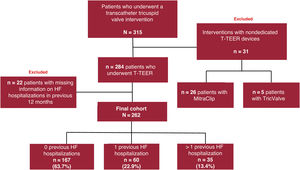
RESULTSStudy populationA total of 262 patients with 159 HFH in the 12 months before T-TEER were included; 167 patients (63.7%) had 0 HFH, 60 (22.9%) had 1 HFH, and 35 (13.4%) had >1 HFH (figure 1). Median follow-up duration was 365 [160–643] days.
Clinical characteristics
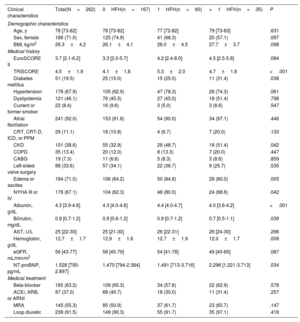
Baseline demographic and clinical characteristics, stratified by the number of HFH before T-TEER, are summarized in table 1. The patients had a median age of 78 [73-82] years, and 186 (71.0%) were women. Those with recurrent HFH were more likely to have more comorbidities (diabetes, anemia, chronic kidney disease) and a higher degree of congestion, as assessed by the presence of edema or ascites. Patients with 0 HFH in the year before T-TEER had the lowest surgical risk according to the TRI-SCORE model (P<.001). They also had lower loop diuretic doses at both baseline and 3 months compared with those with 1 or more HFH (P<.001). Differences in dose changes from baseline to month 3, however, were not significant between the groups (P=.278; table 1 of the supplementary data).
Baseline clinical characteristics according to the number of HFH in the 12 months before tricuspid transcatheter edge-to-edge repair
| Clinical characteristics | Total(N=262) | 0HFH(n=167) | 1HFH(n=60) | >1HFH(n=35) | P |
|---|---|---|---|---|---|
| Demographic characteristics | |||||
| Age, y | 78 [73-82] | 78 [73-82] | 77 [72-82] | 79 [73-83] | .631 |
| Sex, female | 186 (71.0) | 125 (74.9) | 41 (68.3) | 20 (57.1) | .097 |
| BMI, kg/m2 | 26.3±4.2 | 26.1±4.1 | 26.0±4.5 | 27.7±3.7 | .098 |
| Medical history | |||||
| EuroSCORE II | 3.7 [2.1-6.2] | 3.3 [2.0-5.7] | 4.2 [2.4-8.0] | 4.5 [2.5-5.8] | .084 |
| TRISCORE | 4.5±1.9 | 4.1±1.8 | 5.3±2.0 | 4.7±1.8 | <.001 |
| Diabetes mellitus | 51 (19.5) | 25 (15.0) | 15 (25.0) | 11 (31.4) | .038 |
| Hypertension | 178 (67.9) | 105 (62.9) | 47 (78.3) | 26 (74.3) | .061 |
| Dyslipidemia | 121 (46.1) | 76 (45.5) | 27 (45.0) | 18 (51.4) | .798 |
| Current or former smoker | 22 (8.4) | 16 (9.6) | 3 (5.0) | 3 (8.6) | .547 |
| Atrial fibrillation | 241 (92.0) | 153 (91.6) | 54 (90.0) | 34 (97.1) | .446 |
| CRT, CRT-D, ICD, or PPM | 29 (11.1) | 18 (10.8) | 4 (6.7) | 7 (20.0) | .133 |
| CKD | 101 (38.6) | 55 (32.9) | 28 (48.7) | 18 (51.4) | .042 |
| COPD | 35 (13.4) | 20 (12.0) | 8 (13.3) | 7 (20.0) | .447 |
| CABG | 19 (7.3) | 11 (6.6) | 5 (8.3) | 3 (8.6) | .859 |
| Left-sided valve surgery | 88 (33.6) | 57 (34.1) | 22 (36.7) | 9 (25.7) | .535 |
| Edema or ascites | 184 (71.0) | 106 (64.2) | 50 (84.8) | 28 (80.0) | .005 |
| NYHA III or IV | 176 (67.1) | 104 (62.3) | 48 (80.0) | 24 (68.6) | .042 |
| Albumin, g/dL | 4.3 [3.9-4.6] | 4.3 [4.0-4.6] | 4.4 [4.0-4.7] | 4.0 [3.6-4.2] | <.001 |
| Bilirubin, mg/dL | 0.9 [0.7-1.2] | 0.9 [0.6-1.2] | 0.9 [0.7-1.2] | 0.7 [0.5-1.1] | .039 |
| AST, U/L | 25 [22-30] | 25 [21-30] | 26 [22-31] | 26 [24-30] | .296 |
| Hemoglobin, g/dL | 12.7±1.7 | 12.9±1.6 | 12.7±1.9 | 12.0±1.7 | .008 |
| eGFR, mL/min/m2 | 56 [43-77] | 58 [45-79] | 54 [41-78] | 49 [40-65] | .087 |
| NT-proBNP, pg/mL | 1.528 [795-2.897] | 1.470 [794-2.384] | 1.491 [713-3.716] | 2.296 [1.221-3.713] | .034 |
| Medical treatment | |||||
| Beta-blocker | 165 (63.2) | 109 (65.3) | 34 (57.6) | 22 (62.9) | .578 |
| ACEi, ARB, or ARNI | 97 (37.0) | 68 (40.7) | 18 (30.0) | 11 (31.4) | .257 |
| MRA | 145 (55.3) | 85 (50.9) | 37 (61.7) | 23 (65.7) | .147 |
| Loop diuretic | 238 (91.5) | 149 (90.3) | 55 (91.7) | 35 (97.1) | .418 |
ACEI, angiotensin-converting enzyme inhibitor; ARB, angiotensin receptor blocker; ARNI, angiotensin receptor-neprilysin inhibitor; AST, aspartate aminotransferase; BMI, body mass index; CABG, coronary artery bypass grafting; ICD, implantable cardioverter-defibrillator; COPD, chronic obstructive pulmonary disease; CKD, chronic kidney disease; CRT, cardiac resynchronization therapy; CRT-D, cardiac resynchronization therapy with defibrillator; eGFR, estimated glomerular filtration rate; EuroSCORE II, European System for Cardiac Operative Risk Evaluation II; HFH, heart failure hospitalization; NT-proBNP, N-terminal pro-brain natriuretic peptide; MRA, mineralocorticoid receptor antagonist; NYHA, New York Heart Association; PPM, permanent pacemaker; TRISCORE, risk score for predicting in-hospital mortality after isolated tricuspid valve surgery.
Data are expressed as No. (%), mean±SD or median [interquartile range].
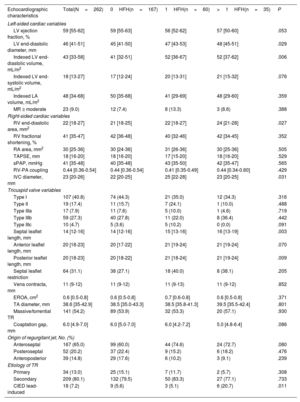
Echocardiographic characteristics are summarized in table 2. Median LVEF was 59% [55%-62%], and a slight trend toward lower values was observed in patients with recurrent HFH (P=.053). These patients also had significantly larger left (P=.029) and right (P=.027) ventricular dimensions. Differences in TR severity between groups were nonsignificant. Secondary TR, observed in approximately 80% of the population, was the most common etiology. Cardiac implantable electronic device lead-induced TR was significantly more common in patients with recurrent HFH (P=.011).
Echocardiographic characteristics according to the number of HFH in the 12 months before tricuspid transcatheter edge-to-edge repair
| Echocardiographic characteristics | Total(N=262) | 0HFH(n=167) | 1HFH(n=60) | >1HFH(n=35) | P |
|---|---|---|---|---|---|
| Left-sided cardiac variables | |||||
| LV ejection fraction, % | 59 [55-62] | 59 [55-63] | 56 [52-62] | 57 [50-60] | .053 |
| LV end-diastolic diameter, mm | 46 [41-51] | 45 [41-50] | 47 [43-53] | 48 [45-51] | .029 |
| Indexed LV end-diastolic volume, mL/m2 | 43 [33-58] | 41 [32-51] | 52 [36-67] | 52 [37-62] | .006 |
| Indexed LV end-systolic volume, mL/m2 | 18 [13-27] | 17 [12-24] | 20 [13-31] | 21 [15-32] | .076 |
| Indexed LA volume, mL/m2 | 48 [34-68] | 50 [35-68] | 41 [29-69] | 48 [29-60] | .359 |
| MR ≥ moderate | 23 (9.0) | 12 (7.4) | 8 (13.3) | 3 (8.6) | .388 |
| Right-sided cardiac variables | |||||
| RV end-diastolic area, mm2 | 22 [18-27] | 21 [18-25] | 22 [18-27] | 24 [21-28] | .027 |
| RV fractional shortening, % | 41 [35-47] | 42 [36-48] | 40 [32-46] | 42 [34-45] | .352 |
| RA area, mm2 | 30 [25-36] | 30 [24-36] | 31 [26-36] | 30 [25-36] | .505 |
| TAPSE, mm | 18 [16-20] | 18 [16-20] | 17 [15-20] | 18 [16-20] | .529 |
| sPAP, mmHg | 41 [35-48] | 40 [35-48] | 43 [35-50] | 42 [35-47] | .565 |
| RV-PA coupling | 0.44 [0.36-0.54] | 0.44 [0.36-0.54] | 0.41 [0.35-0.49] | 0.44 [0.34-0.60] | .429 |
| IVC diameter, mm | 23 [20-26] | 22 [20-25] | 25 [22-28] | 23 [20-25] | .031 |
| Tricuspid valve variables | |||||
| Type I | 107 (40.8) | 74 (44.3) | 21 (35.0) | 12 (34.3) | .316 |
| Type II | 19 (17.4) | 11 (15.7) | 7 (24.1) | 1 (10.0) | .488 |
| Type IIIa | 17 (7.9) | 11 (7.6) | 5 (10.0) | 1 (4.6) | .719 |
| Type IIIb | 59 (27.3) | 40 (27.8) | 11 (22.0) | 8 (36.4) | .442 |
| Type IIIc | 10 (4.7) | 5 (3.6) | 5 (10.2) | 0 (0.0) | .091 |
| Septal leaflet length, mm | 14 [12-16] | 14 [12-16] | 15 [13-16] | 16 [13-19] | .003 |
| Anterior leaflet length, mm | 20 [18-23] | 20 [17-22] | 21 [19-24] | 21 [19-24] | .070 |
| Posterior leaflet length, mm | 20 [18-23] | 20 [18-22] | 21 [18-24] | 21 [19-24] | .009 |
| Septal leaflet restriction | 64 (31.1) | 38 (27.1) | 18 (40.0) | 8 (38.1) | .205 |
| Vena contracta, mm | 11 (9-12) | 11 (9-12) | 11 (9-13) | 11 (9-12) | .852 |
| EROA, cm2 | 0.6 [0.5-0.8] | 0.6 [0.5-0.8] | 0.7 [0.6-0.8] | 0.6 [0.5-0.8] | .371 |
| TA diameter, mm | 38.6 [35-42.9] | 38.5 [35.0-43.3] | 38.5 [35.8-41.3] | 39.5 [35.5-42.4] | .801 |
| Massive/torrential TR | 141 (54.2) | 89 (53.9) | 32 (53.3) | 20 (57.1) | .930 |
| Coaptation gap, mm | 6.0 [4.9-7.0] | 6.0 [5.0-7.0] | 6.0 [4.2-7.2] | 5.0 [4.8-6.4] | .086 |
| Origin of regurgitant jet, No. (%) | |||||
| Anteroseptal | 167 (65.0) | 99 (60.0) | 44 (74.6) | 24 (72.7) | .080 |
| Posteroseptal | 52 (20.2) | 37 (22.4) | 9 (15.2) | 6 (18.2) | .476 |
| Anteroposterior | 39 (14.8) | 29 (17.6) | 6 (10.2) | 3 (9.1) | .239 |
| Etiology of TR | |||||
| Primary | 34 (13.0) | 25 (15.1) | 7 (11.7) | 2 (5.7) | .308 |
| Secondary | 209 (80.1) | 132 (79.5) | 50 (83.3) | 27 (77.1) | .733 |
| CIED lead-induced | 18 (7.2) | 9 (5.6) | 3 (5.1) | 6 (20.7) | .011 |
CIED, cardiac implantable electronic device; EROA, effective regurgitant orifice area; IVC, inferior vena cava; LA, left atrial; LV, left ventricular; MR, mitral regurgitation; PA, pulmonary artery; RA, right atrial; RV, right ventricular; sPAP, systolic pulmonary artery pressure; TA, tricuspid annulus; TAPSE, tricuspid annular plane systolic excursion; TR, tricuspid regurgitation.
Data are expressed as No. (%), mean±SD or median [interquartile range].
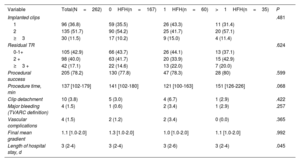
No significant between-group differences were observed for number of devices implanted or residual TR at discharge (P=.624). The percentage of patients with residual TR ≤2+ was 85.4% in the 0-HFH group, 78.0% in the 1-HFH group, and 80% in the >1-HFH group (P=.387). A history of HFH was not associated with periprocedural complications, although patients who had never been hospitalized for HF had shorter hospital stays (table 3).
Procedural outcomes according to the number of HFH in the 12 months before tricuspid transcatheter edge-to-edge repair
| Variable | Total(N=262) | 0HFH(n=167) | 1HFH(n=60) | >1HFH(n=35) | P |
|---|---|---|---|---|---|
| Implanted clips | .481 | ||||
| 1 | 96 (36.8) | 59 (35.5) | 26 (43.3) | 11 (31.4) | |
| 2 | 135 (51.7) | 90 (54.2) | 25 (41.7) | 20 (57.1) | |
| ≥3 | 30 (11.5) | 17 (10.2) | 9 (15.0) | 4 (11.4) | |
| Residual TR | .624 | ||||
| 0-1+ | 105 (42.9) | 66 (43.7) | 26 (44.1) | 13 (37.1) | |
| 2 + | 98 (40.0) | 63 (41.7) | 20 (33.9) | 15 (42.9) | |
| ≥3 + | 42 (17.1) | 22 (14.6) | 13 (22.0) | 7 (20.0) | |
| Procedural success | 205 (78.2) | 130 (77.8) | 47 (78.3) | 28 (80) | .599 |
| Procedure time, min | 137 [102-179] | 141 [102-180] | 121 [100-163] | 151 [126-226] | .068 |
| Clip detachment | 10 (3.8) | 5 (3.0) | 4 (6.7) | 1 (2.9) | .422 |
| Major bleeding (TVARC definition) | 4 (1.5) | 1 (0.6) | 2 (3.4) | 1 (2.9) | .257 |
| Vascular complications | 4 (1.5) | 2 (1.2) | 2 (3.4) | 0 (0.0) | .365 |
| Final mean gradient | 1.1 [1.0-2.0] | 1.3 [1.0-2.0] | 1.0 [1.0-2.0] | 1.1 [1.0-2.0] | .992 |
| Length of hospital stay, d | 3 (2-4) | 3 (2-4) | 3 (2-6) | 3 (2-4) | .045 |
HFH, heart failure hospitalization; TR, tricuspid regurgitation; TVARC, Tricuspid Valve Academic Research Consortium.
Data are expressed as No. (%) or median [interquartile range].
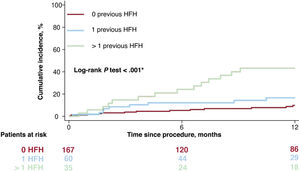
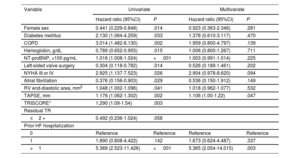
The primary endpoint of all-cause mortality or HFH in the year after T-TEER occurred in 36 patients (13.7%). The rate stratified by the number of prior hospitalizations was 9.9% for 0 HFH, 16.7% for 1 HFH, and 43.1% for >1 HFH (log-rank P<.001, figure 2). Similar percentages were observed in patients in whom the procedure had been unsuccessful (9.1%, 23.1%, and 73.4%, respectively; P<.001). In the subgroup of patients with residual TR ≤2+ at discharge, just 8.9% of those with 0 HFH experienced the primary outcome; the corresponding percentages for those with 1 and >1 HFH were 13.6% and 34% (P=.001). Patients with 1 HFH were significantly less likely to die or be rehospitalized for HF during follow-up than those with recurrent HFH (log-rank, P=.01); the difference with patients in the 0-HFH group was not significant (log-rank P=.14). The results of the univariate Cox regression analysis for the primary endpoint are presented in table 2 of the supplementary data. In the multivariate Cox regression analysis, recurrent HFH (HR=5.37; 95%CI, 2.05–14.02; P=.003) and reduced tricuspid annular plane systolic excursion (HR=1.11; 95%CI, 1.00–1.22; P=.043) were independently associated with the composite of all-cause mortality or HFH during follow-up (table 4).

Kaplan-Meier curves for the primary endpoint stratified by heart failure hospitalization (HFH) in the 12 months before tricuspid transcatheter edge-to-edge repair. *P values from individual analysis of the primary composite endpoint (0 vs 1HFH, P=.14; 0 vs >1HFH, P<.001; 1 vs >1HFH, P=.01).
Multivariate analysis for the composite endpoint of all-cause mortality or HF hospitalization at 1 year
| Variable | Univariate | Multivariate | ||
|---|---|---|---|---|
| Hazard ratio (95%CI) | P | Hazard ratio (95%CI) | P | |
| Female sex | 0.441 (0.229-0.848) | .014 | 0.923 (0.363-2.346) | .281 |
| Diabetes mellitus | 2.130 (1.064-4.259) | .033 | 1.378 (0.610-3.117) | .470 |
| COPD | 3.014 (1.482-6.130) | .002 | 1.959 (0.800-4.797) | .139 |
| Hemoglobin, g/dL | 0.789 (0.652-0.955) | .015 | 1.006 (0.800-1.267) | .711 |
| NT-proBNP, ×100 pg/mL | 1.016 (1.008-1.024) | <.001 | 1.003 (0.991-1.014) | .225 |
| Left-sided valve surgery | 0.304 (0.118-0.782) | .014 | 0.526 (0.189-1.461) | .202 |
| NYHA III or IV | 2.925 (1.137-7.523) | .026 | 2.904 (0.978-8.620) | .094 |
| Atrial fibrillation | 0.376 (0.156-0.903) | .029 | 0.536 (0.150-1.912) | .149 |
| RV end-diastolic area, mm2 | 1.048 (1.002-1.096) | .041 | 1.018 (0.962-1.077) | .532 |
| TAPSE, mm | 1.176 (1.062-1.302) | .002 | 1.106 (1.00-1.22) | .047 |
| TRISCORE* | 1.290 (1.09-1.54) | .003 | ||
| Residual TR | ||||
| ≤2 + | 0.492 (0.236-1.024) | .058 | ||
| Prior HF hospitalization | ||||
| 0 | Reference | Reference | Reference | Reference |
| 1 | 1.890 (0.808-4.422) | .142 | 1.673 (0.624-4.487) | .337 |
| >1 | 5.369 (2.523-11.426) | <.001 | 5.365 (2.054-14.015) | .003 |
COPD, chronic obstructive pulmonary disease; ED, end-diastolic; HF, heart failure; TR, tricuspid regurgitation; NT-proBNP, N-terminal pro-brain natriuretic peptide; NYHA, New York Heart Association; RV, right ventricle; TAPSE, tricuspid annular plane systolic excursion; TRISCORE, risk score for predicting in-hospital mortality after isolated tricuspid valve surgery.
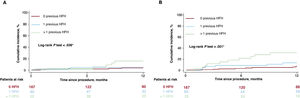
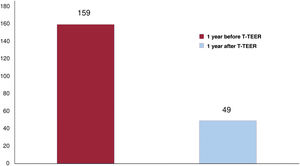
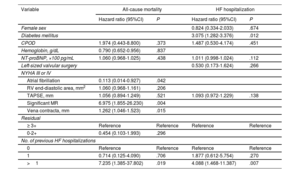
Significant between-group differences were also observed for the secondary endpoints of all-cause mortality (log rank P=.036) and HFH during follow-up (log-rank P<.001) (figure 3). In the multivariate analysis, a history of recurrent HFH was an independent predictor of all-cause mortality (HR=7.24; 95%CI, 1.39-37.80; P=.019) and rehospitalization for HF (HR=4.09; 95%CI, 1.47-11.39; P=.007; table 5). Notably, the total number of annual HFH fell from 159 before T-TEER to 49 afterwards (figure 4). This corresponds to a relative risk reduction of 0.31 (0.24-0.40, P<.001). Admissions for HF during follow-up were significantly less common in patients without a prior history of HFH (5.4% vs 13% for patients with 1 HFH and 20% for those with >1 HFH) (P<.001). Similarly, the mean number of HF admissions per patient in the 12 months after T-TEER was lower in patients with 0 HFH (0.11 vs 0.28 for those with 1 HFH and 0.50 for with >1 HFH). Finally, patients with recurrent HFH before T-TEER had a higher rate of HF readmissions per 100 patient-years than those hospitalized once or never (57.8 vs 37.8 and 14.6, respectively).

Kaplan-Meier curves for all-cause mortality (A) and HFH during follow-up (B) stratified by heart failure hospitalization (HFH) in the 12 months before tricuspid transcatheter edge-to-edge repair. aP value from individual analysis of all-cause mortality (0 vs 1HFH, P=.701; 0 vs >1HFH, P=.022; 1vs >1HFH, P=.144). bP value from individual analysis of HFH during follow-up (0 vs 1HFH, P=.128; 0 vs >1HFH, P<.001; 1 vs >1HFH, P=.048).
Multivariate analysis of secondary outcomes—all-cause mortality and HF hospitalization during a 1-year follow-up
| Variable | All-cause mortality | HF hospitalization | ||
|---|---|---|---|---|
| Hazard ratio (95%CI) | P | Hazard ratio (95%CI) | P | |
| Female sex | 0.824 (0.334-2.033) | .674 | ||
| Diabetes mellitus | 3.075 (1.282-3.376) | .012 | ||
| CPOD | 1.974 (0.443-8.800) | .373 | 1.487 (0.530-4.174) | .451 |
| Hemoglobin, g/dL | 0.790 (0.652-0.956) | .837 | ||
| NT-proBNP, ×100 pg/mL | 1.060 (0.968-1.025) | .438 | 1.011 (0.998-1.024) | .112 |
| Left-sized valvular surgery | 0.530 (0.173-1.624) | .266 | ||
| NYHA III or IV | ||||
| Atrial fibrillation | 0.113 (0.014-0.927) | .042 | ||
| RV end-diastolic area, mm2 | 1.060 (0.968-1.161) | .206 | ||
| TAPSE, mm | 1.056 (0.894-1.249) | .521 | 1.093 (0.972-1.229) | .138 |
| Significant MR | 6.975 (1.855-26.230) | .004 | ||
| Vena contracta, mm | 1.262 (1.046-1.523) | .015 | ||
| Residual | ||||
| ≥ 3+ | Reference | Reference | Reference | Reference |
| 0-2+ | 0.454 (0.103-1.993) | .296 | ||
| No. of previous HF hospitalizations | ||||
| 0 | Reference | Reference | Reference | Reference |
| 1 | 0.714 (0.125-4.090) | .706 | 1.877 (0.612-5.754) | .270 |
| >1 | 7.235 (1.385-37.802) | .019 | 4.088 (1.468-11.387) | .007 |
COPD, chronic obstructive pulmonary disease; HF, heart failure; MR, mitral regurgitation; NYHA, New York Heart Association; NT-proBNP, N-terminal pro-brain natriuretic peptide; TAPSE, tricuspid annular plane systolic excursion; TR, tricuspid regurgitation; RV, right ventricle.

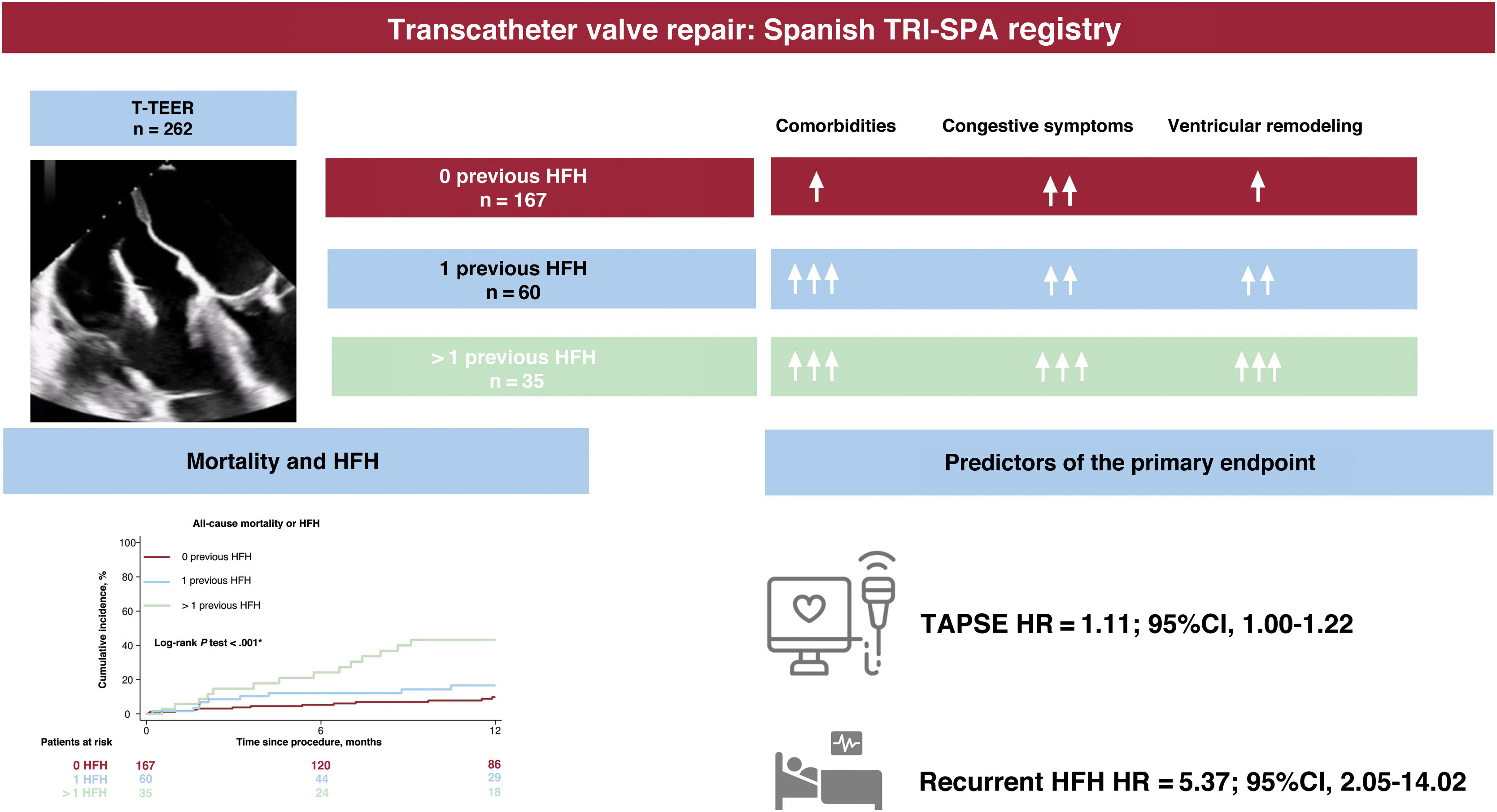
We have analyzed the impact of HFH in the year before T-TEER on clinical outcomes over 12 months of follow-up. Notably, we found that a) patients without a history of HFH had fewer comorbidities and less advanced disease (lower symptom burden and less ventricular remodeling) at baseline; b) patients with recurrent HFH had worse outcomes, including higher rates of HF readmissions and all-cause mortality at 12 months; and c) T-TEER reduced the likelihood of hospitalization for HF during follow-up, regardless of prior hospitalization history (figure 5).

Central illustration. Impact of previous history of heart failure on clinical outcomes after T-TEER. HFH, heart failure hospitalization; HR, hazard ratio; T-TEER, tricuspid transcatheter edge-to-edge repair; TAPSE, tricuspid annular plane systolic excursion; TRI-SPA, Spanish transcatheter tricuspid valve repair registry.
In a recent analysis of the European Society of Cardiology-Heart Failure Association EURObservational Research Programme HF Long-Term Registry, 17% of patients had moderate to severe isolated mitral regurgitation, 5.5% had isolated TR, and 11% had combined mitral regurgitation and TR.20 Isolated TR was independently associated with worse outcomes and was twice as likely to occur in patients with HFpEF (odds ratio=1.93); isolated mitral regurgitation, by contrast, was half as likely in this population (odds ratio=0.42). In our cohort, the median LVEF was 59% [55%–62%]. Patients hospitalized for HF in the year before T-TEER had greater left and right ventricular remodeling, which correlated with worse functional class and higher congestion at the time of the procedure.
Approximately 37% of patients had been hospitalized at least once for HF in the year before T-TEER. This rate is considerably lower than that of nearly 75% reported in the TriValve registry,21 but comparable to rates observed in clinical trials (eg, 25% in the TRILUMINATE Pivotal trial22) and real-world studies (eg, 40% in the bRIGHT study23).
Prognostic impact of previous HF on clinical outcomesAlthough the prognostic impact of previous HF on clinical outcomes has been studied in patients undergoing transcatheter mitral repair, this is the first study to examine the effect of previous HFH on outcomes after T-TEER. We found that patients with recurrent HFH in the 12 months before T-TEER were much more likely to experience adverse outcomes (lower survival and higher readmission rates) than those with 0 or 1 HFH. The impact of prior HFH on cardiovascular events has been studied in various settings. In one study of patients with HF and preserved or reduced LVEF, those previously hospitalized for HF had a higher risk of cardiovascular death and HF readmission.24 The ASCEND-HF trial, by contrast, did not find an increased mortality risk at 6 months in patients with prior HFH.25 Our findings, however, suggest that a history of recurrent HFH in the year before T-TEER is associated with worse outcomes, regardless of residual TR severity or other factors.
In patients with severe aortic stenosis treated with transcatheter aortic valve replacement, prior HFH has also been linked to worse outcomes, particularly in recently hospitalized patients.26 Adamo et al.27 reported that a history of multiple hospitalizations in the year before edge-to-edge mitral repair was associated with increased mortality. In addition, recurrent HFH was the only independent predictor of postprocedural events. Similarly, in our study of T-TEER, patients with >1 HFH had a worse prognosis than those with 0 or 1 HFH (figure 1 of the supplementary data), suggesting that recurrent HF is a marker of more advanced disease in this setting. More proactive approaches, such as interventions before HF decompensation episodes, could potentially reduce the risk of adverse outcomes.
Clinical implicationsAlthough TR treatment can lead to pathophysiologic changes and improve clinical outcomes, optimal timing and indications remain uncertain, largely due to the complex interplay between TR severity reduction and right ventricular function. HFH and mortality rates were lower in the TRILUMINATE trial than in previous studies, likely because of rigorous patient selection and the recruitment of patients with lower disease stages and fewer comorbidities.28–30 Our findings indicate that patients hospitalized for HF in the year before T-TEER have more advanced disease and that even though they experience a reduction in HFH following the procedure, they still have a worse prognosis than patients never hospitalized for HF. Similarly, in a large study of patients with severe TR, Vishal et al.31 found that previous HFH was more common in phenoclusters associated with worse long-term outcomes. The above findings suggest that improved diagnostics could potentially enhance the selection of patients for tricuspid valve interventions. Future studies should investigate whether earlier transcatheter tricuspid valve treatments lead to better outcomes.
LimitationsThis study has some limitations inherent to its observational, retrospective design. Echocardiographic parameters were not analyzed by a central laboratory. Events may be underestimated or overestimated as the information recorded by individual researchers was not independently reviewed. The follow-up time of 12 months is short, although the widespread use of T-TEER is relatively recent. Finally, the lack of a randomized control group and the relatively small sample size may have limited our ability to draw definitive conclusions and detect statistically significant differences between groups.
CONCLUSIONSRecurrent HFH in the 12 months before T-TEER was associated with an increased risk of adverse clinical events in the medium term. T-TEER, however, significantly reduced HF readmissions during follow-up, suggesting that patients undergoing this procedure experience a substantial improvement in clinical stability.
PARTICIPATING HOSPITALS AND LEADING RESEARCHERSThe authors confirm that the researchers at the following hospitals are responsible for the data presented in this study:
Hospital Álvaro Cunqueiro: Rodrigo Estévez Loureiro; Hospital Clínic de Barcelona: Xavier Freixa; Hospital Clínico San Carlos: Luis Nombela Franco; Hospital de la Santa Creu i Sant Pau: Dabit Arzamendi; Hospital Ramón y Cajal: Ángel Sánchez Recalde; Hospital Universitario de Salamanca: Ignacio Cruz González; Hospital Universitario de León: Tomás Benito González; Hospital Universitario de A Coruña: Ruth Pérez; Hospital Universitario 12 de Octubre: Iván Gómez Blázquez; Hospital Universitario de Valladolid: Ignacio J. Amat Santos; Hospital Clínico Universitario de Santiago: Ana Belén Cid Álvarez; Hospital Universitario Virgen de la Victoria: Fernando Carrasco Chinchilla; Hospital Universitario Puerta de Hierro-Majadahonda: Vanessa Moñivas; Hospital Universitario Reina Sofía: Manuel Pan; and Hospital Universitario Central de Asturias: Pablo Avanzas.
FUNDINGThis research received no funding from public, commercial, or nonprofit organizations.
ETHICAL CONSIDERATIONSThe study protocol was approved by the ethics committee at each participating hospital. All participants provided written informed consent after receiving detailed written and verbal explanations about the procedure, data collection, and analyses. The study adhered to the Sex and Gender Equity in Research guidelines and the ethical principles outlined in the Declaration of Helsinki.
USE OF ARTIFICIAL INTELLIGENCEArtificial intelligence tools or services were not used in this study. The authors assume full responsibility for the content of this manuscript.
AUTHORS’ CONTRIBUTIONSAll the authors made substantial contributions to this article. J. Echarte-Morales and R. Estévez-Loureiro: conception and design. J. Echarte-Morales, P. Cepas-Guillén, and A. González-García: data collection. J. Echarte-Morales and R. Estévez-Loureiro: conceptual framework and methodology. J. Echarte-Morales and A. González-García: software and visualization. J. Echarte-Morales and R. Estévez-Loureiro: writing of original draft. D. Arzamendi, V. Moñivas, F. Carrasco-Chinchilla, M. Pan, L. Nombela-Franco, I. Pascual, T. Benito-González, R. Pérez, I. Gómez-Blázquez, I. Amat-Santos, I. Cruz-González, Á. Sánchez-Recalde, A.B. Cid Álvarez, M. Barreiro-Pérez, C. Hion Li, M. del Trigo, J.D. Martínez-Carmona, D. Mesa, P. Mahía, P. Avanzas, and X. Freixa: review of original draft. All the authors approved the final version of the article.
CONFLICTS OF INTERESTJ. Echarte-Morales received support through an educational grant from Fundación Interhospitalaria para la Investigación Cardiovascular-Curso Estructural y Coronario (FIC-CSC). X. Freixa is a consultant and instructor for Abbott Vascular and Edwards Lifesciences. V. Moñivas is an instructor for Abbott Vascular. D. Arzamendi is a consultant and instructor for Abbott Vascular and Edwards Lifesciences. F. Carrasco-Chinchilla is an instructor for Abbott. L. Nombela-Franco is a consultant and instructor for Abbott Vascular. I. Cruz-González is an instructor for Abbott Vascular, Boston Scientific, and Lifetech. I. Pascual is an instructor for Abbott Vascular. M. Barreiro-Pérez is an instructor for Abbott Vascular, Edwards Lifesciences, Venus Medtech, and Jenscare. M. Barreiro-Pérez is an instructor for Abbott Vascular, Edwards Lifesciences, Venus Medtech, and Jenscare. L. Sanchis is an instructor for Abbott Vascular and Edwards Lifesciences. R. Estévez-Loureiro is a consultant and instructor for Abbott Vascular, Edwards Lifesciences, Boston Scientific, Venus Medtech, and Jenscare. P. Avanzas and L. Sanchis are associate editors of Revista Española de Cardiología; the editorial procedure of the journal was followed to ensure impartial handling of the manuscript. The remaining authors have no conflicts of interest to declare in relation to this study.
- -
Moderate to severe TR is a marker of adverse outcomes and associated with all-cause mortality and HFH.
- -
A history of HF is a marker of adverse outcomes in patients with myocardial diseases or left-sided valve disease.
- -
We studied the prevalence and prognostic impact of HFH in the 12 months before T-TEER.
- -
Patients hospitalized for HF more than once before T-TEER have higher all-cause mortality and HF readmission rates than those hospitalized just once or those without a history of HF.