
Our aim was to describe the contemporary epidemiological profile of infective endocarditis (IE) in Spain, and to evaluate variations in IE incidence, characteristics, and outcomes among the different Spanish regions (autonomous communities [AC]).
MethodsWe conducted a retrospective, population-based study, using data obtained from national in-patient hospital activity of all patients discharged with a diagnosis of IE from hospitals included in the Spanish National Health System, from January 2016 to December 2019. Differences in the IE profile between the 17 Spanish AC were analyzed.
ResultsA total of 9008 hospitalization episodes were identified during the study period. Standardized incidence of IE was 5.77 (95%CI, 5.12-6.41) cases per 100 000 population. Regarding predisposing conditions, 26.8% of episodes occurred in prosthetic valve carriers, 36.8% had some kind of valve heart disease, and 10.6% had a cardiac implantable electronic device. Significant differences were found between AC in terms of incidence, predisposing conditions, and microbiological profile. Cardiac surgery was performed in 19.3% of episodes in the total cohort, and in 33.4% of the episodes treated in high-volume referral centers, with wide variations among AC. Overall in-hospital mortality was 27.2%. Risk-adjusted mortality rates also varied significantly among regions.
ConclusionsWe found wide heterogeneity among Spanish AC in terms of incidence rates and the clinical and microbiological characteristics of IE episodes. The proportion of patients undergoing surgery was low and in-hospital mortality rates were high, with wide differences among regions. The development of regional networks with referral centers for IE could facilitate early surgery and improve outcomes.
Keywords
Infective endocarditis (IE) is a life-threatening disease, whose mortality remains high despite recent advances in diagnostic techniques and improvements in therapeutic options.1,2 Some of the reasons for this grim prognosis are the increasing age of the population with IE, the change in the microbiological profile, and the increase in prosthetic and device-related IE.1–8
Furthermore, the incidence of IE has increased significantly in recent years, and temporal-trend studies in Europe and the Unites States have even shown that incidence rate has doubled in the last 2 decades. Multiple factors may be responsible for this striking increase, including population aging and the growth in the number of invasive diagnostic and therapeutic procedures.5–8
Recent studies have analyzed time trends of IE in various countries over the last decades. However, national cohort studies exploring potential disparities among regions within the same country are scarce.9,10
Some studies have suggested that treatment in high-volume expert centers is associated with a better prognosis, but the results on this issue are contradictory.2,11 A referral bias could be present, as these centers receive the most complex cases from secondary hospitals.
The purpose of our study was to provide population-based epidemiological data of IE in Spain from January 2016 to December 2019, and to compare IE incidence, clinical and microbiological characteristics, and outcomes among autonomous community health services (ACHS).
METHODSStudy design and data sourceWe conducted a retrospective, population-based study, using data obtained from national in-patient hospital activity from January 2016 to December 2019.
The Spanish National Health Service (SNHS) provides health care for 98.4% of the Spanish population. The SNHS is divided and managed by 17 ACHS, whose populations range from 300 000 to 8 million.
All patients admitted to SNHS hospitals have anonymous standard data recorded, corresponding to the Spanish Minimum Data Set (MDS), an administrative database that includes both demographic and clinical information for all patients discharged from public hospitals affiliated to the SNHS. For each patient, we extracted demographic and clinical information including sex, age, primary discharge, and up to 19 secondary discharge diagnoses and procedures performed during hospitalization. Diagnoses and procedures are encoded using the International Classification of Diseases Tenth Revision, Clinical Modification (ICD-10-CM) coding system.12
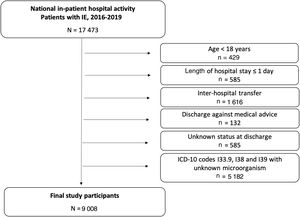
Patient populationAll episodes with a primary or secondary ICD-10-CM discharge diagnosis of IE were included in the study (table 1 of the supplementary data). To improve the accuracy of IE diagnosis, for ICD-10 codes I33.9, I38 and I39, we included only episodes with an identified infectious agent.13 We excluded episodes with unknown status at discharge, age less than 18 years, and length of stay < 1 day and discharged alive to home or nursing home.
If there were multiple hospitalizations due to different IE episodes for a single patient, all the episodes were included in the study. In contrast, hospitalizations resulting from hospital-to-hospital transfers were treated as a single episode, which was assigned to the most complex center.
The study flow chart is depicted in figure 1.
Clinical and microbiological information, previous comorbidities (renal insufficiency or diabetes, cancer, malnutrition, intravenous drug use, previously known native valve disease, prosthetic valve replacement, and cardiac implantable electronic devices), Charlson index, and clinical course during hospitalization were extracted from the ICD codes reported for each episode. Some of these variables were grouped according to the Condition Categories,14 updated yearly by the Agency for Healthcare Research and Quality (table 2 of the supplementary data). The following in-hospital complications were included: heart failure, cardiogenic shock, systemic embolic events and stroke, septic shock, acute renal failure, and need for cardiac surgery. Records of in-hospital death were also obtained.
Incidence rates per year were calculated for the entire population older than 17 years and stratified by sex and age and were expressed as the number of IE episodes per 100 000 population. Total population, age and sex-specific groups, and population for the 17 regions were obtained from the nationwide census provided by Spanish National Statistics Institute.
Statistical analysisContinuous variables are expressed as mean±standard deviation or 95% confidence intervals, or median [interquartile range], and categorical variables as frequencies and percentages.
The student t test was used to compare 2 categories and analysis of variance (ANOVA) corrected by the Bonferroni test to compare 3 or more categories. Categorical variables were compared by the X2 test or Fisher exact test. Linear correlation between continuous variables was assessed by means of the Pearson correlation coefficient (r).
Standardization by age and sex was performed using the direct adjustment method to account for changes in the Spanish population and in each autonomous community throughout the study period.
We performed a multivariable logistic regression model to evaluate the association of different variables with in-hospital mortality. Variables considered clinically relevant were included in the model. The final model was built by means of the stepwise forward selection and backward elimination technique. The significance levels for selection and elimination were P <.05 and P ≥ .10, respectively.
To assess the influence of potential differences between ACHS on outcomes, we constructed a second model (multilevel model) that included a random ACHS-specific intercept along with the selected patient-level epidemiological and clinical characteristics of the logistic regression model, with which the ratios of in-hospital mortality of the ACHS (risk-standardized mortality ratios [RSMR]) were calculated.2,15,16
Calibration of models was assessed by calculating risk deciles of observed and expected in-hospital mortality obtained by the logistic multilevel model. To evaluate the goodness of fit, a significant decrease in the statistical likelihood ratio test compared with the null model was tested. The discrimination of both models (logistic and multilevel) was assessed with receiver operator characteristics (ROC) curves.
In-hospital RSMR was used to compare outcomes among different ACHS, and to analyze the association between cardiac surgery and in-hospital mortality.
To further evaluate the impact of cardiac surgery on in-hospital mortality, propensity score matching was performed. Matching was done from the risk-adjusted models with a 1:1 ratio using a “nearest neighbor” match without replacement, selecting episodes with IE that did not undergo cardiac surgery with the most similar profile to each episode of IE treated with cardiac surgery, according to the variables statistically significant in the risk-adjustment models. The probability of in-hospital death, the effect of differences between groups (average treatment effect) and odds ratios with 95% confidence intervals were calculated. Assessment of the appropriateness of the matching was performed in 2 ways: by constructing Kernel density plots to graphically represent the populations before and after matching and by calculating the standardized mean differences for all covariates. Predictors of in-hospital mortality were those statistically significant in the multivariable logistic regression analysis.
All tests were 2-sided, and differences were considered statistically significant at P-values <.05. Statistical analysis was performed with Stata V.17.0 (StataCorp, USA) and SPSS 21.0 (IBM, USA).
The present study was exempt from additional review by the ethics research committee as all data were deidentified.
RESULTSPatient demographics, clinical characteristics, and outcomesFrom 2016 to 2019, 9008 episodes of IE were identified. The standardized incidence of IE during the study period was 5.77 (95% confidence interval [95%CI], 5.12-6.41) cases per 100 000 population. Standardized incidence rates were more than twice as higher in men than in with women (8.7 [95%CI, 8.5-8.9] vs 3.6 [95%CI, 3.4-3.7] cases per 100 000 population).
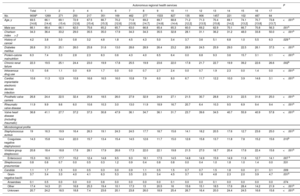
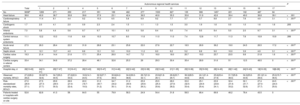
Epidemiological, clinical, and microbiological characteristics are presented in table 1, and in-hospital clinical course and complications in table 2.
Demographic, clinical, and microbiological characteristics of 9008 episodes of infective endocarditis in Spain (2016-2019)
| Autonomous regional health services | P | ||||||||||||||||||
|---|---|---|---|---|---|---|---|---|---|---|---|---|---|---|---|---|---|---|---|
| Total | 1 | 2 | 3 | 4 | 5 | 6 | 7 | 8 | 9 | 10 | 11 | 12 | 13 | 14 | 15 | 16 | 17 | ||
| No. | 9008a | 1269 | 271 | 250 | 217 | 351 | 169 | 462 | 277 | 1533 | 827 | 135 | 906 | 1457 | 221 | 102 | 487 | 64 | |
| Age, y | 69.5 [14.6] | 66.1 [14.4] | 69.1 (15.4) | 72.9 [12.6] | 67.5 [15.4] | 66.7 [15.3] | 70.2 [12.6] | 71.6 [13.9] | 69.2 [14.7] | 69.7 [14.8] | 68.8 (14.4) | 71.2 [12.2] | 71.3 [13.5] | 70.4 [15.8] | 69.1 [14.2] | 74.1 [13.2] | 70.7 [13.8] | 73.8 [13.7] | <.001b |
| Male sex | 66.1 | 68.4 | 66.1 | 62.0 | 75.6 | 65.2 | 65.7 | 63.0 | 66.8 | 65.4 | 65.3 | 60.0 | 69.2 | 62.9 | 70.1 | 66.7 | 70.8 | 56.3 | .001b |
| Charlson index> 2 | 34.3 | 36.4 | 33.2 | 29.0 | 35.5 | 35.0 | 17.9 | 34.3 | 34.3 | 35.5 | 32.8 | 28.1 | 31.1 | 36.2 | 31.2 | 48.0 | 33.8 | 50.0 | <.001b |
| History of cancer | 4.2 | 3.8 | 3.0 | 0.8 | 3.2 | 4.8 | 1.8 | 4.5 | 4.3 | 5.0 | 3.4 | 3.7 | 3.6 | 5.1 | 6.8 | 1.0 | 5.5 | 6.3 | .029 b |
| Diabetes mellitus | 26.8 | 31.3 | 25.1 | 26.0 | 25.8 | 31.6 | 13.0 | 28.6 | 28.9 | 26.4 | 23.2 | 28.9 | 24.5 | 25.9 | 29.0 | 22.5 | 26.1 | 37.5 | <.001b |
| Protein-calorie malnutrition | 6.3 | 7.4 | 3.3 | 2.8 | 2.3 | 8.3 | 0.6 | 4.3 | 4.0 | 6.5 | 6.4 | 0.0 | 6.8 | 9.3 | 3.6 | 15.7 | 3.1 | 3.1 | <.001b |
| Chronic renal failure | 22.3 | 19.5 | 25.1 | 24.4 | 23.0 | 19.9 | 17.8 | 25.5 | 19.9 | 23.6 | 22.0 | 17.8 | 21.7 | 22.7 | 19.9 | 39.2 | 22.6 | 26.6 | .002b |
| Intravenous drug use | 1.5 | 0.6 | 1.1 | 0.0 | 6.9 | 1.7 | 0.0 | 0.0 | 0.7 | 2.7 | 2.4 | 0.0 | 0.7 | 1.9 | 2.3 | 0.0 | 1.4 | 0.0 | <.001b |
| Cardiac implantable electronic devices infection | 10.6 | 11.3 | 12.9 | 10.8 | 16.6 | 16.5 | 16.0 | 10.8 | 7.9 | 6.0 | 8.0 | 6.7 | 11.7 | 12.2 | 10.0 | 3.9 | 14.6 | 3.1 | <.001b |
| Prosthetic valve carriers | 26.8 | 24.4 | 22.5 | 32.4 | 25.8 | 18.5 | 26.0 | 27.9 | 32.9 | 24.9 | 27.1 | 21.5 | 30.7 | 28.8 | 21.3 | 22.5 | 31.6 | 25.0 | <.001b |
| Rheumatic valve disease | 11.9 | 9.9 | 9.6 | 6.0 | 10.6 | 10.3 | 3.0 | 13.0 | 11.9 | 18.9 | 16.7 | 20.7 | 6.4 | 10.3 | 9.5 | 6.9 | 9.4 | 9.4 | <.001b |
| Valve heart disease (including rheumatic) | 36.8 | 41.1 | 27.7 | 37.2 | 37.3 | 30.8 | 47.9 | 36.1 | 34.7 | 36.1 | 31.7 | 23.7 | 39.6 | 34.5 | 40.7 | 55.9 | 40.9 | 57.8 | <.001b |
| Microbiological profile | |||||||||||||||||||
| Staphylococcus aureus | 19 | 16.3 | 19.9 | 16.4 | 26.3 | 19.1 | 24.3 | 24.5 | 17.7 | 18.7 | 15.6 | 14.1 | 18.2 | 20.5 | 17.6 | 12.7 | 23.6 | 25.0 | <.001b |
| Coagulase-negative staphylococci | 14.3 | 15.8 | 14.4 | 22.0 | 15.7 | 13.4 | 15.4 | 14.5 | 12.6 | 11.7 | 15.0 | 12.6 | 15.8 | 13.7 | 11.8 | 7.8 | 15.2 | 15.6 | .010b |
| Viridans group streptococci | 20.8 | 18.4 | 18.8 | 17.6 | 28.1 | 17.9 | 26.6 | 17.3 | 22.0 | 22.1 | 19.8 | 21.5 | 27.0 | 18.7 | 20.4 | 17.6 | 22.4 | 15.6 | <.001b |
| Enterococci | 15.3 | 16.3 | 17.7 | 15.2 | 12.4 | 14.8 | 9.5 | 9.3 | 18.1 | 17.5 | 14.5 | 14.8 | 14.9 | 15.9 | 14.9 | 11.8 | 12.7 | 14.1 | .007 b |
| Streptococcus pneumoniae | 0.8 | 0.6 | 0.7 | 0.0 | 0.5 | 0.3 | 1.2 | 0.9 | 0.4 | 0.8 | 0.8 | 0.0 | 0.4 | 1.0 | 1.8 | 1.0 | 1.4 | 0.0 | .531 |
| Candida | 1.1 | 1.7 | 1.5 | 0.0 | 0.5 | 0.3 | 0.0 | 0.9 | 1.1 | 0.5 | 1.5 | 0.7 | 0.7 | 1.5 | 1.8 | 0.0 | 2.1 | 3.1 | .009 |
| Gram-negative bacilli | 3.7 | 3.4 | 3.3 | 4.0 | 4.1 | 6.3 | 5.3 | 3.5 | 2.5 | 3.4 | 4.5 | 3.7 | 1.8 | 4.8 | 2.3 | 2.0 | 3.9 | 4.7 | .031b |
| Anaerobes | 0.1 | 0.5 | 0.0 | 0.0 | 0.0 | 0.6 | 0.0 | 0.0 | 0.0 | 0.0 | 0.1 | 0.0 | 0.0 | 0.1 | 0.0 | 0.0 | 0.0 | 0.0 | .074 |
| Other | 17.4 | 14.3 | 21 | 16.8 | 25.3 | 19.4 | 10.1 | 17.3 | 13 | 20.5 | 16 | 15.6 | 15.1 | 18.5 | 17.6 | 28.4 | 14.2 | 21.9 | <.001b |
| Unknown | 20.7 | 24.2 | 18.5 | 18.8 | 7.4 | 23.6 | 20.1 | 23.8 | 26.0 | 18.9 | 25.4 | 26.7 | 16.4 | 20.0 | 24.4 | 24.5 | 16.6 | 15.6 | <.001b |
Data are presented as No. (%)or median [interquartile range].
Statistically significant differences among regions.
1, Andalusia; 2, Aragon; 3, Principality of Asturias; 4, Balearic Islands; 5, Canary Islands; 6, Cantabria; 7: Castile-La Mancha; 8, Castile and Leon; 9, Catalonia; 10, Valencian Community; 11, Extremadura; 12, Galicia; 13, Community of Madrid; 14, Region of Murcia; 15, Chartered Community of Navarre; 16, Basque Country; 17, La Rioja.
In-hospital clinical course and outcome of 9008 episodes of infective endocarditis in Spain (2016-2019)
| Autonomous regional health services | P | ||||||||||||||||||
|---|---|---|---|---|---|---|---|---|---|---|---|---|---|---|---|---|---|---|---|
| Total | 1 | 2 | 3 | 4 | 5 | 6 | 7 | 8 | 9 | 10 | 11 | 12 | 13 | 14 | 15 | 16 | 17 | ||
| No. | 9008a | 1269 | 271 | 250 | 217 | 351 | 169 | 462 | 277 | 1533 | 827 | 135 | 906 | 1457 | 221 | 102 | 487 | 64 | |
| Heart failure | 38.6 | 40.9 | 38.7 | 30.8 | 39.6 | 37.9 | 23.1 | 42.4 | 36.5 | 40.9 | 35.3 | 35.6 | 31.9 | 42.6 | 39.4 | 49.0 | 36.8 | 39.1 | <.001 |
| Cardiorespiratory failure | 8 | 11.4 | 8.1 | 4.4 | 9.2 | 10.3 | 6.5 | 5.8 | 6.9 | 9.2 | 7.7 | 3.7 | 5.7 | 8.8 | 2.7 | 7.8 | 4.9 | 3.1 | <.001b |
| Cardiogenic shock | 1.7 | 2.0 | 4.1 | 2.0 | 0.9 | 2.3 | 2.4 | 1.5 | 1.1 | 1.3 | 1.5 | 3.0 | 1.9 | 1.6 | 0.0 | 1.0 | 1.6 | 1.6 | .205 |
| Arterial embolisms | 7.3 | 5.8 | 4.4 | 5.6 | 9.7 | 9.7 | 10.1 | 6.3 | 5.8 | 8.4 | 5.0 | 7.4 | 8.5 | 8.4 | 5.0 | 2.0 | 9.7 | 3.1 | <.001b |
| Central nervous system embolisms | 11.1 | 12.2 | 10.3 | 11.6 | 6.9 | 10.3 | 10.7 | 8.0 | 11.6 | 11.0 | 11.0 | 7.4 | 12.8 | 11.7 | 11.3 | 7.8 | 10.9 | 10.9 | .399 |
| Acute renal failure | 27.5 | 26.3 | 28.4 | 22.0 | 31.8 | 28.8 | 23.1 | 25.8 | 22.0 | 27.6 | 22.7 | 18.5 | 26.9 | 36.2 | 19.0 | 24.5 | 26.5 | 17.2 | <.001b |
| Septic shock | 9 | 12.1 | 13.7 | 4.0 | 8.8 | 13.1 | 5.3 | 10.0 | 11.2 | 8.0 | 8.2 | 5.2 | 8.8 | 9.0 | 10.0 | 3.9 | 4.9 | 3.1 | <.001b |
| Cardiac valve surgery | 19.3 | 21.4 | 14.4 | 21.6 | 17.1 | 25.4 | 26.0 | 14.7 | 7.2 | 16.0 | 18.0 | 20.7 | 19.3 | 23.7 | 23.5 | 9.8 | 21.8 | 1.6 | <.001b |
| Cardiac surgery in referral centers | 33.4 | 34.1 | 34.8 | 37.2 | 26.4 | 46.1 | 32.6 | 25.3 | 29 | 29.3 | 30.4 | 35.4 | 28.9 | 31.6 | 51 | 12.5 | 49.5 | 0 | <.001b |
| Hospital stay, d | 26[13-43] | 24[13-41] | 29[17-47] | 31[16-41] | 26[15-43] | 30[15-47] | 31[14-46] | 22[12-42] | 23[12-38] | 23[13-42] | 21[11-35] | 25[13-36] | 35[19-50] | 28[14-45] | 26[11-42] | 24[10-43] | 18[10-33] | 18[8-28] | <.001b |
| Observed mortality, 95%CI | 27.2(26.2-28.2) | 30.027.5-32.6) | 34.7(29.2-40.5) | 27.2(22.0-33.0) | 18.9(14.1-24.5) | 32.5(27.7-37.5) | 30.8(24.2-38.0) | 34.2(30.0-38.6) | 26.7(21.8-32.1) | 23.9(21.8-26.1) | 26.6(23.7-29.7) | 36.3(28.5-44.6) | 24.1(21.4-26.9) | 25.6(23.4-27.9) | 31.7(25.8-38.0) | 34.3(25.6-43.9) | 25.1(21.4-29.0) | 25.0(15.7-36.5) | <.001b |
| Risk-standardized mortality rates, 95%CI | 27.0 (26.9-27.1) | 27.5 (27.3-27.7) | 29.9 (29.5-30.3) | 28.9 (21.6-22.4) | 22.0 (18.7-19.3) | 31.0 (30.7-31.2) | 34.7 (34.2-35.1) | 31.2 (30.9-31.4) | 25.9 (25.6-26.3.) | 25.5 (25.3-25.6) | 28.0 (27.8-28.2) | 33.0 (32.5-33.4) | 25.1 (24.9-25.4) | 23.9 (23.8-24.1) | 32.4 (31.6-33.2) | 32.1 (31.7-32.6) | 27.4 (27.0-27.7) | 24.5 (24.0-25.0) | <.001b |
| Patients treated in hospitals with cardiac surgery on site | 52.6 | 62.8 | 41.3 | 58 | 64.5 | 55 | 79.9 | 58.3 | 24.9 | 54.4 | 31.8 | 58.5 | 66.4 | 69.9 | 46.2 | 78.4 | 43.5 | 0 | |
95%CI, 95% confidence interval
Unless otherwise indicated, the data are presented as No. (%) or median [interquartile range].
Statistically significant differences among regions.
1, Andalusia; 2, Aragon; 3, Principality of Asturias; 4, Balearic Islands; 5, Canary Islands; 6, Cantabria; 7: Castile-La Mancha; 8, Castile and Leon; 9, Catalonia; 10, Valencian Community; 11, Extremadura; 12, Galicia; 13, Community of Madrid; 14, Region of Murcia; 15, Chartered Community of Navarre; 16, Basque Country; 17, La Rioja.
Mean age was 69.5 (14.6) years, and 5957 (66.1%) of the patients were male. Comorbidities consisted of diabetes mellitus in 26.8% of the patients, chronic kidney disease in 22.3%, and a history of cancer in 4.3%. One third of the patients (34.3%) had a Charlson index higher than 2. Predisposing conditions included patients with valve prostheses in 26.8% of the episodes, some kind of valvular heart disease in 36.8%, and a cardiac implantable electronic device in 10.6%.
The most frequent isolated microorganisms were staphylococci (33.3%; 19.0% Staphylococcus aureus and 14.3% coagulase-negative staphylococci), followed by streptococci (20.8%) and enterococci (15.3%). Culture-negative IE accounted for 20.7% of the episodes.
During hospitalization, the most frequent complication was heart failure (38.6%), followed by acute renal failure (27.5%). Central nervous system embolisms occurred in 11.1% of the episodes, and septic shock in 9%. The median length of hospital stay was 26 [13-43] days.
Cardiac surgery was performed in 19.3% of the episodes in the total cohort, and 33.4% in the episodes treated in high-volume referral centers. Overall, in-hospital mortality was 27.2%.
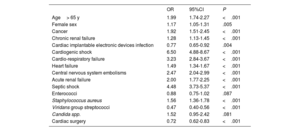
Prognostic factors associated with in-hospital mortalityThe variables found to be independently associated with in-hospital mortality in the multivariable analysis are shown in table 3. In-hospital risk-adjusted logistic multilevel regression model showed good discrimination (area under the ROC curve of 0.80 [95%CI, 0.79-0.81; P <.001]) and calibration (figure 1 of the supplementary data). In the risk-adjusted logistic multilevel regression model, the variables with higher odds ratios for in-hospital mortality were cardiogenic and septic shock, cardiorespiratory failure, and central nervous system embolisms.
Predictors of in-hospital mortality. Multilevel logistic regression model
| OR | 95%CI | P | |
|---|---|---|---|
| Age> 65 y | 1.99 | 1.74-2.27 | <.001 |
| Female sex | 1.17 | 1.05-1.31 | .005 |
| Cancer | 1.92 | 1.51-2.45 | <.001 |
| Chronic renal failure | 1.28 | 1.13-1.45 | <.001 |
| Cardiac implantable electronic devices infection | 0.77 | 0.65-0.92 | .004 |
| Cardiogenic shock | 6.50 | 4.88-8.67 | <.001 |
| Cardio-respiratory failure | 3.23 | 2.84-3.67 | <.001 |
| Heart failure | 1.49 | 1.34-1.67 | <.001 |
| Central nervous system embolisms | 2.47 | 2.04-2.99 | <.001 |
| Acute renal failure | 2.00 | 1.77-2.25 | <.001 |
| Septic shock | 4.48 | 3.73-5.37 | <.001 |
| Enterococci | 0.88 | 0.75-1.02 | .087 |
| Staphylococcus aureus | 1.56 | 1.36-1.78 | <.001 |
| Viridans group streptococci | 0.47 | 0.40-0.56 | <.001 |
| Candida spp. | 1.52 | 0.95-2.42 | .081 |
| Cardiac surgery | 0.72 | 0.62-0.83 | <.001 |
95%CI, 95% confidence interval; OR, odds ratio.
When included in the multilevel regression model, cardiac valve surgery showed a protective effect (odds ratio [OR], 0.72; 95%CI, 0.62-0.84; P <.001). This effect was also found by matching patients treated with cardiac surgery with patients who did not undergo surgery (OR, 0.72; average treatment effect, 23.9% vs 30.3%; 95%CI, 0.62-0.84; P <.001) (table 3 of the supplementary data and figure 2 of the supplementary data).
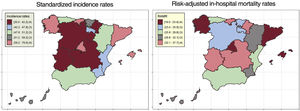
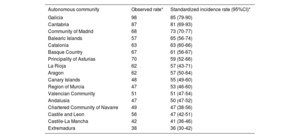
Regional differences in the epidemiology of infective endocarditis in SpainStatistically significant differences in standardized incidence rates of IE between ACHS were found (table 4 and figure 2), varying from 3.6 to 8.5 cases per 100 000 population.
Observed and standardized incidence rates of infective endocarditis in the 17 Spanish autonomous regional health services
| Autonomous community | Observed rate* | Standardized incidence rate (95%CI)* |
|---|---|---|
| Galicia | 98 | 85 (79-90) |
| Cantabria | 87 | 81 (69-93) |
| Community of Madrid | 68 | 73 (70-77) |
| Balearic Islands | 57 | 65 (56-74) |
| Catalonia | 63 | 63 (60-66) |
| Basque Country | 67 | 61 (56-67) |
| Principality of Asturias | 70 | 59 (52-66) |
| La Rioja | 62 | 57 (43-71) |
| Aragon | 62 | 57 (50-64) |
| Canary Islands | 48 | 55 (49-60) |
| Region of Murcia | 47 | 53 (46-60) |
| Valencian Community | 51 | 51 (47-54) |
| Andalusia | 47 | 50 (47-52) |
| Chartered Community of Navarre | 49 | 47 (38-56) |
| Castile and Leon | 56 | 47 (42-51) |
| Castile-La Mancha | 42 | 41 (36-46) |
| Extremadura | 38 | 36 (30-42) |
95%CI, 95% confidence interval.
Central illustration. Standardized incidence rates and risk-adjusted in-hospital mortality rates (RAMR) of infective endocarditis among Spanish autonomous regional health services. Standardized incidence rates are represented as cases per 100 000 population. Brackets: number of autonomous regional health services in each group.
Likewise, there were significant differences among ACHS regarding previously known heart valve disease, and other relevant comorbidities, the microbiological profile, including the percentage of culture-negative IE, and the development of in-hospital complications. The percentage of episodes undergoing cardiac surgery also varied widely among ACHS (table 1 and table 2), ranging from 7.2% to 26%.
Finally, observed and risk-adjusted mortality significantly differed among the different ACHS (table 2). The ACHS with the lowest RSMR was the Balearic Islands (22%), whereas the ACHS with the highest was Cantabria (34.7%).
Relationship between hospital complexity and outcomesNo significant linear correlation was found between being attended in hospitals with cardiac surgery and RSMR (r=0.204; P=.432).
However, being treated in a hospital with cardiac surgery was associated with a higher percentage of infectious agent identification (80.8% vs 77.3%; P <.001), and there was a significant linear correlation between the percentage of infectious agent identification and RSMR (r=-0.616, P=.009).
DISCUSSIONThis Spanish population-based study provides a unique opportunity to assess the current characteristics of IE in Spain and the differences in clinical presentation, microbiology, complications, surgical management, and prognosis among regions. The present study has several main findings. First, the incidence of IE is high and greater than that reported in previous Spanish studies. Second, the clinical profile of patients with IE is characterized by advanced age and a high burden of comorbidities. Third, the mortality rate is high, and the percentage of patients receiving surgery is low. Finally, there are wide variations among Spanish regions in incidence, epidemiological profile, and patients’ management and outcomes.
Epidemiology of infective endocarditisSeveral population-based studies have reported an increase in IE incidence rates over time. Compared with a previous study,2 in which the incidence of IE was 3.49 per 100 000 population in 2014, the findings of the present work show an IE incidence of 5.95 per 100 000 population in the period 2016 to 2019.
The direct standardized incidence of IE also increased from 3.34 in 2014 to 5.77 cases per 100 000 population from 2016 to 2019. Although both incidences are not strictly comparable due to changes in the MDS and ICD codification of the MDS in 2016 (which adopted the ICD-10 classification instead of the ICD-9 and allowed a more refined IE searching strategy), this increasing trend is in line with the results from recent studies, which found that IE incidence has doubled over the past 2 decades in Europe.6,17 Similar to our findings, a contemporary work from England found an incidence of IE of 5 cases per 100 000 population in the period 2018 to 2019.17.
Our study has shown significant differences in the standardized incidence rate of IE among the different ACHS. Among the potential causes, differences in the epidemiological and clinical profile of patients from the different ACHS (such as the percentage of prosthetic valve or implantable electronic device carriers) should be considered. This finding has been observed in other Spanish population studies focused on other cardiovascular diseases,18,19 but its reasons are uncertain and further studies are needed to clarify the causes.
Current clinical and microbiological characteristics of infective endocarditisCurrently, in Europe, IE mainly affects older adults, with the lowest average age (59.1 years) reported in England and the highest in Denmark (72.8 years).3,8,20 The mean age of our study population (69.5 years) agrees closely with the findings of the latter study.
Regarding predisposing cardiac conditions, the aforementioned Danish study described a prevalence of cardiac implantable electronic devices and prosthetic valve carriers in the period from 2011 to 2017 of 16.9% and 21.4%, respectively, similar to the percentages we found in Spain.
Although the occurrence of intravenous drug-associated IE has escalated in the United States, with the prevalence reaching nearly 50% in some areas,21,22 the percentage of patients with intravenous drug use was marginal in our population, which is consistent with most previous contemporary European studies.3,6,8,20
Associated with health care exposure, and, in particular, with transcatheter aortic valve implantations, a significant increase in the incidence of enterococcus-related IE has been reported.7 In our study, enterococcal IE represented 15.3% of all cases, fewer than those caused by streptococcal and Staphylococcus aureus infections, and staphylococci remain the main cause of IE.
The differences between ACHS in the microbiological profile are probably influenced by various factors such as patient demographics and health care practices. In addition, the distribution of urban/rural population in the different regions could play a potential role in the prevalence of certain microorganisms.23 ACHS with a higher prevalence of prosthetic valve carriers, such as those regions located further north, and those with a relatively higher prevalence of IE related to intravenous drug use, had higher proportion of staphylococcal infections. Likewise, in ACHS with a higher implant rate of cardiac implantable electronic devices,24 the percentage of device infections, in particular due to staphylococci, was also higher.
We also found significant differences in the distribution of culture-negative IE, with percentages varying between 7% and 26.7%. The reasons for this heterogeneity may include disparities in access to specific microbiological techniques, such as molecular analysis, differences in the causative microorganisms (for instance those with slow growth or special cultivation requirements), and potential differences in the use of antibiotics in the days prior to blood culture extraction.
Management and outcome of infective endocarditis across Spanish regionsCompared with the previously mentioned Spanish population-based study (2003-2014),2 crude in-hospital mortality has increased from 20.4% to 27.2% in the present report. The reasons for this rise may include an increase in patients’ risk profile in recent years, with progressive aging of patients with IE, a higher prevalence of comorbidities such as diabetes mellitus and chronic renal failure and a higher incidence of in-hospital complications (heart failure, septic shock) compared with the former study.
The ESC-EORP EURO-ENDO (European Infective Endocarditis), a prospective registry that included 3116 patients, mostly from European countries, reported a mortality rate of 17.1%.1 Importantly, most (> 90%) of patients were admitted to high-volume centers, and surgery during the acute phase of the disease was performed in 51.2%.
In the present study, only 52.7% of the patients were treated in hospitals with on-site cardiac surgery, and surgery was performed in only 19.3% of patients during the index hospitalization. Cardiac surgery is critical to improve prognosis in patients with active IE who have a surgical indication, and high-risk patients with heart failure or uncontrolled infection are those who benefit the most from surgery.25,26 Because of our study design, the percentage of patients who had a surgical indication but were not operated on, and the reasons for not undergoing surgery, cannot be analyzed.
A recent study reported that patients treated exclusively in nonreferral centers, compared with those diagnosed and treated in referral centers and patients secondarily transferred to these centers, had higher mortality and were much less frequently managed following European Society of Cardiology (ESC) guideline recommendations regarding imaging techniques, antibiotic therapy, and cardiac surgery.27
Therefore, differences in mortality and cardiac surgery rates among population-based studies such as ours and cohorts from tertiary care referral centers can differ due to disparities in health care resources and the specialized approach of referral centers, with higher mortality being observed in the former.1–9,25 Moreover, the study design inherently incorporates a selection bias, particularly concerning the management of patients with a surgical indication but substantial comorbidity who are diagnosed in regional hospitals.
These patients are frequently not transferred to tertiary centers due to their comorbidity burden, and this phenomenon inadvertently penalizes regional facilities in terms of reported outcomes.28 Conversely, patients who are both operable and have a clear surgical indication are more likely to be transferred to tertiary referral centers. This transfer pattern elevates the surgical percentages at these referral centers, as they receive a selective cohort of patients deemed suitable for surgery. This aspect of patient selection and transfer underscores the complexity of interpreting surgical rates and outcomes among different health care settings.
A few studies have analyzed regional differences among regions and hospitals in Spain in the management and outcomes of several prevalent cardiovascular diseases, mainly in acute myocardial infarction,16,29 but also in heart failure.19 These studies have shown significant variations in risk-adjusted mortality across AC.
Our data also shows notable disparities in the proportion of cardiac surgery among the different ACHS, as well as in both observed and risk-adjusted mortality.
IE is a complex disease, and many aspects should be taken into account when analyzing these findings. First, differences in the epidemiological profile of patients, such as age and comorbidities, and clinical and microbiological characteristics of the infection itself (prosthetic valve IE, staphylococcal infections, central nervous system embolisms) are important prognostic factors that may influence surgery and outcomes.
In addition, potential disparities in access and time to first medical care (emergency department, general practitioner), the distribution of hospitals with cardiac surgery, and access or transfer to these centers, hospital resources and volume, and both the presence and experience of dedicated endocarditis teams are all variables that may potentially influence appropriate and prompt diagnosis and specific treatment, including adequate antibiotic therapy and cardiac surgery.
In the specific case of the wide differences in surgical treatment, we should also consider that patients from some ACHS are more frequently transferred to other regions that have proportionally more services with cardiac surgery. Additionally, the geographical distribution of the population in each autonomous community may play a role; thus, communities with a higher population density showed higher percentages of surgery, as observed in the case of the Community of Madrid, Cantabria, and the Region of Murcia, compared with AC with lower population density such as Aragon and Castile-La Mancha.
The present findings may serve as a basis for the development of region-specific strategies and networks to improve the diagnosis, treatment, and outcomes of patients with IE in Spain.
LimitationsThis study has several limitations. First, since the data are population-based and rely on hospital coding, their accuracy is somewhat dependent on the quality of the coding. This means that the true number of cases and the accuracy of disease classification may be underestimated. However, given the unique features and importance of this disease, it is less likely that patients were coded incorrectly compared with other diseases. To increase diagnostic accuracy in episodes with ICD-10 codes I33.9, I38 and I39, only cases with microbiological identification were included, as previously suggested.13 It is still possible that some cases were missed or reported inaccurately as IE, which may have led to a potential bias when estimating the incidence of the disease in the different regions. In addition, it was not possible to differentiate definite and possible IE episodes.
On the other hand, this study benefits from a nationwide design and the characteristics of the SNHS, which provides health care access to almost the entire population of Spain. As a result, this work provides valuable information that is not biased by referral or selection.
Second, there are certain limitations in terms of available information, such as the type of acquisition (nosocomial or community-acquired), previous interventional procedures or hospital admissions, and diagnostic and therapeutic procedures during IE hospitalization, as well as the distribution of surgical indications, and the percentage of patients with surgical indications who did not undergo surgery. Third, microbiological information was not available in 20% of the cases, so it is unclear whether these episodes were culture-negative IE or if the causative agent was simply not recorded.
Fourth, the time interval between hospitalization for IE and the surgical intervention was not evaluated. This lack of specific temporal data precludes adjustment for the potential of “immortal time bias” in our multivariate analysis of in-hospital mortality. Consequently, while our study identifies a significant association between surgical intervention and reduced mortality, it is important to acknowledge that this does not definitively establish a protective role of surgery, nor does it demonstrate causality.
Finally, it should be noted that data from private hospitals were not available, which may have led to an underestimation of incidence rates of IE. However, private practice represents only a small percentage of centers in Spain, so this effect is expected to be minor.
CONCLUSIONSWide heterogeneity among Spanish AC was found in incidence rates and the clinical and microbiological features of IE episodes. The proportion of patients undergoing surgery was low, and in-hospital mortality rates were high, with wide differences among the AC, suggesting differences in access to cardiac surgery. The development of regional networks with referral centers for IE may facilitate early surgery and improve outcomes.
FUNDINGThe present study was funded by an unconditional grant from the Fundación Interhospitalaria para la Investigación Cardiovascular, Madrid, Spain.
ETHICAL CONSIDERATIONSThe present study was exempt from additional review by the ethics research committee as all data were deidentified. Possible sex/gender biases were considered in the preparation of this article. Informed consent was not requested because the data were anonymized from the information in the minimum data set.
STATEMENT ON THE USE OF ARTIFICIAL INTELLIGENCENo artificial intelligence tool was used in the preparation of this article.
AUTHORS’ CONTRIBUTIONSC. Olmos, I. Vilacosta, F.J. Elola, and C. Fernández-Pérez oversaw the study conception and design. C. Fernández-Pérez, N. del Prado, N. Rosillo, J.L. Bernal, F.J. Elola, and C. Olmos analyzed and interpreted the results. P. Zulet, D. Gómez and C. Olmos drafted the manuscript. All authors reviewed the results, contributed to the interpretation and discussion, and reviewed and edited the manuscript. All authors approved the final version of the manuscript.
- •
The incidence of IE has significantly risen in the last few years. This increase may be related to multiple factors, including population aging and the growth in the number of invasive diagnostic and therapeutic procedures.
- •
Clinical practice guidelines recommend that patients with IE should be managed in referral centers, especially complicated cases, and this strategy has been proved to be effective and to reduce mortality. However, numerous patients are still treated in non-reference centers or are transferred after significant deterioration of their clinical status.
- •
There is no information on potential differences in the management and outcomes of patients with IE among Spanish regions.
- •
The incidence of IE is high and greater than that reported in previous Spanish studies.
- •
The contemporary clinical profile of patients with IE in Spain is characterized by advanced age and a high prevalence of comorbidities. The proportion of patients undergoing surgery is low, and in-hospital mortality rates are unacceptable high.
- •
There are large differences among Spanish regions in the incidence and epidemiological profile of IE, as well as in patient management and outcomes.
None.
Supplementary data associated with this article can be found in the online version, at https://doi.org/10.1016/j.rec.2024.01.003.