
ISSN: 1885-5857 Impact factor 2024 4.9
Vol. 79. Num. 1.
Pages 85-88 (January 2026)

Scientific letter
Echocardiographic-fluoroscopic fusion imaging with the mini 3D transesophageal probe in pediatric congenital heart disease

Imagen de fusión ecocardiográfica-fluoroscópica con la minisonda transesofágica 3D en cardiopatías congénitas pediátricas

Ramona GhengheaaKhaled HadeedaPaul Vignaud-MarighettoaNicolas CombesbPhilippe AcaraClement Karsentyac
https://doi.org/10.1016/j.rec.2025.03.007

Options

Supplementary data
Imagen extra
Rev Esp Cardiol. 2026;79:85-8
To the Editor,

Echocardiography-fluoroscopy fusion (EFF) imaging was introduced several years ago to improve guidance during interventional procedures in adult patients.1 While limited studies have focused on its use in children with congenital heart disease (CHD), they were constrained by the availability of 3-dimensional (3D) probes designed for adults.2,3 The recent development of mini 3D transesophageal echocardiography (3D-TEE) probes has expanded the utility of this technology to smaller patients, including those weighing less than 30kg.4,5

This study aimed to evaluate the feasibility and safety of EFF imaging during pediatric catheterization for CHD using the new mini 3D-TEE probe and to report our initial clinical experience.

This was a prospective study conducted between September and December 2024. All patients weighing less than 30kg who underwent cardiac catheterization and TEE guidance were included. Patients weighing less than 5kg, those with contraindications for TEE, and those whose legal guardians refused participation were excluded from the study. The study was approved by the institutional review board, and informed consent was obtained from all participants or their legal guardians.

EchoNavigator software V4.0 (Philips Healthcare, The Netherlands) was used to obtain EFF images during procedures. The EchoNavigator integrates echocardiography and fluoroscopy in real time by coregistering the new probe (X11-4T connected to Epic CVxi) with the x-ray image (Allura Azurion 7). This new version of EchoNavigator allows echocardiographers to directly control tasks from the ultrasound machine. Markers were positioned on the target zones on the echocardiographic images and were automatically projected onto the fluoroscopy screen for real-time guidance. The quality, accuracy, and usefulness of 2-dimensional (2D)/3D EFF imaging were assessed by 2 experienced operators using a 5-point Likert-type scale (1=very poor, 2=poor, 3=average, 4=good, 5=very good). To assess the safety of EFF, we compared fluoroscopy time, dose area product, and total air kerma of the 18 interventional procedures in the EFF group with data from the control group from the previous year without EFF, which included of 10 cases of ventricular septal defect (VSD) and 8 atrial septal defect (ASD) closures (1:1 ratio) (the Mann-Whitney test was used with Graphpad 10, Prism).

A total of 20 children (median [range] age 3.9 [1.2-11.3] years; weight 16.4 [8.0-24.0] kg) were prospectively enrolled from the pediatric cardiology unit at the Children's Hospital of Toulouse. Eight patients underwent closure of an ostium secundum ASD using 8 Amplatzer atrial septal occluder devices and 1 Cribriform occluder. Ten patients underwent closure of a VSD, categorized as follows: 6 perimembranous VSDs, 1 mid-muscular VSD, and 3 residual post-surgical VSD closures. The closure devices used included 5 Lifetech KONAR-MF occluders, 4 Amplatzer AVPII prostheses, and 1 Amplatzer mVSD prosthesis. For the VSD closures, a retrograde approach was used in 8 cases, while an arteriovenous loop approach was employed in 2 cases. Two patients with complex CHD underwent diagnostic catheterization.

Probe insertion was straightforward and complication-free in all patients. EFF was successfully achieved at each stage of the procedure in all cases, with excellent stability maintained throughout the procedure. The quality of 2D EFF imaging was rated as 5/5 (95% confidence interval [95%CI], 4.5-5), while the quality of 3D EFF imaging was rated as 4.3/5 (95%CI, 4-5). The accuracy of EFF imaging was rated 5/5 (95%CI, 5-5), and its usefulness was 3.5/5 (95%CI, 3-4). Median fluoroscopy time was 7.7 [interquartile range, 6.2-14.0] minutes vs 7.1 [3.8-21.8] minutes (P=.55), dose area product was 1.05 [0.6-1.9] vs 1.7 [0.5-3.2] μGy·m2 (P=.65) and total air kerma was 10.3 [6.2-16.5] vs 14.7 [3.6-38.8] mGy (P=.99) in the EFF group and control group, respectively.

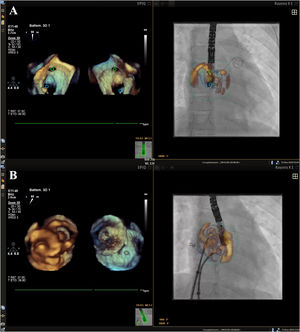
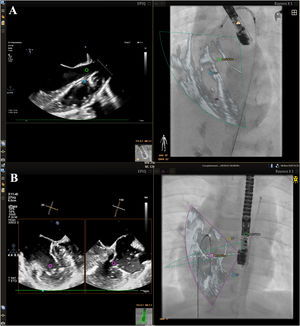
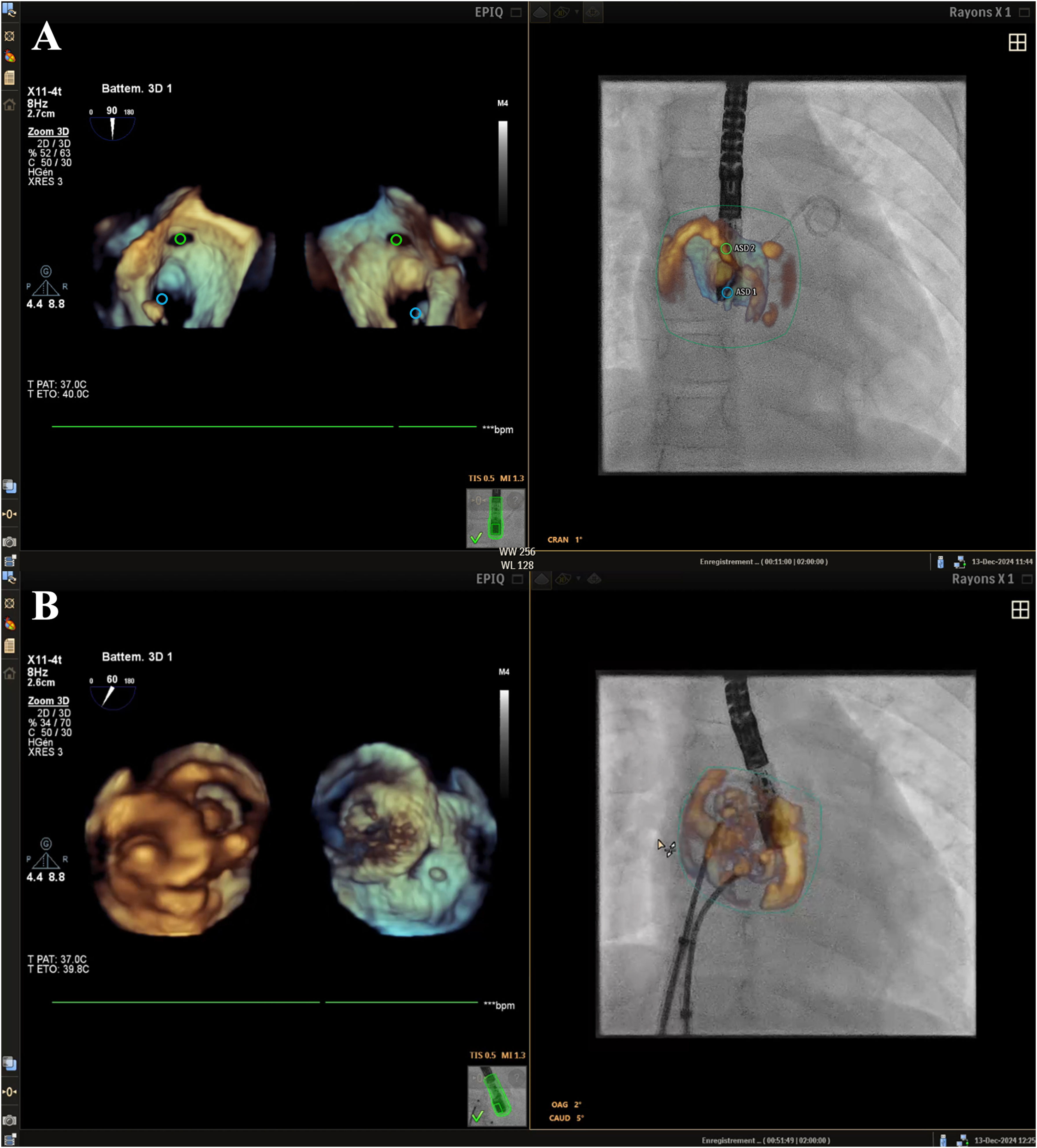
EFF imaging was successfully performed in all 8 ASD cases, and in 1 patient with a complex separated double ASD, EFF imaging offered enhanced guidance for crossing both defects separately, enabling improved manipulation and repositioning of the prosthesis, as well as the simultaneous deployment of 2 ASD occluders (figure 1A,B). EFF imaging was also successfully used in all 10 cases of VSD, enabling assessment of the size, position, and rims of the defects. EFF imaging also facilitated precise VSD crossing using markers (figure 2A) and ensured accurate prosthesis placement (video 1 of the supplementary data). In the case of a 2-year-old patient with congenitally corrected transposition of the great arteries with dextrocardia, a complex diagnostic catheterization was performed guided by EFF imaging. Given the atypical cardiac anatomy and spatial orientation, which complicates visualization and interpretation and the mirrored positioning of the heart and associated structures, EFF imaging played an important role in helping the interventional cardiologist understand the anatomy and the spatial orientation to better guide the catheterization procedure (figure 2B, video 2 of the supplementary data). EFF imaging was also successfully employed for an atrioseptostomy in a 3-year-old patient with nonoperated corrected transposition of the great arteries and VSD.

Figure 1.

Three-dimensional echocardiography-fluoroscopy fusion (3D EFF) imaging during atrial septal defect (ASD) closure in a 17kg patient. A: 3D transesophageal echocardiography showing a face view of 2 markedly separated ostium secundum ASDs from the right atrium (left panel) and the left atrium (right panel). The pigtail crossing the largest defect is shown in both 3D and fluoroscopic images. B: 3D en face view of a 16-mm device (lower device) and a 12-mm device (upper device).

(0.75MB).
Figure 2.

Two-dimensional echocardiography-fluoroscopy fusion (2D EFF) imaging. A: ventricular septal defect (VSD) closure in a (9kg) patient. Mid-esophageal view of the left ventricular outflow tract. Markers were positioned on the VSD and at the aortic valve level, facilizing crossing the VSD by a sheath. B: catheterization of a 13kg patient with congenitally corrected transposition of the great arteries and dextrocardia, showing markers to indicate the spatial positions of all valves. The guidewire can be clearly seen crossing the mitral valve into the left ventricle from the inferior vena cava and right atrium.

(0.85MB).

Furthermore, the use of EFF imaging significantly enhanced communication between the interventional cardiologist and the echocardiographer. The ability to mark and project key anatomical landmarks onto the merged display enhanced understanding of procedural steps and improved communication, potentially leading to more efficient and precise execution of the intervention.

In conclusion, EFF imaging was successfully and safely obtained in all pediatric patients using the mini 3D-TTE probe, which provided excellent and stable image quality during all procedures. The probe provides precise guidance during complex procedures, particularly in CHD cases, and is valuable in the pediatric population, in which anatomical variations are often significant.

FUNDING

The authors received no financial support for this research.

ETHICAL CONSIDERATIONS

This study was performed in accordance with the Declaration of Helsinki of the World Medical Association and was approved by our institutional review committee. Informed consent was obtained from each patient or legal representative. In line with the SAGER guidelines, we did not specifically consider sex/gender bias in our study.

STATEMENT ON THE USE OF ARTIFICIAL INTELLIGENCE

Artificial intelligence tools, such as ChatGPT, were used only for language refinement and grammar correction. The scontent, analysis, and conclusions of the study are entirely the authors’ original work.

AUTHORS’ CONTRIBUTIONS

R. Ghenghea and K. Hadeed, contributed equally as first authors. Conception or design of the work: K. Hadeed, C. Karsenty, and P. Acar. Analysis and interpretation of data: K. Hadeed, C. Karsenty, and R. Ghenghea. Acquisition of data for the work, drafting the work or revising it critically, final approval of the version to be published, and agreement to be accountable for all aspects of the work: all authors.

CONFLICTS OF INTEREST

None declared.

REFERENCES
[1]
J.J. Thaden, S. Sanon, J.B. Geske, et al.
Echocardiographic and Fluoroscopic Fusion Imaging for Procedural Guidance: An Overview and Early Clinical Experience.
J Am Soc Echocardiogr., (2016), 29 pp. 503-512
[2]
K. Hadeed, S. Hascoët, C. Karsenty, et al.
Usefulness of echocardiographic-fluoroscopic fusion imaging in children with congenital heart disease.
Arch Cardiovasc Dis., (2018), 111 pp. 399-410
[3]
S. Hascoët, K. Hadeed, C. Karsenty, et al.
Feasibility, Safety and Accuracy of Echocardiography-Fluoroscopy Imaging Fusion During Percutaneous Atrial Septal Defect Closure in Children.
J Am Soc Echocardiogr Off Publ Am Soc Echocardiogr., (2018), 31 pp. 1229-1237
[4]
C. Karsenty, K. Hadeed, P. Pyra, et al.
Advancing paediatric cardiac imaging: a comprehensive analysis of the feasibility and accuracy of a novel 3D paediatric transoesophageal probe.
Front Cardiovasc Med., (2023), 10 pp. 1294109
[5]
M. Barreiro-Perez, R. Estevez-Loureiro, B. Caneiro-Queija, et al.
Fusion Imaging With Mini–3D TEE Probe: Advanced Tools Under Conscious Sedation.
JACC Cardiovasc Interv., (2025), 18 pp. 677-679

These authors contributed equally as first authors.

Copyright © 2025. Sociedad Española de Cardiología