
Primary percutaneous coronary intervention (pPCI) is recommended for ST elevation myocardial infarction (STEMI). Countries have designed various STEMI network models to optimize out-of-hospital triage, timely treatment, and patient outcomes. The aim of this study was to evaluate the effectiveness of STEMI network implementation including out-of-hospital triage in improving STEMI case-fatality and long-term mortality, and its effect on the proportion of patients presenting with heart failure, their ischemia time, and time to pPCI.
MethodsSystematic review and meta-analysis. Searches of PubMed, Scopus, and Web of Science databases covering January 2000 to December 2023, study selection, and data extraction were completed by 3 independent reviewers.
ResultsA total of 32 articles were selected. STEMI network implementation with out-of-hospital triage was associated with reductions of 35% in case-fatality (95%CI, -23% to -45%), 27% in long-term mortality (95%CI, -22% to -32%), and in the proportion of patients with Killip III-IV at admission, ischemia, time and time to pPCI (-17%, 95%CI, -35% +6%; -19%, 95%CI, -6% to -31%; -33%, 95%CI, -16% to -47%, respectively). Networks based on emergency transport systems and those involving the entire health system, including primary care centers and hospitals without pPCI capabilities, showed similar effectiveness. Greater effectiveness was observed in urban vs rural areas and high-income vs middle- and low-income countries.
ConclusionsThe implementation of out-of-hospital triage-based STEMI networks is effective in reducing STEMI case-fatality and long-term mortality, independently of the geographic and socioeconomic conditions of the region. Participation of the emergency transport system is the key element of successful networks.
Keywords
Ischemic heart disease is the principal cause of morbidity and mortality globally,1 and ST-segment elevation myocardial infarction (STEMI) is one of its principal clinical manifestations.2 In this century, primary percutaneous coronary intervention (pPCI) has emerged as the standard treatment for STEMI, provided pPCI is initiated within 120minutes of diagnosis,3–5 as time to revascularization is directly associated with mortality.6
Initiatives like the European Society of Cardiology's Stent-for-Life and the Door-to-Balloon Alliance have been established to ensure prompt access to pPCI for STEMI patients.7,8 Additionally, various regional or national health systems have implemented STEMI networks to ensure equal and universal access to this treatment and to minimize delays, thereby improving clinical outcomes.9 These networks are based on out-of-hospital triage of patients with suspected STEMI, and 2 main strategies have been implemented: a) emergency transport systems equipped with electrocardiogram (ECG) transmission and direct access to the catheterization laboratory in designated pPCI hospitals (pPCI hub), and b) extended population networks that include the entire health system and stakeholders: primary care centers, spoke hospitals lacking pPCI capabilities, emergency transport systems, and referral hospitals with pPCI.
Several reviews have analyzed and shown the efficacy of these types of network in shortening the time to initiation of reperfusion therapy10–15 or reducing STEMI case-fatality, long-term mortality, and other complications.16–19 Most of these reviews have included studies of telemedicine used in emergency transport systems, but the impact of extended population STEMI networks has not been properly evaluated. Moreover, the efficacy of these networks in rural vs urban areas and in high-income vs low- and middle-income countries has not been adequately assessed.
The aim of this study was to conduct a systematic review and meta-analysis to assess the effectiveness of STEMI network implementation on a population scale, specifically in reducing STEMI case-fatality, long-term mortality, the proportion of patients presenting with signs of heart failure upon hospital admission and during hospitalization, the time of ischemia and the time elapsed before pPCI. We also aimed to explore potential disparities in effectiveness, considering 3 characteristics of these networks: telemedicine in the emergency transport system vs extended population STEMI networks; high-income vs low- and middle-income countries, and urban vs rural environments. Our hypothesis was that the implementation of such networks enhances the short- and long-term prognosis of STEMI patients, independently of specific network characteristics.
METHODSDesignThis systematic review and meta-analysis was registered in the PROSPERO database (CRD42024501607), followed the Cochrane Handbook for Systematic Reviews of Interventions v5.1.0,20 and is reported in accordance with the PRISMA statement.21
Search strategyThree databases—PubMed, Web of Science, and Scopus—were interrogated using the following terms and search strategy: (“Acute myocardial infarction” OR “Acute myocardial infarct” OR “Acute coronary syndrome” OR “STEMI” OR “ST elevation myocardial infarction” OR “ST elevation coronary syndrome”) AND (“Network” OR “Multi-institution systems” OR “Activation” OR “Management” OR “Regional System” OR “Regional health” OR “Code STEMI” OR “Infarction Code” OR “Care program” OR “Myocardial infarction code”) AND (“Emergency teams” OR “Prehospital” OR “Emergency care” OR “Emergency medical service” OR “Emergency department”) AND (“Angioplasty” OR “Reperfusion” OR “Percutaneous coronary intervention” OR “Revascularization” OR “Primary PCI”). The search period covered from 1 January 2000 to 31 December 2023. Duplicate studies were identified.
Study eligibility criteriaTo guide the systematic review, the research question was posed using the population, intervention, comparator, outcome, study design, and time frame (PICOST) format, as follows: P (Population): adult patients with STEMI and out-of-hospital attention; I (Intervention): out-of-hospital STEMI attended by networks with prehospital triage, including emergency transport systems equipped with ECG transmission and direct access to the hemodynamic room in pPCI referral hospitals, or those with an extended population setting that encompasses primary care centers, spoke hospitals, emergency transport systems, and reference hospitals with pPCI capabilities; C (Comparison or control): out-of-hospital STEMI attention without a prehospital triage STEMI network; O (Outcomes): main outcomes of case-fatality (in-hospital or at 28 or 30 days) and 1 year or long-term mortality. Secondary outcomes included Killip III-IV at admission, cardiogenic shock during hospital stay, ischemia time, door-to-balloon (D2B) time, and the proportion of patients with D2B <90minutes; S (Study design): observational studies with a before-and-after design, or comparing STEMI patients attended by emergency transport systems equipped or not equipped with ECG transmission, and comparing areas with and without a STEMI network; T (time frame): all studies published between 1 January 2000 and 31 December 2023. These types of network were initially implemented at the beginning of this century and were formally recommended in the 2012 Guidelines.22
Exclusion criteria: studies were excluded if they: a) examined intrahospital activation codes; b) included self-referring patients as a comparison group, who were not transferred by ambulance to a pPCI hub center and thus did not receive prehospital attention, diagnosis, and treatment; or c) had fewer than 100 patients in either the intervention or comparison group.
Three researchers independently reviewed and analyzed the identified articles in pairs. The three-step selection process involved: a) evaluating the title, b) reviewing the abstract, and c) examining the full text of articles that appeared to meet the study's inclusion criteria. In cases of disagreement, a third researcher reviewed the manuscript, and a consensus was reached. In addition, the bibliography of each selected article was carefully examined to identify any relevant articles not initially captured by the search strategy.
Data extraction and calculationsFrom each selected article, data were extracted for both the intervention (STEMI network) and control (nonnetwork) groups, on the following variables of interest: author, year of publication, country, type of STEMI network (emergency transport or extended population network), rural or urban area, high-income or low- to middle-income country, years studied, number of patients included, case-fatality (at 28-30 days or in-hospital), long-term mortality (≥ 1 year), ischemia time, D2B time, and the proportions of patients with D2B time <90minutes. Data were also collected on cardiogenic shock during hospital stay and Killip III-IV at admission.
For crude case-fatality or long-term mortality, the relative change between the intervention (STEMI network available) and control (nonnetwork) groups was calculated, along with the standard error of this change. In studies showing a multivariate adjusted relative effect, this information was considered as the main result. If studies reported the effect of the STEMI network at multiple follow-up points, the longest follow-up period was used for the meta-analysis.
The proportion of patients with in-hospital cardiogenic shock and those with Killip III-IV at admission was also extracted, and the relative change between the intervention and control groups was calculated, along with the SE of this change.
In the case of D2B time, which does not follow a normal distribution, only studies reporting the median and interquartile range were included, while those presenting mean and standard deviation were excluded. The median was log-transformed, and the result was considered as the mean, assuming a normal distribution. The following calculations were performed:
- -
The standard deviation (SD) of this mean was calculated as: SD=(Ln (quartile 3) – Ln (median))/0.6745; where 0.6745 is the 75th percentile of the standardized normal distribution.
- -
The SE of the mean was calculated as SE=SDn , where n represents the number of patients included in the intervention or control group.
- -
The difference in D2B time between the intervention and control groups was calculated as: Δ D2B time=Ln (median intervention) – Ln (median control).
- -
Finally, the standard error of the difference was calculated as: SE of the Δ in the D2B time = SE intervention2+SE control2
To assess the risk of bias in the included studies, the Risk of Bias in Nonrandomized Studies of Interventions (ROBINS-I) tool was used.23 ROBINS-1 is designed to evaluate studies estimating the comparative effectiveness (harm or benefit) of interventions that did not apply random allocation to comparison groups. Seven types of bias were assessed: confounding, selection of participants, classification of the intervention, measurement of the outcome, deviations from the intended intervention, missing data, and selection of the reported result. The potential effect of each type of bias or domain was classified as low, moderate, serious, critical, or no information.
Statistical analysisFor the statistical analysis, the overall regression coefficients, 95% confidence intervals (95%CI), and 2-sided P values were calculated using random or fixed effects models. The I2 was calculated to test for heterogeneity between studies. When the I2 statistic was ≥ 50%, heterogeneity was considered moderate to high, and the results of the random effect model were selected. When the I2 statistic was <50%, heterogeneity was considered low, and the results of the fixed effect model were selected.
Categorical variables (case-fatality, long-term mortality, and the proportions of patients with Killip IV during hospital stay, Killip III-IV at admission, and D2B time <90min) were analyzed using beta coefficients and the SEs for the odds ratios or relative risks/hazard ratios from multivariate models, if available. For crude proportions, their ratios, corresponding beta coefficients, and SEs were calculated.
For D2B time, we used the estimated change and its SE, as previously described. The results of the meta-analysis are shown as risk ratios and interpreted as the percentage change in this variable.
Analysis of the main outcomes was stratified by the 3 characteristics defined in the aims of the study: emergency transport systems equipped with ECG transmission vs population-based networks; rural vs urban networks; and networks in high-income vs low- and middle-income countries.
Studies with very high samples size were excluded from some sensitivity analyses to evaluate their potential effect on the results. Studies showing multivariate adjusted and crude results were selected and the multivariate and crude results were compared.
To assess the presence of publication bias, funnel plots were used, and the Egger statistic was calculated. All analyses were performed in R 4.1.1 using the Meta R package.
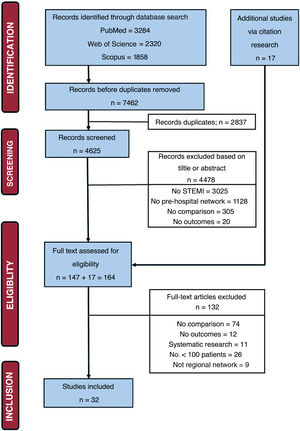
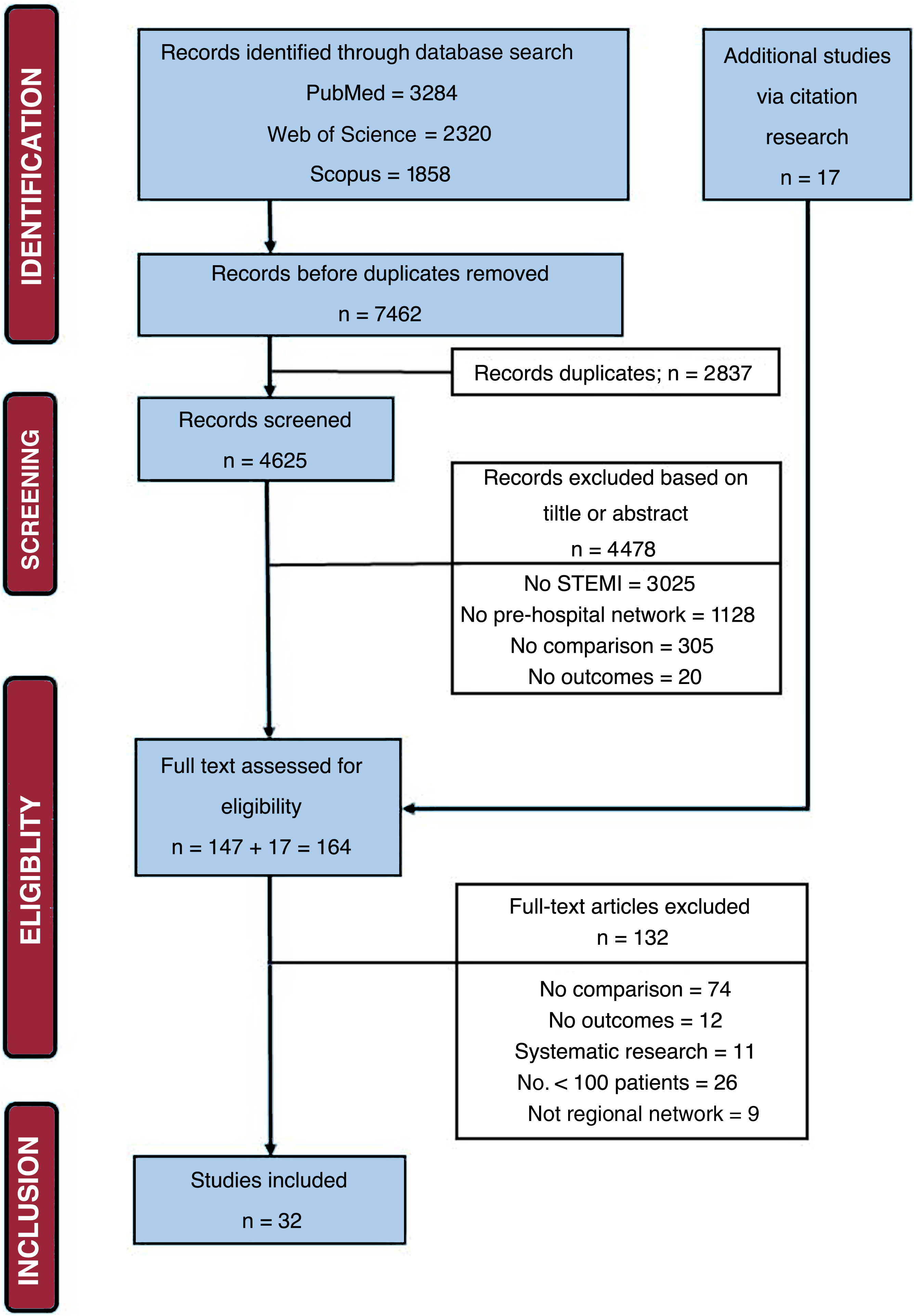
RESULTSLiterature search resultsOur initial literature search identified 4625 unduplicated articles of potential interest. After reviewing the titles and abstracts, 4478 articles were excluded, leaving 147 articles for full-text review. During this review, 17 additional articles were identified from references cited. Of these 164 articles, 32 studies were finally included in our meta-analysis (figure 1).
The 32 studies included in this meta-analysis are listed in table 1 of the supplementary data. Among these, 5 were conducted in the United States and Italy; 4 in Spain and Australia; 2 in the UK and Brazil; and 1 each in the Netherlands, Germany, Denmark, Singapore, Indonesia, Hungary, Poland, India, Egypt, and 1 international study conducted in Brazil and Colombia.
All patients included in the studies had a diagnosed STEMI. The total number of study participants was 112 758, with 36 130 in the control group and 76 628 in the intervention group. The recruitment period for these studies ranged from January 2001 to December 2023.
Primary outcomes: case-fatality and long-term mortalityData from 26 studies provided insight into the effectiveness of STEMI network implementation in reducing case-fatality (in-hospital or at 28-30 days). High heterogeneity of the results was observed between studies (I2=74%) and the random effects model indicated that implementation of this type of network led to a significant 35% reduction in STEMI case-fatality (95%CI, 23% to 45% reduction) (figure 1 of the supplementary data). In a sensitivity analysis, exclusion of the study by Quinn et al, which had a very large sample size, did not substantially modify the main results of the meta-analysis (37% case-fatality reduction). The funnel plot suggested a potential publication bias (Egger P=.0004), indicating that smaller studies reporting no reduction in case-fatality might be underrepresented in the literature (figure 2 of the supplementary data).
Data from 12 studies were included in the analysis of the effectiveness of STEMI network implementation in reducing long-term mortality. Low heterogeneity of the results was observed between studies (I2=31%); the fixed effects model indicated that implementation of this type of network resulted in a significant 27% reduction in STEMI long-term mortality (95%CI: 22% to 32% reduction) (figure 3 of the supplementary data). The funnel plot suggested significant publication bias for this outcome (Egger P=.008) (figure 4 of the supplementary data).
For the sensitivity analysis, we selected studies showing both crude and multivariable adjusted results (9 for case-fatality and 6 for long-term mortality). When adjusted for the effect of covariates, the effect of a STEMI network on case-fatality decreased from 34% to 21% (38% of the effect related to the covariates) and on long-term mortality from 44% to 31% (30% of the effect related to the covariates).
Secondary outcomes: cardiogenic shock during admission, Killip III- IV at admission, ischemia time, D2B time, and D2B time <90minutes.
Only 2 studies provided data on the presence of cardiogenic shock during admission; thus, no meta-analysis was performed. Six studies analyzed the effect of the network on the presence of Killip III-IV at admission. The heterogeneity of study results was moderate (I2=52%) and the results indicated a nonsignificant reduction in this outcome (−17%; 95%CI, −35% to +6%) (figure 5A of the supplementary data). The funnel plot did not suggest the presence of publication bias (figure 6A of the supplementary data).
In the analysis of ischemia time, data from 3 studies were included. High heterogeneity of the study results was observed (I2=80%); implementation of this type of network reduced ischemia time by 19% (95%CI, 6%-31% reduction) (figure 5B of the supplementary data).
In the analysis of D2B time, data from 10 studies were included. High heterogeneity was observed between study results (I2=98%). The results indicated that implementation of this type of network reduced D2B time by 33% (95%CI: 16%-47% reduction) (figure 5C of the supplementary data). The funnel plot showed high variability of the results, limiting the interpretation of the Egger statistics (P=.435) (figure 6B of the supplementary data).
In the analysis of the proportion of patients with D2B time <90minutes, data from 6 studies were included. High heterogeneity of the results was observed (I2=96%). The results indicated that implementation of this type of network increased this proportion by 41% (95%CI, 9% to 82% increase) (figure 5D of the supplementary data). The funnel plot is shown in figure 6C of the supplementary data.
Subgroup analysesAnalysis of the 2 main outcomes was also performed based on 3 characteristics of interest: emergency transport services vs extended population networks, rural vs urban settings, and high-income vs low- and middle-income countries.
Studies assessing STEMI networks based on emergency transport systems equipped with ECG transmission and direct access to PCI showed a similar reduction in both case-fatality and long-term mortality (31% and 39%, respectively), compared with those assessing extended population networks (38% and 39%, respectively) (figures 7 and 8 of the supplementary data).
The reduction in case-fatality observed in studies carried out in rural settings was lower than that observed in urban settings (11% and 40%, respectively) (figure 9 of the supplementary data). Similarly, the reduction in long-term mortality was also lower in rural than in urban settings (31% and 42%, respectively) (figure 10 of the supplementary data).
Analysis of high-income vs middle- or low-income country settings showed a greater reduction in case-fatality resulting from the implementation of a STEMI network in high-income countries (39% vs 27% reduction), although this difference was not statistically significant (figure 11 of the supplementary data). We could not compare differences in long-term mortality because no long-term studies of this outcome were identified in middle- or low-income countries.
Risk of bias analysisThe ROBINS-I assessments related to the main outcomes are shown in figures 12 and 13 of the supplementary data. The evaluation revealed that bias due to confounding was the main risk, ranging from moderate to critical. This was due to the pre-post design of some studies, differences between intervention and control groups, and the fact that most studies presented crude results without any form of adjustment. As described above, we assessed the possible impact of this bias on the results.
Several studies also exhibited bias resulting from the selection of participants, primarily because only patients who underwent pPCI were included. This bias could potentially underestimate the effectiveness of STEMI networks, as their implementation has led to an increased proportion of pPCI among STEMI patients.
Biases related to the classification of the intervention, measurement of the outcome, deviations from the intended intervention, missing data, or selection of the reported result were considered low or moderate.
DISCUSSIONIn this comprehensive systematic review and meta-analysis, we present evidence supporting the effectiveness of population-based networks in reducing STEMI case-fatality and long-term mortality. Networks based on emergency transport systems equipped with ECG transmission and direct access to pPCI, as well as those based on more extended population-based strategies, including other stakeholders in the health system (primary care, spoke hospitals), showed similar reductions in these main outcomes. However, the effectiveness of the STEMI networks was higher in urban than in rural areas and tended to be higher in high-income countries than in middle- or low-income countries. Moreover, we found that these types of network reduce ischemia time and D2B time and increase the proportion of patients with a D2B time <90minutes. No clear effect on the presence of Killip III-IV at admission was observed, and the effect on the presence of cardiogenic shock during admission could not be analyzed due to the very few available studies on this topic.
Randomized clinical trials have consistently shown the superiority of pPCI over fibrinolysis in terms of short- and long-term mortality.4 Current clinical guidelines state that pPCI is the preferred reperfusion strategy for STEMI patients.2 To ensure widespread and equitable access to this life-saving treatment, scientific societies and health care systems at local, regional, and national levels are actively promoting and implementing networks to facilitate access to pPCI for all STEMI patients. In Europe, the Stent-for-Life Initiative was launched in 2008 to foster collaboration among stakeholders to ensure equitable access to pPCI for most STEMI patients.24
This initiative can be implemented at various levels within the health care system, ranging from pPCI centers exclusively to regional population-based networks that also incorporate non-pPCI centers, emergency transport services, and general practitioners and cardiologists.25 In this systematic review, we evaluated the effectiveness of STEMI networks with out-of-hospital triage that encompass emergency transport with ECG transmission to pPCI centers, as well as networks that include general practitioners and other specialists working in spoke hospitals. The rationale for assessing these types of network is that they provide equitable and universal health care, irrespective of geographical location or personal wealth, from symptom onset to timely access to pPCI.26
Our findings indicate that regional population-based STEMI networks are effective, resulting in a significant 35% reduction in STEMI case-fatality. This result aligns with previous meta-analyses that reported a reduction in case-fatality between 38% to 43% associated with telemedicine interventions, particularly ECG transmission.16–19 This reduction could be due to several factors. First, the higher proportion of patients treated with pPCI, which has been shown to reduce STEMI case-fatality by 22% compared with thrombolysis.4,27 Second, the standardization of emergency transport protocols and reduction in related delays, which are the main contributors (50%) to the overall system delay in attending STEMI patients.28 Third, we report a trend of reduced risk of patients presenting with Killip III-IV at hospital admission, indicating that patients reach hospital with better hemodynamic status. This result is based on only 6 studies, which show moderate heterogeneity. It could also be argued that STEMI networks might increase the proportion of patients arriving at the hospital with Killip III-IV who, without the network, might have died before reaching the hospital. Fourth, we report a 19% and 33% reduction in ischemia and D2B time, respectively. Previous meta-analyses have also reported reductions in D2B time, with one reporting a mean reduction of 28minutes (95%CI, 20minutes to 35minutes)17 and another reporting a 40% reduction (95%CI, 33% to 48%),15 both with large heterogeneity (I2=94% and 97%, respectively). Lastly, the STEMI network may enhance the overall management of STEMI patients, independent of the reperfusion therapy employed.17
Furthermore, our analysis indicates that STEMI networks reduce long-term mortality due to STEMI by 27%. This result is consistent with previous meta-analyses conducted by Marcolino and Lazarus et al.,17,19 which reported a 39% and a 48% reduction in long-term mortality associated with telemedicine interventions, respectively. The improvement in long-term mortality could be related to several factors: the reduction in STEMI case-fatality, the improvement of infarct artery patency, which reduces ischemia and necrosis, ventricular arrhythmias and mechanical complications, and improves ejection fraction, as well as the implementation of effective secondary prevention strategies. Moreover, STEMI networks preserve cardiac function, reducing the risk of developing chronic heart failure during the follow-up.29
Our results also indicate that the effectiveness of STEMI networks based on incorporating telemedicine in the emergency transport system is similar to that of more extesive population-based STEMI networks. Therefore, it is important to prioritize these types of intervention in regions that are still without either of these types of STEMI network.
In our analysis stratified by the socioeconomic setting of the network, we observed that those implemented in rural areas and middle- and low-income countries were effective in improving STEMI patients’ prognosis, but the magnitude of the effectiveness was lower than in urban areas and high-income countries. This difference in effectiveness could be attributed to the longer distances and time required to reach the referral hospital in rural areas, as the efficacy of pPCI depends on the delay from symptom onset to pPCI. It may be attributed to the comparatively limited technological capabilities in middle- and low-income countries.
LimitationsThis review has some limitations that should be acknowledged. First, the search strategy employed may not have been completely sensitive, resulting in the omission of relevant studies. However, a comprehensive review of the references cited in the identified articles was undertaken to mitigate this limitation and identify additional relevant studies. Second, the included studies were observational, most with a pre-post intervention design. Observational study design is susceptible to confounding biases that may influence the observed results. Moreover, most of the studies reported crude results without appropriate adjustment for confounding variables, which may limit the robustness of the findings. We calculated that the lack of adjustment for potential confounders could overestimate the effect of STEMI networks on case-fatality and long-term mortality by 38% and 30%, respectively. Third, we observed large heterogeneity in most of the outcomes assessed in this study, which could be related to variations in geographical conditions or disparities in health care capabilities among the included studies. It also indicates that the results should be interpreted with caution. Fourth, we identified the presence of publication bias in our analyses of case-fatality and long-term mortality. Moreover, we cannot discard the presence of this type of bias in the analyses of the secondary outcomes; the high heterogeneity and the low number of studies (≤ 10) limit the visual interpretation of the funnel plot and the results of the Egger statistics. We tried to limit this bias by excluding studies with a small sample size. Fifth, we could not analyze the effect of STEMI networks on out-of-hospital case-fatality. Sixth, the comparison between rural and urban networks in case-fatality and long-term mortality should also be interpreted with caution, as only 4 and 2 studies, respectively, met the criteria for inclusion in the rural setting meta-analysis. Finally, we could not analyze differences by gender or by public-private health systems as the results of the studies were not stratified by these variables.
CONCLUSIONSThe results of this systematic review and meta-analysis support the implementation of regional STEMI networks as an effective strategy to improve the short and long-term prognosis of STEMI patients in diverse health care settings. Participation of the emergency transport system is the key element of successful networks. However, we must consider that, according to the GRADE system, observational studies provide a low level of evidence.
- –
pPCI is the recommended revascularization treatment for STEMI.
- –
STEMI networks have been established to ensure prompt access to pPCI for STEMI patients.
- –
The implementation of out-of-hospital triage-based STEMI networks is effective in reducing STEMI case-fatality (35%, 95% confidence interval: 23 to 45% reduction) and long-term mortality (27%, 95% Confidence Interval: 22% to 32% reduction).
- –
The participation of the emergency transport system is the key element of successful networks.
- –
The effectiveness of these networks is observed in rural areas but mainly in urban areas, and in high- and middle- or low-income countries.
No external funding.
ETHICAL CONSIDERATIONSThe authors accept full responsibility for the content of this study, as specified by the International Committee of Medical Journal Editors. The present paper is a meta-analysis of aggregate data and did not require ethics approval. The study did not involve patient recruitment or access to disaggregated information on individuals. Consequently, informed consent was not required.
STATEMENT ON THE USE OF ARTIFICIAL INTELLIGENCENo artificial intelligence tools were used in the preparation of this work.
AUTHORS’ CONTRIBUTIONSJ. Cartanya-Bonvehi, A. Pericas-Vila, and R. Elosua made substantial contributions to the conception or design of the work. J. Cartanya-Bonvehi, A. Pericas-Vila, and R. Elosua were responsible for data acquisition. J. Cartanya-Bonvehi, A. Pericas-Vila, I. Subirana, and R. Elosua contributed to the analysis. J. Cartanya-Bonvehi, A. Pericas-Vila, I. Subirana, C. García-García, H. Tizón-Marcos, and R. Elosua interpreted the results. J. Cartanya-Bonvehi and R. Elosua drafted the manuscript. A. Pericas-Vila, I. Subirana, C. García-García, and H. Tizón-Marcos critically reviewed the intellectually significant content. J. Cartanya-Bonvehi, A. Pericas-Vila, I. Subirana, C. García-García, H. Tizón-Marcos, and R. Elosua approved the final version for publication. J. Cartanya-Bonvehi, A. Pericas-Vila, I. Subirana, C. García-García, H. Tizón-Marcos, and R. Elosua agreed to be responsible for all aspects of the work and ensure that any questions related to the accuracy or integrity of any part of the work are appropriately investigated and resolved.
CONFLICTS OF INTERESTNothing to declare.