





This study aimed to evaluate the efficacy and safety of sodium-glucose cotransporter 2 (SGLT2) inhibitors throughout the spectrum of kidney function in patients with heart failure (HF).
MethodsThis meta-analysis included randomized controlled trials comparing SGLT2 inhibitors with placebo in patients with HF stratified by renal function. Literature from inception to June 8, 2024 was searched. The primary outcome was a composite of cardiovascular death or HF events.
ResultsFive trials were identified, comprising 21 204 patients (10 605 in the SGLT2 inhibitor group and 10 599 in the placebo group) who were randomized and followed up for a weighted median duration of 1.8 years. When patients were classified by estimated glomerular filtration rate (eGFR) of 60mL/min/1.73 m2, SGLT2 inhibitors reduced the risk of the primary outcome irrespective of kidney function (RR, 0.81; 95%CI, 0.75-0.87; P<.01 for eGFR <60mL/min/1.73 m2; RR, 0.79; 95%CI, 0.72-0.87; P<.01 for eGFR≥ 60mL/min/1.73 m2; test for subgroup differences P=.75). The beneficial impact of SGLT2 inhibitors was consistently observed when patients were further subclassified by eGFR values of 20-30, 30-45, 45-60, and >60mL/min/1.73 m2 (test for subgroup differences, P=.54). Early eGFR decline showed a differential impact with increased risk only in the placebo subgroup (RR, 1.30; 95%CI, 1.15-1.47; P<.01), but not in the SGLT2 inhibitor subgroup (RR, 0.99; 95%CI, 0.86-1.13; P=.84) (test for subgroup differences, P<.01).
ConclusionsSGLT2 inhibitor therapy is safe and effective throughout the spectrum of kidney function and regardless of the initial decline in kidney function in patients with chronic HF.
Registered at PROSPERO: CRD42024565218.
Keywords
Sodium-glucose cotransporter 2 (SGLT2) inhibitors have emerged as an essential therapy in heart failure (HF) due to their demonstrated efficacy in reducing cardiovascular death and HF hospitalization, irrespective of left ventricular ejection fraction (LVEF).1–4 This benefit extends to patients recently hospitalized for HF, with outcomes consistent with those of patients with chronic HF.5,6 Based on recently published results, the use of SGLT2 inhibitors for HF treatment has been elevated to a class 1 recommendation in the latest guidelines, regardless of LVEF.7
HF and chronic kidney disease (CKD) frequently coexist, interacting in a complex way referred to as cardiorenal syndrome.8 This comorbidity significantly worsens prognosis, with each condition accelerating the progression of the other.9,10 Although patients with comorbid HF and CKD have a poor prognosis, they are not optimally treated with guideline-directed medical therapies due to concerns about regarding the safety of these therapies in patients with varying degrees of renal function.10 Similar concerns also extend to the use of SGLT2 inhibitors in this patient population. Several landmark trials have demonstrated the efficacy of SGLT2 inhibitors in HF patients throughout a spectrum of renal function.11–15 However, the generalizability of these findings is limited due to the underrepresentation of specific CKD stages within these trials.
Given the potential benefits of SGLT2 inhibitors in HF and the high prevalence of CKD in this population, a comprehensive understanding of their safety and efficacy throughout the spectrum of kidney function is crucial. To address this knowledge gap, we conducted a systematic review and meta-analysis to evaluate the efficacy and safety of SGLT2 inhibitor therapy in patients with HF stratified by renal function. We hypothesized that SGLT2 inhibitors would show consistent benefits regardless of baseline estimated glomerular filtration rate (eGFR).
METHODSSearch strategy and eligibility criteriaIn this systematic review and meta-analysis, studies were eligible if they met the following criteria: a) compared SGLT2 inhibitors with placebo in patients with HF; b) reported clinical outcomes stratified by renal function; and c) were randomized controlled trials. No studies were excluded based on the duration of follow-up or sample size, but only articles written in English were considered. A literature search of articles in the PubMed, EMBASE, and Cochrane databases from inception to June 8, 2024, was conducted. The search strategy is described in table 1 of the supplementary data. This systematic search of databases was complemented by a manual review of references cited by included articles, recent reviews, editorials, and meta-analyses. Two investigators (D. Hong and O. Kim) independently screened titles and abstracts, identified duplicates, performed full-article reviews, and determined inclusion. Two other investigators (D. Kim and J.-O. Choi) supervised the search and adjudicated disagreements. The reasons for excluding studies after full-text assessment are provided in table 2 of the supplementary data. This study complied with the Preferred Reporting Items for Systematic Reviews and Meta-analyses (PRISMA) guidelines.16 The study protocol was prespecified and registered with PROSPERO (CRD42024565218). The institutional review board of Samsung Medical Center waived the IRB approval process based on the study design, which is a study-level meta-analysis using published materials.
Data extraction, quality assessment, and study outcomesData obtained for this analysis were study-level summary estimates. Summary data as reported in the published manuscripts were recorded in a standardized form. The following data were extracted: trial design, trial characteristics, number of trial participants, median follow-up duration, baseline characteristics of study patients, clinical outcomes, and adverse events. All clinical outcomes were collected and adjudicated on an intention-to-treat basis. Clinical outcomes were extracted based on eGFR categories: eGFR <60 vs ≥ 60mL/min/1.73 m2, with further stratification by eGFR cut-offs of 30, 45, and 60mL/min/1.73 m2. Event data from patients with eGFR levels of 20-45mL/min/1.73 m2 in the EMPULSE trial and 25-45mL/min/1.73 m2 in the DELIVER trial were excluded from the subgroup analysis further stratified according to eGFR. Clinical outcomes were additionally extracted based on the presence of an early decline in eGFR, which had various definitions ranging from >10% decrease in eGFR at 14 days to >20% decrease in eGFR at 4 weeks (table 3 of the supplementary data). Two investigators (D. Hong and O. Kim) independently assessed the quality of the trials included in this study, using the Cochrane Collaboration's tool for assessing the risk of bias 2. Studies were not excluded based on the assessment of risk of bias.
The primary outcome was a composite of cardiovascular death or HF events. Secondary outcomes included individual components of the primary outcome, all-cause death, and composite kidney outcomes. In all studies, HF events were defined as either HF hospitalization alone or in combination with an urgent HF visit. Composite kidney outcomes encompassed a combination of sustained eGFR decline, end-stage renal disease, chronic dialysis, kidney transplantation, and renal death, although their specific definitions varied slightly among trials. Adverse events included serious adverse events, adverse events leading to discontinuation of allocated drugs, volume depletion, urinary tract infection, genital infection, hypoglycemia, and bone fractures. Definitions of HF events, the composite kidney outcomes, and adverse events used in the included trials are presented in tables 3,4 of the supplementary data.
Data analysisPrimary and secondary outcomes and adverse events were analyzed using random-effects models. Relative risks (RR) with 95% confidence intervals (95%CI) are presented as summary statistics. Pooled RR and 95%CI were calculated using the DerSimonian and Laird method. Fixed-effects models were only used for sensitivity analysis, and pooled RR and 95%CI were calculated using the Mantel-Haenszel method. Statistical heterogeneity was quantified with I2 statistics. I2 values <25%, 25% to 50%, and >50% indicate low, moderate, and high degrees of heterogeneity, respectively. Cochran's Q test was performed to evaluate treatment-by-subgroup heterogeneity of the effect size for the primary outcome. Subgroups were divided based on a) CKD (eGFR <60 vs ≥ 60mL/min/1.73 m2) status at baseline and further stratified by renal function categories when assessing the effects of SGLT2 inhibitor and b) treatment assignment (SGLT2 inhibitor vs placebo) when assessing the effect of early eGFR decline. Two-sided P-values <.05 were considered statistically significant. Statistical analyses were performed using the R programming language, version 4.2.3 (R Foundation for Statistical Computing, Vienna, Austria).
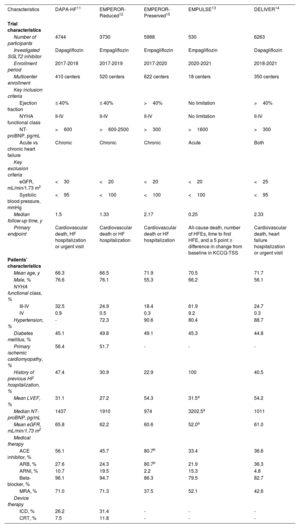
RESULTSIncluded trials and patient characteristicsOf a total of 767 identified studies, full-article assessment was done in 66 studies, and finally, 5 trials and 12 substudies of these trials were included in this meta-analysis (figure 1).1–5,11–15,17–23 The characteristics of the included trials and patients who participated in these trials are summarized in table 1. Three trials enrolled patients with chronic HF, 1 enrolled patients with acute HF, and another trial enrolled patients with both chronic HF and acute HF. LVEF eligibility criteria varied: 2 trials enrolled patients with LVEF ≤ 40%, 2 enrolled patients with LVEF >40%, and 1 included patients without limitation for LVEF. Minimum eGFR for inclusion ranged from 20 to 30mL/min/1.73 m2 among the trials. Mean age ranged from 66.3 to 71.9 years. Median NT-proBNP levels ranged from 974 to 1910 pg/mL, with 1 trial targeting patients with acute HF showing a value higher than 3202.5 pg/mL. All included trials were assessed as high quality with a low risk of bias (figure 1 of the supplementary data).

Characteristics of included trials and patients
| Characteristics | DAPA-HF11 | EMPEROR-Reduced12 | EMPEROR-Preserved15 | EMPULSE13 | DELIVER14 |
|---|---|---|---|---|---|
| Trial characteristics | |||||
| Number of participants | 4744 | 3730 | 5988 | 530 | 6263 |
| Investigated SGLT2 inhibitor | Dapagliflozin | Empagliflozin | Empagliflozin | Empagliflozin | Dapagliflozin |
| Enrollment period | 2017-2018 | 2017-2019 | 2017-2020 | 2020-2021 | 2018-2021 |
| Multicenter enrollment | 410 centers | 520 centers | 622 centers | 18 centers | 350 centers |
| Key inclusion criteria | |||||
| Ejection fraction | ≤ 40% | ≤ 40% | >40% | No limitation | >40% |
| NYHA functional class | II-IV | II-IV | II-IV | No limitation | II-IV |
| NT-proBNP, pg/mL | >600 | >600-2500 | >300 | >1600 | >300 |
| Acute vs chronic heart failure | Chronic | Chronic | Chronic | Acute | Both |
| Key exclusion criteria | |||||
| eGFR, mL/min/1.73 m2 | <30 | <20 | <20 | <20 | <25 |
| Systolic blood pressure, mmHg | <95 | <100 | <100 | <100 | <95 |
| Median follow-up time, y | 1.5 | 1.33 | 2.17 | 0.25 | 2.33 |
| Primary endpoint | Cardiovascular death, HF hospitalization or urgent visit | Cardiovascular death or HF hospitalization | Cardiovascular death or HF hospitalization | All-cause death, number of HFEs, time to first HFE, and a 5 point ≥ difference in change from baseline in KCCQ-TSS | Cardiovascular death, heart failure hospitalization or urgent visit |
| Patients’ characteristics | |||||
| Mean age, y | 66.3 | 66.5 | 71.9 | 70.5 | 71.7 |
| Male, % | 76.6 | 76.1 | 55.3 | 66.2 | 56.1 |
| NYHA functional class, % | |||||
| III-IV | 32.5 | 24.9 | 18.4 | 61.9 | 24.7 |
| IV | 0.9 | 0.5 | 0.3 | 9.2 | 0.3 |
| Hypertension, % | - | 72.3 | 90.6 | 80.4 | 88.7 |
| Diabetes mellitus, % | 45.1 | 49.8 | 49.1 | 45.3 | 44.8 |
| Primary ischemic cardiomyopathy, % | 56.4 | 51.7 | - | - | - |
| History of previous HF hospitalization, % | 47.4 | 30.9 | 22.9 | 100 | 40.5 |
| Mean LVEF, % | 31.1 | 27.2 | 54.3 | 31.5a | 54.2 |
| Median NT-proBNP, pg/mL | 1437 | 1910 | 974 | 3202.5a | 1011 |
| Mean eGFR, mL/min/1.73 m2 | 65.8 | 62.2 | 60.6 | 52.0a | 61.0 |
| Medical therapy | |||||
| ACE inhibitor, % | 56.1 | 45.7 | 80.7b | 33.4 | 36.6 |
| ARB, % | 27.6 | 24.3 | 80.7b | 21.9 | 36.3 |
| ARNI, % | 10.7 | 19.5 | 2.2 | 15.3 | 4.8 |
| Beta-blocker, % | 96.1 | 94.7 | 86.3 | 79.5 | 82.7 |
| MRA, % | 71.0 | 71.3 | 37.5 | 52.1 | 42.6 |
| Device therapy | |||||
| ICD, % | 26.2 | 31.4 | - | - | - |
| CRT, % | 7.5 | 11.8 | - | - | - |
ACE inhibitor, angiotensin-converting enzyme inhibitor; ARB, angiotensin receptor blockers; ARNI, angiotensin receptor neprilysin inhibitor; CRT, cardiac resynchronization therapy; eGFR, estimated glomerular filtration rate; HF, heart failure; HFE, heart failure event; ICD, implantable cardioverter-defibrillator; KCCQ-TSS, Kansas City Cardiomyopathy Questionnaire Total Symptom Score; LVEF, left ventricular ejection fraction; MRA, mineralocorticoid receptor antagonist; NT-proBNP, N-terminal pro-B-type natriuretic peptide; NYHA, New York Heart Association; SGLT2, sodium-glucose cotransporter 2.
This study analyzed data from 21 204 patients (10 605 in the SGLT2 inhibitor group and 10 599 in the placebo group) with reported clinical outcomes stratified by renal function. These patients were followed up for a weighted median duration of 1.8 years. Patients with CKD at baseline were older, had a higher prevalence of hypertension and diabetes mellitus, and had worse New York Heart Association functional class than those without CKD (table 5 of the supplementary data).
Clinical outcomes according to renal functionStratification by CKD status showed a consistent risk reduction in the primary outcome with SGLT2 inhibitors irrespective of renal function (RR, 0.81, 95%CI, 0.75-0.87, P<.01, heterogeneity I2 0% for patients with CKD; RR, 0.79, 95%CI, 0.72-0.87, P<.01, heterogeneity I2 0% for patients without CKD; test for subgroup differences, P=.75) (figure 2). The results were consistent for both components of the primary outcome: cardiovascular death (RR, 0.91, 95%CI, 0.81-1.02, P=.09, heterogeneity I2 0% for patients with CKD; RR, 0.86, 95%CI, 0.75-0.98, P=.02, heterogeneity I2 0% for patients without CKD; test for subgroup differences, P=.53) and HF events (RR, 0.73, 95%CI, 0.67-0.79, P<.01, heterogeneity I2 0% for patients with CKD; RR, 0.75, 95%CI, 0.67-0.84, P<.01, heterogeneity I2 0% for patients without CKD; test for subgroup differences, P=.67 (figure 3). While there were no statistically significant differences in all-cause death and composite kidney outcomes, the risk of all-cause death (RR, 0.94, 95%CI, 0.85-1.05, P=.28, heterogeneity I2 0% for patients with CKD; RR, 0.90, 95%CI, 0.79-1.03, P=.13, heterogeneity I2 0% for patients without CKD; test for subgroup differences, P=.60) and composite kidney outcomes (RR, 0.90, 95%CI, 0.67-1.21, P=.48, heterogeneity I2 41% for patients with CKD; RR, 0.77, 95%CI, 0.54-1.10, P=.15, heterogeneity I2 34% for patients without CKD; test for subgroup differences, P=.51) were each numerically lower in the SGLT2 inhibitor group than in the placebo group in both CKD and non-CKD subgroups (figure 3).

Primary outcome according to chronic kidney disease status at baseline. Forest plot showing the relative risk for the composite of cardiovascular death or heart failure events comparing SGLT2 inhibitors to placebo, stratified by chronic kidney disease status at baseline. 95%CI, 95% confidence interval; eGFR, estimated glomerular filtration rate; RR, relative risk; SGLT2, sodium-glucose cotransporter 2.

Secondary outcomes according to chronic kidney disease status at baseline. Forest plots showing the relative risk of the following outcomes comparing SGLT2 inhibitors with placebo, stratified by chronic kidney disease status at baseline: (A) cardiovascular death, (B) all-cause death, (C) heart failure events, and (D) composite kidney outcomes. *In the EMPEROR-Reduced trial, heart failure events included first and recurrent events. 95%CI, 95% confidence interval; eGFR, estimated glomerular filtration rate; RR, relative risk; SGLT2, sodium-glucose cotransporter 2.
Subclassification by renal function revealed a consistent risk reduction in the primary outcome with SGLT2 inhibitors, with no significant difference in treatment effect (RR, 0.86, 95%CI, 0.67-1.11, P=.25, heterogeneity I2 0% for patients with 20 ≤ eGFR <30mL/min/1.73 m2; RR, 0.87, 95%CI, 0.74-1.04, P=.12, heterogeneity I2 0% for patients with 30 ≤ eGFR <45mL/min/1.73 m2; RR, 0.76, 95%CI, 0.66-0.86, P<.01, heterogeneity I2 0% for patients with 45 ≤ eGFR <60mL/min/1.73 m2; RR, 0.79, 95%CI, 0.72-0.87, P<.01, heterogeneity I2 0% for patients with eGFR >60mL/min/1.73 m2; test for subgroup differences, P=.54) (figure 4).

Primary outcome according to estimated glomerular filtration rate categories. Forest plot showing the relative risk of the composite of cardiovascular death or heart failure events comparing SGLT2 inhibitors with placebo, stratified by eGFR. 95%CI, 95% confidence interval; eGFR, estimated glomerular filtration rate; RR, relative risk; SGLT2, sodium-glucose cotransporter 2.
When we compared the risk of the primary outcome according to early eGFR decline, early eGFR decline was not associated with increased risk in the SGLT2 inhibitor subgroup, whereas it significantly increased risk in the placebo subgroup, with a significantly different impact between the 2 subgroups (RR, 0.99, 95%CI, 0.86-1.13, P=.84, heterogeneity I2 36% for SGLT2 inhibitor subgroup; RR, 1.30, 95%CI, 1.15-1.47, P<.01, heterogeneity I2 47% for placebo subgroup; test for subgroup differences, P<.01) (figure 5).

Primary outcome according to early changes in the estimated glomerular filtration rate. Forest plot showing the relative risk for the composite of cardiovascular death or heart failure events according to early eGFR decline, stratified by treatment assignment (SGLT2 inhibitor vs placebo). *In the DAPA trial, the number of events was calculated by multiplying the event rate by the total number of patients. 95%CI, 95% confidence interval; eGFR, estimated glomerular filtration rate; RR, relative risk; SGLT2, sodium-glucose cotransporter 2.
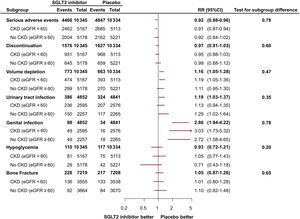
SGLT2 inhibitor treatment was not associated with a significantly increased risk of adverse events compared with placebo, with the exception of genital infections. Even for genital infections, no significant difference in the treatment effect of SGLT2 inhibitors was observed according to CKD status (RR, 3.03, 95%CI, 1.73-5.32, P<.01 for patients with CKD; RR, 2.72, 95%CI, 1.58-4.65, P<.01 for patients without CKD; test for subgroup differences, P=.78) (figure 6).

Adverse events according to chronic kidney disease status at baseline. Forest plots showing the relative risk for adverse events in SGLT2 inhibitor vs placebo groups stratified by chronic kidney disease status at baseline. 95%CI, 95% confidence interval; CKD, chronic kidney disease; eGFR, estimated glomerular filtration rate; RR, relative risk; SGLT2, sodium-glucose cotransporter 2.
This systematic review and meta-analysis of 5 randomized controlled trials comprehensively evaluated the efficacy and safety of SGLT2 inhibitors in patients with HF, with a specific focus on stratification by renal function. The key findings were as follows (figure 7). First, SGLT2 inhibitors significantly reduced the risk of cardiovascular death or HF events compared with placebo, with consistent effects among different categories of baseline CKD status and eGFR. Second, there was a differential effect of early eGFR decline on the risk of cardiovascular death or HF events according to the treatment assignment. In particular, early eGFR decline was not associated with an increased risk of cardiovascular death or HF events in the SGLT2 subgroup. Third, there was no significant difference in the risk of the composite kidney outcomes or adverse events between SGLT2 inhibitor and placebo groups, and these findings were independent of baseline CKD status.

Central illustration. Meta-analysis of SGLT2 inhibitors in heart failure patients over a spectrum of renal function. This meta-analysis included randomized controlled trials comparing SGLT2 inhibitors with placebo in patients with HF stratified by renal function. Five trials were identified, comprising 21 204 patients who were randomized and followed up for a weighted median duration of 1.8 years. SGLT2 inhibitors significantly reduced the risk of cardiovascular death or HF events compared with placebo, with consistent effects among eGFR categories. There was a differential effect of early eGFR decline on the risk of cardiovascular death or HF events according to the treatment assignment. In particular, early eGFR decline was not associated with an increased risk of cardiovascular death or HF events in the SGLT2 subgroup. 95%CI, 95% confidence interval; eGFR, estimated glomerular filtration rate; HF, heart failure; RCT, randomized controlled trial; RR, relative risk; SGLT2, sodium-glucose cotransporter 2.
CKD has been identified as one of the leading comorbidities in HF, affecting 45% to 56% of patients throughout the spectrum of LVEF.24,25 The interaction between HF and CKD creates a vicious circle known as cardiorenal syndrome and worsens the prognosis of both conditions.9 Furthermore, this interaction complicates the management of HF, as many guideline-directed medical therapies for HF can directly and indirectly affect renal function, creating a therapeutic dilemma for drug initiation, titration, and discontinuation. This can lead to suboptimal treatments and may worsen the clinical outcomes of these patients. Previous studies have consistently shown that renal dysfunction is a major barrier to optimal guideline-directed medical therapy in patients with HF.10,26 In a registry analysis of 365 494 HF patients, those with eGFR <30mL/min/1.73 m2 received triple therapy (beta-blocker, renin-angiotensin-aldosterone system inhibitor, and mineralocorticoid receptor antagonist) at only one-sixth of the frequency of patients with eGFR ≥ 60mL/min/1.73 m2.10 In another study, CKD was one of the main reasons that guideline-directed medical therapy in patients with HF was not up-titrated.27 Although SGLT2 inhibitors have emerged as a cornerstone therapy for patients with HF, like other guideline-directed medical therapies, their use in patients with CKD has been limited in real-world practice by concerns regarding their safety and efficacy in patients with varying degrees of renal function. Although major trials have set a low eGFR threshold of 20 to 30mL/min/1.73 m2 as an inclusion criterion, the mean eGFR of patients included in these trials was much higher, suggesting that only a minority of included patients had moderate to severe renal dysfunction. In this context, this meta-analysis aimed to synthesize findings from prior trials to evaluate the efficacy and safety of SGLT2 inhibitors in underrepresented patients with reduced renal function.
Efficacy and safety of SGLT2 inhibitorsA key finding of the study is the demonstration of the consistent efficacy of SGLT2 inhibitors in reducing the risk of cardiovascular death or HF events throughout the spectrum of renal function. This consistency was observed in both components of the primary outcome: cardiovascular death and HF events. A previous meta-analysis already demonstrated the consistent efficacy of SGLT2 inhibitors in patients with eGFR <60 and ≥ 60mL/min/1.73 m2.28 Building upon prior research, this study implemented a more granular approach by classifying patients into subgroups by eGFR. While the benefit of SGLT2 inhibitors in patients with eGFR <45mL/min/1.73 m2 was not statistically significant, a consistent benefit of SGLT2 inhibitor was observed in renal function, including in patients with CKD stages 3B and 4.29 Given the suboptimal application of guideline-directed medical therapies in patients with moderate-to-severe renal dysfunction,10 even in the absence of contraindications, the result of this study may help to improve the application of these therapies by demonstrating the efficacy of SGLT2 inhibitors in this high-risk population.
Another interesting finding of this study is the safety of SGLT2 inhibitors in CKD patients. Consistent with the observed benefits of SGLT2 inhibitors on cardiovascular outcomes, SGLT2 inhibitors had a numerically lower incidence of composite kidney outcomes than placebo, and notably, SGLT2 inhibitors did not significantly increase the risk of composite kidney outcomes. This is consistent with previous substudies of major trials that evaluated SGLT2 inhibitors in patients with HF.11,12,14,15 In those studies, SGLT2 inhibitors demonstrably attenuated the long-term decline in eGFR compared with placebo among patients with and without CKD at baseline. In addition, 2 of these studies specifically analyzed the effect of SGLT2 inhibitors on eGFR decline stratified by baseline CKD status and confirmed that SGLT2 inhibitors showed beneficial effects in both groups.12,15 Expanding on these observations, dedicated trials in patients with CKD demonstrated that SGLT2 inhibitors not only attenuated the decline in eGFR but also reduced composite kidney outcomes.30,31 Collectively, these findings suggest that the renal protective effects of SGLT2 inhibitors, mediated through various well-established mechanisms, operate consistently regardless of baseline renal function or coexisting HF, and SGLT2 inhibitors may be safely used in patients with HF and CKD with minimal risk of further kidney function decline. In this study, SGLT2 inhibitors were associated with an increased risk of genital infection. However, there was no significant difference in the treatment effect of SGLT2 inhibitors on adverse events based on CKD status, suggesting a reassuring safety profile throughout the spectrum of renal function.
A consistent finding in SGLT2 inhibitor trials is that after initiation, their use induces early eGFR decline.17,18,22,23 While long-term data suggest that SGLT2 inhibitors ultimately attenuate eGFR decline, the lack of robust evidence in HF patients has created uncertainty among clinicians regarding treatment continuation during this initial phase. This study addressed this gap by demonstrating a differential effect of early eGFR decline on cardiovascular outcomes according to treatment assignment, with significant differences in its effect. In the SGLT2 inhibitor group, early eGFR decline was not associated with an increased risk of cardiovascular death or HF events, whereas the placebo group experienced a significant increase in risk. The mechanism by which SGLT2 inhibitors cause an early eGFR decline is known to involve a reduction in glucose and sodium reabsorption, triggering tubuloglomerular feedback and lowering intraglomerular pressure.32 However, this effect is transient, and in the long-term, SGLT2 inhibitors provide beneficial effects by reducing physical stress on the glomerular filtration barrier, preserving kidney function, and not worsening cardiovascular outcomes.33 For clinicians managing patients with HF on SGLT2 inhibitors, this study suggests that a transient decline in eGFR within the context of a stable or improving clinical picture should not be a cause for discontinuation, as it likely represents a temporary phenomenon with limited long-term clinical significance.34 Conversely, in patients exhibiting clinical deterioration, attributing renal function decline solely to SGLT2 inhibitors is inappropriate. Multiple factors contribute to worsening renal function in patients with HF, necessitating a comprehensive evaluation and individualized treatment approach.
Lastly, the strength of this study lies in its inclusion of well-designed randomized controlled trials with a low risk of bias. By using these trials, the study robustly demonstrates the efficacy and safety of SGLT2 inhibitors among different levels of renal function through various analyses, increasing the reliability of the results.
LimitationsSome limitations of this study should be acknowledged. First, the included trials had a limited number of patients with eGFR <30mL/min/1.73 m2 and did not include patients with end-stage renal disease. Consequently, the results should not be extrapolated to this high-risk population. Second, most included trials primarily enrolled patients with chronic HF, and caution is warranted when extrapolating the findings of this study to patients with acute HF. Third, this study was a study-level meta-analysis. Therefore, it was not possible to perform various sensitivity analyses, including multivariable adjustment and subgroup analysis, to consolidate the main findings. Fourth, due to the limited number and design of trials reported to date, this study cannot evaluate the efficacy of SGLT2 inhibitors compared with other active comparators or conduct comparisons among different SGLT2 inhibitors. Fifth, this study did not include an analysis based on albuminuria levels, which may have led to the classification of patients with significant kidney damage but preserved filtration capacity into the no CKD group. Sixth, the inclusion criteria and the definitions of composite renal endpoints and early eGFR decline varied among the included studies. Nonetheless, the consistent efficacy of SGLT2 inhibitors, despite this heterogeneity, demonstrates the robustness of the conclusions of the study.
CONCLUSIONSSGLT2 inhibitor therapy is effective and safe throughout the spectrum of kidney function and regardless of the initial decline in kidney function in patients with chronic HF. Therefore, the presence of reduced kidney function in patients with HF should not prevent the use of SGLT2 inhibitors.
FUNDINGNone.
ETHICAL CONSIDERATIONSThe trial was conducted according to the principles of the Declaration of Helsinki. The institutional review board of Samsung Medical Center waived the IRB approval process and informed consent based on the study design, which is a study-level meta-analysis using published materials. Sex and gender have been taken into account in accordance with the Sex and Gender Equity in Research (SAGER) guidelines. The data that support the findings of this study are available from the corresponding author on reasonable request.
STATEMENT ON THE USE OF ARTIFICIAL INTELLIGENCENo artificial intelligence was used in the preparation of this study.
AUTHORS’ CONTRIBUTIONSD. Hong and J.-O. Choi conceived the design of trial. D. Hong and O. Kim acquired data. D. Kim and J.-O. Choi supervised data acquisition. D. Hong conducted analysis and wrote the first draft of the manuscript. All authors interpreted data and critically reviewed the drafts. All authors approved the final version to be published.
CONFLICTS OF INTERESTAll authors declare that there are no competing interests to declare.
Sodium-glucose cotransporter 2 (SGLT2) inhibitors have been shown to reduce the incidence of cardiovascular death and HF events in patients with HF, regardless of LVEF. However, the effects of SGLT2 inhibitors on different levels of kidney function warrant further investigation.
WHAT DOES THIS STUDY ADD?SGLT2 inhibitor therapy is effective and safe throughout the spectrum of kidney function. In addition, early eGFR decline showed a differential impact by treatment, with no increased risk in the SGLT2 inhibitor subgroup. Therefore, the presence of reduced kidney function in patients with HF should not prevent the use of SGLT2 inhibitors.