
ISSN: 1885-5857 Impact factor 2024 4.9
Vol. 77. Num. 10.
Pages 874-876 (October 2024)

Scientific letter
Nutritional status on admission and role in prognosis of cardiogenic shock

Estado nutricional al ingreso y pronóstico en el shock cardiogénico

Javier Pérez CerveraaCarlos Antonio Aranda LópezaJosé Miguel Rojo PérezbClara Nuevo GallardobElena Cobos GonzálezcJosé Ramón López Mínguezb
https://doi.org/10.1016/j.rec.2024.05.008

Options

Imagen extra
Rev Esp Cardiol. 2024;77:874-6
To the Editor,

Patients in cardiogenic shock (CS) have been reported to have a 30-day inhospital mortality between 30% and 50%.1 Multiple predictors of mortality have been described for CS, such as advanced age, diabetes (DM), lactate concentration, advanced stage according to the Society for Cardiovascular Angiography and Intervention (SCAI) classification, and acute kidney failure, among others.2,3

Additionally, patients with chronic heart failure or acute coronary syndrome and poor nutritional status (NS) are known to have poorer prognosis than patients with adequate NS.4

Because of its simplicity, the Controlling Nutritional Status (CONUT) scale is commonly used to evaluate the NS of patients with cardiovascular disease. This scale is based on serum albumin (≥ 3.5g/dL [0 points], 3-3.49g/dL [2 points], 2.5-2.9g/dL [4 points], <2.5g/dL [6 points]), lymphocytes (≥ 1600mm3 [0 points], 1200-1599mm3 [1 point], 800-1199mm3 [2 points], <800mm3 [3 points]), and total cholesterol (> 180mg/dL [0 points)], 140-180mg/dL [1 point], 100-139mg/dL [2 points], <100 mg/dL [3 points]). The sum of these scores is then used to classify nutritional status as normal (0-1) or as light (2-4), moderate (5-8), or severe undernutrition (9-12).5,6

To date, no study has explored the influence of undernutrition on the prognosis of patients in CS. The aim of this study was to assess the role of undernutrition in the prognosis of CS, using the CONUT scale.

The study protocol was approved by the local ethics committee, and the study was conducted in accordance with the Declaration of Helsinki. An informed consent exemption was approved in view of the retrospective and observational design of the study.

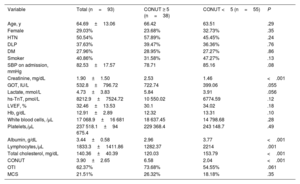
The analysis included data for 93 consecutive patients hospitalized between 2016 and 2023 due to CS secondary to acute myocardial infarction. Patients’ baseline characteristics are listed in table 1.

Table 1.

Patients’ baseline and clinical characteristics and differences according to the presence of moderate-to-severe undernutrition (CONUT ≥ 5)

Variable  Total (n=93)  CONUT ≥ 5 (n=38)  CONUT <5 (n=55)  P 
Age, y  64.69±13.06  66.42  63.51  .29 
Female  29.03%  23.68%  32.73%  .35 
HTN  50.54%  57.89%  45.45%  .24 
DLP  37.63%  39.47%  36.36%  .76 
DM  27.96%  28.95%  27.27%  .86 
Smoker  40.86%  31.58%  47.27%  .13 
SBP on admission, mmHg  82.53±17.57  78.71  85.16  .08 
Creatinine, mg/dL  1.90±1.50  2.53  1.46  <.001 
GOT, IU/L  532.8±796.72  722.74  399.06  .055 
Lactate, mmol/L  4.73±3.83  5.84  3.91  .056 
hs-TnT, pmol/L  8212.9±7524.72  10 550.02  6774.59  .12 
LVEF, %  32.46±13.53  30.1  34.02  .18 
Hb, g/dL  12.91±2.89  12.32  13.31  .10 
White blood cells, /μL  17 068.9±16 681  18 637.45  14 798.68  .28 
Platelets,/μL  237 518.1±94 675.4  229 368.4  243 148.7  .49 
Albumin, g/dL  3.44±0.58  2.96  3.77  <.001 
Lymphocytes,/μL  1833.3±1411.86  1282.37  2214  .001 
Total cholesterol, mg/dL  140.36±40.39  120.03  153.79  <.001 
CONUT  3.90±2.65  6.58  2.04  <.001 
OTI  62.37%  73.68%  54.55%  .061 
MCS  21.51%  26.32%  18.18%  .35 

DLP, dyslipidemia; DM, diabetes mellitus; Hb, hemoglobin; hs-TnT, high-sensitivity troponin T; HTN, hypertension; LVEF, left ventricular ejection fraction; MCS, mechanical circulatory support; OTI, orotracheal intubation; SBP, systolic blood pressure.

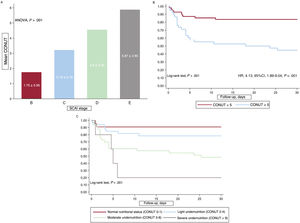
Overall mortality was 48.39%, and 30-day mortality was 32.97%. Patients were classified by severity according to the SCAI scale (B [4.3%], C[55.91%], D (23.66%), and E [16.13%]), and the CONUT score was calculated as described by Ulíbarri et al.6 A normal NS was seen in 23.66% of patients, with light undernutrition observed in 35.48%, moderate in 35.48%, and severe in 5.38% of patients. As NS worsened, shock severity increased (ANOVA test, P<.001) (figure 1A).

Figure 1.

A: association between shock severity according to the Society for Cardiovascular Angiography and Intervention (SCAI) classification and nutritional status according to the Controlling Nutritional Status (CONUT) scale. B: Kaplan-Meier curves comparing survival in patients with normal nutritional status versus light undernutrition (CONUT <5) and moderate or severe undernutrition (CONUT ≥ 5). C: Kaplan-Meier curves comparing survival between the various nutritional statuses. 95%CI, 95% confidence interval; HR, hazard ratio.

(0.24MB).

A total of 98.9% of patients underwent revascularization; of these, percutaneous coronary intervention was performed in 88.17% and fibrinolysis±rescue percutaneous coronary intervention in 11.83%. There were no differences in survival between the 2 groups (P=.72).

The optimal cut-off point for predicting mortality using the CONUT scale was determined using receiver operating characteristic (ROC) curves (5 points; area under the curve=0.71; 95% confidence interval [95%CI], 0.61-0.8; sensitivity=57.8%; specificity=75%). The CONUT score was also shown to be associated with 30-day mortality by a Cox regression analysis (figure 1B). A total of 38 patients (40.86%) had CONUT ≥ 5 points. These patients had worse kidney function (creatinine 2.53mg/dL versus 1.46mg/dL; P<.001) as well as a trend toward higher lactate and aspartate aminotransferase, worse low blood pressure, and stronger likelihood to require orotracheal intubation (OTI) (the differences in baseline and clinical characteristics of both groups are shown in table 1).

The 30-day survival was analyzed using the Kaplan-Meier method, and the groups were compared by a log-rank test. The optimal cut-off point for predicting mortality was determined by ROC curves using creatinine (1.32 mg/dL), lactate (3.96 mmol/L), age (72 years), high-sensitivity troponin T (6.425 pmol/L), and vasoactive–inotropic score (VIS) (45.3). A univariate Cox model was used to analyze the association of these variables (along with left ventricular ejection fraction <30%, SCAI D or E, and DM) with 30-day mortality. The variables were then introduced into a multivariate (backward stepwise) Cox model, identifying the following independent predictors of mortality: CONUT score ≥ 5 (hazard ratio [HR],2.54; 95%CI, 1.14-5.67; P=.023), SCAI stage D or E (HR,5.03; 95%CI, 1.99-12.74; P=.001), lactate ≥ 3.96 mmol/L (HR,6.72; 95%CI, 1.56-28.88; P=.01), high-sensitivity troponin T ≥ 6.425pmol/L (HR,5.31; 95%CI, 1.22-23.11; P=.026), and a history of DM (HR,2.77; 95%CI, 1.31-5.87; P=.008).

As NS worsened, mortality increased significantly (normal NS, 9.1%; light undernutrition, 22.58%; moderate undernutrition, 51.52%; severe undernutrition, 80%; log-rank test, P<.001) (figure 1C).

The results of the study showed the influence of NS on the prognosis of patients in CS; notably, more than 75% of them had an inadequate NS on admission. The association observed between worse NS on admission and shock severity (SCAI) is at least partly explained by the more pronounced kidney function impairment of patients with CONUT ≥ 5, as well as by the trend toward higher lactate and liver enzymes and low blood pressure, all parameters determining shock severity. The potential for early correction of NS to improve CS prognosis is a hypothesis that should be explored in future studies, as it could represent a new pathway to optimizing survival in a group of patients with very high mortality.

This study had several limitations. Because of the retrospective observational nature of the study, causal relationships could not be identified. The study sample was also small; hence, further studies with stronger evidence levels and larger samples are needed to confirm these results. Last, the parameters used in the CONUT scale may also be influenced by inflammation in patients in critical condition. Nevertheless, inflammation is also present in undernutrition, and other studies with patients in critical condition due to other causes (sepsis, trauma, COVID-19) have reported results consistent with our findings.

FUNDING

None.

ETHICAL CONSIDERATIONS

The study protocol was approved by the local ethics committee, and the study was conducted in accordance with the Declaration of Helsinki. An informed consent exemption was approved in view of the retrospective and observational nature of the study.

STATEMENT ON THE USE OF ARTIFICIAL INTELLIGENCE

No artificial intelligence tool was used.

AUTHORS’ CONTRIBUTIONS

All authors made key contributions to the data collection and analysis, as well as to the manuscript writing and revision.

CONFLICTS OF INTEREST

None.

References
[1]
D. Kolte, S. Khera, W.S. Aronow, et al.
Trends in Incidence, Management and Outcomes of Cardiogenic Shock Complicating ST-elevation Myocardial Infarction in the United States.
J Am Heart Assoc., (2014), 3 pp. e000590
[2]
V.P. Harjola, J. Lassus, A. Sionis, et al.
Clinical picture and risk prediction of short-term mortality in cardiogenic shock.
Eur J Heart Fail., (2015), 17 pp. 501-509
[3]
J.H. Yang, K.H. Choi, Y.G. Ko, et al.
Clinical Characteristics and Predictors of In-Hospital Mortality in Patients with Cardiogenic Shock:Results from the RESCUE Registry.
Circ Hear Fail., (2021), 14 pp. E008141
[4]
S. Lim, E.H. Choo, I.J. Choi, et al.
Impact of the risk of malnutrition on bleeding,mortality and ischemic events in patients with acute myocardial infarction.
Nutr Metab Cardiovasc Dis., (2023), 33 pp. 65-74
[5]
A. Zengin, M.B. Karataş, Y. Çanga, et al.
Prognostic performance of Controlling Nutritional Status score in patients with ST segment elevation myocardial infarction treated with primary percutaneous coronary intervention.
Anatol J Cardiol., (2022), 26 pp. 23-28
[6]
J.I.de. Ulíbarri, N.G.P.de. Villar, A. González-Madroño Giménez, et al.
CONUT: A tool for Controlling Nutritional Status. First validation in a hospital population.
Nutr Hosp., (2005), 20 pp. 38-45
Copyright © 2024. Sociedad Española de Cardiología
Are you a healthcare professional authorized to prescribe or dispense medications?