
Percutaneous mitral commissurotomy (PMC) is the standard treatment for rheumatic mitral valve (MV) stenosis, which remains prevalent in many parts of the world.1 While it is known that PMC is better suited for patients with less severe valve deformities, contemporary procedures are increasingly being performed in candidates with “unfavorable” anatomical features, leading to more complications and lower success rates.2
In our center, we use various interventions to address these challenges and achieve a high success rate. In addition to using multimodality imaging—particularly 3D echocardiography—1 to optimize procedural planning and guidance, we selectively apply certain procedural refinements. Each patient provided informed consent, and data collection was approved by the Research Ethics Committee of the Faculty of Medicine, Al-Azhar University. In our most recent experience at Al-Azhar University, Cairo, Egypt, we treated 130 consecutive patients between 2022 and 2023 (76.2% female, mean age 41.5±9.6 years) using the double-balloon technique in 27.5% of cases and the single (Inoue-type) balloon technique in 72.5% of cases. Only 40% of the patients had an ideal anatomy (Wilkins score ≤ 8 with noncalcific symmetrical commissural fusion1), and 14.1% had previously undergone commissurotomy (surgical and/or percutaneous). With the exception of 1 procedure that was halted before introducing the balloon due to an intraprocedural transient ischemic attack, valvuloplasty was feasible in all attempts, with a good result in 89% of cases. Only 4 patients required surgery - all of them due to symptomatic severe mitral regurgitation.
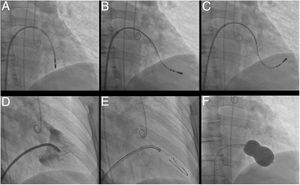
In patients with severe valve and subvalvular deformities and significant atrial dilation, crossing the MV can be challenging due to interatrial septum deviation, unpredictable relationship between the septostomy and mitral orifice planes, and a tight, calcific, distorted MV orifice. We describe a technique to facilitate MV crossing during PMC with the Inoue balloon (Toray Medical Co. Ltd., Japan) using a deflectable ablation catheter. Among our cohort of 130 patients, this technique was required in 5 patients and was successful in 4. After septostomy, if crossing the MV with the Inoue balloon using the standard technique was unsuccessful, a Mullins sheath was reinserted into the left atrium (LA). Over the sheath, a 7-F Therapy 4-mm tip ablation catheter (St Jude Medical, United States) was advanced into the LA. Using the unidirectional-steering push/pull handle, the catheter was deflected to point to the mitral orifice. With gentle manipulations and adjustment of flexion, the catheter moved through the mitral orifice into the left ventricle (LV) (video 1 of the supplementary datafigure 1A,B). In a right anterior oblique projection, the catheter tip was bent upwards to park at the LV apex (figure 1C). With the catheter secured in the LV, the Mullins sheath was advanced (figure 1D) into the LV. The stainless steel pigtail wire of the Inoue balloon, with its loop manually modified to adjust to the small LV cavity, was advanced through the sheath into the LV (figure 1E). The Inoue balloon was then advanced over the wire into the LV, and further standard procedural steps were followed (figure 1F).
Procedural steps of percutaneous mitral commissurotomy facilitated by a deflectable ablation catheter. A: the catheter in the left atrium pointing toward the mitral valve. B: the catheter crossing the mitral valve into the left ventricle. C: catheter tip parked at LV apex. D: the Mullins sheath advanced into the left ventricle. E: a modified-loop stainless steel pigtail wire parked in the LV. F: valvuloplasty balloon successfully dilated across the mitral valve
Difficulty crossing the MV during PMC is frequent and can be due to several reasons, including marked anatomical distortion or a suboptimal location of septostomy. While transesophageal echocardiography guidance can facilitate several procedural steps, including the proper location of transseptal puncture and facilitation of MV crossing, most procedures in developing countries are guided by fluoroscopy only. Nonetheless, even when septostomy position and catheter navigation into the MV are guided by transesophageal echocardiography, mitral valve crossing can still be challenging, and different maneuvers (including venoarterial looping) should be kept in mind to complete the procedure successfully.
Modifications of the standard over-the-stylet technique of MV crossing by the Inoue balloon include vertical, sliding, and looped balloon techniques and stylet reshaping to adapt to different LA sizes and septostomy-to-MV distances and orientations.3 Alternative over-the-wire strategies involve introducing a wire (typically, the stainless steel pigtail wire) into the LV/aorta through the balloon catheter, the Mullins sheath, an end-hole diagnostic catheter, or a balloon-tipped pulmonary wedge catheter.4 In all these techniques, the balloon is eventually advanced over the wire into the LV. We introduce another concept that takes advantage of the steerability of ablation catheters. We used a lumenless ablation catheter that can be sterilized and reused5,6 combined with a Mullins sheath, which is already used for septostomy. While the Mullins sheath is widely used, a limitation of this sheath is that it offers little support. Deflectable-steerable introducers (eg, Agilis NxT, Abbott, United States) can be helpful if the Mullins sheath does not offer sufficient support after the ablation catheter is withdrawn, but they are expensive.
FUNDINGNone.
ETHICAL CONSIDERATIONSAll procedures were carried out in accordance with the Declaration of Helsinki. Informed consent was obtained from all participants. Data collection was approved by the Research Ethics Committee of the Faculty of Medicine, Al-Azhar University. Possible sex/gender biases have been considered in the preparation of this article.
STATEMENT ON THE USE OF ARTIFICIAL INTELLIGENCENone used.
AUTHORS’ CONTRIBUTIONSM. Abdelghani performed the procedure and drafted the manuscript. A.M Metwally compiled data and reviewed the manuscript. M. Samy conceived the idea and reviewed the manuscript.
CONFLICTS OF INTERESTAll authors declare no conflicts of interest in relation to the present report.