
ISSN: 1885-5857 Impact factor 2024 4.9
Vol. 77. Num. 10.
Pages 870-872 (October 2024)

Scientific letter
Challenges in advancing transesophageal echocardiography probes: identifying causes and solutions

Desafíos en el avance de la sonda de ecocardiografía transesofágica: identificación de causas y soluciones

Lucía Fernández GassóabRegina DalmauabSilvia Valbuena LópezabElena Refoyo SalicioabGuadalupe Buitrago WeilandcEsther Pérez Davidab
https://doi.org/10.1016/j.rec.2024.04.018

Options

Imagen extra
Rev Esp Cardiol. 2024;77:870-2
To the Editor,

Transesophageal echocardiography (TEE) is a valuable technique in many clinical scenarios, although it may be hampered by various complications. Operator skill is key, and the technique is generally safe.1 Reported mortality ranges from 0.2% to 1.2%, although this can reach 3.3% in structural cardiac interventions.2 Common complications include oropharyngeal discomfort, swelling, and pharyngeal bleeding. The most feared complication is esophageal perforation, which is associated with considerable morbidity and mortality; the thoracic segment is the most affected.3 Most recorded perforations occur during low-risk surgical procedures.

Advancing the probe may prove difficult, mainly owing to the patient's inability to relax because of anxiety over the procedure, although this can be overcome with appropriate sedation. Conditions such as anatomical abnormalities, swallowing disorders, and esophageal problems can also give rise to difficulties. Other potential obstacles include infection, pharyngeal spasm, tumors, and previous lesions. Any difficulties should be addressed using additional testing, with gastroscopy as the first option, followed by swallow testing, and, finally, contrast-enhanced computed tomography (CT) of the neck and chest when extrinsic compression or tumors are suspected.

We have experienced difficulty advancing the probe during TEE in several cases, leading us to propose strategies to meet this challenge. We present 3 specific cases in which we were faced with obstacles during TEE and discuss the diagnostic approach we subsequently applied.

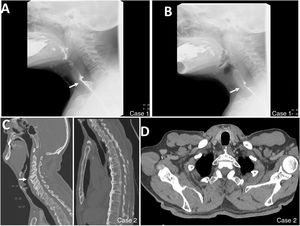
In the first case, TEE was requested to rule out endocarditis in an 85-year-old woman with persistent fever and positive blood cultures after percutaneous implantation of an aortic prosthesis. Implantation was performed according to our protocol, with sedation based on intravenous (IV) midazolam (0.03mg/kg), IV fentanyl (0.05μg/kg), and topical lidocaine. We suspended the procedure because we were unable to advance the probe. Gastroscopy was hampered by difficulty advancing the probe, with no visual evidence of stenosis or extrinsic compression. A barium swallow test revealed an indentation on the posterior aspect of the pharyngoesophageal junction that was indicative of cricopharyngeal muscle hypertonia (figure 1A,B). Deep sedation was administered in the recovery unit based on anesthesia with IV propofol and midazolam to relax the cricopharyngeal muscle, thus enabling the probe to be advanced successfully.

Figure 1.

A and B: case 1, Barium swallow test showing an indentation on the posterior aspect of the pharyngoesophageal junction suggestive of cricopharyngeal muscle hypertonia (arrows). C: case 2, Sagittal computed tomography image of the neck and back. Observe the fusion of the 2 vertebrae with preserved disc spaces (arrow). D: case 2, Axial computed tomography image showing an osteophyte impinging on the esophagus (asterisk).

(0.32MB).

The second case involved a 68-year-old man with a history of ischemic heart disease admitted with stroke for whom TEE was requested owing to a suspected cardioembolic origin. Sedation was effective, and the probe passed freely through the oropharynx. However, the test had to be suspended because of resistance to the probe beyond the first 20cm. CT as part of the stroke work-up during admission revealed prominent cervical osteophytes as a manifestation of Forestier disease, also known as diffuse idiopathic skeletal hyperostosis (DISH), which had not been previously diagnosed and accounted for the difficulty we experienced when attempting to advance the probe (figure 1). DISH is a systemic rheumatic disease characterized by new bone formation at the insertions of ligaments, tendons, and joint capsules.4 This results in ossification of the anterior longitudinal ligament through formation of intervertebral bony bridges. We used a pediatric probe (6-7mm) for the TEE, and the study was completed without complications.

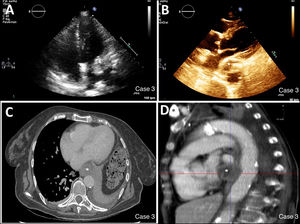
The third patient was a 50-year-old man admitted with stroke. TEE was requested to rule out a cardioembolic origin. Transthoracic echocardiography revealed a mass adjacent to the left atrium that was initially thought to be a hiatus hernia (figure 2). During TEE, however, it was difficult to advance the probe beyond the oropharynx. Therefore, CT was recommended; this revealed esophageal cancer (figure 2).

Figure 2.

Case 3, Transthoracic echocardiogram. A: apical 4-chamber view. B: parasternal long axis plane. Note the extracardiac mass slightly compressing the left atrium (asterisk). C: intravenous contrast–enhanced computed tomography, axial image. D: intravenous contrast–enhanced computed tomography, sagittal image. Note the esophageal mass suggesting an esophageal tumor (asterisk).

(0.44MB).

These procedures were carried between 2021 and 2023 in a tertiary hospital with a total of 2511 procedures recorded. Nevertheless, some cases may have gone unreported, as this was a retrospective evaluation. Advancing the probe was problematic in 20 of these procedures, of which 3 are those reported here. New appointments had to be scheduled in 12 cases; the procedures were performed with deep sedation and anesthesia owing to poor tolerance. One was carried out using a pediatric probe in a patient with severe burn injury and oropharyngeal edema, and 4, which were carried out in the cardiac rehabilitation unit, required sedation and laryngoscopy. Fifteen studies were carried out directly with anesthetists; of these, most involved patients who had previously undergone TEE and requested deep sedation.

In order to tackle the problems faced when advancing the probe in TEE, we propose the following strategies: identify anatomical abnormalities; adapt sedation techniques by means of protocols to improve patient cooperation; consider using pediatric probes to overcome anatomical obstacles or conditions that prevent the probe from advancing; promote interdisciplinary cooperation in specific cases; and ensure continuous assessment throughout the procedure.

These cases illustrate the complexity of the technique and highlight the importance of interdisciplinary cooperation in its management. By sharing our experience and strategies, we hope to contribute to the body of knowledge in this field. While the current literature addresses complications associated with TEE5, there is very little evidence on how to tackle the difficulties faced when advancing the probe, thus highlighting the relevance of our study.

FUNDING

None.

ETHICAL CONSIDERATIONS

The patients’ informed consent was obtained for testing and for publication of the cases. The corresponding international recommendations on possible sex and gender bias were followed.

STATEMENT ON THE USE OF ARTIFICIAL INTELLIGENCE

The authors declare that they did not use any artificial intelligence tool in the preparation of this manuscript.

AUTHORS’ CONTRIBUTIONS

All the authors participated in the drafting, editing, and structuring of the article.

CONFLICTS OF INTEREST

None.

REFERENCES
[1]
E.K. Kronzer, M.F. Eleid, M.A. Alkhouli, et al.
Rates of Oropharyngeal and Esophageal Complications During Structural Heart Disease Procedures Under Transesophageal Echocardiography Guidance.
J Am Soc Echocardiogr., (2023), 36 pp. 431-433
[2]
A.B. Freitas-Ferraz, M. Bernier, R. Vaillancourt, et al.
Safety of Transesophageal Echocardiography to Guide Structural Cardiac Interventions.
J Am Coll Cardiol., (2020), 75 pp. 3164-3173
[3]
S. Sainathan, S. Andaz.
A systematic review of transesophageal echocardiography-induced esophageal perforation.
Echocardiography., (2013), 30 pp. 977-983
[4]
B. Rodrigo Urzúa, E. Maritza Rahal.
Diffuse idiopathic skeletal hiperostosis, respect of two cases.
Rev Otorrinolaringol Cir Cabeza Cuello., (2021), 72 pp. 3
[5]
J.N. Hilberath, D.A. Oakes, S.K. Shernan, et al.
Safety of transesophageal echocardiography.
J Am Soc Echocardiogr., (2010), 23 pp. 1115-1127
Copyright © 2024. Sociedad Española de Cardiología
Are you a healthcare professional authorized to prescribe or dispense medications?