
It is estimated that 5% to 10% of patients with congenital heart disease (CHD) will develop pulmonary arterial hypertension (PAH). This population is highly heterogeneous, and there is limited available evidence regarding their treatment.1
Patients are classified into 4 groups: Eisenmenger syndrome (right-to-left or bidirectional shunt); large defect with left-to-right shunt (causing increased pulmonary pressures and increased pulmonary vascular resistance [PVR] without shunt inversion); small, coincidental defects; and PAH developing after defect repair.1
Although patients with a pretricuspid shunt have shown a poorer clinical course, there are no studies analyzing the prognosis of the various subgroups and with a specific focus on pretricuspid shunts.
In a single-center retrospective study, we analyzed the clinical, functional, hemodynamic, and prognostic characteristics of a cohort of 65 patients followed since 2010 in Hospital Universitario y Politécnico La Fe de Valencia. The patients had PAH associated with a simple pretricuspid defect: atrial septal defect and partial anomalous pulmonary venous return. The study adhered to the Declaration of Helsinki, was approved by the hospital's ethics committee (registration number, 2019-0331), and written informed consent was obtained for participation.
All patients underwent right heart catheterization, which confirmed the presence of PAH: mean pulmonary arterial pressure> 20mmHg, PVR>2 WU, and pulmonary capillary pressure≤15mmHg. Based on the hemodynamic results, patients were classified into 3 groups: Eisenmenger syndrome, PAH associated with a large, uncorrectable left-to-right shunt, and PAH following defect repair. Patients with restrictive shunts were not included. Eisenmenger syndrome was defined as a bidirectional or right-to-left shunt with an estimated Qp/Qs ratio <1 and indexed PVR>8 WU/m2. Large left-to-right shunts were considered uncorrectable when indexed PVR was>4 WU in association with clinical or echocardiographic criteria of advanced pulmonary vascular disease such as O2 saturation <90% during exercise or evidence of bidirectional shunting. Patients showing PAH after defect repair were classified as postrepair PAH.
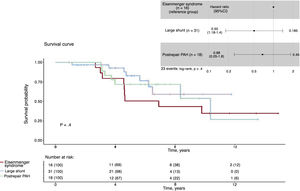
Between-group comparisons were performed using the chi-square test or Wilcoxon rank-sum test. Survival was evaluated by Kaplan-Meier analysis, starting from the initial cardiology unit assessment up to the time the composite event occurred (death or transplantation). Groups were then compared using the log-rank test. Cox regression modeling was performed to determine the survival impact of belonging to each group, with the Eisenmenger syndrome group as the reference (group 1). Hazard ratios with 95% confidence intervals (group 1 as reference) are shown in Figure 1. The clinical impact on survival was assessed using a restricted mean survival time (RMST) analysis, limited to a 10-year follow-up.
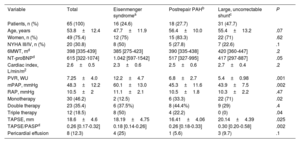
The baseline data and events occurring during follow-up are summarized in table 1. During the mean 6-year follow-up period (1-13 years), there were 21 deaths (32.3%) and 4 transplants (6.1%): 2 double-lung transplants with defect repair and 2 heart-lung transplants. The causes of death included heart failure (48%), complications after non-cardiac interventions (19%), and sudden cardiac death (9.5%). Survival analysis showed no significant differences between the 3 groups (P=.4) (figure 1). The 10-year transplant-free survival was 6.75 years in the Eisenmenger group, 7.86 years in the large shunt group, and 8.02 years in the postrepair PAH group.
Baseline characteristics of the patients and events occurring during follow-up
| Variable | Total | Eisenmenger syndromea | Postrepair PAHb | Large, uncorrectable shuntc | P |
|---|---|---|---|---|---|
| Patients, n (%) | 65 (100) | 16 (24.6) | 18 (27.7) | 31 (47.7) | |
| Age, years | 53.8±12.4 | 47.7±11.9 | 56.4±10.0 | 55.4±13.2 | .07 |
| Women, n (%) | 49 (75.4) | 12 (75) | 15 (83.3) | 22 (71) | .62 |
| NYHA III/IV, n (%) | 20 (30.8) | 8 (50) | 5 (27.8) | 7 (22.6) | .1 |
| 6MWT, md | 398 [335-439] | 385 [275-423] | 390 [335-438] | 420 [360-447] | .2 |
| NT-proBNPd | 615 [322-1074] | 1.042 [597-1542] | 517 [327-995] | 417 [297-887] | .05 |
| Cardiac index, L/min/m2 | 2.6±0.5 | 2.3±0.6 | 2.5±0.6 | 2.7±0.4 | .2 |
| PVR, WU | 7.25±4.0 | 12.2±4.7 | 6.8±2.7 | 5.4±0.98 | .001 |
| mPAP, mmHg | 48.3±12.2 | 60.1±13.0 | 45.3±11.6 | 43.9±7.5 | .002 |
| RAP, mmHg | 10.5±2 | 11.1±2.1 | 10.5±1.8 | 10.3±2.2 | .47 |
| Monotherapy | 30 (46.2) | 2 (12.5) | 6 (33.3) | 22 (71) | .02 |
| Double therapy | 23 (35.4) | 6 (37.5%) | 8 (44.4%) | 9 (29) | .4 |
| Triple therapy | 12 (18.5) | 8 (50) | 4 (22.2) | 0 (0) | .04 |
| TAPSE, mm | 18.6±4.6 | 18.19±4.75 | 16.41±4.06 | 20.14±4.39 | .025 |
| TAPSE/PASPd | 0.26 [0.17-0.32] | 0.18 [0.14-0.26] | 0.26 [0.18-0.33] | 0.30 [0.20-0.58] | .002 |
| Pericardial effusion | 8 (12.3) | 4 (25) | 1 (5.6) | 3 (9.7) | .1 |
6MWT, 6-minute walk test; ERA, endothelin receptor antagonists; mPAP, mean pulmonary arterial pressure; NT-proBNP, N-terminal pro-brain natriuretic peptide; NYHA, New York Heart Association; PAH, pulmonary arterial hypertension; PASP, pulmonary artery systolic pressure; PDEI-5 phosphodiesterase 5 inhibitors; PVR, pulmonary vascular resistance; RAP, right atrial pressure; TAPSE, tricuspid annular plane systolic excursion; WU, Wood units.
Data are expressed as n (%), mean±standard deviation, or median [interquartile range].
Percentage of patients treated with each pharmacologic class in Eisenmenger syndrome: ERA (100%), PDEI-5 (87%), selexipag (31%), systemic prostanoids (19%).
Percentage of patients treated with each pharmacologic class in postrepair PAH: ERA (72%), PDEI-5 (31%), selexipag (11%), systemic prostanoids (17%).
The prognosis of PAH associated with CHD has been examined in several previous registries. In general, the findings indicate that patients with Eisenmenger syndrome have a more favorable prognosis, while those with persistent postrepair PAH have a poorer prognosis2,3 with a clinical course similar to that of idiopathic PAH. Nonetheless, these results are not consistent across all observational studies.4 The populations analyzed show considerable differences (joint analysis of patients with simple and complex heart defects or pretricuspid and post-tricuspid shunts), and therefore, are difficult to compare.
The present study provides the first survival analysis specifically focusing on patients with PAH associated with pretricuspid shunts. In contrast to the findings in previous reports,2,3 mortality was similar in the various hemodynamic groups, although there was a tendency toward a poorer prognosis in patients with Eisenmenger syndrome. This could be attributed to the less favorable hemodynamic and functional status of Eisenmenger syndrome patients, who showed a lower TAPSE/PASP ratio (tricuspid annular plane systolic excursion/pulmonary artery systolic pressure), indicating poorer evolution of the right ventricle compared to that of patients with a post-tricuspid shunt.
Despite the limitations of the study design, (single-center, observational, and retrospective), the findings could have significant implications for clinical practice. The data show that the prognosis of patients with Eisenmenger syndrome and pretricuspid shunts is similar to that of postrepair PAH patients, suggesting that an earlier, more aggressive treatment strategy may be beneficial. Furthermore, the study highlights the poor prognosis of patients with uncorrectable shunts. These findings indicate the need for multicenter studies to better define the indications for specific treatment, establish criteria for reparability, and determine the role of genetic studies for identifying high-risk patients.
FUNDINGNo funding was received for this study.
ETHICAL CONSIDERATIONSThe study was conducted in accordance with the Declaration of Helsinki and was reviewed and approved by the hospital's ethics committee (registration number 2019-0331). Written informed consent was obtained as required.
STATEMENT ON THE USE OF ARTIFICIAL INTELLIGENCEArtificial intelligence was not used in the preparation of this manuscript.
AUTHORS’ CONTRIBUTIONSAll authors have met the authorship criteria by participation in the following tasks: data collection, analysis, and interpretation; critically approving the manuscript; and providing final approval for the submitted work. The corresponding author was responsible for the study design, drafting the manuscript, and its final development.
CONFLICTS OF INTERESTNone.