
ISSN: 1885-5857 Impact factor 2024 4.9
Vol. 79. Num. 2.
Pages 100-105 (February 2026)

Original article
Reduced stent strategy versus conventional percutaneous coronary revascularization in patients presenting with STEMI: design of the COPERNICAN trial

Estrategia de reducción de stents frente a revascularización coronaria percutánea convencional en el IAMCEST: el ensayo COPERNICAN

Jorge Sanz-SánchezabSandra Santos MartínezcEva Rumiz GonzálezdJuan Francisco Oteo DomínguezeDavid Tejada PoncefAntonio Gómez MencherogGuillermo Sánchez ElvirahGeorgina Fuertes FerreiFernando Rivero CrespojAntonela Lukic OtanovickJosé Díaz FernándezlEladio Galindo FernándezmCristóbal Urbano CarrillonNeus Salvatella GiraltoMauricio Torres SánchezpArturo García TouchardeBorja Ibáñez CabezabqrGiulio StefaninisFernando Alfonso ManterolajHéctor García GarcíatIgnacio J. Amat-Santosbu
Rev Esp Cardiol. 2026;79:106-710.1016/j.rec.2025.08.007
Bruno Scheller
https://doi.org/10.1016/j.rec.2025.05.005
Supplementary data
Imagen extra
Rev Esp Cardiol. 2026;79:100-5
Abstract
Introduction and objectives

Primary percutaneous coronary intervention (PCI) with drug-eluting stent implantation (DES) is the standard of treatment in patients presenting with ST-segment elevation myocardial infarction (STEMI). However, target lesion failure can occur due to stent underexpansion, malapposition, hypersensitivity, fracture, and neoatherosclerosis. Drug-coated balloons (DCB) represent a potential alternative supported by the concept of “leaving nothing behind.” The aim is to compare a reduced stent strategy based on DCB- with DES-PCI in patients presenting with STEMI.

Methods

Prospective, pragmatic, multicenter, noninferiority, randomized clinical trial.

Results

A total of 1 272 patients presenting with STEMI will be randomized to any paclitaxel-DCB vs any sirolimus-DES (both with CE approval) for all culprit and nonculprit lesions during PCI. The primary endpoint will be target-lesion failure: cardiac death, target-vessel myocardial infarction, or ischemia-driven target lesion revascularization at 12-month follow-up. An independent clinical events committee masked to treatment allocation will adjudicate all suspected events. Clinical follow-up will be performed after 1 month (30 days±5 days) and 1 year (365 days±30 days). An extended follow-up at 3, 5, and 10 years is planned.

Conclusions

The COPERNICAN trial will be the first randomized study comparing clinical outcomes of DCB vs DES in STEMI patients.

ClinicalTrials.gov: NCT06353594.

Keywords

ST-segment elevation myocardial infarction
STEMI
Drug-eluting stent implantation
DES
Drug-coated balloon
DCB
INTRODUCTION

Primary percutaneous coronary intervention (PCI) with drug-eluting stent implantation (DES) is the standard of care in patients presenting with ST-segment elevation myocardial infarction (STEMI).1 Compared with bare metal stents, second-generation DES have shown to reduce the rate of short-term target-lesion revascularization and stent thrombosis, as well as long-term patient-orientated composite events (all-cause death, any myocardial infarction, or any revascularization).2,3 However, this approach is not without limitations, as stent-related complications occur with cardiac adverse events reported to be as high as 32.4% at 10-year follow-up.4

Drug-coated balloons (DCB) have been developed as a potential alternative treatment option to DES.5 DCBs are balloon catheters coated with antiproliferative agents that are released into the vessel wall upon balloon inflation. The drug is absorbed by the vessel, inhibiting cell proliferation and reducing neointimal hyperplasia.6 The absence of a permanent metal scaffold may help to preserve vessel vasomotion and potentially reduce the risk of long-term adverse events.7

However, data on the role of DCBs in patients presenting with STEMI are scarce.8–10 During the last decade, the management of patients presenting with STEMI has improved through the implementation of networks between hospitals and iterations in secondary prevention medical therapy.11 However, the revascularization of this population has remained unchanged for more than a decade and has exclusively focused on the implantation of DES.1 Therefore, we have designed the Reduced Stent Strategy vs Conventional Percutaneous Coronary Revascularization in Patients Presenting with STEMI (COPERNICAN) trial with the aim of evaluating the role of DCB revascularization in the setting of STEMI through a randomized clinical trial.

METHODSRationale and design

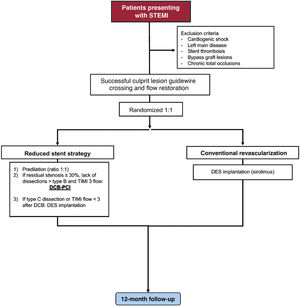
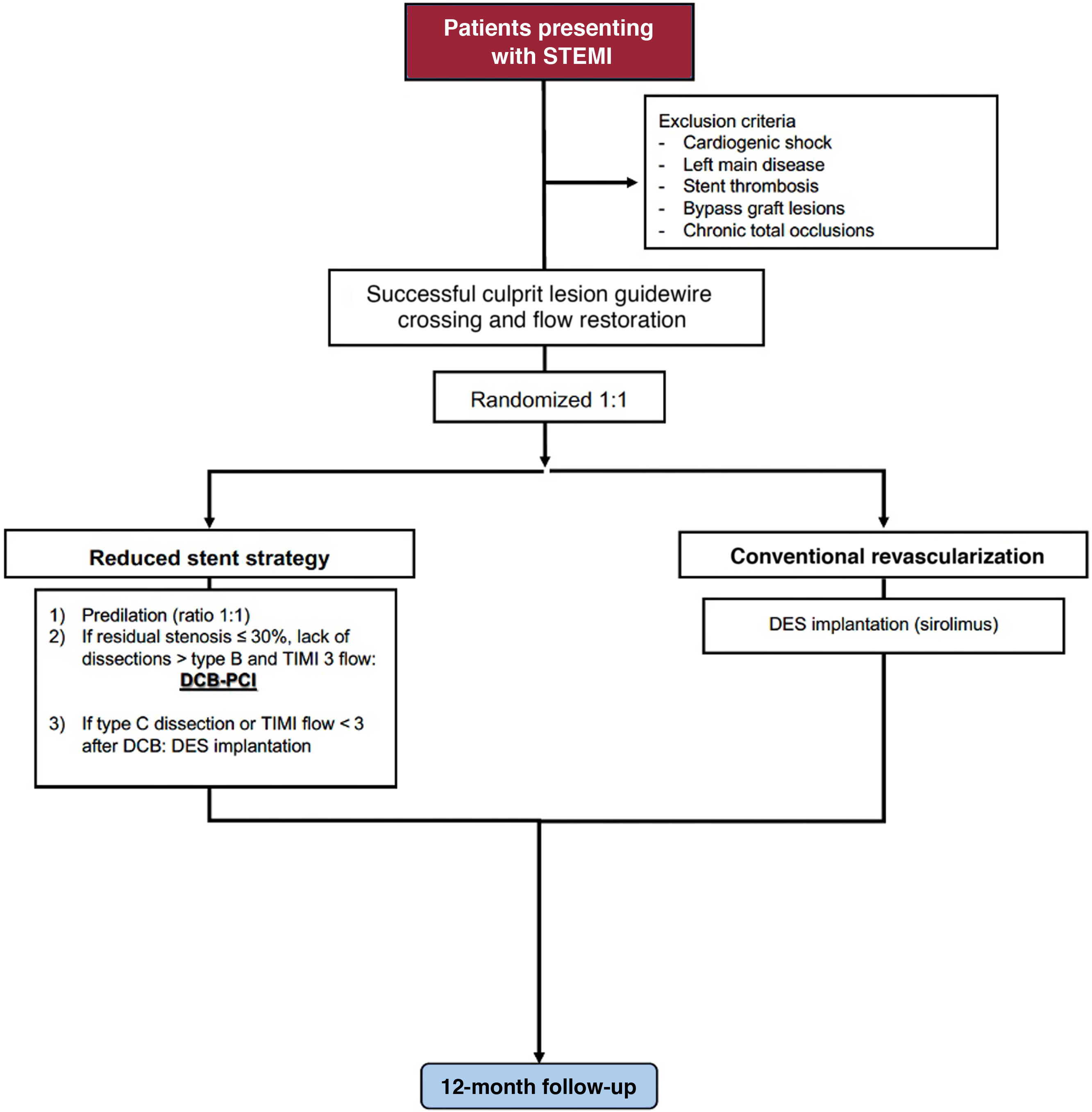
The COPERNICAN trial (ClinicalTrials.gov: NCT06353594) is a prospective, investigator-initiated randomized clinical trial aiming to compare a reduced stent strategy (DCB-based) with a conventional DES revascularization strategy in patients presenting with STEMI among 16 Spanish centers. The lead Hospital Universitario y Politécnico La Fe (Valencia, Spain) Ethics Committee (reference number 555) and the local ethics committees at the participating study sites approved the study protocol. The study flow is shown in figure 1, and the participating centers are listed in table 1 of the supplementary data. An independent data safety and monitoring board is responsible for monitoring patient safety and evaluating the efficacy and conduct of the study. All boards and committees are listed in table 2 of the supplementary data.

Figure 1.

Central illustration. Study flowchart. DCB, drug-coated balloon; PCI, percutaneous coronary intervention; STEMI, ST-segment elevation myocardial infarction.

(0.3MB).
Eligibility and screening

Patients presenting with STEMI and with an indication to undergo primary PCI will be screened for enrollment in the study. To maximize generalizability and representativeness, we applied broad inclusion criteria and strict exclusion criteria specified in table 1. Eligible patients will be informed about the study and will have to sign informed consent prior to inclusion in the study. Patients will be informed at the emergency care unit, intensive care unit, or at the catheterization laboratory (depending on where the indication to undergo coronary angiography was established) prior to the performance of the coronary angiography. From the moment the patient is informed until the coronary angiography is performed, the patient will need to have enough time to understand the study and agree to participate in it. If the patient cannot sign informed consent prior to the procedure, verbal informed consent will be provided by the patient to the principal health care provider and a proxy not involved in the study.

Table 1.

Eligibility criteria

Inclusion criteria 
Patients presenting with STEMIPatients with indication to undergo primary PCI 
Exclusion criteria 
Life expectancy <1 y due to noncardiac diseaseCardiogenic shockLeft ventricular ejection fraction <15%Left main diseaseStent thrombosisPatients with prior bypass graft lesions requiring PCIPatients with chronic total occlusionsUntreatable coronary diseaseNonidentified culprit lesionKnown allergies to aspirin, ticagrelor, prasugrel, clopidogrel, paclitaxel or sirolimusInability to provide informed consent 

PCI, percutaneous coronary intervention; STEMI, ST-elevation myocardial infarction.

Randomization, treatment, and follow-up

Randomization will be performed after successful culprit lesion guidewire crossing and vessel flow restoration. Randomization will be stratified by center and the presence of multivessel disease within the electronic case report forms.

Random allocation will be performed in a 1:1 fashion to one of the following strategies:

Strategy 1, study group: reduced stent strategy (DCB-based)

Prior to DCB use, meticulous lesion preparation will be required. Any device can be used for lesion preparation according to the operator's preference with a distal reference balloon diameter/vessel diameter ratio of 1:1. Culprit lesion revascularization with paclitaxel-DCB will be performed after coronary predilation if residual stenosis ≤30%, lack of dissections >type B, and TIMI 3 flow. A paclitaxel-DCB with a ratio of 1:1 between distal vessel size and balloon diameter is recommended. If any of the following lesion characteristics are present after lesion preparation (residual stenosis >30%, dissections > type B, and TIMI <3 flow) or a relevant dissection is present after DCB-PCI (type C dissection or TIMI flow <3), a sirolimus-DES will be implanted following standard recommendations.12

Strategy 2, control group: culprit lesion revascularization with the implantation of sirolimus-DES

Notably, the reduced stent strategy arm includes patients treated exclusively with DCB, as well as those requiring stent implantation in any culprit or nonculprit lesions after DCB-PCI if the acute result does not meet the standard success criteria.12 Any paclitaxel-DCB and any sirolimus-DES can be used in the study. The use of intracoronary imaging during the primary PCI procedure will be left to the discretion of the operator, as well as antithrombotic therapy, according to the current European guidelines on the management of patients presenting with STEMI.1

Patients presenting with multivessel coronary artery disease requiring a same-procedure or staged nonculprit lesion PCI procedure will also be included. The revascularization strategy of nonculprit lesions will be determined according to the culprit lesion allocation group (DCB-based or DES-based) following the same indications as previously described regarding the culprit lesion strategy.

Patients will be followed up after hospital discharge at 1 month and 1 year. An extended follow-up at 3, 5, and 10 years will also be performed. Clinical status, clinical events, and medication regimens will be obtained.

Study endpoints

The primary endpoint is target-lesion failure, a composite of cardiac death, target-vessel myocardial infarction, or ischemia-driven target-lesion revascularization at 12-month follow-up. Secondary endpoints are detailed in table 2. All endpoints will be defined according to Academy Research Consortium criteria except for myocardial infarction, which will be defined according to the fourth universal definition.13,14 An independent clinical event committee will review and adjudicate all events according to the study protocol.

Table 2.

Clinical endpoints

Primary endpoint 
Target-lesion failure: cardiac death, target-vessel myocardial infarction or ischemia-driven target-lesion revascularization 
Secondary endpoints 
All-cause deathCardiovascular deathTarget-lesion revascularizationTarget-vessel revascularizationTarget-vessel myocardial infarctionAny myocardial infarctionStent thrombosisAcute vessel closureAcute kidney injuryStrokeBARC bleedingThrombectomy before and after the device (DCB or DES)Percentage of use of IIB-IIIAFinal TIMI flow 

BARC, Bleeding Academic Research Consortium scale; DCB, drug-coated balloon; DES, drug-eluting stent; TIMI, Thrombolysis in Myocardial Infarction score.

Statistical analysis and sample size considerations

Assuming an event rate for target-lesion failure of 6% in the conventional (DES-based) revascularization arm,15 the inclusion of a total of 1,272 patients will provide 80% power to demonstrate noninferiority with a margin of 3.6%, assuming an attrition rate of 15%.

The primary objective is to determine if a reduced stent strategy will be noninferior to conventional revascularization in reducing the rate of target-lesion failure. If noninferiority is shown after one year, superiority at 3 years after randomization will be tested. The secondary objective is to determine whether a reduced stent strategy will be superior to conventional DES-based revascularization. To control the overall type I error, prespecified hierarchical sequential testing will be performed first on the primary outcome for noninferiority and finally on the primary outcome for superiority. To minimize the potential impact of missing data on type I error, a comprehensive strategy will include a triple approach with: a) data collection optimization; b) monitoring and reporting missing data to allow an informed evaluation of their potential impact; and c) statistical handling of missing data through multiple imputation techniques. Sensitivity analyses will also be conducted to assess the robustness of the conclusions.

All primary analyses will be performed in the intention-to-treat population, which includes all randomized patients by their allocated strategy. Predefined subgroup analyses will include age, sex, renal insufficiency, diabetes mellitus, complex lesions, severe coronary calcification, presence of multivessel coronary artery disease, prior history of myocardial infarction, bleeding/ischemic risk, use of intracoronary imaging, type of DCB or DES implanted, and use of coronary physiology of nonculprit lesions.

DISCUSSION

Primary PCI with DES implantation is the cornerstone treatment in patients presenting with STEMI1,16 However, this strategy is not without risk, as stent-related cardiac events occur with no plateau evident at least up to 10-year follow-up.4 Several mechanisms have been purported to explain the ongoing risk of target-lesion-related restenosis and stent thrombosis such as stent underexpansion, malapposition, uncovered struts, hypersensitivity reactions, device fracture, and neoatherosclerosis.17,18 Against this background, DCBs have emerged as a potential treatment alternative in patients with coronary artery disease, supported by the concept of “leaving nothing behind”, combining the benefits of local drug delivery without the complications of a permanent stent scaffold.12 However, data on the safety and efficacy of DCB-PCI is mainly available for patients presenting with in-stent restenosis and small-vessel disease.19,20 In the meantime, evidence in large vessels is yet emerging (TRANSFORM-II and SELUTION DeNovo trials).21,22

During the last decade, the revascularization strategy in patients presenting with STEMI has remained unvaried and exclusively focused on the implantation of DES. The concept of a reduced stent strategy involves minimizing the use of permanent metallic stents by performing culprit and nonculprit lesion revascularization based on DCB-PCI. The rationale for DCB-PCI in patients presenting with STEMI is based on several key aspects. First, the inflammation and vasoconstriction process present during STEMI might lead to an underestimation of vessel size, stent undersizing, and incomplete stent apposition at follow-up due to positive vessel remodeling.23 This phenomenon might be enhanced due to thrombus dissolution. On the other hand, aggressive stent deployment can cause distal embolization and no-reflow. Second, suboptimal lesion preparation in STEMI patients, especially in patients with severe calcified lesions, has been associated with stent underexpansion and adverse clinical outcomes.24,25 Therefore, the “leaving nothing behind” strategy provided by DCB-PCI might avoid stent underexpansion and malapposition and potentially reduce the risk of adverse clinical outcomes. In addition, plaques in STEMI patients are usually soft, and adequate plaque modification can be easily achieved through DCB-PCI (<30% residual stenosis and low grade of dissection). Moreover, the ruptured lipid-rich plaque can potentially be an ideal reservoir for effective paclitaxel uptake.26,27 On the other hand, DCBs might also pose certain risks in the setting of STEMI patients, such as acute recoil with closure of the culprit lesion due to the lack of vessel scaffolding.28 However, this risk remains theoretical and has not been prospectively investigated yet.

Previous studies have provided insights into the comparative efficacy of DCB-PCI vs DES-PCI in patients presenting with STEMI. The Revelation randomized trial, which included 120 STEMI patients, has shown that a DCB strategy was noninferior to DES in terms of fractional flow reserve at 9 months, resulting in a safe and feasible strategy.8 In a retrospective propensity score matching analysis involving 1139 patients, Merinopoulos et al.9 have shown that DCB-PCI in patients presenting with STEMI was safe in terms of all-cause mortality and all net adverse cardiac events, including unplanned target-lesion revascularization. However, the lack of a large randomized clinical trial powered for a relevant clinical endpoint and the important limitations in terms of study design and small sample size of included patients in the available published literature preclude determination of the role of DCB-PCI in patients presenting with STEMI. Therefore, the aim of the COPERNICAN trial is to compare a reduced stent strategy with a complete DES revascularization in patients presenting with STEMI in the setting of a randomized clinical trial powered for a relevant clinical endpoint. Several important aspects of the COPERNICAN trial must be highlighted.

First, patients will be randomized following vessel flow restoration and before obtaining optimal culprit lesion preparation, with the objective of maximizing the applicability of the reduced stent strategy to the greatest possible number of patients presenting with STEMI. This is a key differential aspect from ongoing randomized clinical trials evaluating the role of DCB in large vessel coronary artery disease, where randomization is performed just in the selected population where optimal lesion preparation has been achieved (NCT04893291).21

Second, patients will be randomized to 2 different revascularization strategies and not to 2 different devices. For patients assigned to the reduced stent strategy, the need for DES implantation will be evaluated twice: first after lesion preparation and second after DCB-PCI. DES will be implanted if there is more than type B dissection, more than 30% vessel recoil, or TIMI flow <3 and will not be considered a crossover between groups but part of the strategy. A good practices handbook will be facilitated to the investigators, including specific criteria for good lesion preparation, recommendations for the use of intravascular imaging, management of thrombus burden, and guidelines-directed antithrombotic recommendations. Third, patients with multivessel coronary artery disease will also be included, and the revascularization strategy for nonculprit lesions will be determined by the culprit lesion allocation group (DCB-based or DES-based).

In summary, the COPERNICAN trial will be the first randomized clinical trial evaluating a change in the revascularization paradigm in patients presenting with STEMI by assessing the role of DCB-PCI.

CONCLUSIONS

The revascularization strategy in patients presenting with STEMI has remained unvaried and focused on the implantation of DES for more than a decade. The COPERNICAN trial will determine, for the first time, the efficacy and safety of a reduced stent strategy based on DCB-PCI in a broad spectrum of patients presenting with STEMI.

WHAT IS KNOWN ABOUT THE TOPIC?

  • PCI with DES implantation is the standard of care in patients presenting with STEMI.

  • However, stent-related complications occur in up to 32.4% at 10-year follow-up.

  • DCBs have been developed as a potential alternative treatment option to DES.

  • However, data on the role of DCBs in patients presenting with STEMI are scarce.

WHAT DOES THIS STUDY ADD?

  • The COPERNICAN trial will determine, for the first time, the efficacy and safety of a reduced stent strategy based on DCB-PCI in patients presenting with STEMI.

  • The primary endpoint is target-lesion failure, a composite of cardiac death, target-vessel myocardial infarction, or ischemia-driven target-lesion revascularization at 12-month follow-up.

  • Longer follow-up is warranted.

FUNDING

The investigators received a nonconditioned grant from SEINPRE and Cardiospain.

ETHICAL CONSIDERATIONS

The study was approved by the local ethics committees of all the participating institutions. All patients will provide with informed consent. The SAGER guidelines have been followed with respect to possible sex/gender bias.

STATEMENT ON THE USE OF ARTIFICIAL INTELLIGENCE

No artificial intelligence was used during the writing of this manuscript.

AUTHORS’ CONTRIBUTIONS

J. Sanz-Sánchez I.J. and Amat-Santos designed this study. All authors approved the final version.

CONFLICTS OF INTEREST

None of the authors have anything to disclose related to the contents of this manuscript.

REFERENCES
[1]
R.A. Byrne, X. Rossello, J.J. Coughlan, et al.
2023 ESC Guidelines for the management of acute coronary syndromes.
Eur Heart J., (2023), 44 pp. 3720-3826
[2]
T. Palmerini, G. Biondi-Zoccai, D. Della Riva, et al.
Clinical outcomes with drug-eluting and bare-metal stents in patients with ST-segment elevation myocardial infarction: evidence from a comprehensive network meta-analysis.
J Am Coll Cardiol., (2013), 62 pp. 496-504
[3]
M. Sabate, A. Cequier, A. Iñiguez, et al.
Everolimus-eluting stent versus bare-metal stent in ST-segment elevation myocardial infarction (EXAMINATION): 1 year results of a randomised controlled trial.
Lancet., (2012), 380 pp. 1482-1490
[4]
S. Brugaletta, J. Gomez-Lara, L. Ortega-Paz, et al.
10-Year Follow-Up of Patients With Everolimus-Eluting Versus Bare-Metal Stents After ST-Segment Elevation Myocardial Infarction.
J Am Coll Cardiol., (2021), 77 pp. 1165-1178
[5]
C. Yerasi, B.C. Case, B.J. Forrestal, et al.
Drug-Coated Balloon for De Novo Coronary Artery Disease: JACC State-of-the-Art Review.
J Am Coll Cardiol., (2020), 75 pp. 1061-1073
[6]
F. Alfonso, B. Scheller.
State of the art: balloon catheter technologies - drug-coated balloon.
EuroIntervention., (2017), 13 pp. 680-695
[7]
T. Kawai, T. Watanabe, T. Yamada, et al.
Coronary vasomotion after treatment with drug-coated balloons or drug-eluting stents: a prospective, open-label, single-centre randomised trial.
EuroIntervention., (2022), 18 pp. e140-e148
[8]
N.S. Vos, N.D. Fagel, G. Amoroso, et al.
Paclitaxel-Coated Balloon Angioplasty Versus Drug-Eluting Stent in Acute Myocardial Infarction: The REVELATION Randomized Trial.
JACC Cardiovasc Interv., (2019), 12 pp. 1691-1699
[9]
I. Merinopoulos, T. Gunawardena, N. Corballis, et al.
Assessment of Paclitaxel Drug-Coated Balloon Only Angioplasty in STEMI.
JACC Cardiovasc Interv., (2023), 16 pp. 771-779
[10]
H. Hu, L. Shen.
Drug-coated balloons in the treatment of acute myocardial infarction (Review).
Exp Ther Med., (2021), 21 pp. 464
[11]
O. de Diego, F. Rueda, X. Carrillo, et al.
Performance analysis of a STEMI network: prognostic impact of the type of first medical contact facility.
Rev Esp Cardiol., (2023), 76 pp. 708-718
[12]
R.V. Jeger, S. Eccleshall, W.A. Wan Ahmad, et al.
Drug-Coated Balloons for Coronary Artery Disease: Third Report of the International DCB Consensus Group.
JACC Cardiovasc Interv., (2020), 13 pp. 1391-1402
[13]
H.M. Garcia-Garcia, E.P. McFadden, A. Farb, et al.
Standardized End Point Definitions for Coronary Intervention Trials: The Academic Research Consortium-2 Consensus Document.
Circulation., (2018), 137 pp. 2635-2650
[14]
K. Thygesen, J.S. Alpert, A.S. Jaffe, et al.
Fourth Universal Definition of Myocardial Infarction (2018).
Circulation., (2018), 138 pp. e618-e651
[15]
J.F. Iglesias, O. Muller, D. Heg, et al.
Biodegradable polymer sirolimus-eluting stents versus durable polymer everolimus-eluting stents in patients with ST-segment elevation myocardial infarction (BIOSTEMI): a single-blind, prospective, randomised superiority trial.
Lancet., (2019), 394 pp. 1243-1253
[16]
J. Sanz-Sánchez, G.G. Stefanini.
Timing and completeness of revascularisation in acute coronary syndromes.
[17]
M.V. Madhavan, A.J. Kirtane, B. Redfors, et al.
Stent-Related Adverse Events >1 Year After Percutaneous Coronary Intervention.
J Am Coll Cardiol., (2020), 75 pp. 590-604
[18]
G.G. Stefanini, F. Alfonso, E. Barbato, et al.
Management of myocardial revascularisation failure: an expert consensus document of the EAPCI.
EuroIntervention J Eur Collab with Work Gr Interv Cardiol Eur Soc Cardiol., (2020), 16 pp. e875-e890
[19]
J. Sanz Sánchez, M. Chiarito, B. Cortese, et al.
Drug-Coated balloons vs drug-eluting stents for the treatment of small coronary artery disease: A meta-analysis of randomized trials.
Catheter Cardiovasc Interv Off J Soc Card Angiogr Interv., (2021), 98 pp. 66-75
[20]
D. Giacoppo, F. Alfonso, B. Xu, et al.
Paclitaxel-coated balloon angioplasty vs. drug-eluting stenting for the treatment of coronary in-stent restenosis: a comprehensive, collaborative, individual patient data meta-analysis of 10 randomized clinical trials (DAEDALUS study).
Eur Heart J., (2020), 41 pp. 3715-3728
[21]
A. Greco, A. Sciahbasi, A. Abizaid, et al.
Sirolimus-coated balloon versus everolimus-eluting stent in de novo coronary artery disease: Rationale and design of the TRANSFORM II randomized clinical trial.
Catheter Cardiovasc Interv., (2022), 100 pp. 544-552
[22]
C. Spaulding, F. Krackhardt, K. Bogaerts, et al.
Comparing a strategy of sirolimus-eluting balloon treatment to drug-eluting stent implantation in de novo coronary lesions in all-comers: Design and rationale of the SELUTION DeNovo Trial.
Am Heart J., (2023), 258 pp. 77-84
[23]
A.-Y. Her, G.B. Singh, J.-H. Chung, et al.
Vasoconstrictor component of atherothrombotic culprit lesions in ST-segment elevation myocardial infarction.
J Saudi Hear Assoc., (2019), 31 pp. 114-120
[24]
J.W. van Werkum, A.A. Heestermans, A.C. Zomer, et al.
Predictors of coronary stent thrombosis: the Dutch Stent Thrombosis Registry.
J Am Coll Cardiol., (2009), 53 pp. 1399-1409
[25]
J. Sanz-Sanchez, H.M. Garcia-Garcia, M. Branca, et al.
Coronary calcification in patients presenting with acute coronary syndromes: insights from the MATRIX trial.
Eur Heart J Acute Cardiovasc Care., (2023), 12 pp. 782-791
[26]
O.A. Kajander, N. Pinilla-Echeverri, S.S. Jolly, et al.
Culprit plaque morphology in STEMI - an optical coherence tomography study: insights from the TOTAL-OCT substudy.
EuroIntervention., (2016), 12 pp. 716-723
[27]
R.C. Maranhão, E.R. Tavares, A.F. Padoveze, et al.
Paclitaxel associated with cholesterol-rich nanoemulsions promotes atherosclerosis regression in the rabbit.
Atherosclerosis., (2008), 197 pp. 959-966
[28]
B. Cortese, P. Silva Orrego, P. Agostoni, et al.
Effect of Drug-Coated Balloons in Native Coronary Artery Disease Left With a Dissection.
JACC Cardiovasc Interv., (2015), 8 pp. 2003-2009
Copyright © 2025. Sociedad Española de Cardiología