
ISSN: 1885-5857 Impact factor 2024 4.9
Vol. 79. Num. 2.
Pages 178-180 (February 2026)

Scientific letter
Systematic triplet expansion testing in patients with genetically negative Brugada syndrome

Prueba sistemática de expansión de tripletes en pacientes con síndrome de Brugada genéticamente negativo

Alexis HermidaabGuillaume JedraszakbcFlavie AderdefPhilippe MaurygPhilippe CharronfhijEstelle Gandjbakhchfhi
https://doi.org/10.1016/j.rec.2025.04.005

Options

Imagen extra
Rev Esp Cardiol. 2026;79:178-80
To the Editor,

In 2013, Wahbi et al.1 reported a type 1 Brugada pattern (BrP) on the electrocardiograms (ECGs) of 7 out of 914 (0.8%) patients with type 1 myotonic dystrophy (DM1). The results of SCN5A sequencing were normal in all patients. Analysis of ventricular myocardial specimens revealed abnormal splicing of SCN5A exon 6, with overexpression of the “neonatal” isoform, exon 6A, in patients with DM1 but not in controls. Subsequently, Pambrun et al.2 performed an electrophysiological study and an ajmaline challenge in 12 patients with DM1, of whom 3 had a positive test. Maury et al.3 performed an ajmaline challenge in 44 patients with DM1 who had minor depolarization/repolarization abnormalities suggestive of possible Brugada syndrome. A total of 8 patients (18%) tested positive. These findings suggest an association between DM1 and BrP. Furthermore, DM1 diagnosis can be challenging, particularly in asymptomatic or late-onset cases.

Here, we hypothesized that some BrP patients might have undiagnosed DM1. To investigate this, we performed cytosine-thymine-guanine (CTG) triplet expansion testing in the 3’ untranslated region of the DMPK gene using fluorescent polymerase chain reaction (AmplideX DM1 Dx kit [Assuragen]) on deoxyribonucleic acid extracted from all consecutive patients with BrP referred to the Cardiogenetics Laboratory at Pitié-Salpêtrière Hospital between 2015 and 2022, who had no pathogenic or likely pathogenic SCN5A variant and no reported musculoskeletal involvement. The research was conducted in accordance with internationally accepted recommendations for clinical investigation (Declaration of Helsinki of the World Medical Association). Written informed consent was obtained from all participants, archived, and is available. The study protocol was approved by the Institutional Review Boards (CER Sorbonne Université) on January 31, 2023.

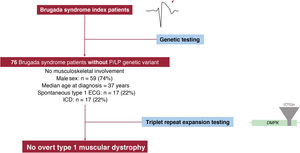
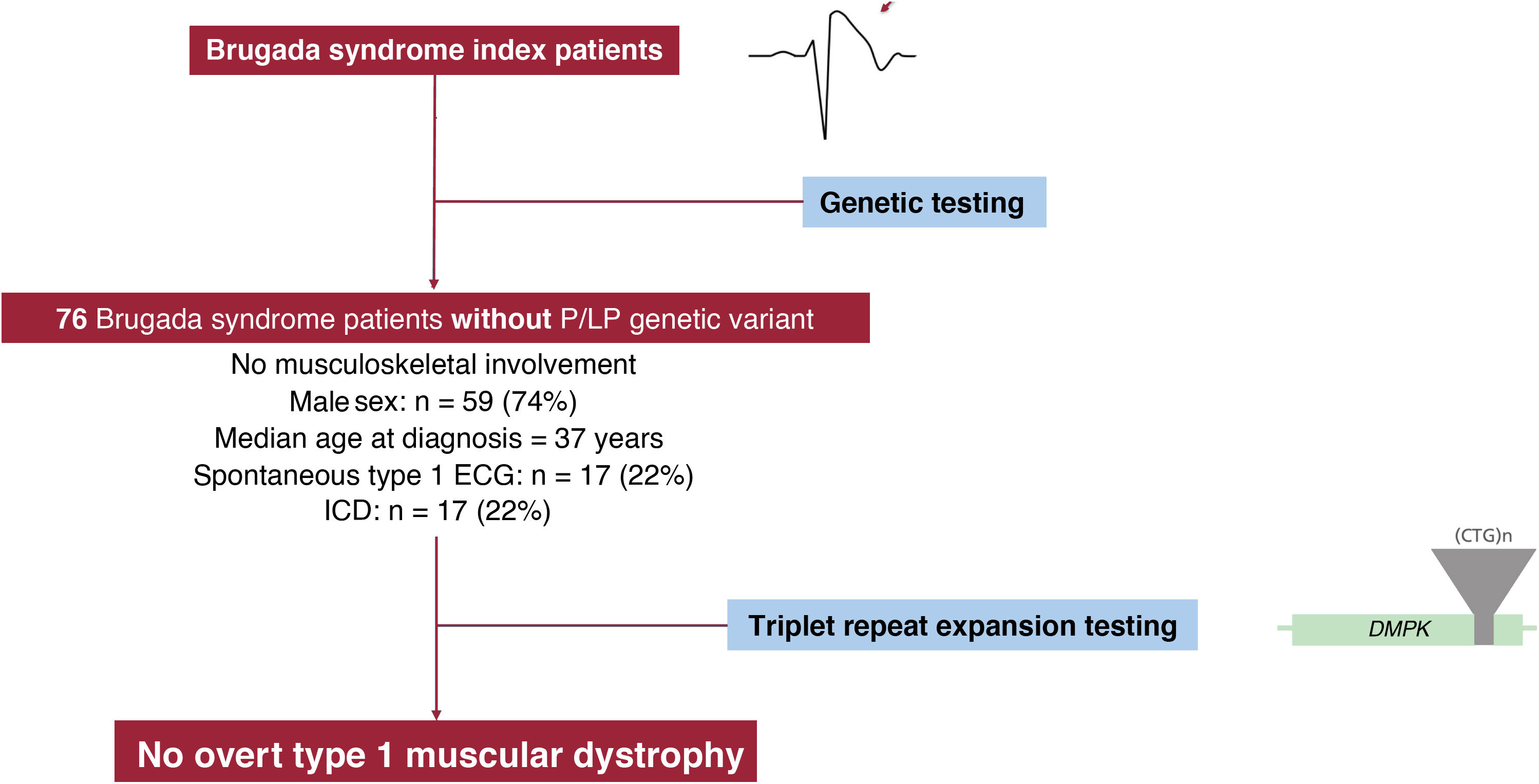
In total, 76 index cases were included, 56 of whom were male (74%), with a median [interquartile range (IQR)] age at diagnosis of 37 [16] years (figure 1). None of the patients with genetically negative Brugada syndrome exhibited musculoskeletal symptoms. Brugada syndrome was incidentally discovered in 53 patients, while the remainder were symptomatic at diagnosis (3 cardiac arrests, 14 with syncope, and 5 with palpitations). A total of 17 patients (22%) had a spontaneous type 1 BrP on ECG, while the pattern was observed only after a provocation test in the remaining patients. Two patients had a first-degree atrioventricular block and none had complete interventricular conduction disorders. Transthoracic echocardiography showed no signs of cardiomyopathy in any patient. A total of 17 patients (22%) underwent defibrillator implantation. Genetic analysis revealed normal triplet expansion alleles (5-35 CTG repeats) in all cases, with no detected premutations (36-50 repeats), indicating that our cohort was not enriched with DM1 cases.

Figure 1.

Main characteristics of patients included and study results. CTG, cytosine-thymine-guanine; ECG, electrocardiogram; ICD, implantable cardioverter defibrillator; LP, likely pathogenic; P, pathogenic.

(0.24MB).

Several clinical studies have reported an association between Brugada syndrome and DM1. Wahbi et al.1 found a prevalence of 7.7 per 1000 of a spontaneous type 1 Brugada ECG pattern in patients with DM1, nearly 40-fold higher than in the healthy European population. Maury et al.3 identified Brugada syndrome in 18% of patients with DM1 and minor depolarization/repolarization abnormalities suggestive of possible Brugada syndrome after a drug challenge compared with 0.5% in the general population. Pambrun et al.4 described the deleterious effect of DM1 on the clinical expression of a loss-of-function SCN5A mutation.

Aberrant alternative splicing of pre-mRNAs, caused by the toxic effects of mutant DMPK mRNAs, is a primary pathogenic feature of DM1.5 This often leads to the overexpression of fetal splicing isoforms, which is related to the disruption of the functional balance between the splicing regulators MBNL1 and CELF1. In a study by Wahbi et al.,1 analysis of a ventricular myocardial specimen from a patient with DM1 revealed abnormal splicing of SCN5A exon 6, with expression of a fetal isoform called exon 6A. The protein sequence deduced from exon 6A contains seven amino acid substitutions, corresponding to a previously reported sodium channel variant, Nav1.5e, which is normally expressed during embryonic development in various mammalian species. Nav1.5e exhibits distinct electrophysiological properties that result in sodium current loss of function, including a depolarized shift of steady-state activation, slower activation and inactivation kinetics, delayed recovery from inactivation, and reduced channel availability compared with Nav1.5. In addition, sodium current dysfunction has been demonstrated in a transgenic mouse model mimicking the triplet expansion observed in DM1.6 Thus, we hypothesize a link between SCN5A missplicing, sodium current dysfunction, and the cardiac manifestations of DM1, including the Brugada pattern which our findings do not contradict. Genetically negative Brugada syndrome could be explained by numerous mechanisms, such as alternative genetic contributors or epigenetic regulation of SCN5A expression.

Our study includes a small number of patients, particularly considering the low prevalence of DM1 in the general population, resulting in limited statistical power. Therefore, the findings should be interpreted with caution.

In this study, we investigated whether asymptomatic DM1 cases could be identified in a cohort of patients with genetically negative BrP. All patients tested negative for triplet expansion, suggesting that systematic DM1 testing in genetically negative BrP patients is not justified. However, it is important to thoroughly investigate suggestive neuromuscular symptoms, and systematic creatine kinase measurement could be of interest.

FUNDING

The study was funded by a grant to Alexis Hermida from the Ligue contre la Cardiomyopathie.

ETHICAL CONSIDERATIONS

The research was conducted in accordance with internationally accepted recommendations for clinical investigation (Declaration of Helsinki of the World Medical Association). Written informed consent was obtained from all participants, archived, and is available. The study protocol was approved by the Institutional Review Boards (CER Sorbonne Université) on 31 January 2023.

STATEMENT ON THE USE OF ARTIFICIAL INTELLIGENCE

No artificial intelligence was used in the preparation of this manuscript.

AUTHORS’ CONTRIBUTIONS

All authors made substantial contributions to the conception of the work, drafted the manuscript, gave final approval of the version to be published and agreed to be accountable for all aspects of the work.

CONFLICTS OF INTEREST

P. Charron reports personal fees for consultancies (outside the scope of the present work) from Amicus, Bristol Myers Squibb, Owkin, Pfizer, Sanofi and Servier. E. Gandjbakhch reports personal fees for consultancies and educational activities from Medtronic, Tenaya, Abbott, Microport, Biotronik, Boston Scientific, and Zoll.

Acknowledgments

We thank Prof. Karim Wahbi for his careful review of the manuscript.

References
[1]
K. Wahbi, V. Algalarrondo, H.M. Bécane, et al.
Brugada syndrome and abnormal splicing of SCN5A in myotonic dystrophy type 1.
Arch Cardiovasc Dis., (2013), 106 pp. 635-643
[2]
T. Pambrun, A. Bortone, P. Bois, et al.
Unmasked Brugada Pattern by Ajmaline Challenge in Patients with Myotonic Dystrophy Type 1: Unmasked Brugada in Myotonic Dystrophy.
Ann Noninvasive Electrocardiol., (2015), 20 pp. 28-36
[3]
P. Maury, M. Audoubert, P. Cintas, et al.
Prevalence of type 1 Brugada ECG pattern after administration of Class 1C drugs in patients with type 1 myotonic dystrophy: Myotonic dystrophy as a part of the Brugada syndrome.
Heart Rhythm., (2014), 11 pp. 1721-1727
[4]
T. Pambrun, A. Mercier, A. Chatelier, et al.
Myotonic dystrophy type 1 mimics and exacerbates Brugada phenotype induced by Nav1.5 sodium channel loss-of-function mutation.
Heart Rhythm., (2014), 11 pp. 1393-1400
[5]
J.W. Day, Ranum LPW:.
RNA pathogenesis of the myotonic dystrophies.
Neuromuscul Disord., (2005), 15 pp. 5-16
[6]
V. Algalarrondo, K. Wahbi, F. Sebag, et al.
Abnormal sodium current properties contribute to cardiac electrical and contractile dysfunction in a mouse model of myotonic dystrophy type 1.
Neuromuscul Disord., (2015), 25 pp. 308-320

These authors share senior authorship.

Copyright © 2025. Sociedad Española de Cardiología