
Early diagnosis and treatment of congenital heart diseases have improved the prognosis of these conditions in recent years. However, some patients are still diagnosed in adulthood with congenital systemic-to-pulmonary shunt (CSPS) with some degree of pulmonary hypertension (PH), adversely impacting the course of the disease.1 There is some controversy about CSPS closure because irreversible remodeling of the pulmonary tree has already occurred in some patients, and PH can progress or reappear, even years after closure, thus worsening the prognosis.2 Current European guidelines on the treatment of adult congenital heart diseases recommend complete CSPS closure in the case of pulmonary-to-systemic flow ratio (Qp/Qs) > 1.5 and pulmonary vascular resistance (PVR) < 5 WU, whether at baseline or after treatment with pulmonary vasodilators (PVs). In these patients, closure tends to be safe and leads to improvement of symptoms and reduced pulmonary pressures. Complete shunt closure is usually not advisable if PVR is persistently ≥ 5 WU because long-term survival in these patients may be even worse than if the shunt were left uncorrected or a fenestrated or incomplete closure were performed.3
Several groups of PVs have been shown to reduce PVR. However, there are only limited data on the use of one or more PVs to achieve operability in patients with CSPS and significant PH (“treat-and-repair” strategy). Published experience is limited to occasional case reports and small series with scant follow-up.4,5
We describe the results of the “treat-and-repair” strategy in 7 consecutive patients referred to a PH unit between 2011 and 2021 who had nonrestrictive CSPS and who initially had PVR values too high to consider complete closure of the shunt. The variables analyzed were response to PVs, operability, and clinical progress after shunt repair. Informed consent was obtained from all patients for both testing and publication. The underlying congenital heart disease was pretricuspid shunt in 6 patients: 3 with ostium secundum atrial septal defects and 3 with sinus venosus and anomalous pulmonary venous return. The only posttricuspid shunt was patent ductus arteriosus.
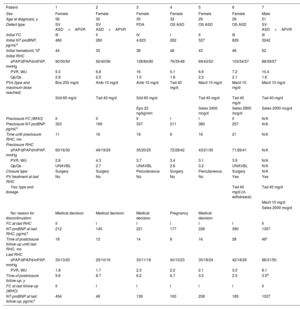
Table 1 lists patients’ clinical characteristics, PV usage, and clinical progress. In 6 of 7 patients, PVR was sufficiently reduced to achieve operability after a median of 17 months (range, 6-21), with one or more PVs included sequentially. There were no drug-induced adverse events requiring withdrawal. Complete shunt repair was performed in 6 patients (surgical in 4 cases and percutaneous with an Amplatzer duct occluder [Abbott, United States] in 2). No patients experienced procedure-related complications. After a median postclosure follow-up of 7.5 years (range, 2.5-9.6), 5 of 6 patients undergoing surgery remained in functional class I and only 1 was still receiving PVs (due to persistence of PVR ≥ 3 WU at 2 years after repair).
Details on patients’ diagnosis, medical treatment, and clinical and hemodynamic progress
| Patient | 1 | 2 | 3 | 4 | 5 | 6 | 7 |
|---|---|---|---|---|---|---|---|
| Sex | Female | Female | Female | Female | Female | Female | Male |
| Age at diagnosis, y | 58 | 30 | 35 | 32 | 29 | 26 | 51 |
| Defect type | SV ASD+APVR | SV ASD+APVR | PDA | OS ASD | OS ASD | OS ASD | SV ASD+APVR |
| Initial FC | III | II | IV | I | II | III | III |
| Initial NT-proBNP, pg/mLa | 460 | 260 | 4.623 | 262 | 527 | 829 | 3242 |
| Initial hematocrit, %b | 44 | 35 | 38 | 48 | 43 | 46 | 52 |
| Initial RHC | |||||||
| sPAP/dPAPd/mPAP, mmHg | 90/30/50 | 92/40/56 | 128/84/90 | 76/35/48 | 69/43/52 | 103/34/57 | 88/39/57 |
| PVR, WU | 5.3 | 6.8 | 16 | 5.1 | 6.6 | 7.2 | 10.4 |
| Qp/Qs | 2.8 | 2.0 | 1.5 | 1.8 | 2.2 | 2.1 | 1.6 |
| PVs (type and maximum dose reached) | Bos 250 mg/d | Amb 10 mg/d | Amb 10 mg/d | Tad 40 mg/d | Macit 10 mg/d | Macit 10 mg/d | Macit 10 mg/d |
| Sild 60 mg/d | Tad 40 mg/d | Sild 60 mg/d | Tad 40 mg/d | Tad 40 mg/d | Tad 40 mg/d | ||
| Epo 22 ng/kg/min | Selex 2400 mcg/d | Selex 2800 mcg/d | Selex 2000 mcg/d | ||||
| Preclosure FC (WHO) | II | II | II | I | I | II | N/A |
| Preclosure NT-proBNP, pg/mLa | 323 | 169 | 337 | 211 | 380 | 257 | N/A |
| Time until preclosure RHC, mo | 11 | 16 | 19 | 6 | 18 | 21 | N/A |
| Preclosure RHC | |||||||
| sPAP/dPAPd/mPAP, mmHg | 60/16/30 | 49/19/29 | 35/20/25 | 72/28/42 | 43/21/30 | 71/26/41 | N/A |
| PVR, WU | 2.8 | 4.3 | 3.7 | 3.4 | 3.1 | 3.9 | N/A |
| Qp/Qs | UNAVBL | 2.7 | UNAVBL | 2.6 | 3.2 | UNAVBL | N/A |
| Closure type | Surgery | Surgery | Percutaneous | Surgery | Percutaneous | Surgery | N/A |
| PV treatment at last RHC | No | No | No | No | No | Yes | Yes |
| Yes: type and dosage | Tad 40 mg/d (in withdrawal) | Tad 40 mg/d | |||||
| Macit 10 mg/d | |||||||
| Selex 2000 mcg/d | |||||||
| No: reason for discontinuation | Medical decision | Medical decision | Medical decision | Pregnancy | Medical decision | ||
| FC at last RHC | II | I | I | I | I | I | II |
| NT-proBNP at last RHC, pg/mLa | 212 | 145 | 221 | 177 | 226 | 390 | 1307 |
| Time of postclosure follow-up until last RHC, mo | 18 | 12 | 14 | 8 | 16 | 28 | 46c |
| Last RHC | |||||||
| sPAP/dPAPd/mPAP, mmHg | 33/13/20 | 29/10/16 | 33/11/18 | 40/15/23 | 35/18/24 | 42/18/26 | 88/31/50 |
| PVR, WU | 1.8 | 1.7 | 2.3 | 2.2 | 2.1 | 3.0 | 8.1 |
| Time of postclosure follow-up, y | 9.6 | 8.7 | 8.2 | 6.7 | 3.5 | 2.5 | 3.5d |
| FC at last follow-up (WHO) | II | I | I | I | I | I | II |
| NT-proBNP at last follow-up, pg/mLa | 454 | 48 | 139 | 163 | 208 | 185 | 1027 |
Amb, ambrisentan; APVR, anomalous pulmonary venous return; ASD, atrial septal defect; Bos, bosentan; d, day; dPAP, diastolic pulmonary arterial pressure; Epo, epoprostenol; FC, functional class; Macit, macitentan; mPAP, mean pulmonary arterial pressure; N/A, not applicable; NT-proBNP, N-terminal fragment of pro–brain (B-type) natriuretic peptide; OS, ostium secundum; PDA, patent ductus arteriosus; PVR, pulmonary vascular resistance; PVs, pulmonary vasodilators; Qp/Qs, pulmonary-to-systemic flow ratio; RHC, right heart catheterization; Selex, selexipag; Sild, sildenafil; sPAP, systolic pulmonary arterial pressure; SV, sinus venosus; Tad, tadalafil; UNAVBL, not available; WHO, World Health Organization; WU, Wood units.
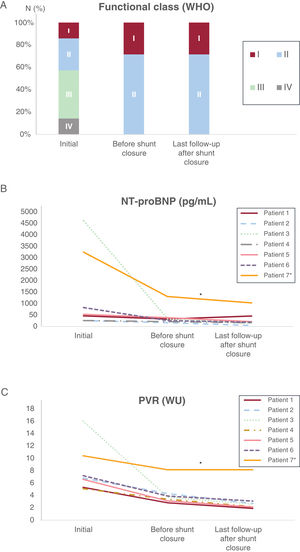
Figure 1A,B shows the trend of baseline functional class and N-terminal pro–brain (B-type) natriuretic peptide (NT-proBNP) after PV treatment and at the last follow-up after shunt closure. Figure 1C depicts the PVR trend for all patients, showing a significant reduction in these values after PVs and an even larger reduction after shunt repair, which was maintained during follow-up. One patient with patent ductus presented at age 35 years with shock, hypoxemia, very high PVR, and moderate biventricular dysfunction. The ductus was 8 mm in diameter and exhibited bidirectional flow at its cross-section. Surprisingly, 19 months after triple vasodilator treatment was started and other causes of PH had been ruled out, PVR was sufficiently reduced to consider closure, which was carried out successfully. The only patient who did not achieve operability despite treatment with 3 PVs (tadalafil, macitentan, and selexipag) was a 51-year-old man with sinus venosus atrial septal defect and anomalous pulmonary venous return, with very high PVR (10.4 WU) since the time of diagnosis. After more than 3.5 years with 3 PVs, with improved functional class but insufficiently reduced PVR, closure was ruled out. The patient is receiving follow-up to assess other options, such as transplantation, in case of clinical decline.
A: trend of functional class after PV treatment and before and after shunt closure. B: trend of N-terminal fragment of pro–brain (B-type) natriuretic peptide hormone after PV treatment and before and after shunt closure. C: trend of PVR with PVs before and after shunt closure. In patient 7, the shunt could not be corrected because PVR values indicative of operability were not achieved (asterisk). NT-proBNP, N-terminal fragment of pro–brain (B-type) natriuretic peptide hormone; PVs, pulmonary vasodilators; PVR, pulmonary vascular resistance; WHO, World Health Organization; WU, Wood units.
In summary, our experience shows that the PV strategy may successfully achieve operability in a high percentage of patients with CSPS and with PH contraindicating complete defect correction might offer long-term efficacy. Because these are very specific cases involving complex decisions, these patients should be evaluated at facilities specializing in PH. Larger systematic studies are needed to confirm the positive experience of our series and other small case series published in the literature. The innovation of our study is the use of more modern PVs (such as macitentan and selexipag) and longer follow-up periods.
FUNDINGThis study has received no funding.
ETHICAL CONSIDERATIONSThe study complied with all ethics codes, and informed consent was obtained from all patients to report the information described in this letter. Possible sex- and gender-related biases have been taken into consideration.
STATEMENT ON THE USE OF ARTIFICIAL INTELLIGENCENo artificial intelligence tool was used.
AUTHORS’ CONTRIBUTIONSM. Gómez-Bueno, L. Pérez Gómez, and J. Segovia Cubero participated in the study design, data collection and analysis, and manuscript preparation. F.J. Hernández Pérez, C.D. Mitroi and M. Rivas Lasarte collaborated in revision of the article.
CONFLICTS OF INTERESTM. Gómez-Bueno has received lecture fees as well as enrollment and travel grants for Janssen conferences. All other authors state that they have no conflicts of interest in relation to this study.