
ISSN: 1885-5857 Impact factor 2024 4.9
Vol. 77. Num. 9.
Pages 790-793 (September 2024)

Scientific letter
Implications of atrial cardiomyopathy in the incidence of cardioembolic events in patients with cryptogenic stroke

Implicaciones de la miocardiopatía auricular en la incidencia de eventos cardioembólicos en pacientes con ictus criptogénico

Marine VialaVirginie HeanbAntoine Da CostaacJean-Philippe CamdessanchébdPierre GarnierbcJean-Baptiste Guichardacef
https://doi.org/10.1016/j.rec.2024.03.006

Options

Imagen extra
Rev Esp Cardiol. 2024;77:790-3
To the Editor,

Approximately 17% of ischemic stroke patients receive a diagnosis of embolic stroke with undetermined source (ESUS).1 ESUS patients have a higher risk of stroke recurrence, emphasizing the importance of understanding causation for effective prevention. While atrial fibrillation (AF) has emerged as the predominant mechanism in ESUS, the definitive cause remains undetermined. Potential causes may be identified by assessing atrial cardiomyopathy (ACM),2 even before AF onset, as a substantial portion of the ESUS population have clinical markers of ACM.1 Nevertheless, the correlation between ACM and clinical prognosis post-ESUS remains unclear. This study aimed to evaluate predictors, particularly ACM markers, of cardioembolic event occurrence in ESUS patients over long-term follow-up.

This observational and single-center retrospective cohort study enrolled consecutive patients who experienced ischemic stroke confirmed through brain imaging, excluding transient ischemic attack, at the Stroke Unit of the University Hospital of Saint-Étienne (France) from 2009 to 2012. ESUS was initially defined and confirmed as a negative comprehensive etiologic screening, which included a> 24-hour Holter electrocardiogram (ECG), transesophageal echocardiography, and intracranial artery imaging. The aim was to exclude any ischemic stroke with an identified cause, including patent foramen ovale.3 The study protocol was approved by the local ethics committee, and all patients were duly informed.

Markers of ACM were itemized at baseline through the CHA2DS2-VASc score, P-wave morphology, left atrial (LA) dilatation, increased burden of premature atrial contractions (PACs),4 and the presence of nonsustained supraventricular tachycardia.

Long-term follow-up data were collected from both former and current physicians. The occurrence of a cardioembolic event was a composite outcome that included diagnosis of AF and/or recurrence of ischemic stroke, in which a cardioembolic cause was identified based on the etiologic evaluation.

Patients who were lost to follow-up were censored at the time of their last assessment. Univariate and multivariate analyses were conducted using Fine-Gray proportional subdistribution hazard model regression analysis, including all-cause mortality as a competing event with cardiovascular events. All statistical analyses were performed using IBM SPSS Statistics.

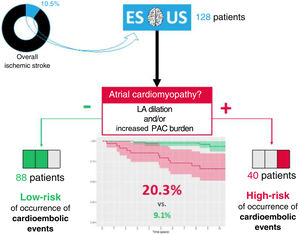
Among the entire cohort of patients with an ischemic stroke, a potential cause was identified in 1094 patients. Out of these patients, 128 met the criteria for ESUS and were included in the study, representing 10.5% of patients with ischemic stroke overall (figure 1). The baseline characteristics of the ESUS population were as follows: the mean age was 61 years, hypertension was present in 68.8%, there was no history of stroke or transient ischemic attack in 87.5%, the median CHA2DS2-VASc score was 2, and LA dilatation was present in 26.6%. Upon discharge, antiplatelet therapy was prescribed in most patients (82.6%).

Figure 1.

The initial presence of atrial cardiomyopathy, characterized by left atrial dilation and/or increased premature atrial contraction burden, is a significant predictor of cardioembolic event occurrence during long-term follow-up. LA, left atrial; ESUS, embolic stroke with undetermined source; PAC, premature atrial contraction.

(0.37MB).

During the median 9.2-year follow-up period, 30 patients (25.0% of the whole cohort) died. The cumulative incidence of a diagnosis of cardioembolic events was 16.9%±4.5%. Among them, 13 patients were diagnosed with AF and 4 patients had a cardioembolic stroke.

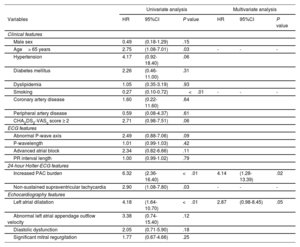
Through univariate analysis, several predictors of cardioembolic events during follow-up were identified (table 1). Although not statistically significant, there was a trend suggesting an association between abnormal P-wave axis and reduced left atrial appendage outflow velocity and diagnosis of a cardioembolic source. Interestingly, none of the characteristics of the baseline ischemic stroke were associated with the occurrence of cardioembolic events. Independent predictors of the occurrence of cardioembolic events were the presence of LA dilatation based on baseline transthoracic echocardiography assessment (hazard ratio [HR], 2.87; 95% confidence interval [95%CI], 0.98-8.45; P=.05) and increased burden of PACs during a 24-hour Holter-ECG (HR, 4.13; 95%CI, 1.28-13.39; P=.02) as reported in table 1. At inclusion, 31.3% of the cohort had at least 1 of these independent predictors, defined as the presence of ACM. Patients with LA dilatation and/or increased PAC burden had a 5-fold higher risk of experiencing a cardioembolic event during the long-term follow-up (HR, 5.00; 95%CI, 1.84-13.60; P=.001) as illustrated in the figure 1.

Table 1.

Predictors of cardioembolic events after ESUS

  Univariate analysisMultivariate analysis
Variables  HR  95%CI  P value  HR  95%CI  P value 
Clinical features
Male sex  0.49  (0.18-1.29)  .15       
Age> 65 years  2.75  (1.08-7.01)  .03 
Hypertension  4.17  (0.92-18.40)  .06       
Diabetes mellitus  2.26  (0.46-11.00)  .31       
Dyslipidemia  1.05  (0.35-3.19)  .93       
Smoking  0.27  (0.10-0.72)  <.01 
Coronary artery disease  1.60  (0.22-11.60)  .64       
Peripheral artery disease  0.59  (0.08-4.37)  .61       
CHA2DS2-VASc score ≥ 2  2.71  (0.98-7.51)  .06       
ECG features
Abnormal P-wave axis  2.49  (0.88-7.06)  .09       
P-wavelength  1.01  (0.99-1.03)  .42       
Advanced atrial block  2.34  (0.82-6.66)  .11       
PR interval length  1.00  (0.99-1.02)  .79       
24-hour Holter-ECG features
Increased PAC burden  6.32  (2.36-16.40)  <.01  4.14  (1.28-13.39)  .02 
Non-sustained supraventricular tachycardia  2.90  (1.08-7.80)  .03 
Echocardiography features
Left atrial dilatation  4.18  (1.64-10.70)  <.01  2.87  (0.98-8.45)  .05 
Abnormal left atrial appendage outflow velocity  3.38  (0.74-15.40)  .12       
Diastolic dysfunction  2.05  (0.71-5.90)  .18       
Significant mitral regurgitation  1.77  (0.67-4.66)  .25       

95%CI, 95% confidence interval; ECG, electrocardiogram; ESUS, embolic stroke with undetermined source; HR, harzard ratio; PAC, premature atrial contraction.

The prevalence of ESUS in our cohort of ischemic stroke patients (10.5%) falls within the lower range reported in several studies (9% to 25%).1 This variance likely highlights the crucial need for a thorough etiological evaluation when assessing ischemic stroke, including transesophageal echocardiography to rule out patent foramen ovale. Ischemic stroke recurrence occurred in 10.2% of the cohort, which is lower than the reported incidence (4% to 5% per year).1 While the retrospective design of the study may introduce ascertainment bias, the lower prevalence of ESUS likely facilitated the initiation of appropriate therapies based on stroke etiology in many patients and reduced long-term complications.

ESUS is a heterogeneous condition with various underlying causes, including unknown peripheral atherosclerosis and cardioembolic sources. ACM is an emerging concept2 that has the potential to improve diagnostic management in ESUS patients. ACM assessment in clinical practice is constrained by the lack of standardized criteria. Recently, the ARCADIA trial did not demonstrate the superiority of an ACM-based therapy in the ESUS population with ACM, likely because of an inaccurate definition of ACM.5 Our study highlights an alternative definition of ACM, based on the presence of a dilated LA and an increased PAC burden, present in one third of the ESUS population at baseline, leading to a 5-fold higher long-term risk of cardioembolic events (figure 1). A randomized clinical trial assessing the benefit of an ACM-based therapeutic strategy as defined in our study is warranted.

In conclusion, the presence of ACM, defined as LA dilatation or increased PAC burden at baseline, is predictive of the diagnosis of a cardioembolic source during long-term follow-up in the ESUS population (figure 1).

FUNDING

This work was supported by institutional grants from the French Federation of Cardiology (FFC) and Centro de Investigación Biomédica en Red de Enfermedades Cariovasculares (CIVERCV).

ETHICAL CONSIDERATIONS

The study protocol was approved by the local ethics committee of the University Hospital of Saint-Étienne. Prior to the start of the study, all patients received an information sheet, provided written informed consent, and had the option to withdraw from participation. Possible sex/gender biases have been considered in the preparation of this paper.

STATEMENT ON THE USE OF ARTIFICIAL INTELLIGENCE

No artificial intelligence tool was used in the preparation of this article.

AUTHORS’ CONTRIBUTIONS

M. Vial, V. Hean, P. Garnier, and J.B. Guichard conceived, designed, and performed the analysis. A. Da Costa and J.P. Camdessanché reviewed and edited the manuscript.

CONFLICTS OF INTEREST

J.B. Guichard reports honoraria as a consultant for Microport CRM, a lecturer for Microport CRM and Abbott, and unrestricted grant support for a fellowship from Abbott. The remaining authors have nothing to disclose.

References
[1]
G. Ntaios.
Embolic Stroke of Undetermined Source: JACC Review Topic of the Week.
J Am Coll Cardiol., (2020), 75 pp. 333-340
[2]
J.B. Guichard, S. Nattel, Atrial Cardiomyopathy:.
A Useful Notion in Cardiac Disease Management or a Passing Fad?.
J Am Coll Cardiol., (2017), 70 pp. 756-765
[3]
H. Zhang, Z. Li, Y. Dai, E. Guo, C. Zhang, Y. Wang.
Ischaemic stroke etiological classification system: the agreement analysis of CISS, SPARKLE and TOAST.
Stroke Vasc Neurol., (2019), 4 pp. 123-128
[4]
B.S. Larsen, P. Kumarathurai, J. Falkenberg, O.W. Nielsen, A. Sajadieh.
Excessive Atrial Ectopy and Short Atrial Runs Increase the Risk of Stroke Beyond Incident Atrial Fibrillation.
J Am Coll Cardiol., (2015), 66 pp. 232-241
[5]
H. Kamel, W. Longstreth, D.L. Tirschwell, et al.
The Atrial Cardiopathy and Antithrombotic Drugs In prevention After cryptogenic stroke randomized trial: Rationale and methods.
Int J Stroke., (2019), 14 pp. 207-214
Copyright © 2024. Sociedad Española de Cardiología