
Cardiac resynchronization therapy (CRT) is an effective treatment for patients with nonischemic dilated cardiomyopathy associated with left bundle branch block (LBBB). In these patients, the device can normalize left ventricular ejection fraction (LVEF). Nevertheless, it remains unclear whether CRT responders still require neurohormonal blockers. The aim of this study is to determine the long-term safety of withdrawing drug therapy in these patients.
MethodsThe REMOVE trial is a prospective, multicenter, open-label and randomized 1:1 study designed to assess the effect of withdrawing neurohormonal blockers in patients with nonischemic dilated cardiomyopathy associated with left bundle branch block who recovered LVEF after CRT. The study will include a 12-month follow-up with the option to continue into the follow-up extension phase for up to 24 months. The primary endpoint is the recurrence of cardiomyopathy defined as any of the following criteria: a) a reduction in LVEF >10% (provided the LVEF is <50%); b) a reduction in LVEF >10% accompanied by an increase >15% in the indexed end-systolic volume relative to the previous value and in a range higher than the normal values, or c) decompensated heart failure requiring intravenous diuretic administration. In patients meeting the primary endpoint, drug therapy will be restarted.
ConclusionsThe results of this study will help to enhance our understanding of CRT superresponders, a specific group of patients.
Registred at ClinicalTrials.gov (Identifier: NCT05151861).
Keywords
In patients with heart failure (HF) and reduced left ventricular ejection fraction (LVEF), optimal medical therapy (OMT) significantly improves prognosis1 and often leads to favorable reverse remodeling. However, in certain clinical situations, such as reduced LVEF associated with left bundle branch block (LBBB), the effectiveness of OMT declines.2 In such situations, cardiac resynchronization therapy (CRT), a treatment option recommended in clinical practice guidelines,3 provides excellent results when OMT proves insufficient.
The response obtained with CRT varies, yet within a subset of patients, known as CRT super-responders, both LVEF and ventricular volumes return to normal.4 It is hypothesized that, in these patients, the main factor in the development of ventricular dysfunction is the conduction disorder. By correcting the disorder with the device, cardiac structure and function can be normalized, an outcome not achieved with OMT. This different response indicates that the cardiomyopathy is reversible and secondary to the electromechanical disorder, which CRT effectively resolves.5
In patients with recovered LVEF secondary to dilated cardiomyopathy unrelated to LBBB, discontinuation of OMT has proven to be detrimental, leading to clinical deterioration in nearly half the patients at short-term.6 However, there are few data on complete, sustained, long-term withdrawal in CRT super-responders.7
This study aims to determine the safety of OMT withdrawal in CRT super-responders through an analysis of clinical and imaging parameters associated with the recurrence of cardiomyopathy during follow-up.
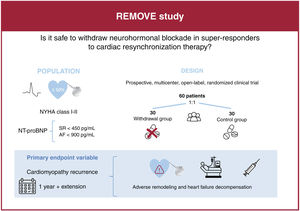
METHODSDesignThe REMOVE study is a prospective, multicenter, open-label, randomized clinical trial. The study is designed to evaluate the effect of withdrawing neurohormonal blockade drug therapy for HF, including beta-blockers, angiotensin-converting enzyme inhibitors (ACEIs), angiotensin II receptor blockers (ARBs), angiotensin receptor neprilysin inhibitors (ARNIs), and mineralocorticoid receptor antagonists (MRAs) compared with continuing this therapy in patients with CRT who recovered LVEF function and normal volumes (figure 1). Sodium-glucose cotransporter type 2 inhibitors are not included within this OMT, as they were introduced after the trials justifying CRT use and provide benefits across the entire LVEF spectrum. After signing the informed consent for participation, patients meeting all the inclusion criteria and none of the exclusion criteria (table 1 of the supplementary data), will be randomized at a 1:1 ratio to either OMT withdrawal (intervention group) or continuation (control group). Randomization will be controlled by groups: age (<60 years vs 60-75 years vs >75 years), sex, atrial fibrillation, time since CRT (<2 years vs ≥2 years), and time since LVEF normalization (<2 years vs ≥2 years). Assignment to each group will be carried out using an online computer program generated by the Plataforma de Informática Biomédica y Bioinformática (IMIB, Biomedical Informatics and Bioinformatics Platform; Pascual Parrilla, Spain). The study is registered in ClinicalTrials.gov (NCT05151861) and has been approved by the ethics committee of the coordinating center (CEIm Hospital Clínico Universitario Virgen de la Arrixaca) and the Spanish Agency for Medicines and Medical Devices (AEMPS). The conduct of this study will adhere to the principles of Good Clinical Practice, the Declaration of Helsinki, and current legislation regarding clinical trials. All patients will sign informed consent before inclusion in the study.
Study populationThe study population will include outpatients of both sexes, aged ≥18 years with a CRT device implanted at least 1 year previously to treat LBBB and LVEF ≤40% due to a nonischemic cause. Patients will qualify for enrollment if they meetall the inclusion criteria and none of the exclusion criteria (table 1 of the supplementary data). The main inclusion criteria are as follows: current LVEF ≥50% and normal volume measurements in 2 consecutive echocardiography studies at least 3 months apart, with the most recent one within the last 6 months; New York Heart Association (NYHA) class I-II; no HF hospital admissions within the past year; N-terminal pro-B-type natriuretic peptide (NT-proBNP) fraction <450 pg/mL (<900 pg/mL if atrial fibrillation is present) in the last 6 months; OMT with beta-blockers, ACEIs/ARBs/ARNIs with or without MRAs; and a properly functioning CRT device with pacing >95%. The key exclusion criteria are as follows: significant, nonrevascularized coronary artery disease; history of sustained ventricular tachycardia or aborted sudden death or appropriate implantable cardioverter defibrillator shock; uncontrolled hypertension; beta-blocker requirement for other indications, such as arrhythmia control; severe valve disease; diabetes or hypertension with microalbuminuria or proteinuria; and renal insufficiency with estimated glomerular filtration rate <30 mL/min/1.73 m2 (Chronic Kidney Disease Epidemiology Collaboration formula).
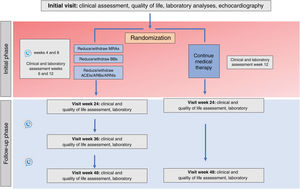
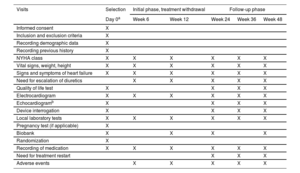
Study protocol and follow-upPatients will be randomized 1:1 to withdrawal (intervention group) or continuation (control group) of medical treatment. As this is an open-label study, both the research team and the patients will be aware of the study group assigned; only the cardiologist performing the echocardiography studies will be blinded to the assigned group. The study design, medical visits, and procedures are summarized in figure 2 and table 1.
Schedule of study visits and procedures
| Visits | Selection | Initial phase, treatment withdrawal | Follow-up phase | |||
|---|---|---|---|---|---|---|
| Day 0a | Week 6 | Week 12 | Week 24 | Week 36 | Week 48 | |
| Informed consent | X | |||||
| Inclusion and exclusion criteria | X | |||||
| Recording demographic data | X | |||||
| Recording previous history | X | |||||
| NYHA class | X | X | X | X | X | X |
| Vital signs, weight, height | X | X | X | X | X | X |
| Signs and symptoms of heart failure | X | X | X | X | X | X |
| Need for escalation of diuretics | X | X | X | X | X | |
| Quality of life test | X | X | X | X | ||
| Electrocardiogram | X | X | X | X | X | X |
| Echocardiogramb | X | X | X | X | ||
| Device interrogation | X | X | X | X | ||
| Local laboratory tests | X | X | X | X | X | X |
| Pregnancy test (if applicable) | X | |||||
| Biobank | X | X | X | X | ||
| Randomization | X | |||||
| Recording of medication | X | X | X | X | X | X |
| Need for treatment restart | X | X | X | |||
| Adverse events | X | X | X | X | X | |
Echocardiography protocol (methods). Both baseline and follow-up echocardiographic studies will be performed by the same operator and with the same equipment in each center. The study number and assigned study group will be masked in the digitized images before independent analysis. A manual containing specific instructions and protocols to standardize the techniques for acquiring the echocardiographic studies will be sent to each local center.
NYHA, New York Heart Association.
Medical therapy withdrawal will be conducted in 2-week steps during the first 12 weeks, with strict supervision at each visit. The drug discontinuation process will proceed gradually, (always 1 medication at a time) for a maximum period of 10 weeks. This approach will allow for detection of any signs of clinical decline at each reduction and eliminate potential risks associated with abruptly stopping all medication. Throughout the withdrawal period, patients will be assessed by telephone contact and in-person visits. The withdrawal protocol, except for nonmandatory cessation of diuretics, is the same as that used in the TRED-HF6 trial to ensure patient safety while addressing the hypothesis. Withdrawal will begin with MRAs, followed by beta-blockers, and conclude with ACEIs/ARBs or ARNIs. At each visit, only 1 drug will be tapered or discontinued. If a patient is receiving low doses of certain medications—spironolactone or eplerenone at a dose of <50mg/d, beta-blockers or ACEIs/ARBs at ≤25% of the maximum recommended dose, or ARNIs at a dose of 24/26 mg—the corresponding drug will be stopped immediately. For higher doses, a gradual reduction of up to 50% every 2 weeks will be implemented until complete cessation. Telephone assessments will be conducted at weeks 4 and 8 of this phase to evaluate each patient's clinical status, blood pressure, and heart rate. At week 6 and week 12 (ie, 2 weeks after concluding the maximum established withdrawal period), an in-person clinical evaluation will be carried out, including NT-proBNP measurement. After the medication withdrawal phase, a follow-up period will begin, with visits scheduled at weeks 24, 36, and 48. These visits will include determination of renal function, ion levels, blood count, and NT-proBNP levels, as well as echocardiography testing and quality of life evaluation using the Kansas City Cardiomyopathy Questionnaire (KCCQ) and Minnesota Living With Heart Failure Questionnaire (MLHFQ). In addition, interspersed telephone reviews will be carried out to ensure ongoing safety during follow-up.
Control or medication continuation groupThese patients will undergo a clinical and analytical assessment at week 12, including NT-proBNP measurement. Additionally, at week 24 and the final visit at week 48, they will complete the KCCQ and MLHFQ scales, and undergo NT-proBNP analysis and echocardiography study.
Both patient groups will have access to unscheduled or additional visits at the discretion of the attending physician. In the event of suspected HF decompensation, an echocardiogram and NT-proBNP analysis will be performed for proper event adjudication, as per protocol.
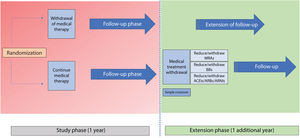
Extension and simple crossover phaseAfter the week 48 visit (final visit), a phase involving extension of follow-up or a simple crossover will be initiated (figure 3). Immediately after completion of each patient's assessment, they will be offered the option to participate for an additional year in the trial's extension phase, according to 2 possibilities:
- A.
Patients from the intervention group: once the safety hypothesis of treatment withdrawal has been confirmed, these patients will continue without treatment and undergo clinical examination, laboratory testing, and echocardiography study at 6 and 12 months under the same criteria for drug reintroduction as in the main phase of the study.
- B.
Patients from the control group: if they continue to meet the inclusion criteria and show no exclusion criteria, control patients will be offered the opportunity to switch to the intervention group. The follow-up and data collection protocols will be the same as those established for the main study phase and will last for 1 year.
Echocardiography studies, both baseline and follow-up, will be carried out by the same operator and using the same technical equipment at each participating center. A manual with instructions and specific protocols aimed at standardizing the techniques for acquiring echocardiographic data will be sent to each center (methods of the supplementary data). The digitized images (DICOM format) will be masked to conceal the date and the patient's personal data, study number, and assigned study group before independent, blinded analysis by a central laboratory. The masking process and the study will be validated independently using a cloud-based web repository before image interpretation.
Safety protocol and medication restartIf any components of the primary endpoint occur within the intervention group, the drugs withdrawn will be fully restarted. The research team will individually reassess management in patients who have other events (eg, sustained arrhythmia), except in the case of hypertension. In these cases, the use of dihydropyridine calcium channel blockers or thiazides, as well as lifestyle measures, will be prioritized. Treatment initiation for hypertensive patients with values >140/90mmHg will follow current recommendations,8 starting with ACEIs/ARBs as the first-line therapy, followed by MRAs, and finally, beta-blockers.
The research team will monitor the progress of the study once per month. Any events during follow-up will be reported and analyzed by the team, which will collaborate with the cardiologist responsible for each center to determine subsequent decisions and the suitability of continuing with the study. The decision to continue in the extension or crossover phase will be made on a patient-by-patient basis, following the same clinical safety criteria used in the main phase of the study, provided there are no major events and patients experiencing a recurrence of cardiomyopathy show a positive response to medication resumption.
Primary and secondary endpointsThe primary endpoint is recurrence of cardiomyopathy at any point of the study after medication withdrawal, defined by at least 1 of the following criteria: a) a reduction in LVEF >10% (provided the overall LVEF is <50%) compared with baseline echocardiography findings; b) a decrease in LVEF >10% accompanied by an increase in left ventricular end-systolic volume indexed by body surface area >15% relative to baseline values and exceeding the normal range (31 mL/m2 in men and 27 mL/m2 in women), or c) unplanned hospital admission, emergency room visit, or day hospital visit due to decompensated HF requiring intravenous diuretics, as determined by the research team.
The secondary endpoints include the following: a) a composite of total mortality, cardiovascular mortality, unscheduled hospital admission, emergency room visit, or day hospital visit due to HF, and sustained atrial or ventricular arrhythmia (>30 s); b) changes in LVEF values, indexed ventricular volumes, indexed left atrial volume by body surface area, and global longitudinal left ventricular strain with respect to baseline values; c) quantitative changes in NT-proBNP values; and d) changes in quality of life, according to the results of the KCCQ and MLHFQ scales.
Sample size and statistical analysisBased on calculations performed in the TRED-HF6 study, with 80% power and a significance level of 5%, a sample size of 30 patients per group allows for detection of differences between the groups (assuming no relapses in the control group), if the incidence of the primary event in the treatment withdrawal group is 23%.
Demographic data and other baseline characteristics of the trial participants will be reported using descriptive statistical indices for the total sample and each of the study groups. Continuous variables will be described using measures of central tendency (mean) and dispersion (standard deviation), whereas categorical values will be summarized using tables of absolute and relative frequency. Baseline characteristics of the 2 participating groups will be compared. Categorical variables will be compared using the chi-square test, and continuous variables with the Student t-test. A P-value <.05 will be considered significant. Analysis of both primary and secondary variables will be conducted on an intention-to-treat basis.
For the analysis of the primary endpoint variable, relapse percentages with 95% confidence intervals will be calculated for both groups. Differences between the groups will be estimated using a proportions test. A logistic regression model will be used to adjust for age and sex. Secondary endpoint variables, such as mortality and hospital readmissions, will be analyzed using Kaplan-Meir survival curves and log-rank tests. Age and sex adjustments will be made using Cox proportional hazards modeling. Additional continuous indicators, such as echocardiography findings and NT-proBNP values will be analyzed using paired t-tests and multiple regression models, adjusting for age and sex.
DISCUSSIONCardiac resynchronization therapy for the treatment of heart failure with reduced left ventricular ejection fractionIn HF patients with decreased LVEF, the use of pharmacological treatments that block neurohormonal activation offers substantial benefits by notably reducing morbidity, mortality, and hospital readmissions.1,3 Within this patient population, there is a specific subset with ventricular dysfunction and LBBB who can benefit from CRT, an option that provides prognostic advantages beyond those achieved with OMT. Clinical guidelines recommend CRT for patients with LVEF ≤35% who remain symptomatic despite receiving OMT for a minimum of 3 months.3 The accumulated evidence indicates that individuals with nonischemic dilated cardiomyopathy and LBBB exhibit a heightened response in terms of remodeling and enhanced ejection fraction,9 and therefore, better clinical outcomes after CRT.10 While medications act at the neurohormonal level, CRT primarily addresses the electromechanical contraction delays and subsequent myocardial stress caused by intraventricular and interventricular asynchrony.11
Ventricular response to cardiac resynchronization therapy: responder patientsFollowing CRT, the degree of improvement in cardiac remodeling varies. In certain cases, patients achieve normalization of LVEF, earning them the name super-responders. The prevalence of this favorable response varies widely, ranging from 10% to 29%, and is highly dependent on the definition used, which is based on both echocardiographic and clinical parameters.4,12,13 Super-responders embody the most favorable outcome, characterized by LVEF ≥50% and a considerable reduction in ventricular volumes (≥30% decrease in end-systolic volumes) following CRT.4 This response has led to the hypothesis that the primary cause of ventricular dysfunction in these patients is the conduction disorder, as correction with the device can restore normal cardiac structure and function. In essence, what maximum tolerated doses of OMT failed to achieve can be accomplished with CRT. This differential response suggests a reversible cardiomyopathy secondary to the electromechanical disorder corrected by CRT.5 Several studies have shown that super-responders have a favorable prognosis, marked by low overall and cardiovascular mortality rates, as well as fewer HF readmissions.14,15 Generally, these patients also have a low incidence of ventricular arrhythmias and appropriate shocks due to improved cardiac remodeling and reduced wall stress.16,17 However, this notion has been questioned,18 possibly because it is derived from studies including patients with pre-existing ventricular arrhythmia and an unfavorable substrate, such as significant myocardial fibrosis, which is more prevalent in ischemic dilated cardiomyopathy.
Role of pharmacological treatment in the response to cardiac resynchronizationIt has been suggested that the observed improvement in remodeling after CRT is due to the combined effect of CRT itself and the subsequent enhancement of OMT, as higher doses can be administered. Thus, patients receiving higher post-CRT OMT doses have a better prognosis at follow-up.19,20 However, this does not necessarily imply causation; it may simply identify patients with less advanced disease showing a better intrinsic response to CRT. Moreover, it remains unclear whether dosage changes alone can explain such a marked remodeling improvement. Studies indicate only a modest 16% difference in the maximum treatment dose between super-responders and nonsuper-responders.21 In addition, these investigations analyzed the role of OMT in the total population of resynchronized patients, with a wide range of LVEF values post-CRT. Hence, the findings may not provide sufficient evidence to allow definitive conclusions.
Withdrawal of pharmacological therapy in patients responding to cardiac resynchronization therapyWhile there is no denying that OMT has a role in post-CRT patients with persistent ventricular dysfunction, its significance in patients with normalized function remains unclear. It is unknown whether OMT withdrawal in such cases offers benefits either in preserving LVEF or in decreasing events during follow-up. A study investigating OMT withdrawal in patients with recovered LVEF6 reported short-term recurrence of cardiomyopathy in nearly half the sample. However, the study did not include patients with CRT. Thus, the initial LVEF recovery was due to OMT and not CRT, and the results obtained would be expected. To date, only 1 recent study7 has analyzed OMT withdrawal in a specific patient population experiencing LVEF normalization following CRT. The authors concluded that discontinuation of this therapy was safe in most patients after a 2-year follow-up. Notably, the study randomized patients to various withdrawal strategies: withdrawal of beta-blockers only, of renin-angiotensin-aldosterone system blockers only, or complete medication withdrawal. This last group, the focus of our study, comprised 20 patients, and only a minority successfully sustained total withdrawal at completion of follow-up due to emerging cardiologic comorbidities, such as hypertension and supraventricular arrhythmia. Therefore, the available scientific evidence on complete OMT withdrawal in CRT super-responders is quite limited.
LimitationsThe limitations of this study include enrollment of a small number of patients and an initial follow-up period of 1 year, with the possibility of extending to 2 years, which, nevertheless, might not suffice to detect long-term recurrence of cardiomyopathy. In addition, the open-label study design might lead to biases, although these could be minimized by masking echocardiography measurements related to the primary endpoint. Lastly, the intervention group will undergo a larger number of follow-up visits for safety purposes. This might affect the results by enhancing the detection of events in these patients. Nonetheless, the definition established for the primary event decreases the likelihood that irrelevant findings will influence the study outcomes.
CONCLUSIONSThe results of this study will heighten our understanding of the true role of OMT in this singular patient subgroup: CRT super-responders. This will provide a more robust scientific basis for decision-making than the current state of knowledge.
- -
On the basis of consensus, OMT is continued indefinitely in patients with LVEF decreases, despite improvements in cardiac function. However, ventricular dysfunction has diverse causes and patients with this condition are not clinically homogeneous. There is little prospective evidence on OMT withdrawal in patients who are CRT super-responders. In these patients, the primary causal factor is believed to be the electromechanical disorder, which has been corrected by CRT.
- -
This study could mark an advance in recognizing ventricular dysfunction secondary to ventricular asynchrony as a separate entity, in which the preferred treatment could be CRT alone. The clinical impact would be substantial, as it addresses an area of uncertainty in the evidence and clinical practice within a specific context, involving medications with potential adverse effects, in addition to an associated cost.
This study was funded by the Carlos III Health Institute (ISCIII) through project PI20/00789 and cofunded by the European Union.
ETHICAL CONSIDERATIONSThe study is registered at ClinicalTrials.gov (NCT05151861) and has received approval from the ethics committee of the coordinating center (CEIm Hospital Clínico Universitario Virgen de la Arrixaca) and the Spanish Agency of Medicines and Medical Devices (AEMPS). The study will be conducted in accordance with Good Clinical Practice standards, the Declaration of Helsinki, and current legislation governing clinical trials. All patients will provide signed informed consent prior to enrollment. Sex and gender variables have been considered following SAGER guidelines.
STATEMENT ON THE USE OF ARTIFICIAL INTELLIGENCENo artificial intelligence tools were used in the preparation of this article.
AUTHORS’ CONTRIBUTIONSF.J. Pastor-Pérez and D.A. Pascual-Figal participated in the conception and design of the study. A. Hernández-Vicente proposed the statistical analysis. F.J. Pastor-Pérez and M.T. Pérez Martínez drafted the initial version of the manuscript. I.P. Garrido-Bravo, P. Peñafiel-Verdú, S. Manzano-Fernández, N. Fernández-Villa, C. Caro-Martínez, M.J. Oliva-Sandoval, and D.A. Pascual-Figal participated in the revision and correction of the manuscript. F.J. Pastor-Pérez, M.T. Pérez-Martínez, and D.A. Pascual-Figal approved the final version.
CONFLICTS OF INTERESTThe authors declare no conflicts of interest.