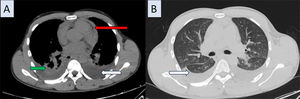

A 36-year-old male patient presented to the emergency department with pleuritic and pericarditic chest pain. Relevant medical history included smoking and alcohol consumption. He had previously been admitted due to an episode of acute idiopathic pericarditis with electrocardiographic changes and no pericardial effusion, myocardial involvement, or echocardiographic abnormalities. The episode resolved fully Findings from the physical examination during this new episode were unremarkable. An electrocardiogram revealed sinus tachycardia and incomplete right bundle branch block. Cardiomegaly was observed on chest X-ray, and laboratory testing showed leukocytosis with neutrophilia, elevated acute phase reactants, and no enzyme activity indicative of myocardial injury.
Given the clinical course suggestive of recurrent pericarditis and the presence of new-onset cardiomegaly, assessment by the cardiology department was requested. A transthoracic echocardiogram performed during sinus tachycardia showed generalized hypokinesia with mild to moderate biventricular dysfunction and mild pericardial effusion surrounding the heart, with no evidence of hemodynamic impairment or pericardial constriction, leading to a decision to admit the patient.
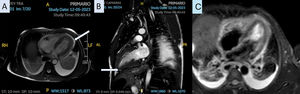
The patient reported persistent pain despite anti-inflammatory treatment, prompting a chest computed tomography (figure 1) and cardiac magnetic resonance scans (figure 2). The former revealed a small bilateral pleural effusion and cardiomegaly with mild pericardial effusion; findings from T2-weighted short-tau inversion recovery (STIR) sequences with late enhancement and fat signal suppression were compatible with acute pericardial inflammation with no evidence of myocarditis.
Cardiac magnetic resonance. A: four-chamber view with late gadolinium enhancement. B: two-chamber view with late gadolinium enhancement. C: T2-weighted STIR sequences with late gadolinium enhancement and fat suppression. Diffuse enhancement is seen on both sides of the pericardial layers (white arrows), raising suspicion of acute pericarditis, although without hyperenhancement suggestive of intramyocardial fibrosis or necrosis or loss of myocardial viability. T2-weighted, gadolineum-enhanced STIR sequences with fat suppression showing no myocardial involvement.
Subsequent serology testing confirmed exposure to Coxiella burnetii (negative phase I IgG titer; positive phase II IgG titer of 1:160). As a result, the patient received specific treatment with doxycycline 100 mg and colchicine 0.5mg every 12hours, leading to a marked improvement in clinical symptoms and laboratory findings. Follow-up echocardiography showed resolution of the pleural and pericardial effusion and improved ventricular function (both left and right ventricular fraction), and the patient was discharged. Follow-up laboratory studies confirmed resolution of the infection.
Q fever, a zoonotic infection with a worldwide geographic distribution, is caused by the gram-negative coccobacillus Coxiella burnetii. The exact prevalence of the disease is unknown, and its clinical manifestations vary considerably. The disease exists in a wide range of animal species, although human infection can result from accidental spread of the organism, most commonly through inhalation.1,2
Of note, 80% of recurrent pericarditis cases have an unknown cause. The remaining 20% result from infection, mostly due to enteric cytopathic human orphan (ECHO) and Coxsackie viruses, while the most common causative bacterium is C. burnetii. According to current evidence, infections caused by this bacterium can cause nonspecific echocardiographic changes such as contractile abnormalities and severe systolic dysfunction.3 In the patient reported here, the finding of biventricular dysfunction on the initial transthoracic echocardiogram had 2 limitations: the context in which the study was performed (ie, at bedside, with the patient in sinus tachycardia at 120 bpm), and the absence of correlation with other laboratory test results (ie, lack of enzyme level elevation; no abnormalities on cardiac computed tomography and magnetic resonance imaging).
C. burnetii displays phase-specific antigen variation, a feature exploited for serologic diagnosis and to distinguish between acute and chronic infection. Acute infection is confirmed by a 4-fold increase in phase II IgG or IgM antibodies, with a 3- to 6-week period between acute and convalescent samples. During primary infection, phase II antibody titer values (IgG 2: 200mg/dl; IgM 2: 50mg/dL) tend to be higher than during phase I, while higher phase I antibodies are associated with persistent infection.2 In the case reported here, the patient had positive serology for phase II IgG and negative serology for phase I antibodies. Although no record was made of the difference between the acute and convalescent samples, these findings are likely compatible with acute Q fever.
Direct diagnostic methods such as culturing or polymerase chain reaction can also be useful in cases of suspected acute infection provided the samples are obtained within 2 weeks of infection and before antibiotic therapy is initiated.2 If the patient had required pericardial drainage due to a torpid clinical course, subsequent fluid analysis might have produced useful findings, although with a low diagnostic yield, as the test conditions were not optimal.4
In conclusion, awareness of this infection is necessary despite its low prevalence, as a delay in diagnosis and treatment can increase morbidity and mortality.4,5
FUNDINGNo specific funding was received for this research.
ETHICAL CONSIDERATIONSThe patient gave his written informed consent to publish this report.
STATEMENT ON THE USE OF ARTIFICIAL INTELLIGENCENo artificial intelligence tools were used in the preparation of this article.
AUTHORS’ CONTRIBUTIONSA.B. Merón Pino is the lead author of the article. A. Vaello Paños supervised drafting of the manuscript and diagnosed the patient alongside E. Picazo Feu and A. Alonso Campana. M.A. Vallejo Ruiz participated in drafting the manuscript and designing the figures.
CONFLICTS OF INTERESTNone.
STATEMENTThis case was selected for publication in Revista Española de Cardiología from among those received in the 2024 edition of the League of Clinical Cases of the Spanish Society of Cardiology.