
ISSN: 1885-5857 Impact factor 2024 4.9
Vol. 77. Num. 12.
Pages 1062-1064 (December 2024)

Editorial comment
Acute pericarditis: when is an exhaustive search of causes needed?

Pericarditis aguda: ¿cuándo es necesaria una búsqueda exhaustiva de las causas?

José Rozadoab
Rev Esp Cardiol. 2024;77:1060-110.1016/j.rec.2024.05.014
Ana Belén Merón Pino, Andrea Alonso Campana, Eugenio Picazo Feu, Miguel Ángel Vallejo Ruiz, Alejandra Vaello Paños
https://doi.org/10.1016/j.rec.2024.05.016

Options

Imagen extra
Rev Esp Cardiol. 2024;77:1062-4

Acute pericarditis is the most prevalent pericardial syndrome. This condition is characterized by active inflammation of the pericardium and accounts for 5% of emergency department visits for acute chest pain and 0.2% of hospital admissions.1,2 The term acute pericarditis is reserved for de novo cases. Recurrences after a symptom-free period of 4 to 6 weeks (the duration of empirical anti-inflammatory treatment) are termed recurrent pericarditis. Recurrences before 4 to 6 weeks or symptoms persisting beyond 4 to 6 weeks are termed incessant pericarditis, and inflammation persisting for more than 3 months is known as chronic pericarditis.3 Recurrent pericarditis is recorded in 15% to 30% of cases of acute pericarditis, rising to 50% in patients with previous recurrences, those treated with corticosteroids, and those with a nonidiopathic cause.2,3

The etiology varies according to the epidemiological situation, population, and clinical setting. Idiopathic and viral pericarditides are the most common types in developed countries (80%-90%), while tuberculous pericarditis is are the most prevalent form in endemic areas (eg, Sub-Saharan Africa, 70%). In developed countries, pericarditis caused by cancer, bacterial infection, systemic autoimmune diseases (systemic lupus erythematosus, Sjögren syndrome, rheumatoid arthritis, and scleroderma) and autoinflammatory diseases (familial Mediterranean fever, tumor necrosis factor receptor-associated periodic syndrome) has a frequency of 5%.

The prognosis of acute idiopathic pericarditis is generally favorable, with cardiac tamponade occurring in <2% of cases, chronic constriction in <0.5%, and in-hospital death in 1.1%. However, nonidiopathic acute pericarditis (especially the tuberculous, purulent, neoplastic, or autoimmune types) has been associated with a high risk of recurrent pericarditis (57% at 72 months), constriction (8%), and cardiac tamponade (up to 50%). Therefore, it is essential to determine the etiology of the disease to ensure targeted therapy is administered.1–3 Concurrent myocardial involvement, known as myopericarditis, is detected in 15% of patients with acute pericarditis. Myopericarditis is characterized by activation of markers of myocardial injury, albeit without focal or diffuse impairment of ventricular function on magnetic resonance imaging (MRI) or echocardiography. While myopericarditis does not generally affect prognosis, patients are often admitted for monitoring and screening for other diseases, such as myocardial ischemia, stress cardiomyopathy, and myocarditis with pericardial involvement (perimyocarditis), characterized by focal or diffuse reduction in ventricular function.2,3

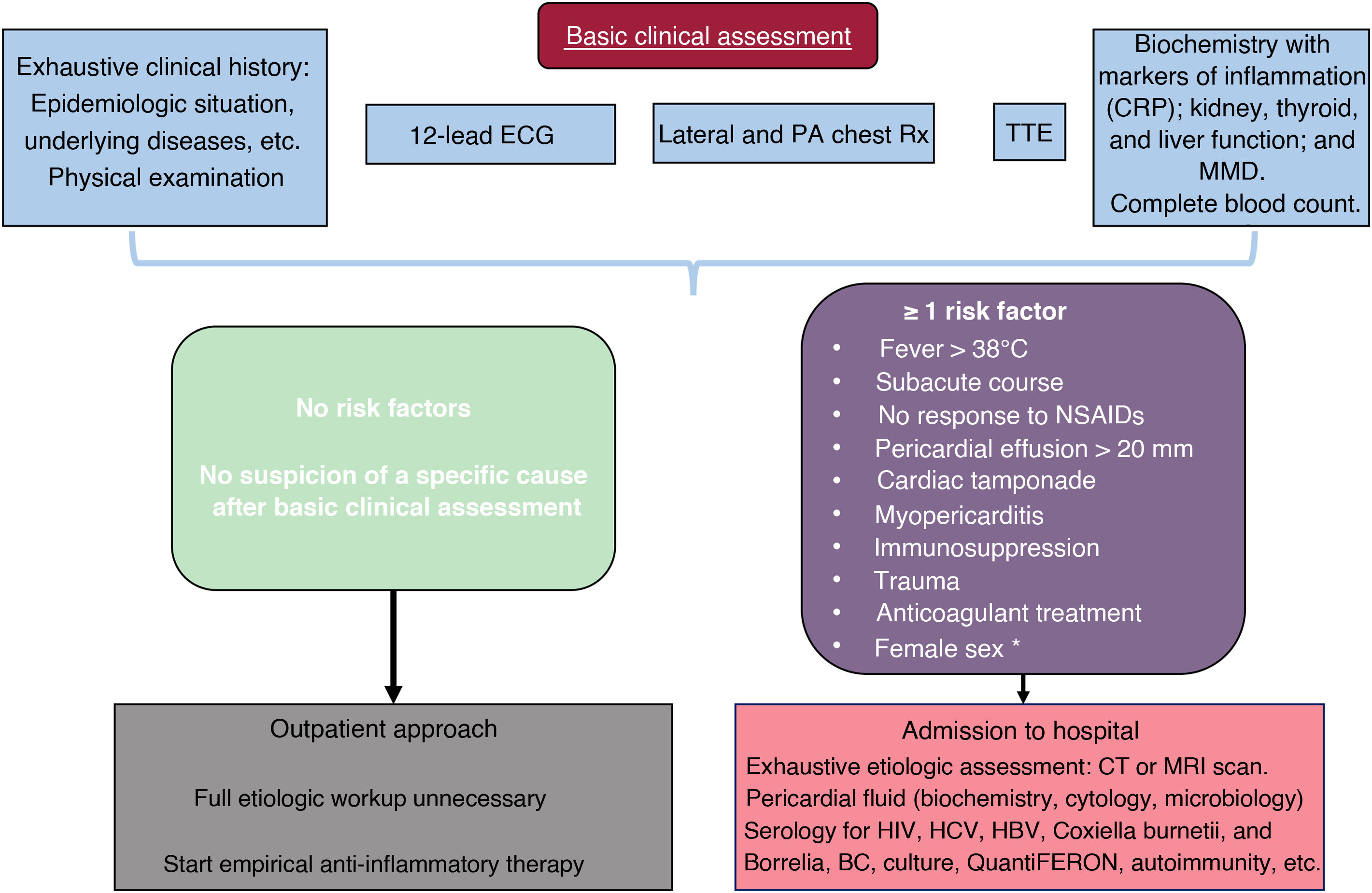
In their scientific letter published in Revista Española de Cardiología, Merón Pino et al.4 report an interesting case of recurrent acute pericarditis caused by the bacteria Coxiella burnetii. Pericarditis occurring as a manifestation of Q fever has received little attention and, until recently, was considered rare. However, in European countries with a high prevalence of this zoonosis, such as Spain, France, and the United Kingdom, a targeted search could lead to as many as 6% of cases of idiopathic pericarditis being reclassified as pericarditis associated with Q fever, which some authors consider the main cause of bacterial pericarditis in these populations, surpassing tuberculous pericarditis.5 Importantly, consistent with European clinical practice guidelines and consensus documents, the diagnosis of acute pericarditis requires at least 2 of the following signs and symptoms: pericardial chest pain (acute and constant, worsened by inspiration and supine position, and relieved by bending forward), pericardial rub on auscultation (grating, increases with inspiration, with an audible triphasic waveform in atrial systole, ventricular diastole-systole; almost 100% specificity), echocardiographic changes in the form of diffuse ST-segment elevation with the moustache sign, PR-segment depression, and new or exacerbated pericardial effusion.1–3 During this initial diagnostic workup, however, it is necessary to screen for risk factors associated with nonidiopathic causes and a greater risk of complications, such as fever >38°C, subacute course, nonresponse to anti-inflammatory agents, pericardial effusion >20 mm, cardiac tamponade, myopericarditis, immunosuppression, trauma, anticoagulant treatment, and, according to some authors, female sex.1–3 If the diagnostic criteria for pericarditis are met in the absence of the abovementioned risk factors, it is sufficient to run a basic diagnostic workup based on an appropriate medical history and physical examination with a 12-lead ECG, chest x-ray, transthoracic echocardiography, and blood workup, including biochemistry (kidney, liver, and thyroid function; C-reactive protein; markers of myocardial injury; and complete blood count). The lack of a suspected specific etiology after these studies points to low-risk viral or idiopathic disease, enabling initiation of empirical therapy with anti-inflammatory agents and colchicine. Additional tests are unnecessary, as they would not change the therapeutic approach. Nevertheless, as physicians, the clinical history and physical examination will enable a comprehensive investigation of the epidemiological contexts (contact with animals, toxins, drugs, microorganisms, consumption of unpasteurized milk, travel, trauma, and invasive procedures) and underlying conditions (immunosuppression, systemic diseases, and cancer) that rule out secondary causes.1–3If a nonidiopathic cause is suspected or if risk factors are present, the patient should be admitted for monitoring and undergo an exhaustive diagnostic workup with second-line testing to confirm or rule out an infectious, neoplastic, or systemic origin. The main tests are as follows: MRI and computed tomography of the heart and other sites; serology testing (hepatitis B and C virus, human immunodeficiency virus, C burnetii, and Borrelia species); detection of viruses and bacteria in pericardial fluid, blood, and other tissues; QuantiFERON testing; and autoantibody testing (antinuclear, extractable nuclear, and anticytoplasmic antibodies). Moreover, genetic testing can be performed for autoinflammatory diseases. However, to ensure a rational and cost-effective approach, the clinical history, together with basic tests, should point to suspected diagnoses that facilitate the selection of tests for detection of unknown underlying diseases requiring treatment of the underlying causes (figure 1).1–3 Thus, it does not seem inappropriate to perform specific diagnostic tests, such as systematic C burnetii serology in endemic regions,5 similar to screening for tuberculous pericarditis in endemic regions or in patients with human immunodeficiency virus.3

Figure 1.

Diagnostic approach to acute pericarditis. BC, blood culture; CRP, C-reactive protein; CT, computed tomography; ECG, electrocardiogram; HBV, hepatitis B virus; HCV, hepatitis C virus; HIV, human immunodeficiency virus; MMD, marker of myocardial damage; MRI, magnetic resonance imaging; NSAID, nonsteroidal anti-inflammatory drug; PA, posteroanterior; TTE, transthoracic echocardiogram; Rx, x-ray.

*Not all authors consider female sex a risk factor. Current evidence indicates that this a controversial point.

(0.44MB).

I would like to point out that recurrent pericarditis usually presents with milder symptoms and may not even fulfill the diagnostic criteria. Moreover, given that up to 10% of cases of acute pericarditis progress with recurrent pain and no pericardial inflammation, testing for C-reactive protein and imaging tests such as computed tomography and, more specifically, MRI, are essential for confirming or ruling out pericardial inflammation in affected patients.2 However, in the case of recurrent pericarditis with no risk factors, symptom-free intervals between episodes, and an exhaustive clinical workup ruling out nonidiopathic causes, it is not necessary to repeat an exhaustive search for each recurrence, except when new clinical characteristics appear.2,3

Returning to the case reported by Merón Pino et al.4, it would have been useful to know the patient's exact epidemiological situation, laboratory values, and whether there were risk factors for acute pericarditis at the initial admission to determine whether serology testing for C burnetii and other etiological tests were indicated. Furthermore, the case clearly reflects the essential role of cardiac MRI in confirming pericardial inflammation and ruling out associated myocardial damage in this presentation of recurrent pericarditis with no associated electrocardiographic or auscultatory findings.

There seems to be general agreement on the diagnostic tests used in the basic clinical assessment. However, systematic use of serology testing for specific viruses and bacteria, markers of autoimmunity, and even second-line imaging tests does not seem to be universally indicated. Therefore, our approach should be truly clinical, with appropriate value accorded to an exhaustive history and physical examination to establish suspected diagnoses. This, in turn, should guide us in selecting the studies needed to reduce the frequency of idiopathic pericarditis and diagnose the underlying causes. Such a strategy can prove essential in specific settings.

FUNDING

None.

CONFLICTS OF INTEREST

None.

References
[1]
A.A. Malik, J.W. Lloyd, N.S. Anavekar, S.A. Luis.
Acute and Complicated Inflammatory Pericarditis: A Guide to Contemporary Practice.
May Clin Proc., (2024), 99 pp. 795-811
[2]
A. Andreis, M. Imazio, M. Casula, S. Avondo, A. Brucato.
Recurrent pericarditis: an update on diagnosis and management.
Intern Emerg Med., (2021), 16 pp. 551-558
[3]
G. Habib, P. Lancellotti, M.J. Antunes, et al.
2015 ESC Guidelines for the management of infective endocarditis: The Task Force for the Management of Infective Endocarditis of the European Society of Cardiology (ESC). Endorsed by: European Association for Cardio-Thoracic Surgery (EACTS), the European Association of Nuclear Medicine (EANM).
Eur Heart J., (2015), 36 pp. 2921-2964
[4]
A.B. Merón Pino, A. Alonso Campana, E. Picazo Feu, M.A. Vallejo Ruiz, A. Vaello Paños.
Acute pericarditis due to Q fever: a rare manifestation.
[5]
P.Y. Levy, F. Gouriet, G. Habib, J.L. Bonnet, D. Raoult.
Diagnosis of Coxiella burnetii pericarditis by using a systematic prescription kit in cases of pericardial effusion: an 8-year experience.
Clin Microbiol Infect., (2009), Suppl 2 pp. 173-175
Copyright © 2024. Sociedad Española de Cardiología