
ISSN: 1885-5857 Impact factor 2024 4.9
Vol. 77. Num. 12.
Pages 1065-1066 (December 2024)

Image in cardiology
Four-dimensional intracardiac echocardiography-guided appendage occlusion

Cierre de orejuela guiado por ecocardiografía intracardiaca cuatridimensional

Karim Jamhour-ChelhXavier Millán ÁlvarezDabit Arzamendi Aizpurua
https://doi.org/10.1016/j.rec.2024.06.011

Options

Supplementary data
Imagen extra
Rev Esp Cardiol. 2024;77:1065-6

A 72-year-old man with atrial fibrillation, a high risk of embolism, and a history of severe gastrointestinal bleeding treated with the anticoagulant edoxaban was referred to our center for percutaneous left atrial appendage occlusion. We present the first national experience of performing this procedure guided by 4-dimensional intracardiac echocardiography (4D-ICE). The patient provided informed consent for the procedure and the subsequent publication of this case report.

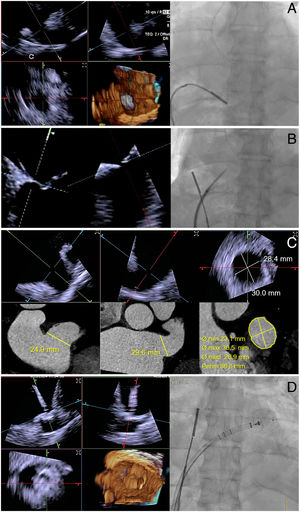
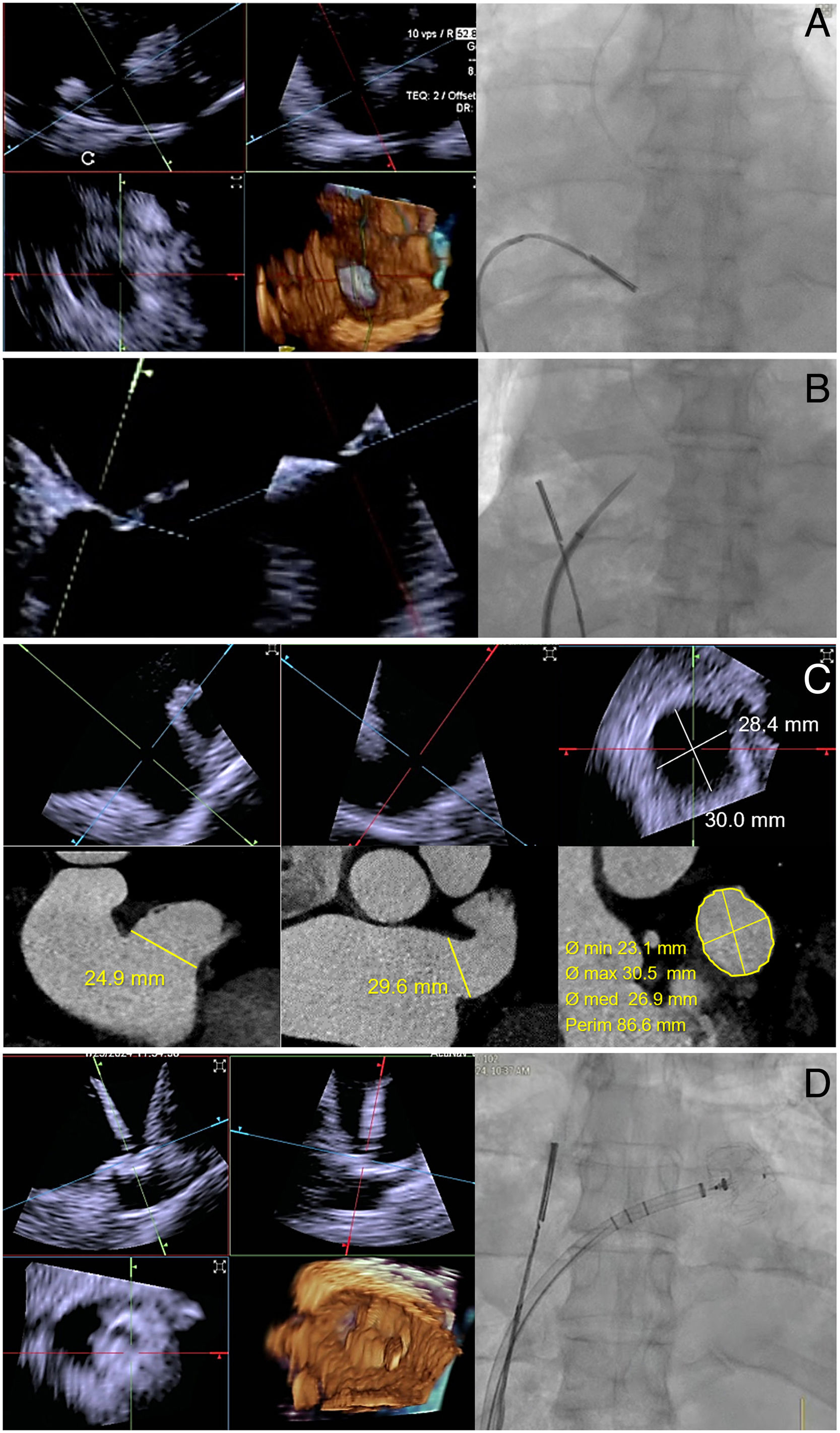
In accordance with standard practice, the procedure was planned using computed tomography, which revealed a chicken-wing morphology with an ostium measuring 26.9mm, a landing zone of 24.2mm, and no evidence of thrombosis. Ultrasound monitoring was performed using the ACUSON AcuNav Volume 4D ICE probe (Siemens Healthcare GmbH, Germany). With the probe placed in the right atrium, we were able to rule out thrombosis of the appendage (figure 1A). We then performed a transeptal puncture in the posteroinferior fossa ovalis (figure 1B) and, after dilating the interatrial septum using the delivery sheath of the WATCHMAN FLX system (Boston Scientific, USA), we advanced the 4D-ICE probe to the left atrium. The anatomy of the appendage was analyzed using multiplanar reconstruction in both the mid-atrial and supramitral positions. The ostium measured 25.8 by 27.6mm in diameter, and the correlation with the tomography findings was good (figure 1C). Finally, under continuous monitoring with the 4D-ICE device, we successfully implanted a 31-mm WATCHMAN FLX device (figure 1D) with no complications (see video 1 of the supplementary data for details of the procedure). Our first experience indicates that appendage occlusion guided by 4D-ICE is a feasible and safe alternative. However, many more case studies will be necessary to assess its full potential.

Figure 1
(0.5MB).
FUNDING

None.

ETHICAL CONSIDERATIONS

This case was reported from daily clinical practice. Therefore, the approval of the Ethics Committee of Hospital de la Santa Creu i Sant Pau was not necessary. The patient gave his informed consent for the procedure and the subsequent publication of this case report.

STATEMENT ON THE USE OF ARTIFICIAL INTELLIGENCE

No artificial intelligence was used during the preparation of this manuscript.

AUTHORS’ CONTRIBUTIONS

K. Jamhour-Chelh and X. Millán Álvarez contributed equally to the present work. K. Jamhour-Chelh collected data, drafted the text, and edited the audiovisual material. X. Millán Álvarez participated in the procedure and drafted the text and prepared the figure. D. Arzamendi Aizpurua participated in the procedure and reviewed the work.

CONFLICTS OF INTEREST

X. Millán Álvarez and D. Arzamendi Aizpurua have acted as proctors for Boston Scientific. K. Jamhour-Chelh reports no conflicts of interest with respect to the present article.

APPENDIX. SUPPLEMENTARY DATA

Supplementary data associated with this article can be found in the online version available at https://doi.org/10.1016/j.rec.2024.06.011

Both authors contributed equally to this work.