
ISSN: 1885-5857 Impact factor 2024 4.9
Vol. 78. Num. 5.
Pages 481-482 (May 2025)

Scientific letter
Coronary plaque modification and impact on the microcirculation territory after drug-coated balloon angioplasty: the PLAMI study

Modificación de placa coronaria e impacto en la microcirculación tras angioplastia con balón farmacoactivo: el estudio PLAMI

José Antonio Sorolla RomeroaAndrea Teira CalderónaJean Paul Vilchez TschischkeaJosé Luis Díez GilabHector M. Garcia-GarciacJorge Sanz Sánchezab
https://doi.org/10.1016/j.rec.2024.10.001

Options

To the Editor,

Among local treatments, percutaneous coronary intervention (PCI) with drug-eluting stents is the standard of care for patients with obstructive coronary artery disease.1 However, stent-related complications, such as stent thrombosis and in-stent restenosis, may occur.2 Drug-coated balloons (DCB) offer an alternative to drug-eluting stents, based on the concept of “leaving nothing behind”, which may help preserve vessel vasomotion and potentially reduce the risk of adverse cardiac events.3,4 Nevertheless, the wall healing processes, plaque remodeling, and the impact of DCB-PCI on the coronary microcirculation remain unknown.

The PLAMI study (NCT06080919) is an investigator-initiated, single-center, single-arm, open-label pilot study that aimed to evaluate coronary arterial response to paclitaxel DCB-PCI (Pantera Lux, BIOTRONIK AG, Switzerland). The full study design, including inclusion and exclusion criteria, has been previously described.5 Briefly, all-comer de novo lesions with no limitations regarding vessel size or lesion characteristics, were included, except for patients presenting with ST-segment elevation myocardial infarction. The patients underwent paclitaxel DCB-PCI under intravascular ultrasound (IVUS) guidance (Opticross HD 60MHz; Boston Scientific, United States) according to current guidelines.1 IVUS and adenosine-free angiographic microvascular resistance (AMR) using uFR software (AngioPlus Core, Shanghai Pulse Medical Technology, Shanghai, China) were performed before, immediately after DCB-PCI, and at 3 months of follow-up (3M-FU). All IVUS and AMR data were analyzed by an independent core lab.

The primary endpoint was the change in percentage atheroma volume (PAV) evaluated by IVUS from baseline to the 3-month follow-up (3M-FU). Secondary endpoints included: a) changes in lumen area and external elastic membrane from baseline to post-DCB-PCI and to the 3M-FU (minimum, maximum, and average), b) the percentage of remodeling types (neutral, negative, and positive), and c) changes in uFR and AMR from baseline to post-DCB-PCI and the 3M-FU.

Continuous data are presented as mean±standard deviation and were compared using analysis of variance. A P value <.05 was considered statistically significant. Analyses were performed using SAS V 18 (SAS Institute, United States).

Thirty native coronary lesions were treated with paclitaxel-coated drug-eluting balloons (DCB). The mean age of the patients was 71.1 years, 29% were women, and diabetes mellitus was present in 32%. A total of 54.8% of the patients presented with non–ST-segment elevation myocardial infarction, and the most commonly treated vessel was the left anterior descending artery (51.6%). The mean treated vessel diameter was 3.04±0.46mm, with a mean lesion length of 24.8±5mm, and 16.6% of the lesions were severely calcified. After DCB-PCI, 6 type A, 3 type B, and 2 type C dissections were identified, none of which were flow-limiting. No bailout stenting was required in any of the patients. At the 3M-FU, only 1 nonischemia-driven target lesion revascularization occurred.

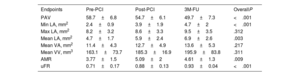
Primary and secondary endpoints are shown in table 1. A significant 9% reduction in mean PAV was observed at the 3M-FU (95% confidence interval [95%CI], 4.83-12.94; P<.001). Additionally, paclitaxel DCB-PCI resulted in a significant increase in minimum lumen area of 2.3 mm2 and mean lumen area of 1.9 mm2, without significant changes in mean vessel area or vessel volume (table 1). Positive vessel remodeling occurred in 76.5% of cases. Regarding the impact of paclitaxel DCB-PCI on microcirculation and coronary physiology, a significant increase in AMR was observed immediately after DCB-PCI, which normalized at 3M-FU. Conversely, a significant increase in uFR from baseline and post-PCI to 3M-FU was noted (table 1).

Table 1.

Intravascular ultrasound and angiographic microvascular resistance findings

Endpoints  Pre-PCI  Post-PCI  3M-FU  OverallP 
PAV  58.7±6.8  54.7±6.1  49.7±7.3  <.001 
Min LA, mm2  2.4±0.9  3.9±1.9  4.7±<.001 
Max LA, mm2  8.2±3.2  8.6±3.3  9.5±3.5  .312 
Mean LA, mm2  4.7±1.7  5.9±2.4  6.9±2.6  .003 
Mean VA, mm2  11.4±4.3  12.7±4.9  13.6±5.3  .217 
Mean VV, mm3  163.1±73.7  185.3±16.9  195.9±83.8  .311 
AMR  3.77±1.5  5.09±4.61±1.3  .009 
uFR  0.71±0.17  0.88±0.13  0.93±0.04  <.001 

AMR, adenosine-free angiographic microvascular resistance; FU, follow-up; LA, lumen area; PAV, percent atheroma volume; PCI, percutaneous coronary intervention; uFR, Murray's law-based quantitative flow ratio; VA, vessel area, VV, vessel volume. Data are expressed as mean ± standard deviation.

In conclusion, paclitaxel DCB-PCI was associated with a significant reduction in PAV at the 3M-FU. Additionally, paclitaxel DCB-PCI induced positive remodeling and late lumen enlargement, which were maintained in the mid- term, translating into a significant increase in the angio-derived index for the functional evaluation of the disease, without impacting the microcirculation. The main limitation of this study is its pilot design and limited sample size. However, based on these findings, paclitaxel DCB-PCI may not only treat coronary stenosis from a mechanical perspective but also influence the progression of atherosclerotic plaque by reducing its size. Further randomized studies are needed to evaluate the potential impact of these intracoronary imaging findings on mid- and long-term clinical outcomes in patients undergoing DCB-PCI.

FUNDING

No funding in this research project.

ETHICAL CONSIDERATIONS

This study was approved by the ethics committee of Hospital La Fe, Valencia, Spain. Eligible patients were informed about the study and signed informed consent prior to inclusion in the study. No sex/gender biases are present in the study.

STATEMENT ON THE USE OF ARTIFICIAL INTELLIGENCE

No artificial intelligence was used in this investigation.

AUTHORS’ CONTRIBUTIONS

J. Sanz Sánchez, J.A. Sorolla Romero and H. Garcia Garcia designed the study. J. Sanz Sánchez, J.A. Sorolla Romero, A. Teira Calderón, J.P. Vilchez Tschischke, J L. Díez Gil and H. Garcia Garcia contributed to the data analysis, writing and supervision of the manuscript.

CONFLICTS OF INTEREST

There are no conflicts of interest to declare.

References
[1]
F. Neumann, M. Sousa-Uva, A. Ahlsson, et al.
2018 ESC/EACTS Guidelines on myocardial revascularization.
Eur Heart J., (2019), 40 pp. 87-165
[2]
G. Stefanini, F. Alfonso, E. Barbato, et al.
Management of myocardial revascularisation failure: an expert consensus document of the EAPCI.
EuroIntervention., (2020), 16 pp. e875-e890
[3]
J. Sanz Sánchez, M. Chiarito, B. Cortese, et al.
Drug-Coated balloons vs drug-eluting stents for the treatment of small coronary artery disease: A meta-analysis of randomized trials.
Catheter Cardiovasc Interv., (2021), 98 pp. 66-75
[4]
F. Alfonso, M. Pérez-Vizcayno, A. Cárdenas, et al.
A Prospective Randomized Trial of Drug-Eluting Balloons Versus Everolimus-Eluting Stents in Patients With In-Stent Restenosis of Drug-Eluting Stents: The RIBS IV Randomized Clinical Trial.
J Am Coll Cardiol., (2015), 66 pp. 23-33
[5]
J.A. Sorolla Romero, A. Teira Calderón, Vílchez Tschischke, et al.
Plaque modification and impact on the microcirculation territory after drug-coated balloon angioplasty. The PLAMI study design.
REC Interv Cardiol., (2024), 6 pp. 83-88
Copyright © 2024. Sociedad Española de Cardiología