
Patent foramen ovale (PFO) closure is increasingly recognized as a potential treatment option to prevent recurrent stroke in older patients with cryptogenic stroke. Recently, we conducted a multicenter observational study of carefully selected patients aged ≥ 60 years with presumed PFO-associated stroke. Our findings showed that PFO closure, compared with medical therapy alone, was associated with a significantly lower risk of ischemic events, particularly in those with high-risk PFO.1 A pertinent question arises regarding the role of age in deciding whether to employ device closure in this patient cohort, given the potential differences in hidden comorbidities that can precipitate stroke in patients in their 60s compared with those in their 70s. Here, we further analyzed the relationships between age group, treatment method, and ischemic outcomes.
Details of the study cohort have been described elsewhere.1 Patients from 10 stroke centers underwent a standardized evaluation protocol, including transesophageal echocardiography and assessment by a heart-brain team to rule out other identifiable mechanisms of stroke. The outcomes of interest were recurrent ischemic stroke and a composite of ischemic stroke or transient ischemic attack (TIA). This study was approved by the institutional review board at each participating center, with a waiver for written informed consent. To account for death as a competing risk, the Fine-Gray subdistribution hazard model was used, and interaction testing was performed between age groups (range 60-69 vs ≥70 years) and treatment modalities. The clinically relevant baseline factors listed in table 1 were selected as potential risk-adjusting variables. Statistical analyses were performed using the R software version 4.3.2. A 2-sided P<.05 was considered significant.
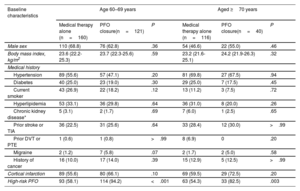
Baseline characteristics of 437 elderly patients with cryptogenic stroke and PFO
| Baseline characteristics | Age 60–69 years | Aged ≥70 years | ||||
|---|---|---|---|---|---|---|
| Medical therapy alone (n=160) | PFO closure(n=121) | P | Medical therapy alone (n=116) | PFO closure(n=40) | P | |
| Male sex | 110 (68.8) | 76 (62.8) | .36 | 54 (46.6) | 22 (55.0) | .46 |
| Body mass index, kg/m2 | 23.6 (22.2-25.3) | 23.7 (22.3-25.6) | .59 | 23.2 (21.6-25.1) | 24.2 (21.9-26.3) | .32 |
| Medical history | ||||||
| Hypertension | 89 (55.6) | 57 (47.1) | .20 | 81 (69.8) | 27 (67.5) | .94 |
| Diabetes | 40 (25.0) | 23 (19.0) | .30 | 29 (25.0) | 7 (17.5) | .45 |
| Current smoker | 43 (26.9) | 22 (18.2) | .12 | 13 (11.2) | 3 (7.5) | .72 |
| Hyperlipidemia | 53 (33.1) | 36 (29.8) | .64 | 36 (31.0) | 8 (20.0) | .26 |
| Chronic kidney disease* | 5 (3.1) | 2 (1.7) | .69 | 7 (6.0) | 1 (2.5) | .65 |
| Prior stroke or TIA | 36 (22.5) | 31 (25.6) | .64 | 33 (28.4) | 12 (30.0) | >.99 |
| Prior DVT or PTE | 1 (0.6) | 1 (0.8) | >.99 | 8 (6.9) | 0 | .20 |
| Migraine | 2 (1.2) | 7 (5.8) | .07 | 2 (1.7) | 2 (5.0) | .58 |
| History of cancer | 16 (10.0) | 17 (14.0) | .39 | 15 (12.9) | 5 (12.5) | >.99 |
| Cortical infarction | 89 (55.6) | 80 (66.1) | .10 | 69 (59.5) | 29 (72.5) | .20 |
| High-risk PFO | 93 (58.1) | 114 (94.2) | <.001 | 63 (54.3) | 33 (82.5) | .003 |
DVT, deep vein thrombosis; PFO, patent foramen ovale; PTE, pulmonary thromboembolism; TIA, transient ischemic attack.
The data are expressed as No. (%) or median [interquartile range].
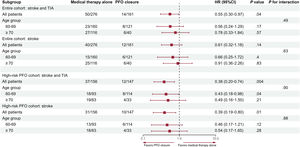
The cohort consisted of 281 patients aged between 60 and 69 years and 156 patients aged ≥ 70 years. Baseline features were similar between treatments in each age group. However, patients who underwent PFO closure had higher proportions of high-risk PFO features in both age groups (table 1). Figure 1 depicts the results of the multivariable analyses for both the entire and the high-risk PFO cohorts. In the entire cohort, the composite outcome of ischemic stroke or TIA tended to be lower with PFO closure than with medical therapy alone, with hazard ratios (HRs) of 0.56 (95% confidence interval [95%CI], 0.24-1.29) for the group aged 60 to 69 years and HR 0.78 (95%CI, 0.33-1.84) for the group aged ≥70 years, respectively (P for interaction=.49). In the high-risk PFO cohort, both the risk of the composite of ischemic stroke or TIA (HR, 0.43; 95%CI, 0.18-0.98 and HR, 0.49; 95%CI, 0.16-1.50 for each age group, respectively) and ischemic stroke alone (HR, 0.46; 95%CI, 0.17-1.21 and HR, 0.54; 95%CI, 0.17-1.65 for each age group, respectively) tended to be lower in patients with PFO closure, with similar degrees of risk reduction in both age groups. Formal interaction testing showed that the relative treatment effect of PFO closure vs medical therapy alone was consistent across age subgroups for each outcome (P for interaction=.90 and .88, respectively).
In this analysis, we found that in carefully selected older patients with a high likelihood of PFO-associated stroke, the effect direction favoring PFO closure was consistent between age groups among cohorts and endpoints, and the point estimate was closely similar for the high-risk PFO cohort. Compelling evidence suggests that PFO closure should not be systematically limited in older patients, as the burden of PFO-associated stroke could be substantial in this population.2 In a systematic review of reports including 194 patients with pulmonary embolism and trapped thrombus in PFO—a condition regarded as impending paradoxical embolism—53.5% were aged ≥60 years and 31.0% were aged ≥70 years.3 Considering the increased risk of venous thromboembolism with advancing age, it is reasonable to speculate that patients who have their first PFO-associated stroke could have a higher risk of early recurrence. This higher recurrence risk could be more pronounced in patients with high-risk PFO characterized by a large shunt flow. Notably, an autopsy study of 965 normal hearts indicated that PFO size tends to increase with age, with a mean range of 3.9 to 4.4mm in 10- to 39-year-olds, 5.3 to 5.7mm in 40- to 59-year-olds, and 5.3 to 6.5mm in 60- to 89-year-olds.4 Since high-risk PFO features have been associated with a substantial reduction in recurrent stroke risk when considered as an indication for PFO closure in younger patients, our findings in the high-risk PFO cohort support the view that advanced age alone should not determine eligibility for PFO closure.
Several limitations should be acknowledged for careful interpretation. First, because this was an observational study, it is inherently prone to bias, and the findings should be viewed as exploratory. Second, there was a lack of standardization in the duration of rhythm monitoring for atrial fibrillation detection and in antithrombotic therapy after the index stroke between the 2 groups. Third, the analysis included a small number of patients, particularly in the group aged ≥70 years. Further studies are warranted.
FUNDINGNone.
ETHICAL CONSIDERATIONSThis study was approved by the institutional review board of each participating center, with a waiver for written informed consent. The authors confirm that possible sex/gender biases have been taken into account in the preparation of this article.
STATEMENT ON THE USE OF ARTIFICIAL INTELLIGENCENo artificial intelligence was used in the preparation of this paper.
AUTHORS’ CONTRIBUTIONSS. Jung and P.H. Lee were responsible for the statistical analysis and drafting the manuscript. B.J. Sun, S.H. Ann, J.S. Woo, and J.-S. Kim were responsible for data collection and have critically reviewed the manuscript.