
Advances in the diagnosis and treatment of congenital heart disease have improved the survival of affected patients. Today, congenital heart disease is more frequently observed in adults than in children. In this setting, heart failure (HF) is a common complication and the main cause of death.1
Several factors have been associated with HF in patients with congenital heart disease, and the complexity of the underlying cardiac condition plays a key role in its onset and severity.2
The characteristics of patients with complex congenital heart disease (CCHD) are both specific and distinct. Signs and symptoms are often nonspecific and may differ from those of HF in the rest of the population due to the relatively younger age of the patients and the complex nature of their anatomical abnormalities, which include systemic right ventricle, Fontan circulation, cyanosis, and systemic-to-pulmonary collateral flow. Renal dysfunction as a progressive complication of HF is very prevalent, hampering treatment of systemic venous congestion, with a high incidence of resistance to diuretic treatment and hemodynamic instability.3
These observations, together with the absence of clinical trials and the difficulty of extrapolating findings and advances observed in the treatment of HF in the general population, explain the scant evidence on the treatment of decompensated HF in adults with CCHD.
We present a series of patients with CCHD whose refractory congestion was treated on the ward with peripheral access ultrafiltration. Patients were admitted with decompensated HF between January 2023 and April 2024 and received escalating diuretic therapy. The escalation protocol included intravenous furosemide with or without hypertonic saline and sequential additions of mineralocorticoid receptor antagonists/thiazide, acetazolamide or sodium-glucose transporter 2 inhibitors, or tolvaptan. Diuretic resistance, defined as insufficient weight loss and diuresis despite high perfusion doses of furosemide (> 120mg/d) and persistent congestive symptoms leading to admission, was managed with in-hospital ultrafiltration.
The procedure was performed using a peripherally inserted central catheter (PowerMidline, Bard Access Systems, United States) placed in the basilic vein or 2 peripheral venous lines (18 G), generally in the same arm. The device used was the Aquadex SmartFlow (Nuwellis), which has been approved by the United States Food and Drug Administration for effective fluid management in patients unresponsive to diuretics.
The anticoagulant therapy administered during the procedure was similar to that taken at baseline, maintaining treatment with vitamin K antagonists (international normalized ratio, 2-3), direct oral anticoagulants, or low-molecular-weight heparin. Among patients not taking anticoagulants, treatment was initiated with low doses of low-molecular-weight heparin adjusted to kidney function.
The effectiveness of ultrafiltration was evaluated at 2 time-points during admission: before ultrafiltration (after escalation of the diuretic regimen) and after ultrafiltration (before discharge).
The baseline parameters were similar in all patients, with a blood flow of 40mL/min and an ultrafiltration rate of 150mL/h, although adjustments were made according to the clinical situation and/or interest in attaining a greater negative fluid balance and/or in response to suction or return alarms. All diuretics were suspended during ultrafiltration to reverse diuretic resistance.
The main variables collected were clinical status at admission, diuretics during hospitalization, and response to ultrafiltration.
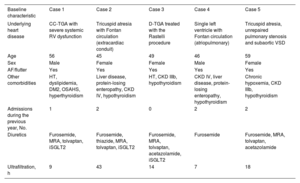
Table 1 shows the patients’ baseline characteristics. All 5 patients had CCHD, and 2 had not undergone previous repair. The mean age was 51 years, and all patients had a history of atrial arrhythmia.
Baseline characteristics
| Baseline characteristic | Case 1 | Case 2 | Case 3 | Case 4 | Case 5 |
|---|---|---|---|---|---|
| Underlying heart disease | CC-TGA with severe systemic RV dysfunction | Tricuspid atresia with Fontan circulation (extracardiac conduit) | D-TGA treated with the Rastelli procedure | Single left ventricle with Fontan circulation (atriopulmonary) | Tricuspid atresia, unrepaired pulmonary stenosis and subaortic VSD |
| Age | 56 | 45 | 49 | 46 | 59 |
| Sex | Male | Female | Female | Male | Female |
| AF/flutter | Yes | Yes | Yes | Yes | Yes |
| Other comorbidities | HT, dyslipidemia, DM2, OSAHS, hyperthyroidism | Liver disease, protein-losing enteropathy, CKD IV, hypothyroidism | HT, CKD IIIb, hypothyroidism | CKD IV, liver disease, protein-losing enteropathy, hypothyroidism | Chronic hypoxemia, CKD IIIb, hypothyroidism |
| Admissions during the previous year, No. | 1 | 2 | 0 | 2 | 2 |
| Diuretics | Furosemide, MRA, tolvaptan, iSGLT2 | Furosemide, thiazide, MRA, tolvaptan, iSGLT2 | Furosemide, MRA, tolvaptan, acetazolamide, iSGLT2 | Furosemide | Furosemide, MRA, tolvaptan, acetazolamide |
| Ultrafiltration, h | 9 | 43 | 14 | 7 | 18 |
HT, hypertension; CKD, chronic kidney disease; CC-TGA, congenitally corrected transposition of the great arteries; DM2, type 2 diabetes mellitus; D-TGA, dextro-transposition of the great arteries; iSGLT2, sodium-glucose cotransporter 2 inhibitor; MRA, mineralocorticoid receptor antagonist; OSAHS, obstructive sleep apnea/hypopnea syndrome; RV, right ventricle; VSD, ventricular septal defect.
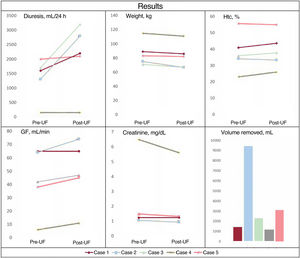
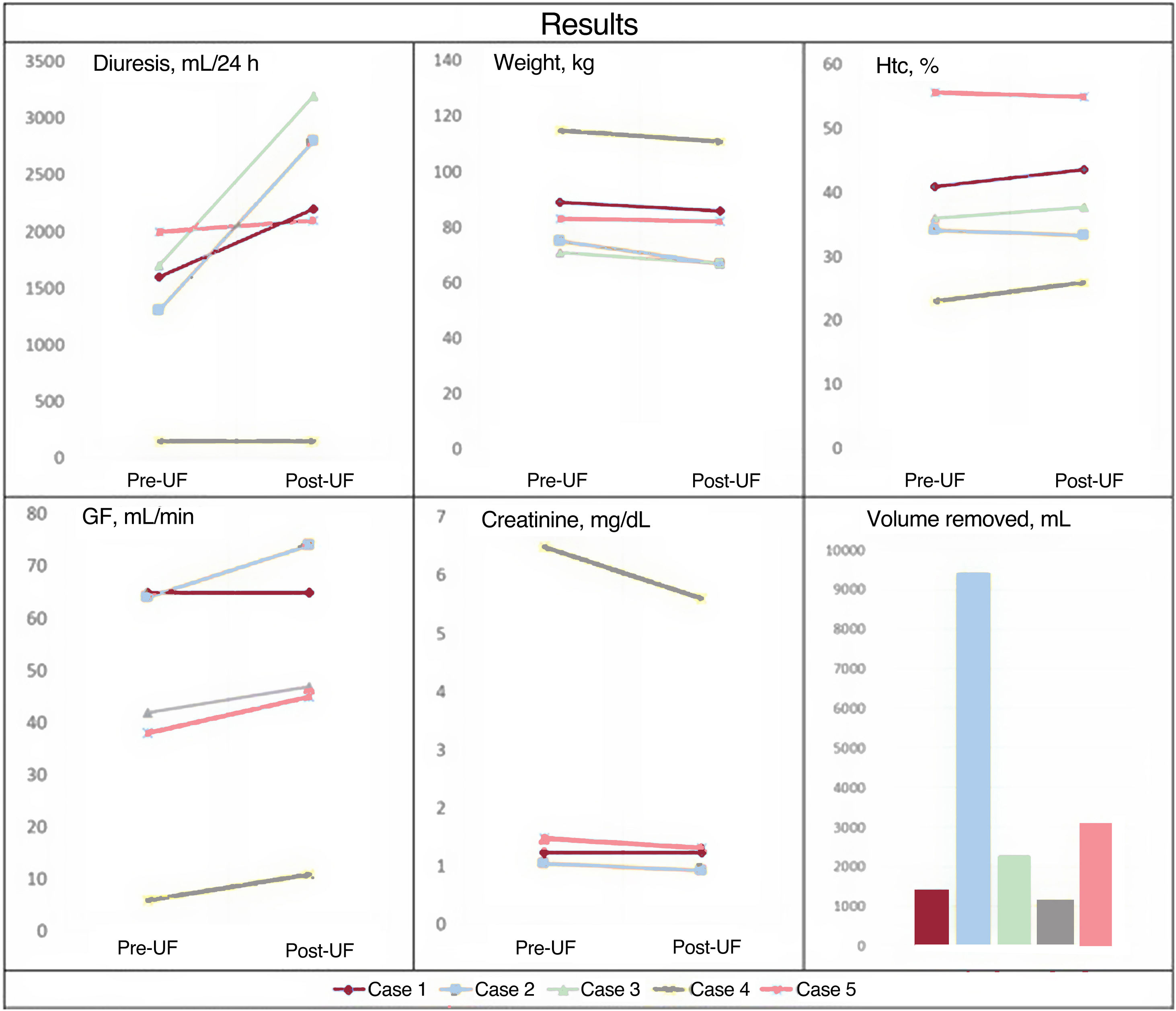
Ultrafiltration was clinically well tolerated by all patients. Kidney function, weight, and hematocrit are shown in figure 1. The poorest response was observed in patient 4, who continued to have oliguria due to stage V kidney disease present at baseline.

No significant changes in ion concentrations or hematocrit were recorded. Hemodynamic tolerance was very good, with no procedure-related adverse effects. In case 5, the ultrafiltration system coagulated before the treatment was complete, likely due to high viscosity at baseline. All 5 patients were discharged.
Patients with CCHD and a systemic right ventricle, single ventricle, or Fontan circulation, such as those analyzed in the present study, often have conditions such as cyanosis, hemodynamic lability, high viscosity, and elevated central venous pressure, which contribute to cardiorenal syndrome. These patients also have increased resistance to maximum-dose diuretic treatment.1,2
Treatment of HF in patients with CCHD is based on the general recommendations of the European Society of Cardiology. Patients with diuretic-resistant volume overload may receive inotropes or vasopressors when cardiac output is low, renal replacement therapy for end-stage kidney failure, peritoneal dialysis for long-term treatment in stable disease, or ultrafiltration.3
Peripheral access ultrafiltration enables better control of the speed and volume of fluid removal, with greater net sodium loss and reduced neurohormonal activation. It also allows diuretics to be temporarily discontinued to reduce their harmful effects on the kidneys. Consequently, it offers certain advantages over other techniques, such as peritoneal dialysis, since patients with CCHD experience greater intra-abdominal pressure due to high central venous pressure and a greater risk of peritonitis due to cyanosis and coagulation abnormalities. It is also necessary to prepare the patient and perform abdominal surgery.4,5
In the 5 cases discussed above, ultrafiltration was safe and well tolerated, with no signficant adverse effects. Body weight decreased, spontaneous diuresis increased, and kidney function improved. A patient with a right-to-left shunt developed thrombosis and system obstruction before completing the full number of hours. The use of filters in the venous extraction system when treating these patients, together with the associated erythrocytosis, can promote system obstruction.
In conclusion, peripheral access ultrafiltration in patients with CCHD, HF and diuretic-refractory congestion is effective, safe, and well-tolerated.
FUNDINGNone.
ETHICAL CONSIDERATIONSThe study was approved by the local ethics committee.
Patients gave their informed consent for testing and publication of the cases.
Potential sex and gender biases according to the SAGER guidelines were considered during the drafting of the present article.
STATEMENT ON THE USE OF ARTIFICIAL INTELLIGENCENo artificial intelligence was used during the preparation of this work.
AUTHORS’ CONTRIBUTIONSB. Guerrero Cervera: study design; data collection, analysis, and interpretation; and drafting of the manuscript. R. López-Vilella: study conception and design; interpretation of the data; and drafting and review of the manuscript. J. Rueda Soriano: study conception and design; data interpretation; and drafting and review of the manuscript. V. Donoso Trenado: study conception and design and review of the manuscript. F. Buendía Fuentes: data interpretation; drafting and review of the manuscript. L. Almenar-Bonet: study conception and design; data analysis and interpretation; drafting and review of the manuscript. All the authors approved the final version of the article and vouch for the accuracy and integrity of the work performed.
CONFLICTS OF INTERESTThe authors declare that they have no conflicts of interest.