
ISSN: 1885-5857 Impact factor 2025 4.2
Vol. 78. Num. 3.
Pages 277-279 (March 2025)

Scientific letter
David after Ross: a possible option before Bentall?

David tras Ross, ¿una opción posible antes que Bentall?

César A. Rodríguez CanedoaRamón Pérez-CaballerobCarlos A. Pardo PardobJosé F. Gutiérrez DíezaRaquel Prieto-ArevalocJuan-Miguel Gil-Jaurenab
https://doi.org/10.1016/j.rec.2024.08.010

Options

Imagen extra
Rev Esp Cardiol. 2025;78:277-9
To the Editor,

The Ross procedure is one option for the treatment of aortic stenosis in pediatric patients, young adults, and women of reproductive age. Pulmonary autograft in the aortic position is the only valve replacement conducted with living tissue and with growth capacity. Accordingly, this grafting procedure offers advantages over mechanical prostheses, such as a projected life expectancy comparable to that of the unaffected population, no need for anticoagulation, and suitability as a good alternative in young populations.1

Its postprocedural complications include autograft dilatation, valve regurgitation (60.5% vs 23.7% of patients requiring reoperation),2 or a combination of the two. Regurgitation due to lack of coaptation secondary to neoaortic root dilatation is frequent, as well as regurgitation without dilation, which usually develops at an earlier stage after the Ross procedure.2

We present the cases of 3 patients managed in our center who had dilatation and severe pulmonary autograft regurgitation and who were treated with conservative surgery involving neoaortic valve resuspension (David I procedure).3

The median age of our patients at reintervention was 29 years (23, 29, and 36 years), similar to other series.2

The 3 patients underwent a pediatric Ross procedure involving placement of a pulmonary autograft in the aortic position with full root replacement and coronary artery reimplantation, the most commonly used technique.4 The mean patient age at the first surgery was 12.7 years (9, 13, and 16 years). The main indication for surgery was clinical follow-up findings of progressive dilatation of the neoaortic root, mainly, and pulmonary autograft regurgitation (secondary to the dilatation), as well as elevated gradients in the pulmonary conduit.

Reintervention was indicated a mean of 16.7 years (14, 16, and 20 years) after the first surgery, similar to other series.5

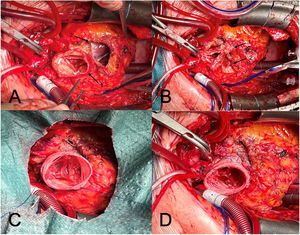
All 3 patients underwent aortic root repair using the David technique6 and the conduit from the right ventricle to the pulmonary artery was replaced after dissection of the autograft up to the previous Ross procedure suture area. In our opinion, this maneuver greatly facilitates the mobilization of the coronary ostia and is advisable regardless of their functional status. Next, we resected the dilated Valsalva sinuses, preserving the valve. For replacement of the aortic root, we used a straight 30-mm Dacron tube and performed a valve resuspension, with appropriate coaptation identified in a static saline test (figure 1A-D).

Figure 1.

A: dissection of the pulmonary autograft (1). Enucleation of the previous pulmonary conduit (2). B: suspension of the commissures. Mobilization of the coronary ostia (2). C: placement of the Dacron tube and fixation of the commissures with leaflet coaptation. D: reimplantation of the coronary ostia.

(0.65MB).

In the pulmonary position, we implanted a porcine biological pulmonary conduit (BioPulmonic) in 2 patients and a pulmonary homograft in 1 patient.

The mean cardiopulmonary bypass time was 218minutes while the cross-clamp time was 175minutes.

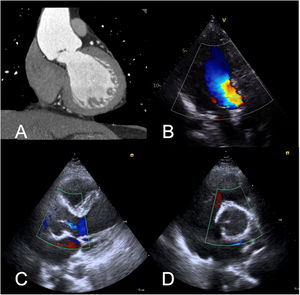
The postoperative course was incident-free, and predischarge echocardiography revealed no significant residual valve regurgitation (figure 2C-D). During follow-up, 2 patients had mild neoaortic regurgitation; all patients had low transvalvular gradients and the pulmonary conduit was functioning normally. The longest follow-up was 27 months.

Figure 2.

A: dilation of the neoaortic root in computed tomography angiography. B: preoperative ultrasound showing severe neoaortic regurgitation. C: postoperative ultrasound showing mild neoaortic regurgitation (long axis). D: postoperative ultrasound showing mild neoaortic regurgitation (short axis).

(0.26MB).

Based on our initial experience, we conclude that preservation of a dysfunctioning pulmonary autograft after the Ross procedure is feasible and safe.

Valve resuspension using the technique described by David and Feindel6 allows preservation of the native valve and avoids its replacement with a prosthesis.

By maintaining the native valve, the advantages of the Ross procedures in terms of life expectancy vs mechanical prostheses are possibly preserved.1 The results show the feasibility of a valve preservation technique that provides the benefits of native valve preservation in this young population. Conservative autograft surgery is a safe and feasible procedure. To evaluate the long-term course of the neoaortic valve after this technique, with a view to a paradigm shift, a longer follow-up and larger sample size are required.

FUNDING

No funding received.

ETHICAL CONSIDERATIONS

This scientific letter was approved by Hospital General Universitario Gregorio Marañón and the corresponding ethics committee. Informed consent was obtained and recorded. Possible sex and gender biases according to SAGER guidelines have been considered in the drafting of this article.

STATEMENT ON THE USE OF ARTIFICIAL INTELLIGENCE

No artificial intelligence was used in the preparation of this article.

AUTHORS’ CONTRIBUTIONS

C.A. Rodríguez Canedo, first author. R. Pérez-Caballero, coauthor and reviewer. C.A. Pardo Pardo, reviewer. J.F. Gutiérrez Díez, reviewer. R. Prieto-Arévalo, reviewer and advisor. J.-M. Gil-Jaurena, reviewer.

CONFLICTS OF INTEREST

None.

References
[1]
A. Mazine, R.V. Rocha, I. El-Hamamsy, et al.
Ross Procedure vs Mechanical Aortic Valve Replacement in Adults: A Systematic Review and Meta-analysis.
JAMA Cardiol., (2018), 3 pp. 978-987
[2]
F. Juthier, A. Vincentelli, C. Pinçon, et al.
Reoperation after the Ross procedure: incidence, management, and survival.
Ann Thorac Surg., (2012), 93 pp. 598-605
[3]
M. Takura, K. Eishi, T. Miura, et al.
David Operation for Insufficient Pulmonary Autograft After Ross-Konno Procedure.
Ann Thorac Surg., (2022), 113 pp. e279-e281
[4]
M. Liebrich, T. Weimar, I. Tzanavaros, D. Roser, K.N. Doll, W.B. Hemmer.
The David procedure for salvage of a failing autograft after the Ross operation.
Ann Thorac Surg., (2014), 98 pp. 2046-2052
[5]
G.B. Luciani, G. Cullurà, A. Segreto, et al.
Long-term Outcomes of the Ross Procedure for Young Patients with Aortic Valve Disease.
Semin Thorac Cardiovasc Surg., (2023), 35 pp. 115-124
[6]
T.E. David, C.M. Feindel.
An aortic valve-sparing operation for patients with aortic incompetence and aneurysm of the ascending aorta.
J Thorac Cardiovasc Surg., (1992), 103 pp. 617-622
Copyright © 2024. Sociedad Española de Cardiología