
ISSN: 1885-5857 Impact factor 2024 4.9
Vol. 77. Num. 9.
Pages 788-790 (September 2024)

Scientific letter
SINUS XL self-expanding stents for pre-stenting in pulmonary valve replacement

Stents autoexpandibles SINUS XL para implante previo en el recambio valvular pulmonar

Lisa BiancoaGerard Marti AguascabYassin BelahnechbPedro Betrián Blascoa
https://doi.org/10.1016/j.rec.2024.02.013

Options

Imagen extra
Rev Esp Cardiol. 2024;77:788-90
To the Editor,

In the last decade, percutaneous pulmonary valve implantation (PPVI) has emerged as an effective and less invasive alternative to surgery for patients with pulmonary insufficiency and/or severe pulmonary stenosis. The main valves used during this period are the Melody (Medtronic, USA) and the Edwards Sapien (XT and S3; Edwards Lifesciences, USA), both yielding good results.1-3 The practice of pre-stenting (placing a stent before valve implantation) to enhance valve durability and create a favorable landing zone for the valve has been widely reported.3 In this scenario, balloon-expandable stents have mostly been used, necessitating large caliber introducers.4

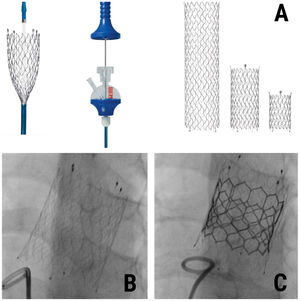
The Sinus XL (OptiMed, Germany) is a self-expanding stent composed of a bare nitinol mesh with shape memory. It features a closed-cell design, exhibiting high radial force compared with other self-expandable stents (though lower than balloon-expandable stents), and excellent flexibility. There are no covered models. The stent is placed using a delivery system with a coaxial pull-back mechanism requiring only a 10 Fr introducer. It is available in various sizes, ranging from 16-34mm in diameter and 30-100mm in length (figure 1A).5 Its main indication has been in treating the peripheral venous system, although there have been a few reports of off-label cases of aortic coarctation stenting in adults.

Figure 1.

A: from right to left, coaxial pull-back release system, 10 Fr delivery system, the closed-cell stent designs, with distal and proximal markers at the end of the stent. B: fluoroscopic image of a 30° cranial projection of the Sinus XL stent correctly deployed in the right outflow tract. C: image in the same projection of the stent after implantation of the Edwards S3 valve.

(0.22MB).

Implantation is usually monitored with right ventriculography performed with a pigtail catheter from a contralateral access. The self-expanding nature of the stent allows progressive and fully controlled release, enabling total recapture until around a 50% degree of deployment, a feature not shared by balloon-expandable stents.

We routinely assess the suitability for PPVI, which includes hemodynamic assessment of pressures, standard angiography, and measurements of the basal diameters of the right ventricular outflow tract (RVOT) and the diameters of RVOT balloon waists. Additionally, coronary angiography is conducted to rule out compression during balloon inflation of the RVOT. If it is determined that the anchoring area lacks sufficient consistency, we typically stage the procedure in 2 phases, implanting the valve in a second procedure after endothelization of the stent. We choose a Sinus diameter at least 3 to 4mm larger than the diameter of the waist, and if possible, large enough to reach the normal RVOT walls.

This is an observational and retrospective single-center study conducted at a tertiary referral hospital for pediatric and adult patients with congenital heart disease. The study was approved by the ethics committee of the center. Oral informed consent was obtained from the patients. The aim of the present work is to report our experience of PPVI using a Sinus XL. We included all consecutive patients who underwent to PPVI and in whom a Sinus XL stent was implanted between June 2017 and February 2023. Electronic health records were reviewed to collect baseline demographic characteristics, clinical history, and procedural features. Follow-up was completed in August 2023.

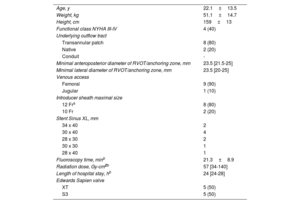
During the study period, a Sinus XL stent was implanted in a total of 10 patients (figure 1B,C, and videos 1-4 of the supplementary data). The baseline characteristics of the patients and the procedural details are outlined in table 1. The most common underlying cardiac conditions were repaired tetralogy of Fallot (60%), and the main indication for valve replacement was severe native tract regurgitation in 90%. In most cases, access was femoral using a short 12-Fr introducer sheath. No complications were recorded during the implantation. In 2 cases, both the stent and a 29-mm Edwards Sapien valve were implanted at the same time. The first was a patient with severe comorbidities who had poor hemodynamic tolerance to free pulmonary regurgitation associated with stent implantation. The second was a patient who had severe stenoregurgitation. In this patient prestenting showed a narrower and more consistent waist than expected, and consequently we decided to perform the PPVI at the same time. The median length of hospital stay was 24 [24-38] hospital; only the 2 above-mentioned patients were admitted to the intensive care unit (for <24hours). No data were compatible with significant displacement or deformation of the stent. After a median follow-up of 45 [17-58] months, all the patients showed good clinical outcomes, and no endocarditis, reinterventions, or valve dysfunctions were reported. One patient had a fracture of the distal struts at 6 months of follow-up without experiencing any clinical symptoms. There was 1 death unrelated to the procedure in a patient with oncological illness.

Table 1.

Patients and procedural characteristics

Age, y  22.1±13.5 
Weight, kg  51.1±14.7 
Height, cm  159±13 
Functional class NYHA III-IV  4 (40) 
Underlying outflow tract   
Transannular patch  8 (80) 
Native  2 (20) 
Conduit 
Minimal anteroposterior diameter of RVOT/anchoring zone, mm  23.5 [21.5-25] 
Minimal lateral diameter of RVOT/anchoring zone, mm  23.5 [20-25] 
Venous access   
Femoral  9 (90) 
Jugular  1 (10) 
Introducer sheath maximal size   
12 Fra  8 (80) 
10 Fr  2 (20) 
Stent Sinus XL, mm   
34 x 40 
30 x 40 
28 x 30 
30 x 30 
28 x 40 
Fluoroscopy time, minb  21.3±8.9 
Radiation dose, Gy-cm2b  57 [34-140] 
Length of hospital stay, hb  24 [24-28] 
Edwards Sapien valve   
XT  5 (50) 
S3  5 (50) 

NYHA, New York Heart Association; RVOT, right ventricular outflow tract.

Data are expressed as No. (%), mean±standard deviation, or median [p25-p75], depending on their distribution.

a

A short sheath of up to 12 Fr was used in some patients whose RVOT interrogated with an AGA balloon.

b

Two patients who underwent percutaneous pulmonary valve implantation in the same procedure were omitted from the calculations.

Contrary to a previously reported case of a major complication (pulmonary artery perforation) with this technique,6 in our series, the prestenting procedure with Sinus XL was safe and effective and with relatively low complexity. It has the additional advantage of using relatively small caliber introducer sheaths and the possibility of performing the implantation in a very progressive and controlled way compared with balloon-expandable stents. In our opinion, self-expandable stents seem to be a better choice than balloon-expandable stents in patients with a highly dilated RVOT and only a minimal waist during balloon sizing. The absence of covered models and its radial force make it less suitable in calcified and stenotic RVOT.

This study has several limitations, including its retrospective design, small sample size, and single-center nature, limit the generalizability of our results and these data should be interpreted with caution.

In conclusion, the use of the self-expanding prestenting technique may represent a viable alternative to balloon-expandable stents in PPVI procedures with the Edwards Sapien valve, mainly in dilated RVOT with a lack of consistent anchoring areas.

FUNDING

Y. Belahnech is supported by an unconditioned grant (Río Hortega CM22/00242).

ETHICAL CONSIDERATIONS

The study was approved by the ethics committee of the Vall d’Hebron Hospital. Following SAGE guidelines, verbal informed consent was obtained from the patients due to the distance from their home to hospital and patient comfort. The Sex and Gender Equity in Research (SAGER) guidelines have been taken in account.

STATEMENT ON THE USE OF ARTIFICIAL INTELLIGENCE

No artificial intelligence tool was used in the preparation of this article.

AUTHORS’ CONTRIBUTIONS

L. Bianco oversaw manuscript drafting and analysis of the data. Y. Belahnech, G. Marti Aguasca, and P. Betrián Blasco reviewed the manuscript and analyzed the data. G. Marti Aguasca and P. Betrián Blasco conceived and reviewed the manuscript. All the authors contributed to the final version of the manuscript.

CONFLICTS OF INTEREST

None.

REFERENCES
[1]
D. Kenny, J.F. Rhodes, G.A. Fleming, et al.
3-Year Outcomes of the Edwards SAPIEN Transcatheter Heart Valve for Conduit Failure in the Pulmonary Position From the COMPASSION Multicenter Clinical Trial.
JACC Cardiovasc Interv., (2018), 11 pp. 1920-1929
[2]
T.K. Jones, D.B. McElhinney, J.A. Vincent, et al.
Long-Term Outcomes After Melody Transcatheter Pulmonary Valve Replacement in the US Investigational Device Exemption Trial.
Circ Cardiovasc Interv., (2022), 15 pp. e010852
[3]
S. Hascoët, J.R. Bentham, L. Giugno, et al.
Outcomes of transcatheter pulmonary SAPIEN 3 valve implantation: an international registry.
Eur Heart J., (2024), 45 pp. 198-210
[4]
C. Karsenty, S. Malekzadeh-Milani, A. Fraisse, et al.
Right ventricular outflow tract prestenting with AndraStent XXL before percutaneous pulmonary valve implantation.
Arch Cardiovasc Dis., (2020), 113 pp. 113-120
[5]
A.M. Augustin, L.J. Lucius, A. Thurner, R. Kickuth.
Malignant obstruction of the inferior vena cava: clinical experience with the self-expanding Sinus-XL stent system.
Abdom Radiol (NY)., (2022), 47 pp. 3604-3614
[6]
A. Rasines-Rodríguez, C. Abelleira Pardeiro, E.J. Balbacid Domingo.
Pulmonary artery perforation due to off-label stent.
REC Interv Cardiol., (2023), 5 pp. 87-88
Copyright © 2024. Sociedad Española de Cardiología