
ISSN: 1885-5857 Impact factor 2025 4.2
Vol. 78. Num. 4.
Pages 327-337 (April 2025)

Original article
Early and late hospital readmissions after percutaneous left atrial appendage closure

Rehospitalizaciones precoces y tardías tras el cierre percutáneo de la orejuela izquierda

Kim Hoang TrinhaJorge NucheaIgnacio Cruz-GonzálezbcPaul GuedeneydDabit ArzamendieXavier FreixafLuis Nombela-FrancogVicente PeralhBerenice Caneiro-QueijaiAntonio MangierijkBlanca Trejo-VelascobLluis AsmaratsePedro Cepas-GuillénafPablo SalinasgJoan Siquier-PadillahRodrigo Estevez-LoureiroiAlessandra LaricchialGilles O’haraaGilles MontalescotdMélanie CôtéaJules MesnieraJosep Rodés-Cabauaf
https://doi.org/10.1016/j.rec.2024.07.009

Options

Supplementary data
Imagen extra
Rev Esp Cardiol. 2025;78:327-37
Abstract
Introduction and objectives

Percutaneous left atrial appendage closure (LAAC) has emerged as a nonpharmacological alternative for the prevention of thromboembolic events in patients with nonvalvular atrial fibrillation. However, there are few data on readmissions after LACC. The aim of this study was to determine the rate of early (≤ 30 days) and late (31-365 days) readmission after LAAC, and to assess the predictors and clinical impact of rehospitalization.

Methods

This multicenter study included 1419 consecutive patients who underwent LAAC. The median follow-up was 33 [17-55] months, and follow-up was complete in all but 54 (3.8%) patients. The primary endpoint was readmissions for any cause. Logistic regression and Cox regression analysis were performed to determine the predictors of readmission and its clinical impact.

Results

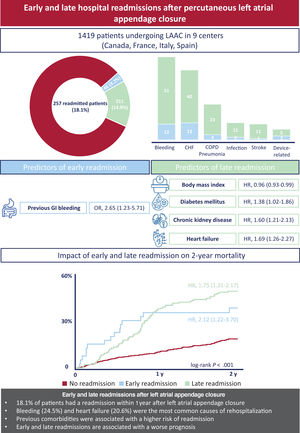
A total of 257 (18.1%) patients were readmitted within the first year after LAAC (3.2% early, 14.9% late). The most common causes of readmission were bleeding (24.5%) and heart failure (20.6%). A previous gastrointestinal bleeding event was associated with a higher risk of early readmission (OR, 2.65; 95%CI, 1.23-5.71). The factors associated with a higher risk of late readmission were a lower body mass index (HR, 0.96-95%CI, 0.93-0.99), diabetes (HR, 1.38-95%CI, 1.02-1.86), chronic kidney disease (HR, 1.60; 95%CI, 1.21-2.13), and previous heart failure (HR, 1.69; 95%CI, 1.26-2.27). Both early (HR, 2.12-95%CI, 1.22-3.70) and late (HR, 1.75; 95%CI, 1.41-2.17) readmissions were associated with a higher risk of 2-year mortality.

Conclusions

Readmissions within the first year after LAAC were common, mainly related to bleeding and heart failure events, and associated with patients’ comorbidity burden. Readmission after LAAC confered a higher risk of mortality during the first 2 years after the procedure.

Keywords

Atrial fibrillation
Left atrial appendage closure
Rehospitalization
Readmission
INTRODUCTION

Percutaneous left atrial appendage closure (LAAC) has emerged as a nonpharmacological alternative for the prevention of thromboembolic events in patients with nonvalvular atrial fibrillation who are at high risk of bleeding from long-term oral anticoagulation (OAC).1,2 Over the years, LAAC has proven to be a safe and effective procedure, demonstrating similar efficacy to OAC in preventing stroke and systemic embolism, while significantly reducing hemorrhagic stroke and nonprocedural major bleeding.3 However, patients undergoing LAAC are typically elderly and have multiple comorbidities, conferring a high risk for adverse events during follow-up.1,4 Short-term readmission rates after a hospitalization are an important metric for hospital performance and quality of care, often influencing financial penalties.5 Among Medicare beneficiaries, unplanned readmissions within 30 days after discharge occurred in up to 20% of patients, leading to an annual financial burden of $17.6 billion.6

Given the high-risk profile of LAAC recipients, identifying patients at increased risk of major complications is essential to implement appropriate preventive strategies.1 While many studies have identified risk factors for hospital readmission in patients undergoing transcatheter heart procedures, research specifically focusing on the LAAC population is limited. Moreover, no data exist on late readmission after LAAC.

The aim of this study was to determine the incidence, predictive factors, and clinical impact of hospital readmissions after LAAC.

METHODSStudy population

This was a nonprespecified retrospective analysis of prospectively collected data. Information regarding patients’ baseline characteristics and procedural details was collected prospectively. Patients underwent regular follow-ups after the procedure, and data on adverse events and readmissions were recorded in each local database.

From an initial cohort of 1653 patients who underwent percutaneous LAAC, we excluded those who died during the procedure or before discharge (9 [0.5%]) and those whose procedure was performed less than 1 year before the analysis (225 [14%]). Thus, a total of 1419 patients undergoing LAAC in 9 university hospitals in Canada and Europe from 2009 to 2022 were included in the analysis.

The indications for LAAC for each patient were assessed by a multidisciplinary team, including interventional cardiologists, electrophysiologists, and specialists in cardiac image at each center. LAAC procedures were performed using commercially approved devices. A LAAC procedure was considered successful if the patient was discharged alive, without any in-hospital embolic events, and with the device implanted in the left atrial appendage. Complete occlusion was defined as patients with no significant peri-device leak.

Baseline, procedural, and follow-up data were prospectively collected in a dedicated database. If present, contraindication for OAC was classified as relative (eg, previous gastrointestinal [GI] bleeding, anemia) or absolute (eg, history of intracranial [IC] bleeding, major/life threatening bleeding within the first 24hours following LAAC) (table 1 of the supplementary data).

Clinical follow-up was performed via clinical visits or telephone contacts at 1, 6, and 12 months after LAAC and yearly thereafter. Clinical outcomes were defined according to Valve Academic Research Consortium-2 criteria.7 The study was performed in accordance with the local ethics committee of each participating center and all patients provided written informed consent before the procedure.

Hospital readmissions

Readmission was defined as the need for hospitalization in a hospital ward or intensive care unit. Visits to the emergency room lasting less than 24hours were not counted as hospital readmissions. Readmission date, length of stay, primary and secondary reasons for hospitalization, and in-hospital death were recorded after a detailed medical records review. The time to readmission was calculated from the date of procedure discharge to the first hospital readmission day. Readmissions were classified as early (≤ 30 days) or late (31 to 365 days).

The causes of hospital readmission were classified as either cardiac or noncardiac. Cardiac causes included heart failure, acute coronary syndrome, arrhythmia, LAAC-related hospitalization (such as endocarditis, device-related thrombosis [DRT], need for reintervention, and procedure-related pericardial effusion), or planned cardiac interventions. Noncardiac causes included acute respiratory disease, bleeding, stroke, peripheral vascular events, infectious diseases, trauma, gastrointestinal events, neurological events, any noncardiac elective intervention, or other causes.

Statistical analysis

Qualitative variables were reported as percentages, and continuous data as mean±standard deviation or median [interquartile range], depending on their distribution. Continuous variables were compared using the Student t test or Mann-Whitney U rank-sum tests, as appropriate. Qualitative variables were compared using the chi-square or Fisher exact tests.

The predictors of early readmission were determined using a logistic regression analysis. Variables with P values<.20 in the univariable analysis were included in the multivariable model, and the Akaike information criterion were used to select the best predictive Cox model. Cox multivariable regression analysis was performed to identify independent predictors of late readmission and predictors of mortality. Survival curves were summarized using Kaplan-Meier estimates, and log-rank tests were used to compare groups. A 2-sided alpha level of 0.05 was used for all statistical testing. All statistical analyses were performed using SAS version 9.4 (SAS Institute, United States).

RESULTS

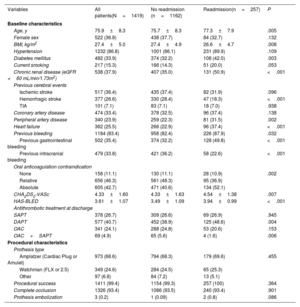
Baseline and procedural characteristics, in-hospital outcomes and discharge medications of the study population are detailed in table 1. The mean age of the study population was 75.9±8.3 years and 36.8% were female. The CHADS-Vasc and HAS-BLED scores were 4.33±1.60 and 3.61±1.07, respectively. Table 2 of the supplementary data compares baseline and procedural characteristics between patients with early and late readmission.

Table 1.

Baseline, procedural characteristics, and in-hospital outcomes, overall and according to readmission within 1 year following LAAC

Variables  All patients(N=1419)  No readmission (n=1162)  Readmission(n=257)  P 
Baseline characteristics
Age, y  75.9±8.3  75.7±8.3  77.3±7.9  .005 
Female sex  522 (36.8)  438 (37.7)  84 (32.7)  .132 
BMI, kg/m2  27.4±5.0  27.4±4.9  26.6±4.7  .008 
Hypertension  1232 (86.8)  1001 (86.1)  231 (89.9)  .109 
Diabetes mellitus  482 (33.9)  374 (32.2)  108 (42.0)  .003 
Current smoking  217 (15.3)  166 (14.3)  51 (20.0)  .053 
Chronic renal disease (eGFR <60 mL/min/1.73m2)  538 (37.9)  407 (35.0)  131 (50.9)  <.001 
Previous cerebral events
Ischemic stroke  517 (36.4)  435 (37.4)  82 (31.9)  .096 
Hemorrhagic stroke  377 (26.6)  330 (28.4)  47 (18.3)  <.001 
TIA  101 (7.1)  83 (7.1)  18 (7.0)  .938 
Coronary artery disease  474 (33.4)  378 (32.5)  96 (37.4)  .138 
Peripheral artery disease  340 (23.9)  259 (22.3)  81 (31.5)  .002 
Heart failure  362 (25.5)  266 (22.9)  96 (37.4)  <.001 
Previous bleeding  1184 (83.4)  958 (82.4)  226 (87.9)  .032 
Previous gastrointestinal bleeding  502 (35.4)  374 (32.2)  128 (49.8)  <.001 
Previous intracranial bleeding  479 (33.8)  421 (36.2)  58 (22.6)  <.001 
Oral anticoagulation contraindication
None  158 (11.1)  130 (11.1)  28 (10.9)  .002 
Relative  656 (46.3)  561 (48.3)  95 (36.9)   
Absolute  605 (42.7)  471 (40.6)  134 (52.1)   
CHA2DS2-VASc  4.33±1.60  4.33±1.63  4.54±1.38  .007 
HAS-BLED  3.61±1.07  3.49±1.09  3.94±0.99  <.001 
Antithrombotic treatment at discharge
SAPT  378 (26.7)  309 (26.6)  69 (26.9)  .945 
DAPT  577 (40.7)  452 (38.9)  125 (48.6)  .004 
OAC  341 (24.1)  288 (24.8)  53 (20.6)  .153 
OAC+SAPT  69 (4.9)  65 (5.6)  4 (1.6)  .006 
Procedural characteristics
Prothesis type
Amplatzer (Cardiac Plug or Amulet)  973 (68.6)  794 (68.3)  179 (69.6)  .455 
Watchman (FLX or 2.5)  349 (24.6)  284 (24.5)  65 (25.3)   
Other  97 (6.8)  84 (7.2)  13 (5.1)   
Procedural success  1411 (99.4)  1154 (99.3)  257 (100)  .364 
Complete occlusion  1326 (93.4)  1086 (93.5)  240 (93.4)  .901 
Prothesis embolization  3 (0.2)  1 (0.09)  2 (0.8)  .086 

BMI, body mass index; DAPT, dual antiplatelet therapy; eGFR, estimated glomerular filtration rate; OAC, oral anticoagulant; TIA, transient ischemic attack; SAPT, single antiplatelet therapy.

The data are expressed as No. (%) or mean±standard deviation.

Incidence, timing, and causes of hospital readmission

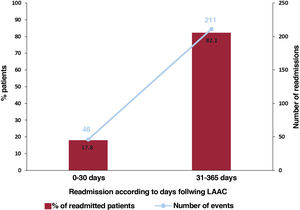
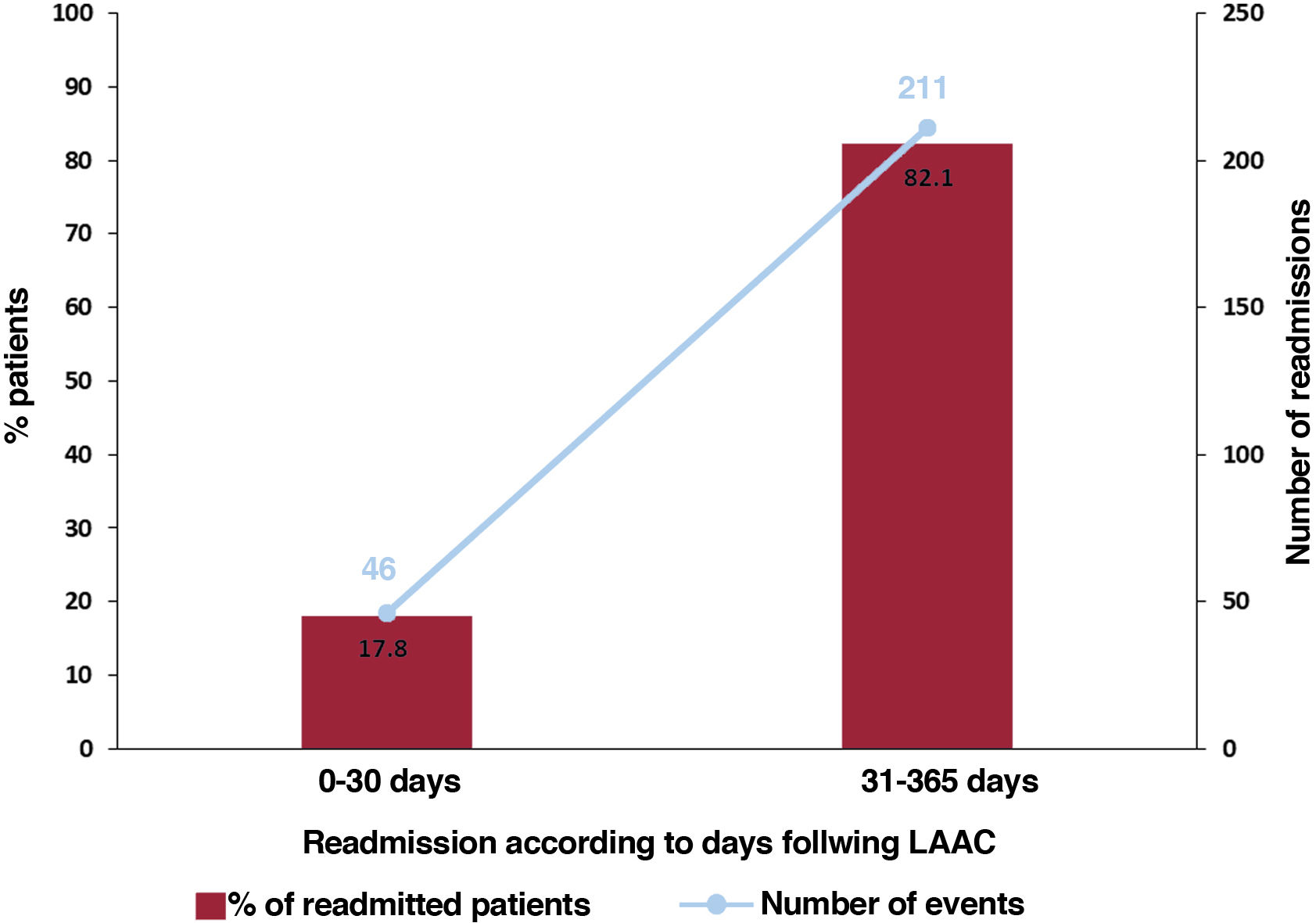
A total of 257 patients (18.1%) were readmitted within the first year after the LAAC procedure. Early readmission (≤ 30 days) occurred in 46 patients (17.9%). From 31 days to 1 year after LAAC, 211patients (82.1%) were readmitted (figure 1).

Figure 1.

Rate early and late readmissions after LAAC procedure. LAAC, left atrial appendage closure.

(0.1MB).

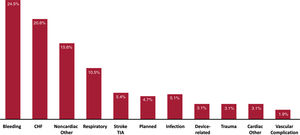
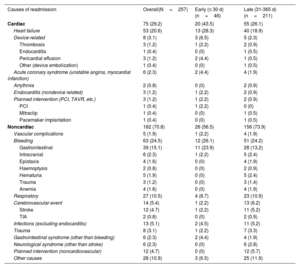
The causes of readmission are summarized in table 2 and figure 2. Noncardiac origin accounted for most rehospitalizations (182 hospitalizations [70.8%]), with bleeding events being the most common cause (24.5% of all readmissions). A total of 75 patients (29.2%) were admitted due to cardiac causes, with heart failure being the primary cardiac cause and the second most common cause overall (20.6% of total hospitalizations). The causes of admission were similar for both early and late rehospitalizations.

Table 2.

Causes of hospital readmission within 1 year after LAAC, overall and according to the timing of readmission

Causes of readmission  Overall(N=257)  Early (≤ 30 d)(n=46)  Late (31-365 d)(n=211) 
Cardiac  75 (29.2)  20 (43.5)  55 (26.1) 
Heart failure  53 (20.6)  13 (28.3)  40 (18.9) 
Device-related  8 (3.1)  3 (6.5)  5 (2.3) 
Thrombosis  3 (1.2)  1 (2.2)  2 (0.9) 
Endocarditis  1 (0.4)  0 (0)  1 (0.5) 
Pericardial effusion  3 (1.2)  2 (4.4)  1 (0.5) 
Other (device embolization)  1 (0.4)  0 (0)  1 (0.5) 
Acute coronary syndrome (unstable angina, myocardial infarction)  6 (2.3)  2 (4.4)  4 (1.9) 
Arrythmia  2 (0.8)  0 (0)  2 (0.9) 
Endocarditis (nondevice related)  3 (1.2)  1 (2.2)  2 (0.9) 
Planned intervention (PCI, TAVR, etc.)  3 (1.2)  1 (2.2)  2 (0.9) 
PCI  1 (0.4)  1 (2.2)  0 (0) 
Mitraclip  1 (0.4)  0 (0)  1 (0.5) 
Pacemaker implantation  1 (0.4)  0 (0)  1 (0.5) 
Noncardiac  182 (70.8)  26 (56.5)  156 (73.9) 
Vascular complications  5 (1.9)  1 (2.2)  4 (1.9) 
Bleeding  63 (24.5)  12 (26.1)  51 (24.2) 
Gastrointestinal  39 (15.1)  11 (23.9)  28 (13.2) 
Intracranial  6 (2.3)  1 (2.2)  5 (2.4) 
Epistaxis  4 (1.6)  0 (0)  4 (1.9) 
Haemoptysis  2 (0.8)  0 (0)  2 (0.9) 
Hematuria  5 (1.9)  0 (0)  5 (2.4) 
Trauma  3 (1.2)  0 (0)  3 (1.4) 
Anemia  4 (1.6)  0 (0)  4 (1.9) 
Respiratory  27 (10.5)  4 (8.7)  23 (10.9) 
Cerebrovascular event  14 (5.4)  1 (2.2)  13 (6.2) 
Stroke  12 (4.7)  1 (2.2)  11 (5.2) 
TIA  2 (0.8)  0 (0)  2 (0.9) 
Infections (excluding endocarditis)  13 (5.1)  2 (4.5)  11 (5.2) 
Trauma  8 (3.1)  1 (2.2)  7 (3.3) 
Gastrointestinal syndrome (other than bleeding)  6 (2.3)  2 (4.4)  4 (1.9) 
Neurological syndrome (other than stroke)  6 (2.3)  0 (0)  6 (2.8) 
Planned intervention (noncardiovascular)  12 (4.7)  0 (0)  12 (5.7) 
Other causes  28 (10.9)  3 (6.5)  25 (11.9) 

PCI, percutaneous coronary intervention; TAVR, transcatheter aortic valve replacement; TIA, transient ischemic attack.

Data are expressed as No. (%) or mean±standard deviation.

Figure 2.

Causes of readmission after LAAC. CHF, congestive heart failure; LAAC, left atrial appendage closure; TIA, transient ischemic attack.

(0.13MB).
Predictors of hospital readmission

Patients requiring readmission were older (75.7±8.3 years vs 77.3±7.9 years; P=.005) and more often had a history of diabetes mellitus (32.2% vs 42.0%, P=.003), peripheral artery disease (22.3% vs 31.5%; P=.002), and heart failure (22.9% vs 37.4%; P <.001). Consequently, patients readmitted after LAAC had a higher ischemic risk as assessed by the CHA2DS2-VASc score (4.33±1.63 vs 4.54±1.38; P=.007). In addition, those readmitted within the first year after LAAC had a lower body mass index (27.4±4.9kg/m2 vs 26.6±4.7kg/m2; P=.008) and more often had a previous history of impaired renal function (35.0% vs 50.9%; P <.001), and GI bleeding (32.2% vs 49.8%, P <.001). The HAS-BLED score was higher in patients with readmission (3.49±1.09 vs 3.94±0.99; P <.001). Procedural characteristics did not differ between groups, and the rate of procedural success was also equivalent (99.3% vs 100%; P=.364) (table 1).

The predictors for early and late readmission after LAAC are presented in table 3. In the multivariable analysis, the only factor associated with early readmission was a previous history of GI bleeding (odds ratio [OR], 2.65; 95% confidence interval [95%CI], 1.23-5.71; P=.013). A lower BMI (hazard ratio [HR], 0.96; 95%CI, 0.93-0.99; P=.008), history of diabetes mellitus (HR, 1.38; 95%CI, 1.02-1.86; P=.036), chronic kidney disease (CKD) (HR, 1.60; 95%CI, 1.21-2.13; P=.001) and previous history of heart failure (H,: 1.69; 95%CI, 1.26-2.27; P <.001) were associated with a higher risk of late readmission.

Table 3.

Independent predictors of early (≤ 30 days) and late (> 30 days) readmission after LAAC

Predictors of early readmission
Model  Univariate modelMultivariate model
Variable  OR (95%CI)  P  OR (95%CI)  P 
Age, y  1.04 (1.01-1.08)  .048     
Body mass index, kg/m2  0.96 (0.90-1.02)  .151     
Previous coronary artery disease  1.68 (0.92-3.04)  .089     
Previous gastrointestinal bleeding  3.17 (1.72-5.82)  <.001  2.65 (1.23-5.71)  .013 
Dual antiplatelet therapy at discharge  1.12 (1.17-3.85)  .014     
Predictors of late readmission
Model  Univariate modelMultivariate model
Variable  HR (95%CI)  P  HR (95%CI)  P 
Age, y  1.02 (1.01-1.04)  .027     
Female sex  0.81 (0.61-1.08)  .158     
Body mass index, kg/m2  0.96 (0.93-0.99)  .029  0.96 (0.93-0.99)  .008 
Diabetes mellitus  1.55 (1.18-2.03)  .002  1.38 (1.02-1.86)  .036 
Chronic kidney disease, eGFR (<60 mL/min/1.73 m2)  2.00 (1.52-2.64)  <.001  1.60 (1.21-2.13)  .001 
Peripheral artery disease  1.55 (1.16-2.06)  .003     
Heart failure  2.09 (1.59-2.76)  <.001  1.69 (1.26-2.27)  <.001 
Previous gastrointestinal bleeding  1.82 (1.39-2.40)  <.001     
Previous intracranial bleeding  0.58 (0.42-0.79)  <.001     

95%CI, 95% confidence interval; eGFR, estimated glomerular filtration rate; HR, hazard ratio; OR, odds ratio.

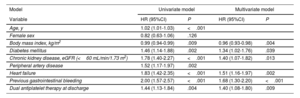
Last, a lower BMI (HR, 0.96; 95%CI, 0.93-0.98; P=.004), history of diabetes mellitus (HR, 1.34; 95%CI, 1.02-1.76; P=.039), CKD (HR, 1.40; 95%CI, 1.07-1.82; P=.013), heart failure (HR, 1.51; 95%CI, 1.16-1.97; P=.002), previous GI bleeding (HR, 1.68; 95%CI, 1.30-2.20; P <.001) and dual antiplatelet therapy (DAPT) at hospital discharge (HR, 1.40; 95%CI, 1.08-1.80; P=.009) were associated with a higher risk of any rehospitalization (early or late) (table 4). DAPT was not independently associated with a higher risk of early readmission. The median time to readmission in patients on DAPT was 116 [36-216] days, and 19% of them were readmitted due to bleeding.

Table 4.

Independent predictors of readmission overall after LAAC

Model  Univariate modelMultivariate model
Variable  HR (95%CI)  P  HR (95%CI)  P 
Age, y  1.02 (1.01-1.03)  <.001     
Female sex  0.82 (0.63-1.06)  .126     
Body mass index, kg/m2  0.99 (0.94-0.99)  .009  0.96 (0.93-0.98)  .004 
Diabetes mellitus  1.46 (1.14-1.88)  .002  1.34 (1.02-1.76)  .039 
Chronic kidney disease, eGFR (<60 mL/min/1.73 m2)  1.78 (1.40-2.27)  <.001  1.40 (1.07-1.82)  .013 
Peripheral artery disease  1.52 (1.17-1.97)  .002     
Heart failure  1.83 (1.42-2.35)  <.001  1.51 (1.16-1.97)  .002 
Previous gastrointestinal bleeding  2.00 (1.57-2.57)  <.001  1.68 (1.30-2.20)  <.001 
Dual antiplatelet therapy at discharge  1.44 (1.13-1.84)  .004  1.40 (1.08-1.80)  .009 

95%CI, 95% confidence interval; eGFR, estimated glomerular filtration rate; HR, hazard ratio.

Readmissions and mortality

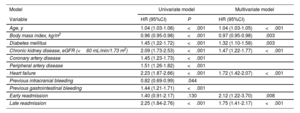
Patients were followed up for a median time of 33 months (IQR, 17 to 55 months), and follow-up was complete in all but 54 (3.8%) patients who were lost to follow-up. A total of 274 patients (19.3%) died within the first 2 years after LAAC. The predictors of mortality within the first 2 years are presented in table 5.

Table 5.

Independent predictors of all-cause death (2 years) after LAAC

Model  Univariate modelMultivariate model
Variable  HR (95%CI)  P  HR (95%CI)   
Age, y  1.04 (1.03-1.06)  <.001  1.04 (1.03-1.05)  <.001 
Body mass index, kg/m2  0.96 (0.95-0.98)  <.001  0.97 (0.95-0.98)  .003 
Diabetes mellitus  1.45 (1.22-1.72)  <.001  1.32 (1.10-1.58)  .003 
Chronic kidney disease, eGFR (<60 mL/min/1.73 m2)  2.09 (1.73-2.53)  <.001  1.47 (1.22-1.77)  <.001 
Coronary artery disease  1.45 (1.23-1.73)  <.001     
Peripheral artery disease  1.51 (1.26-1.82)  <.001     
Heart failure  2.23 (1.87-2.66)  <.001  1.72 (1.42-2.07)  <.001 
Previous intracranial bleeding  0.82 (0.69-0.99)  .044     
Previous gastrointestinal bleeding  1.44 (1.21-1.71)  <.001     
Early readmission  1.40 (0.91-2.17)  .130  2.12 (1.22-3.70)  .008 
Late readmission  2.25 (1.84-2.76)  <.001  1.75 (1.41-2.17)  <.001 

95%CI, 95% confidence interval; eGFR, estimated glomerular filtration rate; HR, hazard ratio.

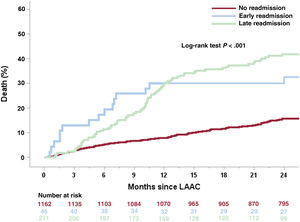
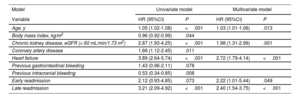
Early readmission (HR, 2.12; 95%CI, 1.22-3.70; P=.008) and late readmission (HR, 1.75; 95%CI, 1.41-2.17; P <.001) were independently associated with a higher risk of 2-year mortality from any cause. Factors associated with a higher risk of cardiovascular mortality are detailed in table 6. The Kaplan-Meier curves for mortality within the first 2 years after LAAC according to the time or the readmission status (early, late or no readmission) are shown in figure 3.

Table 6.

Independent predictors of cardiovascular death (2 years) after LAAC

Model  Univariate modelMultivariate model
Variable  HR (95%CI)  P  HR (95%CI)  P 
Age, y  1.05 (1.02-1.08)  <.001  1.03 (1.01-1.06)  .013 
Body mass index, kg/m2  0.96 (0.92-0.99)  .044     
Chronic kidney disease, eGFR (< 60 mL/min/1.73 m2)  2.87 (1.93-4.25)  <.001  1.98 (1.31-2.99)  .001 
Coronary artery disease  1.66 (1.12-2.45)  .011     
Heart failure  3.89 (2.64-5.74)  <.001  2.72 (1.79-4.14)  <.001 
Previous gastrointestinal bleeding  1.43 (0.96-2.11)  .078     
Previous intracranial bleeding  0.53 (0.34-0.85)  .008     
Early readmission  2.12 (0.93-4.85)  .073  2.22 (1.01-5.44)  .049 
Late readmission  3.21 (2.09-4.92)  <.001  2.40 (1.54-3.75)  <.001 

95%CI, 95% confidence interval; eGFR, estimated glomerular filtration rate; HR, hazard ratio.

Figure 3.

Kaplan-Meier survival curves for 2-year mortality. LAAC, left atrial appendage closure.

(0.17MB).
DISCUSSION

The main findings of this study can be summarized as follows (figure 4): a) almost one-fifth of LAAC patients had a readmission within the first year after the procedure; b) the most common causes for readmission were bleeding and heart failure events; c) lower body mass index and a history of diabetes mellitus, CKD, heart failure, GI bleeding and DAPT at discharge were associated with a higher risk of 1-year rehospitalization, but only prior GI bleeding was associated with an increased risk of early (within 30 days) readmission, and d) both early and late hospitalizations were associated with an increased risk of all-cause 2-year mortality.

Figure 4.

Central illustration. Early and late hospital readmissions after percutaneous left atrial appendage closure.

(0.85MB).
Rehospitalization rate in the context of transcatheter interventions

Several studies have evaluated short-term (30-day) readmission rates after percutaneous interventions. After transcatheter aortic valve replacement (TAVR) and percutaneous coronary intervention (PCI), these rates ranged from approximately 3% to 15%.8,9 In the LAAC population, the 30-day readmission rate after the procedure has been ∼9%, which is higher than the 3.2% rate observed in our study.10 This reduced rate of early readmissions may be partially related to the inclusion of more contemporary LAAC cases (40% of our study cohort was treated in the last 5 years), along with potential differences in post-procedural management (eg, more aggressive antithrombotic management, with a combination of anticoagulation and antiplatelet has been commonly used in US centers, compared with dual or single antiplatelet therapy in Canada and Europe).11

Information on late readmissions after LAAC is scarce. Barsoum et al.12 reported a 15% readmission rate within the first 45 days after LAAC, while Murthi et al.13 found a 90-day rehospitalization rate of 17%.12,14 In our cohort, 18.1% of patients were readmitted within the first year after LAAC. This rate is lower than that reported for other percutaneous procedures, such as TAVR (∼44%) and PCI (∼35%).8,9 The difference between the rates reported in this study versus those performed in other percutaneous interventions may be explained by several factors: LAAC is a preventive procedure, while PCI are TAVR are often performed in unstable and often more vulnerable patients, which likely leads to a higher risk of readmission. Furthermore, because LAAC is a prophylactic intervention, patients at a higher risk of reintervention might have been excluded to avoid futility.

Causes of rehospitalization

We found that noncardiac causes accounted for 70.8% of all readmissions, while cardiac causes contributed 29.2%. Bleeding events represented approximately 25% of all rehospitalizations, which agrees with previous reports in which bleeding-related readmissions ranged from 9% to 19% .13,15 The main indication for LAAC is relative or absolute contraindication for OAC, reflecting the high bleeding risk in these patients.1,4 Bleeding events remain a significant concern after LAAC, particularly during the phase of intensive pharmacotherapy after implantation to prevent DRT.16,17

In our population, 3 patients (1.2%) had a DRT leading to rehospitalization. This rate is lower than the 3.8% reported in a previous meta-analysis.18 However, our study includes only DRT patients requiring hospitalization. Therefore, we cannot directly compare our findings with the aforementioned meta-analysis, as our study did not take into account DRT patients who were managed in the outpatient clinic, which likely represents the majority of cases. In addition, 1 patient (0.4%) had a device embolization, leading to late readmission. A systematic review evaluating device embolization after LAAC reported a 0.6% rate (when centers did report the overall numbers of LAAC performed), which is similar to the rate in our study.19 Although most device embolizations occur within 24hours of the procedure, almost 20% occured more than 45 days later.19

The stroke rate in our study was 2.2% in the first 30 days and 5.2% from 31 days to 1 year, which is similar to other studies reporting rates ranging from 0.5% to 6.6% (30 days) and up to 1.2% (180 days).10,11,15 The rate of IC bleeding was 2.2% at 30 days and 2.4% at 1 year. These findings, together with previous experiences, highlight that in patients undergoing LAAC, the risk of bleeding may outweigh the risk of thrombotic or ischemic events.

To date, no definitive evidence exists regarding the optimal antithrombotic regimen following LAAC, and different regimens have been used in real-world practice.20,21 In our study, DAPT at discharge was associated with a higher risk of overall readmission. DAPT is commonly stopped 3 to 6 months after the procedure (in our population 86% underwent de-escalation of their antithrombotic therapy in the first 6 months after the procedure). This association between DAPT and readmission might be driven by the combination of early rehospitalizations and those occurring between 1 and 6 months after the procedure. While our study design prevents us from formulating a causal inference, this association would suggest that requiring a more intense antithrombotic therapy could increase the risk of readmission in patients undergoing LAAC. However, it is crucial to balance this with the risk of device thrombosis when choosing the antithrombotic regimen. Dedicated clinical trials are needed to identify the optimal antithrombotic strategy, considering both ischemic and bleeding risks, to better guide therapy after LAAC.

Several ongoing trials are currently evaluating the safety and efficacy of different antithrombotic regimens after LAAC, such as the ANDES trial (NCT03568890), the APPENDAGE trial (NCT04796714) and the ADALA study.22 Furthermore, an observational study conducted by Mesnier et al.23 supported the interruption of all antithrombotic medication once the device is endothelized and reported no association with increased risk of mortality or thromboembolic events (2 years follow-up).

Heart failure was the second most common cause of rehospitalization, accounting for approximately 20% of readmissions. This observation is consistent with those of previous studies in which heart failure was either the primary or secondary cause of rehospitalization.13,15 The left atrial appendage has been demonstrated to play a role in hemodynamic regulation through its endocrine function.24–26 Removing this structure might have a negative impact on hemodynamic regulation.26 The LAA is also known to serve as a reservoir when atrial pressure and volume increase, which contributes to atrial compliance during ventricular systole.26 Whether LAAC is associated with a poorer fluid management leading to an increased risk of heart failure should be evaluated in dedicated studies. Additionally, the volume overload during the procedure, intended to improve device sizing, might exacerbate congestive status, increasing the risk of heart failure-related readmissions in the first few days following the procedure.27 Therefore, in patients undergoing LAAC, a comprehensive assessment of congestion status—through physical exams and NT-proBNP levels—and optimization of diuretic therapy could help reduce heart failure-related rehospitalizations.

Predicting the risk and assessing the impact of readmissions after LAAC

In the present study, previous GI bleeding was associated with a higher risk of readmission within the first 30 days after the procedure, which is consistent with previous experiences.15,28 We also identified several predictors of late readmissions, including lower BMI, diabetes mellitus, CKD, and heart failure. Interestingly, Mesnier et al.29 identified similar items as predictors of early mortality after LAAC, such as older age, lower BMI, reduced estimated glomerular filtration rate, prior diabetes, and prior heart failure. It is well established that patients with a significant comorbidity burden are at higher risk of complications following catheter-based procedures, leading to an increased risk of readmission.8 In addition, both early and late readmissions were independently associated with a higher risk of mortality after 2 years.

These findings highlight that comorbidity burden is associated with poorer results after LAAC including an increased risk of rehospitalizations and a reduced survival. Thus, an accurate preprocedural evaluation is paramount to make a proper assessment of the benefit/risk ratio, avoiding unnecessary interventions in patients who may not obtain a favorable net benefit due to a high risk of adverse events or early mortality.

Study limitations

Our study has several limitations that should be acknowledged. First, although data were collected prospectively, this analysis was not prespecified, which may have introduced unmeasured confounding factors, such as patient frailty.

Second, while some patients experienced multiple readmissions after LAAC, only the first readmission for each patient was analyzed. Thus, the impact of subsequent hospitalizations could not be assessed in this study.

Third, the level of experience of the operators and participating centers was not considered, which might have influenced the procedure outcomes. Due to these limitations, the conclusions drawn from this analysis and should be validated through future dedicated studies.

CONCLUSIONS

Approximately one-fifth of LAAC recipients were rehospitalized within the year following the procedure. A higher burden of comorbidities was associated with an increased risk of readmission. Furthermore, rehospitalization after LAAC was linked to a greater risk of mortality at the 2-year follow-up. These results highlight the importance of identifying patients who are likely to benefit most from LAAC to optimize outcomes and avoid unnecessary procedures.

What is known about the topic?

  • -

    Bleeding is known to be one of the main causes of rehospitalization in transcatheter interventions.

  • -

    Patients’ comorbidity burden is associated with a higher risk of readmission.

  • -

    Rehospitalizations have a major impact on patients’ quality of life and are considered a burden on the health care system.

What does this study add?

  • -

    Almost one-fifth of patients are readmitted within the first year after LAAC and readmission is associated with a worse prognosis.

  • -

    Bleeding and heart failure are the main causes of rehospitalization after LAAC.

  • -

    A thorough evaluation of LAAC is necessary to optimize the treatment of comorbidities and reduce the risk of readmissions.

  • -

    An individualized approach to antithrombotic therapy after LAAC is warranted, given the high bleeding risk profile of this population.

FUNDING

J. Rodés-Cabau holds the Research Chair Fondation Famille Jacques Larivière for the development of structural heart disease interventions. J. Nuche was funded by the Fundación Alfonso Martin Escudero (Madrid, Spain).

ETHICAL CONSIDERATIONS

This study was conducted according to the ethics committee of each participating center, and all patients provided signed informed consent for the procedures. This study was conducted in accordance with the SAGER (Sex and Gender Equity in Research) guidelines.

STATEMENT ON THE USE OF ARTIFICIAL INTELLIGENCE

No artificial intelligence was used to prepare this article.

AUTHORS’ CONTRIBUTIONS

K.H. Trinh, J. Nuche and J. Rodés-Cabau conceived and designed the study. J. Mesnier and K.H. Trinh merged local databases from all participating centers and was responsible for ensuring data quality. M. Côté and J. Nuche performed the statistical analysis and designed the figures. K.H. Trinh and J. Nuche drafted the manuscript. All authors contributed to the design and completion of the local databases, approved the final version of the manuscript, and ensured the accuracy and integrity of the work. All authors had access to all the data in the study and were responsible for the decision to submit the manuscript for publication. J. Rodés-Cabau is the guarantor for the overall content of the study.

CONFLICTS OF INTEREST

I. Cruz-González serves as a proctor for Boston Scientific, Abbott, and Lifetech. L. Nombela-Franco is a proctor for Abbott. J. Rodés-Cabau has received institutional research grants from Boston Scientific. All other authors have reported no relevant financial relationships to disclose.

APPENDIX
SUPPLEMENTARY DATA

Supplementary data associated with this article can be found in the online version, at https://doi.org/10.1016/j.rec.2024.07.009

References
[1]
J. Mesnier, I. Cruz-González, V. Peral, et al.
Ten-Year Outcomes Following Percutaneous Left Atrial Appendage Closure in Patients With Atrial Fibrillation and Absolute or Relative Contraindications to Chronic Anticoagulation.
Circ Cardiovasc Interv., (2021), 14 pp. e010821
[2]
G. Hindricks, T. Potpara, N. Dagres, 2020 ESC Guidelines for the diagnosis and management of atrial fibrillation developed in collaboration with the European Association for Cardio-Thoracic Surgery (EACTS): The Task Force for the diagnosis and management of atrial fibrillation of the European Society of Cardiology (ESC) Developed with the special contribution of the European Heart Rhythm Association (EHRA) of the ESC, et al.
Eur Heart J., (2021), 42 pp. 373-498
[3]
M.K. Turagam, P. Osmancik, P. Neuzil, S.R. Dukkipati, V.Y. Reddy.
Left Atrial Appendage Closure Versus Oral Anticoagulants in Atrial Fibrillation: A Meta-Analysis of Randomized Trials.
J Am Coll Cardiol., (2020), 76 pp. 2795-2797
[4]
D.R. Holmes Jr., V.Y. Reddy, N.T. Gordon, et al.
Long-Term Safety and Efficacy in Continued Access Left Atrial Appendage Closure Registries.
J Am Coll Cardiol., (2019), 74 pp. 2878-2889
[5]
A.H. Malik, S. Yandrapalli, S. Zaid, et al.
Impact of Frailty on Mortality Readmissions, and Resource Utilization After TAVI.
Am J Cardiol., (2020), 127 pp. 120-127
[6]
S.F. Jencks, M.V. Williams, E.A. Coleman.
Rehospitalizations among patients in the Medicare fee-for-service program.
N Engl J Med., (2009), 360 pp. 1418-1428
[7]
A.P. Kappetein, S.J. Head, P. Généreux, et al.
Updated standardized endpoint definitions for transcatheter aortic valve implantation: the Valve Academic Research Consortium-2 consensus document.
Eur Heart J., (2012), 33 pp. 2403-2418
[8]
L. Nombela-Franco, M. del Trigo, G. Morrison-Polo, et al.
Incidence Causes, and Predictors of Early (≤30 Days) and Late Unplanned Hospital Readmissions After Transcatheter Aortic Valve Replacement.
JACC Cardiovasc Interv., (2015), 8 pp. 1748-1757
[9]
C.S. Kwok, A. Narain, H.M. Pacha, et al.
Readmissions to Hospital After Percutaneous Coronary Intervention: A Systematic Review and Meta-Analysis of Factors Associated with Readmissions.
Cardiovasc Revasc Med., (2020), 21 pp. 375-391
[10]
R. Kabra, S. Girotra, M. Vaughan Sarrazin.
Clinical Outcomes of Mortality.
Readmissions, and Ischemic Stroke Among Medicare Patients Undergoing Left Atrial Appendage Closure via Implanted Device. JAMA Netw Open., (2019), 2 pp. e1914268
[11]
M. Farwati, M. Amin, T. Isogai, et al.
Short-Term Outcomes Following Left Atrial Appendage Closure in the Very Elderly: A Population-Based Analysis.
J Am Heart Assoc., (2022), 11 pp. e024574
[12]
M. Murthi, U. Vardar, M.K. Sana, H. Shaka.
Causes and predictors of immediate and short-term readmissions following percutaneous left atrial appendage closure procedure.
J Cardiovasc Electrophysiol., (2022), 33 pp. 2213-2216
[13]
M.U. Rahman, A. Amritphale, S. Kumar, C. Trice, G.M. Awan, B.A. Omar.
Assessment of independent clinical predictors of early readmission after percutaneous endoluminal left atrial appendage closure with the Watchman device using National Readmission Database.
Int J Cardiol., (2021), 343 pp. 21-26
[14]
K. Barsoum, M. Khalil, M.M. Eid, et al.
Outcomes and Readmissions after Left Atrial Appendage Occlusion in Octogenarians: A Contemporary Analysis.
J Am Med Dir Assoc., (2023), 25
[15]
M.A. Sundhu, T.A. Waheed, U. Nasir, et al.
Thirty-Day Readmissions After Percutaneous Left Atrial Appendage Occlusion: Insights from the Nationwide Readmissions Database.
Curr Probl Cardiol., (2022), 47 pp. 101006
[16]
J. Mesnier, P. Cepas-Guillén, X. Freixa, et al.
Antithrombotic Management After Left Atrial Appendage Closure: Current Evidence and Future Perspectives.
Circ Cardiovasc Interv., (2023), 16 pp. e012812
[17]
M.J. Price, V.Y. Reddy, M. Valderrábano, et al.
Bleeding Outcomes After Left Atrial Appendage Closure Compared With Long-Term Warfarin: A Pooled, Patient-Level Analysis of the WATCHMAN Randomized Trial Experience.
JACC Cardiovasc Interv., (2015), 8 pp. 1925-1932
[18]
M. Alkhouli, T. Busu, K. Shah, M. Osman, F. Alqahtani, B. Raybuck.
Incidence and Clinical Impact of Device-Related Thrombus Following Percutaneous Left Atrial Appendage Occlusion: A Meta-Analysis.
JACC Clin Electrophysiol., (2018), 4 pp. 1629-1637
[19]
S. Eppinger, K. Piayda, R. Galea, et al.
Embolization of percutaneous left atrial appendage closure devices: Timing, management and clinical outcomes.
Cardiovasc Revasc Med., (2024), 64 pp. 7-14
[20]
J. Saw, J.E. Nielsen-Kudsk, M. Bergmann, et al.
Antithrombotic Therapy and Device-Related Thrombosis Following Endovascular Left Atrial Appendage Closure.
JACC Cardiovasc Interv., (2019), 12 pp. 1067-1076
[21]
P. Calabrò, F. Gragnano, G. Niccoli, et al.
Antithrombotic Therapy in Patients Undergoing Transcatheter Interventions for Structural Heart Disease.
Circulation., (2021), 14 pp. 1323-1343
[22]
E.J. Flores-Umanzor, P.L. Cepas-Guillen, D. Arzamendi, I. Cruz-González, A. Regueiro, X. Freixa.
Rationale and design of a randomized clinical trial to compare two antithrombotic strategies after left atrial appendage occlusion: double antiplatelet therapy vs. apixaban (ADALA study).
J Interv Card Electrophysiol., (2020), 59 pp. 471-477
[23]
J. Mesnier, I. Cruz-González, D. Arzamendi, et al.
Early Discontinuation of Antithrombotic Treatment Following Left Atrial Appendage Closure.
Am J Cardiol., (2022), 171 pp. 91-98
[24]
D.R. Holmes Jr., K. Korsholm, J. Rodés-Cabau, J. Saw, S. Berti, M.A. Alkhouli.
Left atrial appendage occlusion.
EuroIntervention., (2023), 18 pp. e1038-e1065
[25]
T. Tabata, T. Oki, H. Yamada, et al.
Role of left atrial appendage in left atrial reservoir function as evaluated by left atrial appendage clamping during cardiac surgery.
Am J Cardiol., (1998), 81 pp. 327-332
[26]
G. Murtaza, B. Yarlagadda, K. Akella, et al.
Role of the Left Atrial Appendage in Systemic Homeostasis Arrhythmogenesis, and Beyond.
Card Electrophysiol Clin., (2020), 12 pp. 21-28
[27]
R.J. Spencer, P. DeJong, P. Fahmy, et al.
Changes in Left Atrial Appendage Dimensions Following Volume Loading During Percutaneous Left Atrial Appendage Closure.
JACC Cardiovasc Interv., (2015), 8 pp. 1935-1941
[28]
R.J. Lin, A.T. Evans, A.E. Chused, M.E. Unterbrink.
Anemia in general medical inpatients prolongs length of stay and increases 30-day unplanned readmission rate.
South Med J., (2013), 106 pp. 316-320
[29]
J. Mesnier, I. Cruz-González, D. Arzamendi, et al.
Incidence and Predictors of Early Death in Patients Undergoing Percutaneous Left Atrial Appendage Closure.
JACC Clin Electrophysiol., (2022), 8 pp. 1093-1102

Both authors are considered first authors.

Copyright © 2024. Sociedad Española de Cardiología