
ISSN: 1885-5857 Impact factor 2025 4.2
Vol. 78. Num. 8.
Pages 682-691 (August 2025)

Original article
Impact of coronary artery tortuosity on outcomes following stenting with newer-generation drug-eluting stents. An analysis of the randomized BIOFLOW trials

Impacto de la tortuosidad de las arterias coronarias en los resultados del implante de stent farmacoactivo de nueva generación: un análisis de los estudios aleatorizados BIOFLOW

Nader MankeriousabRalph ToelgacdMohammad AbdelghaniefgHector M. Garcia-GarciahSerdar FarhaniAbdelhakim AllalijStephan WindeckerkThierry LefèvrelShigeru SaitomDavid E. KandzarinRon WaksmanhGert RichardtacRayyan Hemetsbergero
Rev Esp Cardiol. 2025;78:692-310.1016/j.rec.2025.02.017
Íñigo Lozano, Ramón López-Palop, José Ramón Rumoroso
https://doi.org/10.1016/j.rec.2024.12.009

Options

Supplementary data
Imagen extra
Rev Esp Cardiol. 2025;78:682-91
Abstract
Introduction and objectives

Patients undergoing percutaneous coronary intervention in vessels with moderate-to-severe tortuosity are at higher risk of adverse outcomes, but data are scarce in the era of newer-generation stents. We compared outcomes following percutaneous coronary intervention in vessels with moderate-to-severe tortuosity using a bioresorbable-polymer sirolimus-eluting stent (BP-SES) vs a durable-polymer everolimus-eluting stent (DP-EES).

Methods

A total of 2350 patients from the BIOFLOW II, IV, and V randomized trials were stratified into 2 groups based on target-vessel tortuosity: none-to-mild and moderate-to-severe. The primary endpoints included target lesion failure (TLF)—a composite of cardiac death, target-vessel myocardial infarction (TV-MI), or ischemia-driven target lesion revascularization (TLR)—and probable/definite stent thrombosis at 3 years.

Results

Patients with moderate-to-severe tortuosity (n=903) had more comorbidities than those with none-to-mild tortuosity (n=1447). Rates of TLF (P=.354), cardiac death (P=.690), TLR (P=.447), and stent thrombosis (P=.084) were similar between the 2 groups, whereas TV-MI occurred more frequently in the moderate-to-severe tortuosity group (P=.031). However, on multivariate analysis, moderate-to-severe tortuosity was not an independent predictor of TV-MI (adjusted HR, 1.06; 95% CI, 0.72-1.55; P=.772). Among patients with moderate-to-severe tortuosity, the use of BP-SES was associated with significantly lower rates of TLF compared with the DP-EES (7.8% vs 13.4%; HR, 0.57; 95% CI, 0.37-0.87; P=.009), driven by reductions in TV-MI (5.0% vs 9.2%; HR, 0.54; 95% CI, 0.32-0.90; P=.018) and TLR (2.7% vs 6.1%; HR, 0.45; 95% CI, 0.23-0.90; P=.021).

Conclusions

This pooled analysis of the randomized BIOFLOW trials demonstrates that patients with none-to-mild and moderate-to-severe tortuosity have comparable long-term adverse event rates. However, the use of BP-SES in patients with moderate-to-severe tortuosity may help mitigate potential ischemic risks.

Clinical trial registration: Clinicaltrials.gov NCT01356888, NCT01939249, NCT02389946.

Keywords

BIOFLOW
Newer-generation drug-eluting stent
Orsiro
Xience
Coronary tortuosity
Percutaneous coronary intervention
INTRODUCTION

Percutaneous coronary intervention (PCI) has rapidly evolved in the past few decades. Advances in drug-eluting stent technology have led to thinner struts, biocompatible or bioresorbable polymers, and more effective antiproliferative drugs, resulting in lower rates of both early and late adverse events.1,2 Coronary artery tortuosity is a common finding in patients undergoing PCI3–5 and is associated with advanced age, female sex, and hypertension.6–8 Target-vessel tortuosity has been reported to be associated with impaired perfusion and ischemia during stress, mediated through blood flow alterations.9,10 Moreover, it has been related to a risk of spontaneous coronary dissections.11 The pathophysiology may be explained by degradation of elastin in the coronary vessel wall.12 Additionally, coronary tortuosity is believed to predispose to the formation of atherosclerotic plaques through increased shearing forces,13 contributing to coronary calcification.14

Target-vessel tortuosity is a recognized factor that adds to PCI complexity and is associated with a high rate of acute complications, including acute vessel closure,15 as it potentially relates to device delivery problems, especially with concurrent vessel calcification. Consequently, target-vessel tortuosity has been incorporated into the ACC/AHA scheme for target lesion complexity.15,16

However, there is a scarcity of data directly comparing different stent platforms in tortuous target vessels. Most available data focus on bare-metal stents or early-generation drug-eluting stents (DES).5

Recently, the BIOFLOW-V trial17 demonstrated a lower rate of target lesion failure (TLF) and stent thrombosis with the Orsiro (Biotronik, Switzerland) bioresorbable-polymer sirolimus-eluting stent (BP-SES) compared with the Xience (Abbott, United States) durable-polymer everolimus-eluting stent (DP-EES).

In the present study, we aimed to investigate the long-term clinical outcomes of patients undergoing PCI in moderately-to-severely tortuous vessels with a BP-SES vs DP-EES in a pooled dataset of the randomized BIOFLOW II,18 BIOFLOW IV,19 and BIOFLOW V17 trials.

METHODSStudy population and design

This is a post-hoc analysis of patient-level data pooled from the multicenter, randomized BIOFLOW II, BIOFLOW IV, and BIOFLOW V trials. The study designs are available on ClinicalTrials.gov (NCT01356888, NCT01939249, and NCT02389946). The trials compared PCI with BP-SES (Orsiro, Biotronik, Switzerland) vs DP-EES (Xience, Abbott, United States) in de novo native coronary artery lesions. Patient inclusion and exclusion criteria are summarized in table 1 of the supplementary data.

The trials complied with the provisions of the Declaration of Helsinki and were approved by the institutional review board or ethics committee at each enrolling site. Eligible patients signed written informed consent. An independent clinical events committee adjudicated all clinical endpoints. An independent core laboratory (MedStar Cardiovascular Research Network, Angiographic Core Laboratory, Washington DC, United States) analyzed all angiographic data. The trials were funded by Biotronik. The authors (N. Mankerious, R. Hemetsberger) had unrestricted access to the data and are responsible for the analyses and drafting of the manuscript.

For this analysis, we divided the study population according to the presence of core lab-adjudicated tortuosity into patients with none-to-mild vs moderate-to-severe tortuosity. Vessel tortuosity was assessed angiographically in the segment proximal to the lesion and classified according to a modified scheme of the American College of Cardiology and American Heart Association.16 Moderate tortuosity was present if the lesion was distal to 2 bends, and severe tortuosity if the lesion was beyond 3 or more bends.

Study endpoints and definitions

The main endpoints were TLF at 3 years (a composite of cardiac death, target-vessel myocardial infarction [TV-MI], or ischemia-driven target lesion revascularization [TLR]) and definite or probable stent thrombosis (according to the Academic Research Consortium criteria).20

Periprocedural MI was defined according to the modified Academic Research Consortium criteria as a troponin or creatine kinase myocardial band measured within 48hours of the interventional procedure elevated >3 times above the upper normal limit of normal. Spontaneous MI was defined as any troponin or creatine kinase myocardial band elevation above the upper limit of normal with associated ischemic symptoms, new electrocardiographic abnormalities suggestive of ischemia, or new development of imaging evidence of infarction. Ischemia-driven revascularization was defined as any repeat revascularization of the target lesion or vessel due to either ischemic symptoms or abnormal coronary physiological study and ≥ 50% coronary stenosis on quantitative angiography, or any revascularization of a ≥ 70% diameter stenosis. Cardiac death was defined as any death due to any proximate cardiac cause, unwitnessed death, or death of unknown cause. Renal disease was defined as an estimated glomerular filtration rate <60mL/min/1.73 m2.

Statistical methods

Patient-level data were combined into a single dataset. Continuous variables are summarized as mean±standard deviation or as medians with lower and upper quartiles and were compared using the 2-sided t-test or the nonparametric Wilcoxon rank-sum test. Categorical variables are summarized as frequencies and percentages and were compared using the chi-square or Fisher exact test. Clinical endpoints were compared using time-to-event Kaplan-Meier estimates and Cox regression, with results expressed as hazard ratios (HR) and 95% confidence intervals (95%CI). A P value of less than .05 was established as the level of statistical significance. Multivariate Cox regression analysis was performed and covariates with P.01 in univariate analysis were included, as well as the moderate-to-severe tortuosity variate, given its clinical relevance. All statistical analyses were performed using SAS, version 9.4 (SAS Institute, United States).

RESULTS

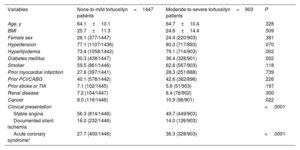
Out of 2360 patients, 10 had no core laboratory data and were excluded from this analysis; 1447 (61.6%) underwent PCI in none-to-mild tortuous vessels and 903 (38.4%) had PCI in moderate-to-severe tortuous vessels. The 3-year follow-up was complete in 94.9% of patients with none-to-mild tortuosity and in 91.9% of patients with moderate-to-severe tortuosity. Patients with moderate-to-severe tortuosity had a higher prevalence of hyperlipidemia and diabetes mellitus and more frequently presented with acute coronary syndrome compared with patients with none-to-mild tortuosity. Baseline clinical characteristics are shown in table 1. Lesions in moderate-to-severe tortuosity were more often type B2/C, severely calcified, and bifurcation lesions, and required more pre- and postdilatation (table 2). Patients with moderate-to-severe tortuosity more often received a smaller diameter stent (≤3.0mm).

Table 1.

Clinical characteristics at baseline

Variables  None-to-mild tortuosityn=1447 patients  Moderate-to-severe tortuosityn=903 patients  P 
Age, y  64.1±10.1  64.7±10.4  .328 
BMI  25.7±11.3  24.6±14.4  .509 
Female sex  26.1 (377/1447)  24.4 (220/903)  .381 
Hypertension  77.1 (1107/1436)  80.3 (717/893)  .070 
Hyperlipidemia  73.4 (1058/1442)  79.1 (714/903)  .002 
Diabetes mellitus  30.3 (438/1447)  36.4 (328/901)  .002 
Smoker  59.5 (861/1446)  62.8 (567/903)  .118 
Prior myocardial infarction  27.6 (397/1441)  28.3 (251/888)  .739 
Prior PCI/CABG  40.1 (578/1442)  42.6 (382/896)  .226 
Prior stroke or TIA  7.1 (102/1445)  5.6 (51/903)  .197 
Renal disease  7.2 (104/1447)  8.4 (76/902)  .300 
Cancer  8.0 (116/1446)  10.9 (98/901)  .022 
Clinical presentation      <.0001 
Stable angina  56.3 (814/1446)  49.7 (449/903)   
Documented silent ischemia  16.0 (232/1446)  14.0 (126/903)   
Acute coronary syndrome*  27.7 (400/1446)  36.3 (328/903)  <.0001 

BMI, body mass index; CABG, coronary artery bypass graft; PCI, percutaneous coronary intervention; TIA, transient ischemic attack.

Data are expressed as mean±standard deviation or percent (n/N).

*

NSTEMI and unstable angina

Table 2.

Lesion characteristics and procedural parameters (core lab)

  None-to-mild tortuosityn=1755 lesions  Moderate-to-severe tortuosityn=1015 lesions  P 
Variables       
Lesions per patient*  1.1±0.3  1.3±0.5  <.0001 
Multivessel treatment*  10.3 (149/1441)  15.5 (138/893)  <.0001 
Complex lesion (B2/C)  36.8 (638/1734)  89.3 (906/1014)  <.0001 
Bifurcation lesion  8.7 (153/1755)  15.4 (156/1015)  <.0001 
Thrombus  0.9 (16/1755)  1.2 (12/1015)  .555 
Vessel tortuosity      <.0001 
None/mild  100 (1755/1755)  0 (0/1015)   
Moderate  0 (0/1755)  58.2 (591/1015)   
Severe  0 (0/1755)  41.8 (424/1015)   
Calcification      <.0001 
None/mild  89.0 (1562/1755)  72.3 (734/1015)   
Moderate  8.4 (148/1755)  21.1 (214/1015)   
Severe  2.6 (45/1755)  6.6 (67/1015)   
Lesion length, mm  13.6±6.7  13.1±7.6  <.0001 
Long lesion (> 20 mm)  16.2 (283/1742)  15.4 (156/1015)  .553 
RVD, mm  2.73±0.52  2.59±0.55  <.0001 
RVD ≤ 2.75 mm  56.0 (982/1755)  65.2 (662/1015)  <.0001 
Procedural characteristics       
Stent*      .193 
BP-SES  67.4 (976/1447)  64.8 (585/903)   
DP-EES  32.6 (471/1447)  35.2 (318/903)   
No. stents per patient*  1.3±0.5  1.5±0.8  <.0001 
Max. stent impl. pressure atm  14.1±3.0  14.1±2.9  .020 
Stent diameter ≤ 3.0 mm  72.2 (1257/1740)  79.4 (796/1003)  <.0001 
Stent length, mm  20.1±6.4  22.0±7.7  .002 
Total stent length, mm*  23.6±12.2  28.9±17.0  <.0001 
Predilatation  83.8 (1441/1719)  97.5 (989/1014)  <.0001 
Postdilatation  46.8 (764/1632)  54.5 (525/963)  <.0001 
Diam. stenosis at baseline  62.43±14.55  57.39±14.00  <.0001 
Diam. stenosis postprocedure  6.31±8.06  9.21±8.77  <.0001 

BP-SES, bioresorbable-polymer sirolimus-eluting stent; diam, diameter; DP-EES, durable-polymer everolimus-eluting stent; impl., implantation; max., maximum; RVD, reference vessel diameter.

Data are expressed as mean±standard deviation or percent (n/N).

*

Patient level.

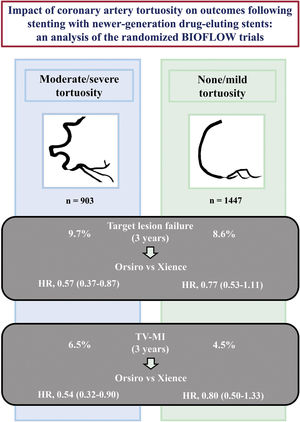
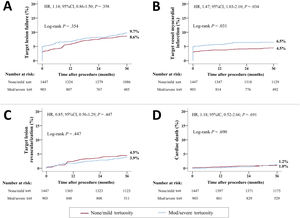
Clinical outcomes after 3 years are presented in figure 1 and figure 2 and in table 2 of the supplementary data. The TLF rate after 3 years was not significantly different between patients with none-to-mild and moderate-to-severe tortuosity (8.6% vs 9.7%; log-rank P=.354; HR, 1.139; 95%CI, 0.86-1.50; P=.358). Additionally, the of cardiac death (1.0% vs 1.2%; log-rank P=.690; HR, 1.18; 95%CI, 0.52-2.66; P=.691) and TLR (4.5% vs 3.9%; log-rank P=.447; HR, 0.85; 95%CI, 0.56-1.29; P=.447) did not significantly differ between patients with none-to-mild vs moderate-to-severe tortuosity. TV-MI occurred more frequently after PCI in moderate-to-severe tortuous vessels (4.5% vs 6.5%; log-rank P=.031; HR, 1.47; 95%CI, 1.03-2.10; P=.034). However, after adjustment for potential confounders, moderate-to-severe tortuosity was not significantly associated with TV-MI (adjusted HR 1.06; 95%CI, 0.72-1.55; P=.772) (table 3 of the supplementary data).

Figure 1.

Central Illustration. Clinical outcomes after 3 years in patients with lesions located in none-to-mild and moderate-to-severe tortuous vessels receiving PCI with an Orsiro or Xience stent. HR, hazard ratio.

(0.41MB).
Figure 2.

Clinical outcomes after 3 years in patients receiving PCI in none-to-mild and moderate-to-severe vessel tortuosity (tort). Kaplan-Meier estimates for target lesion failure (A) and its components: target-vessel myocardial infarction (B), clinically indicated target lesion revascularization (C), and cardiac death (D). 95%CI, 95% confidence interval; HR, hazard ratio.

(0.41MB).

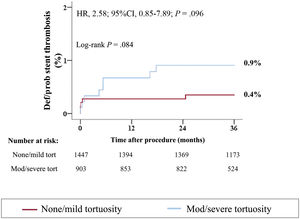
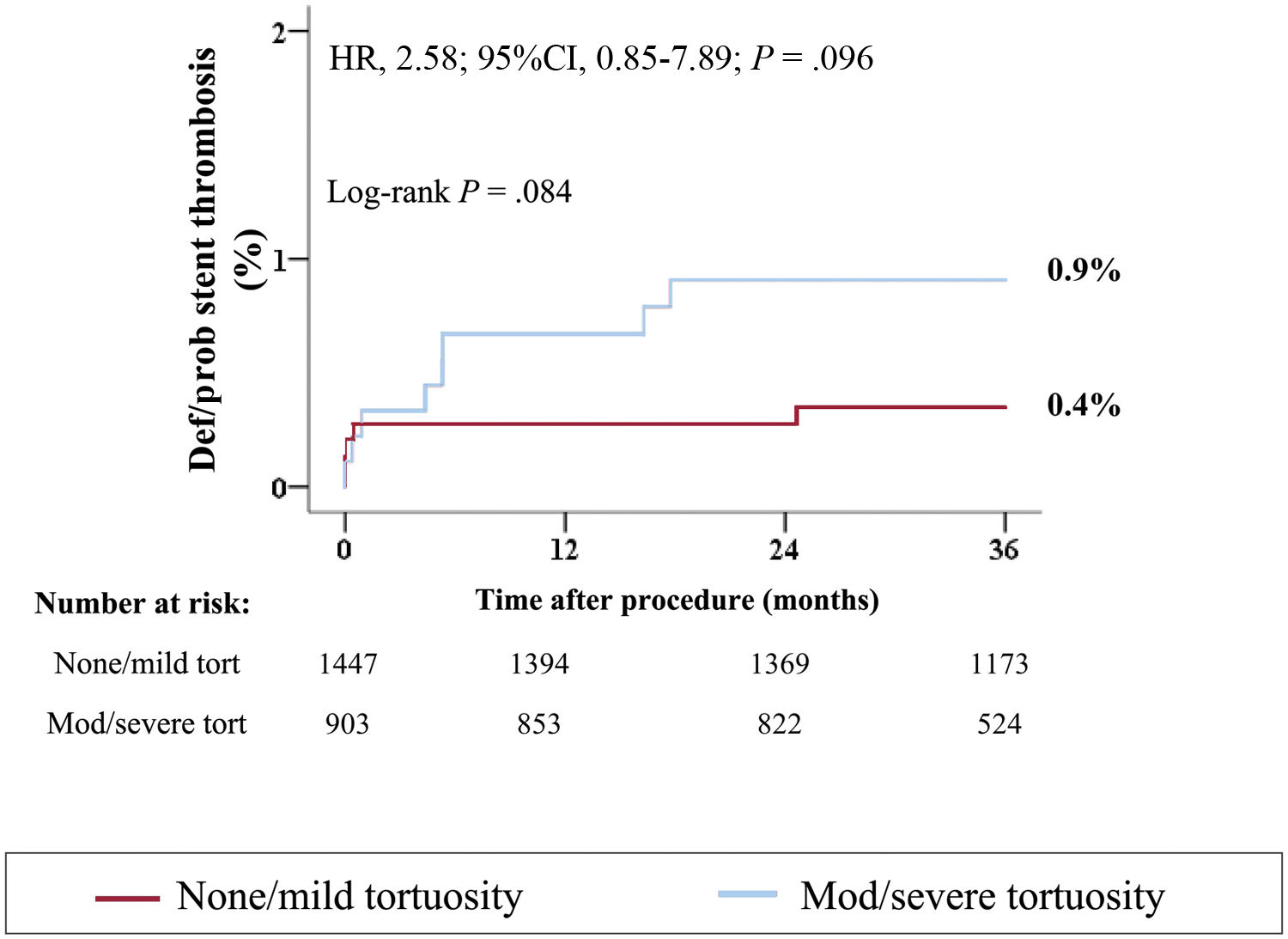
More probable-definite stent thrombosis was observed in patients with moderate-to-severe tortuosity compared with those with none-to-mild tortuosity, but this difference did not reach statistical significance (0.4% vs 0.9%; log-rank P=.084; HR, 2.58; 95%CI, 0.85-7.89; P=.096) (figure 3).

Figure 3.

Kaplan-Meier estimates for definite (def) or probable (prob) stent thrombosis after 3 years in patients receiving PCI in none-to-mild and moderate (mod)-to-severe vessel tortuosity (tort). 95%CI, 95% confidence interval; HR, hazard ratio.

(0.09MB).

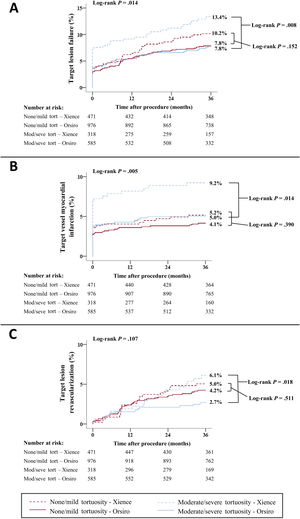
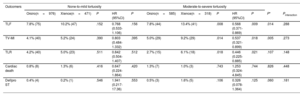
In patients with moderate-to-severe tortuosity, TLF rates were lower with BP-SES than with DP-EES (7.8% vs 13.4%; HR, 0.57; 95%CI, 0.37-0.87; P=.009), driven by lower rates of TV-MI (5.0% vs 9.2%; HR, 0.54; 95%CI, 0.32-0.90; P=.018), and TLR (2.7% vs 6.1%; HR, 0.45; 95%CI, 0.23-0.89; P=.021). On the other hand, the rates of TLF, TV-MI, and TLR were not significantly different between BP-SES and DP-EES in patients with none-to-mild tortuosity (figure 4 and table 3). Cardiac death rates were comparable between BP-SES and DP-EES in both the none-to-mild tortuosity group (0.8% vs 1.3%; HR, 0.65; 95%CI, 0.22-1.86; P=.420) and the moderate-to-severe tortuosity group (1.3% vs 1.0%; HR, 1.25; 95%CI, 0.32-4.85; P=.744). Similarly, rates of probable-definite stent thrombosis did not differ significantly between BP-SES and DP-EES in the none-to-mild tortuosity group (0.4% vs 0.2%; HR, 1.94; 95%CI, 0.22-17.36; P=.553) or the moderate-to-severe tortuosity group (0.5% vs 1.6%; HR, 0.33; 95%CI, 0.08-1.36; P=.125) (table 3).

Figure 4.

Clinical outcomes after 3 years in patients receiving PCI in none-to-mild and moderate-to-severe vessel tortuosity with bioresorbable-polymer sirolimus-eluting stents or durable-polymer everolimus-eluting stents. Kaplan-Meier estimates for target lesion failure (A), target-vessel myocardial infarction (B), and clinically indicated target lesion revascularization (C). 95%CI, 95% confidence interval; mod, moderate; seve, severe; tort, tortuosity.

(0.72MB).
Table 3.

Three-year clinical outcomes in patients with none-to-mild vs moderate-to-severe tortuosity treated with bioresorbable-polymer sirolimus-eluting stent vs durable-polymer everolimus-eluting stent

Outcomers  None-to-mild tortuosityModerate-to-severe tortuosity   
  Orsiro(n=976)  Xience(n=471)  P  HR (95%CI)  P  Orsiro(n=585)  Xience(n=318)  P  HR (95%CI)  P  P*  Pinteraction 
TLF  7.8% (75)  10.2% (47)  .152  0.768 (0.533-1.106)  .156  7.8% (44)  13.4% (41)  .008  0.568 (0.371-0.869)  .009  .014  .288 
TV-MI  4.1% (40)  5.2% (24)  .390  0.803 (0.484-1.332)  .395  5.0% (29)  9.2% (29)  .014  0.537 (0.321-0.899)  .018  .005  .273 
TLR  4.2% (40)  5.0% (23)  .511  0.842 (0.504-1.407)  .512  2.7% (15)  6.1% (18)  .018  0.446 (0.225-0.885)  .021  .107  .148 
Cardiac death  0.8% (8)  1.3% (6)  .416  0.647 (0.224-1.864)  .420  1.3% (7)  1.0% (3)  .743  1.253 (0.324-4.845)  .744  .826  .448 
Def/pro ST  0.4% (4)  0.2% (1)  .546  1.941 (0.217-17.36)  .553  0.5% (3)  1.6% (5)  .106  0.326 (0.078-1.364)  .125  .060  .181 

95%CI, 95% confidence interval; Def/pro ST, definite and probable stent thrombosis; HR, hazard ratio; TLF, target lesion failure; TLR, ischemia-driven target lesion revascularization; TV-MI, target-vessel myocardial infarction.

*

Log rank over all 4 groups.

DISCUSSION

In this patient-level pooled analysis of the randomized BIOFLOW trials, we found that: a) in the entire study population, clinical outcomes were not significantly different between patients with moderate-to-severe tortuosity and those with none-to-mild tortuosity; b) the implantation of BP-SES in lesions located in moderate-to-severe tortuous vessels led to significantly lower rates of TLF, driven by lower rates of TV-MI and TLR compared with the use of DP-EES; c) clinical outcomes were comparable when BP-SES or DP-EES was used in vessels with none-to-mild tortuosity.

Coronary artery tortuosity is a common finding during coronary angiography.4 PCI of lesions located in tortuous vessels demands significant effort due to potential challenges. The coronary wire may trigger an accordion effect, resulting in diminished coronary perfusion and thus causing procedural angina or even hemodynamic compromise. Additionally, navigating balloons and stents through tortuous coronaries can be difficult, often requiring the use of buddy wires or guide extensions, which raises the likelihood of procedural complications. As a result, performing PCI in a tortuous target vessel is associated with a heightened risk of acute procedural complications, including coronary dissection and potential stent loss.15 In a recent analysis investigating a high-risk population of patients receiving rotational atherectomy, severe tortuosity emerged as an independent predictor of in-hospital adverse outcomes.21 In the same vein, vessel tortuosity was related to lower revascularization success rates in patients with a chronic total occlusion.22

In our analysis, although patients in the moderate-to-severe tortuosity cohort had worse baseline clinical characteristics and more complex lesion anatomies, both cohorts showed comparable clinical outcomes after treatment with 2 modern DES, after accounting for potential confounders. An explanation for these findings is that the expected worse outcomes in the moderate-to-severe tortuosity cohort were mitigated by the better performance of the BP-SES, which was used in 64.8% of patients in this cohort. Our data showed that the use of BP-SES in patients with moderate-to-severe tortuosity led to lower rates of TLF, TV-MI, and TLR compared with the use of DP-EES. On the other hand, the favorable outcomes with BP-SES were not obvious in the nonmild tortuosity arm.

It is important to note that lesion complexity significantly influences the capacity of a stent-vs-stent trial to identify differences between the devices under study.23

The favorable outcomes of the BP-SES could be explained by the Orsiro BP-SES stent structure iterations with ultra-thin struts (60μm) for platforms ≤ 3.0 mm and thin struts (80 μm) for platforms >3.0mm. On the other hand, the Xience DP-EES possess thin struts measuring 81μm across all stent platforms. DES equipped with thinner struts may demonstrate enhanced longitudinal flexibility and improved trackability compared with those with thicker struts, resulting in superior procedural outcomes.24 Additionally, thinner struts were reported to cause less side branch compromise, which might result in lower rates of periprocedural MI25 with BP-SES.

DES platforms with thicker struts have been associated with increased platelet aggregation and inflammatory cell response, negatively affecting endothelial recovery and strut coverage compared with thinner struts.26 In our analysis, this could be reflected by patients with BP-SES showing numerically lower ST rates compared with those with DP-EES. However, these differences did not reach statistical significance, likely due to the low event rates in both study groups.

The favorable outcomes of BP-SES compared with DP-EES were observed in the general population of the BIOFLOW trials, as well as in the randomized BIOSTEMI trial with lower TLF rates at 5 years in a STEMI population treated with BP-SES compared with DP-EES.27 In the same vein, the BP-SES showed lower TLF rates after rotational atherectomy when the ≤3.0mm stent platform was used.28

In the current analysis, patients with moderate-to-severe tortuosity had more comorbidities with more complex lesions compared with those with none-to-mild tortuosity. Consequently, patients with moderate-to-severe tortuosity were considered both clinically and angiographically susceptible to ischemic adverse events and ongoing progression of the atherosclerotic disease over time. However, in the entire study population, moderate-to-severe tortuosity per se was not associated with adverse cardiac events compared with the none-to-mild tortuosity cohort, most likely due to pooling of 2 different stent platforms with dissimilar performance. In other words, two-thirds of the study population received a BP-SES, which seems to have mitigated the drawbacks of DP-EES in the whole population and could have potentially led to equalization of the ischemic risk between the none-to-mild and moderate-to-severe tortuosity cohorts.

Limitations

This analysis has several limitations. First, this is a post-hoc analysis of a patient-level pooled dataset from randomized trials comparing 2 different stent platforms. Since this analysis was not prespecified, patients were not randomized according to the presence of moderate-to-severe tortuosity. Therefore, the findings of the study should be considered as hypothesis-generating rather than definitive. Second, this study was not powered for grouping patients based on the severity of tortuosity when comparing the outcomes of patients treated with BP-SES or DP-EES. Third, no data regarding intravascular imaging were collected during the course of this study. Given the benefits of intravascular imaging in PCI, particularly in complex lesions, the absence of this information represents a notable limitation, and the inclusion of this information would have enriched the analysis. Fourth, the database did not include variables on medical therapy or control of cardiovascular risk factors, which might have influenced clinical outcomes. Fifth, no data on the different Xience stent generations were collected in the database. Therefore, an analysis of the impact of the changes in the Xience stent design over time on the clinical outcomes was not possible.

CONCLUSIONS

In this pooled analysis of the randomized BIOFLOW trials, patients with none-to-mild and moderate-to-severe vessel tortuosity had comparable adverse events. The use of BP-SES in patients with moderate-to-severe tortuosity might mitigate potential ischemic risk.

FUNDING

The BIOFLOW II, IV, and V trials were sponsored by Biotronik. This post-hoc analysis was not funded.

ETHICAL CONSIDERATIONS

The trials adhered to the provisions of the Declaration of Helsinki and were approved by the institutional review board or ethics committee at each enrolling site. Eligible patients signed written informed consent. SAGER guidelines were followed by reporting patients’ sex in baseline characteristics.

STATEMENT ON THE USE OF ARTIFICIAL INTELLIGENCE

No artificial intelligence was used in the preparation of this article.

AUTHORS’ CONTRIBUTIONS

Conception: N. Mankerious, R. Toelg, M. Abdelghani, S. Farhan, A. Allali, S. Windecker, T. Lefevre, S. Saito, DE. Kandzari, R. Waksman, G. Richardt, and R. Hemetsberger. Design: N. Mankerious, R. Toelg, M. Abdelghani, HM Garcia-Garcia, A. Allali, S. Windecker, T. Lefevre, DE. Kandzari, G. Richardt, and R. Hemetsberger. Analysis and interpretation of the data: N. Mankerious, R. Toelg, M. Abdelghani, HM Garcia-Garcia, S. Farhan, A. Allali, S. Windecker, T. Lefevre, S. Saito, DE. Kandzari, R. Waksman, G. Richardt, and R. Hemetsberger. Drafting: N. Mankerious, and R. Hemetsberger. Revision of the work critically for important intellectual content: N. Mankerious, R. Toelg, M. Abdelghani, HM. Garcia-Garcia, S. Farhan, A. Allali, S. Windecker, T. Lefevre, S. Saito, DE. Kandzari, R. Waksman, G. Richardt, and R. Hemetsberger. Final approval of the version to be published and agreement to be accountable for all aspects of the work in ensuring that questions related to the accuracy or integrity of any part of the work are appropriately investigated and resolved: N. Mankerious, R. Toelg, M. Abdelghani, HM. Garcia-Garcia, S. Farhan, A. Allali, S. Windecker, T. Lefevre, S. Saito, DE. Kandzari, R. Waksman, G. Richardt, and R. Hemetsberger.

CONFLICTS OF INTEREST

N. Mankerious received speaker's honoraria from Biotronik and Boston Scientific. R. Toelg has received speakers’ honoraria from Biotronik. H. M. Garcia-Garcia has received institutional research/grant support from Biotronik. M. Abdelghani, S. Farhan, A. Allali have nothing to declare. S. Windecker reports research and educational grants to the institution from Abbott, Amgen, Astra Zeneca, BMS, Bayer, Biotronik, Boston Scientific, Cardinal Health, CardioValve, CSL Behring, Daiichi Sankyo, Edwards Lifesciences, Guerbet, InfraRedx, Johnson & Johnson, Medicure, Medtronic, Novartis, Polares, OrPha Suisse, Pfizer, Regeneron, Sanofi-Aventis, Sinomed, Terumo, V-Wave. He serves as unpaid member of the steering/executive group of trials funded by Abbott, Abiomed, Amgen, Astra Zeneca, BMS, Boston Scientific, Biotronik, Cardiovalve, Edwards Lifesciences, MedAlliance, Medtronic, Novartis, Polares, Sinomed, V-Wave and Xeltis, but has not received personal payments by pharmaceutical companies or device manufacturers. He is also member of the steering/excecutive committee group of several investigated-initiated trials that receive funding by industry without impact on his personal remuneration. S. Windecker is an unpaid member of the Pfizer Research Award selection committee in Switzerland. T. Lefèvre has received consultant fees from Biotronik and Abbott and Honoraria from Abbott, Terumo, Boston and Edwards. S. Saito has nothing to declare. D.E. Kandzari receives institutional research/grant support from Ablative Solutions, Biotronik, Medtronic, Orbus Neich, Teleflex; and personal consulting honoraria from Medtronic. R. Waksman reports consultant fees from Abbott Vascular, Amgen, Biosensors, Biotronik, Boston Scientific, Corindus, Lifetech Medical, Medtronic, and Philips Volcano; advisory board for Abbott Vascular, Amgen, Boston Scientific, Medtronic, and Philips Volcano; grant support from Abbott Vascular, Biosensors, Biotronik, Boston Scientific, and Edwards Lifesciences; and speakers bureau from AstraZeneca. G. Richardt has received institutional research grants from St. Jude Medical, Biotronik, and Medtonic. R. Hemetsberger received speaker's honoraria from Biotronik, Boston Scientific, and Cordis; consulting honoraria from Boston Scientific; institutional grants from Abbott, Boston Scientific, and Schockwave.

WHAT IS KNOWN ABOUT THE TOPIC?

  • -

    Patients undergoing PCI in moderate-to-severe vessel tortuosity were at higher risk of adverse outcomes in the era of bare-metal and first-generation drug-eluting stents (DES).

  • -

    Data on PCI in vessels with moderate-to-severe vessel tortuosity with newer-generation DES are scarce.

WHAT DOES THIS STUDY ADD?

  • -

    This patient-level pooled analysis of the randomized BIOFLOW II, IV, and V trials showed that PCI with an Orsiro bioresorbable-polymer sirolimus-eluting stent in lesions located in moderate-to-severe tortuous vessels led to lower clinical event rates compared with the use of a Xience durable-polymer everolimus-eluting stent.

  • -

    However, in vessels with none-to-mild tortuosity, clinical outcomes were comparable when Orsiro or Xience was used.

  • -

    A well-powered randomized comparison of different newer-generation drug-eluting stent platforms in moderate-to-severe vessel tortuosity is needed.

REFERENCES
[1]
D.J. Kereiakes, K. Sudhir, J.B. Hermiller, et al.
Comparison of everolimus-eluting and paclitaxel-eluting coronary stents in patients undergoing multilesion and multivessel intervention: the SPIRIT III (A Clinical Evaluation of the Investigational Device XIENCE V Everolimus Eluting Coronary Stent System [EECSS] in the Treatment of Subjects With De Novo Native Coronary Artery Lesions) and SPIRIT IV (Clinical Evaluation of the XIENCE V Everolimus Eluting Coronary Stent System in the Treatment of Subjects With De Novo Native Coronary Artery Lesions) randomized trials.
JACC Cardiovasc Interv., (2010), 3 pp. 1229-1239
[2]
R.A. Byrne, G.W. Stone, J. Ormiston, A. Kastrati.
Coronary balloon angioplasty, stents, and scaffolds.
Lancet., (2017), 390 pp. 781-792
[3]
H.C. Han.
Twisted blood vessels: symptoms, etiology and biomechanical mechanisms.
J Vasc Res., (2012), 49 pp. 185-197
[4]
E.S. Zegers, B.T. Meursing, E.B. Zegers, A.J. Oude Ophuis.
Coronary tortuosity: a long and winding road.
Neth Heart J., (2007), 15 pp. 191-195
[5]
M. Konigstein, O. Ben-Yehuda, B. Redfors, et al.
Impact of Coronary Artery Tortuosity on Outcomes Following Stenting: A Pooled Analysis From 6 Trials.
JACC Cardiovasc Interv., (2021), 14 pp. 1009-1018
[6]
Y. Li, C. Shen, Y. Ji, Y. Feng, G. Ma, N. Liu.
Clinical implication of coronary tortuosity in patients with coronary artery disease.
[7]
J. Chiha, P. Mitchell, B. Gopinath, G. Burlutsky, P. Kovoor, A. Thiagalingam.
Gender differences in the prevalence of coronary artery tortuosity and its association with coronary artery disease.
Int J Cardiol Heart Vasc., (2017), 14 pp. 23-27
[8]
S.S. Groves, A.C. Jain, B.E. Warden, W. Gharib, R.J. Beto 2nd..
Severe coronary tortuosity and the relationship to significant coronary artery disease.
W V Med J., (2009), 105 pp. 14-17
[9]
N. Gaibazzi, F. Rigo, C. Reverberi.
Severe coronary tortuosity or myocardial bridging in patients with chest pain, normal coronary arteries, and reversible myocardial perfusion defects.
Am J Cardiol., (2011), 108 pp. 973-978
[10]
X. Xie, Y. Wang, H. Zhou.
Impact of coronary tortuosity on the coronary blood flow: a 3D computational study.
J Biomech., (2013), 46 pp. 1833-1841
[11]
M.F. Eleid, R.R. Guddeti, M.S. Tweet, et al.
Coronary artery tortuosity in spontaneous coronary artery dissection: angiographic characteristics and clinical implications.
Circ Cardiovasc Interv., (2014), 7 pp. 656-662
[12]
A.Y. Lee, B. Han, S.D. Lamm, C.A. Fierro, H.C. Han.
Effects of elastin degradation and surrounding matrix support on artery stability.
Am J Physiol Heart Circ Physiol., (2012), 302 pp. H873-H884
[13]
P.D. Stein, M.S. Hamid, K. Shivkumar, T.P. Davis, F. Khaja, J.W. Henry.
Effects of cyclic flexion of coronary arteries on progression of atherosclerosis.
Am J Cardiol., (1994), 73 pp. 431-437
[14]
M. El Tahlawi, A. Sakrana, A. Elmurr, M. Gouda, M. Tharwat.
The relation between coronary tortuosity and calcium score in patients with chronic stable angina and normal coronaries by CT angiography.
Atherosclerosis., (2016), 246 pp. 334-337
[15]
B. Saeed, S. Banerjee, E.S. Brilakis.
Percutaneous coronary intervention in tortuous coronary arteries: associated complications and strategies to improve success.
J Interv Cardiol., (2008), 21 pp. 504-511
[16]
S.G. Ellis, M.G. Vandormael, M.J. Cowley, et al.
Coronary morphologic and clinical determinants of procedural outcome with angioplasty for multivessel coronary disease. Implications for patient selection. Multivessel Angioplasty Prognosis Study Group.
Circulation., (1990), 82 pp. 1193-1202
[17]
D.E. Kandzari, L. Mauri, J.J. Koolen, et al.
Ultrathin, bioresorbable polymer sirolimus-eluting stents versus thin, durable polymer everolimus-eluting stents in patients undergoing coronary revascularisation (BIOFLOW V): a randomised trial.
Lancet., (2017), 390 pp. 1843-1852
[18]
S. Windecker, M. Haude, F.J. Neumann, et al.
Comparison of a novel biodegradable polymer sirolimus-eluting stent with a durable polymer everolimus-eluting stent: results of the randomized BIOFLOW-II trial.
Circ Cardiovasc Interv., (2015), 8 pp. e001441
[19]
S. Saito, R. Toelg, B. Witzenbichler, et al.
BIOFLOW-IV, a randomised, intercontinental, multicentre study to assess the safety and effectiveness of the Orsiro sirolimus-eluting stent in the treatment of subjects with de novo coronary artery lesions: primary outcome target vessel failure at 12 months.
EuroIntervention., (2019), 15 pp. e1006-e1013
[20]
D.E. Cutlip, S. Windecker, R. Mehran, et al.
Clinical end points in coronary stent trials: a case for standardized definitions.
Circulation., (2007), 115 pp. 2344-2351
[21]
N. Mankerious, R. Hemetsberger, H. Traboulsi, et al.
Predictors of In-Hospital Adverse Outcomes after Rotational Atherectomy: Impact of the Target Vessel SYNTAX Score.
Cardiovasc Revasc Med., (2020), 21 pp. 754-759
[22]
J. Karacsonyi, D. Karmpaliotis, K. Alaswad, et al.
The Impact of Proximal Vessel Tortuosity on the Outcomes of Chronic Total Occlusion Percutaneous Coronary Intervention: Insights From a Contemporary Multicenter Registry.
J Invasive Cardiol., (2017), 29 pp. 264-270
[23]
J. Hausleiter, A. Kastrati, J. Mehilli, et al.
Impact of lesion complexity on the capacity of a trial to detect differences in stent performance: results from the ISAR-STEREO trial.
American Heart J., (2003), 146 pp. 882-886
[24]
M.J. Grundeken, M.A. Beijk.
A Narrative Review of Ultrathin-strut Drug-eluting Stents: The Thinner the Better?.
Heart Int., (2021), 15 pp. 84-93
[25]
H. Kawamoto, V.F. Panoulas, K. Sato, et al.
Impact of Strut Width in Periprocedural Myocardial Infarction: A Propensity-Matched Comparison Between Bioresorbable Scaffolds and the First-Generation Sirolimus-Eluting Stent.
JACC Cardiovasc Interv., (2015), 8 pp. 900-909
[26]
K. Kolandaivelu, R. Swaminathan, W.J. Gibson, et al.
Stent thrombogenicity early in high-risk interventional settings is driven by stent design and deployment and protected by polymer-drug coatings.
Circulation., (2011), 123 pp. 1400-1409
[27]
J.F. Iglesias, M. Roffi, S. Losdat, et al.
Long-term outcomes with biodegradable polymer sirolimus-eluting stents versus durable polymer everolimus-eluting stents in ST-segment elevation myocardial infarction: 5-year follow-up of the BIOSTEMI randomised superiority trial.
Lancet., (2023), 402 pp. 1979-1990
[28]
N. Mankerious, R. Hemetsberger, H. Traboulsi, et al.
Outcomes of patients treated with a biodegradable-polymer sirolimus-eluting stent versus durable-polymer everolimus-eluting stents after rotational atherectomy.
Clin Res Cardiol., (2021), 110 pp. 1574-1585
Copyright © 2024. Sociedad Española de Cardiología