
We read with interest the article “Geriatric conditions and invasive management in frail patients with NSTEMI. A subgroup analysis of a randomized clinical trial,” recently published in Revista Española de Cardiología.1
The MOSCA-FRAIL trial2 compared conservative and invasive strategies in patients aged 70 years or older with non–ST-segment elevation myocardial infarction (NSTEMI) and frailty, defined by a Clinical Frailty Scale (CFS) score ≥ 4,3,4 finding no significant differences between the groups.
The newly published study in Revista Española de Cardiología1 aimed to analyze components of geriatric assessment that can identify frail patients with NSTEMI who could benefit from an invasive approach. The CFS was one of the components studied. Individuals with CFS> 4 did not benefit from invasive management, likely due to a greater incidence of adverse effects in patients with more severe frailty, thus offsetting the possible advantages of invasive management. The authors conclude that the CFS could be a useful indicator of the potential benefit of invasive management. They further note that more pronounced differences between groups would have been found if they had included nonfrail patients. Although the CFS is a particularly attractive measure of frailty in acute settings, its scoring method is not free from subjectivity. Therefore, certain aspects of the scale must be considered before proposing its systematic use.
First, clinical experience is likely required to properly assign frailty scores. To improve the reliability of CFS scoring by healthcare professionals less familiar with geriatric assessment, a classification tree has been developed.5 A study of CFS scoring supported by the classification tree in an emergency department found that 63% of scores matched those of an expert geriatrician, while 30% differed by±1 level.5 The MOSCA-FRAIL study2 does not specify whether expert judgment or a classification tree was used when assigning CFS scores and provides no calculation of interrater agreement to determine their reliability.
Second, there is debate about whether patients with a CFS of 4 should be considered frail. In the original description3 this rating was not an indicator of frailty, but rather of “apparently vulnerable” patients whose activity-limiting symptoms may be attributable to a coronary syndrome, as in the case of individuals with NSTEMI. Data from Sanchis et al.1 appear to support the inclusion of patients with NSTEMI and a CFS of 4 in the group of nonfrail individuals when considering invasive management.
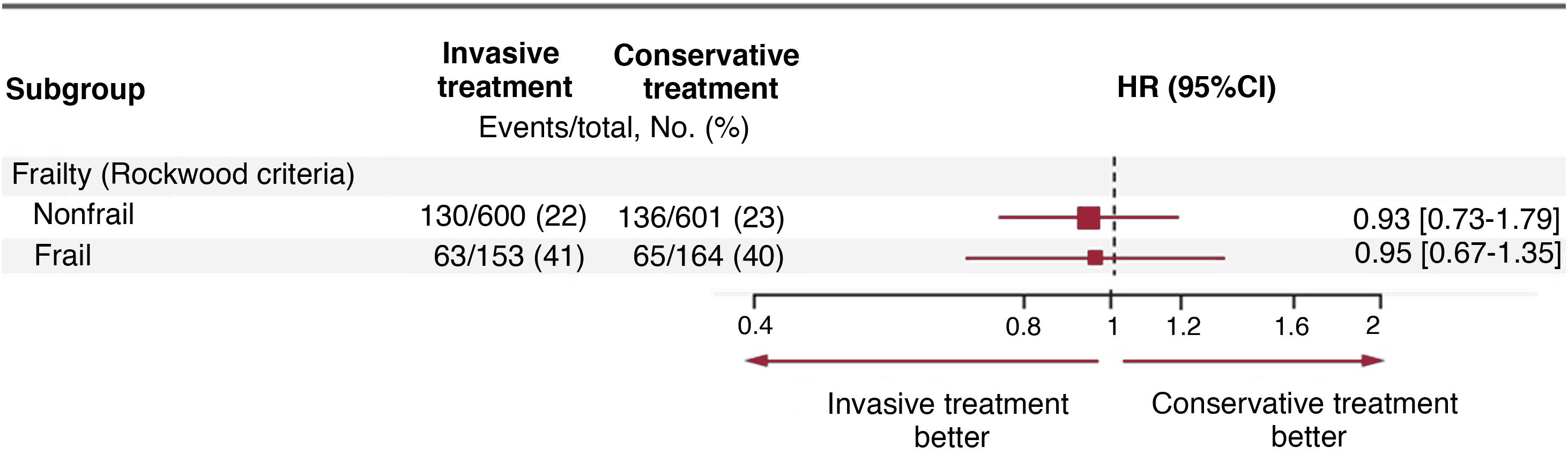
Last, findings from the SENIOR-RITA study6 question the value of the CFS when weighing invasive treatment in elderly patients with NSTEMI, and dispute the assessment of Sanchis et al.1 that the inclusion of nonfrail patients could increase the discriminatory capacity of the tool. The SENIOR-RITA study compared invasive and conservative strategies in patients with NSTEMI aged 75 years or older. Patients with a CFS> 4 (21%) were considered frail, and 20% had a CFS of 4. In a subgroup analysis, CFS scores did not influence the potential benefit of invasive management, and the approach was not associated with better outcomes in patients with a CFS ≤ 4 (figure 1). Although these apparently contrasting results may be attributable to differences in study populations and methodological aspects between MOSCA-FRAIL and SENIOR-RITA, they suggest that further evidence is needed to justify the clinical application of the CFS when assessing the potential benefit of invasive management in elderly patients with NSTEMI.
Subgroup analysis of the SENIOR-RITA study comparing nonfrail patients and patients with frailty, defined as a score of >4 according to Rockwood's modified Clinical Frailty Scale (CFS).6 Reprinted with permission from the Massachusetts Medical Society. HR: hazard ratio; 95%CI, 95% confidence interval.
No funding was received for this publication.
STATEMENT ON THE USE OF ARTIFICIAL INTELLIGENCENo artificial intelligence tools were used to conduct this research.
AUTHORS’ CONTRIBUTIONSAll authors contributed to the conception and design of the study, drafting of the manuscript, critical revision of its contents, and final approval of the final draft. All authors assume responsibility over all aspects of the article and commit to investigate and resolve any issues related to the accuracy and truthfulness of any of its parts.
CONFLICTS OF INTERESTThe authors declare that they have no conflicts of interest related to the present study.
Dr. María Isabel Baños Maturano and Dr. Juan Carlos Bonaque for their contributions to the conception of the manuscript.