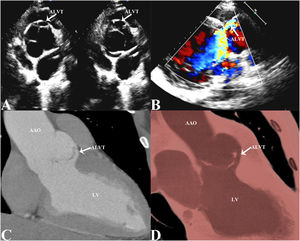

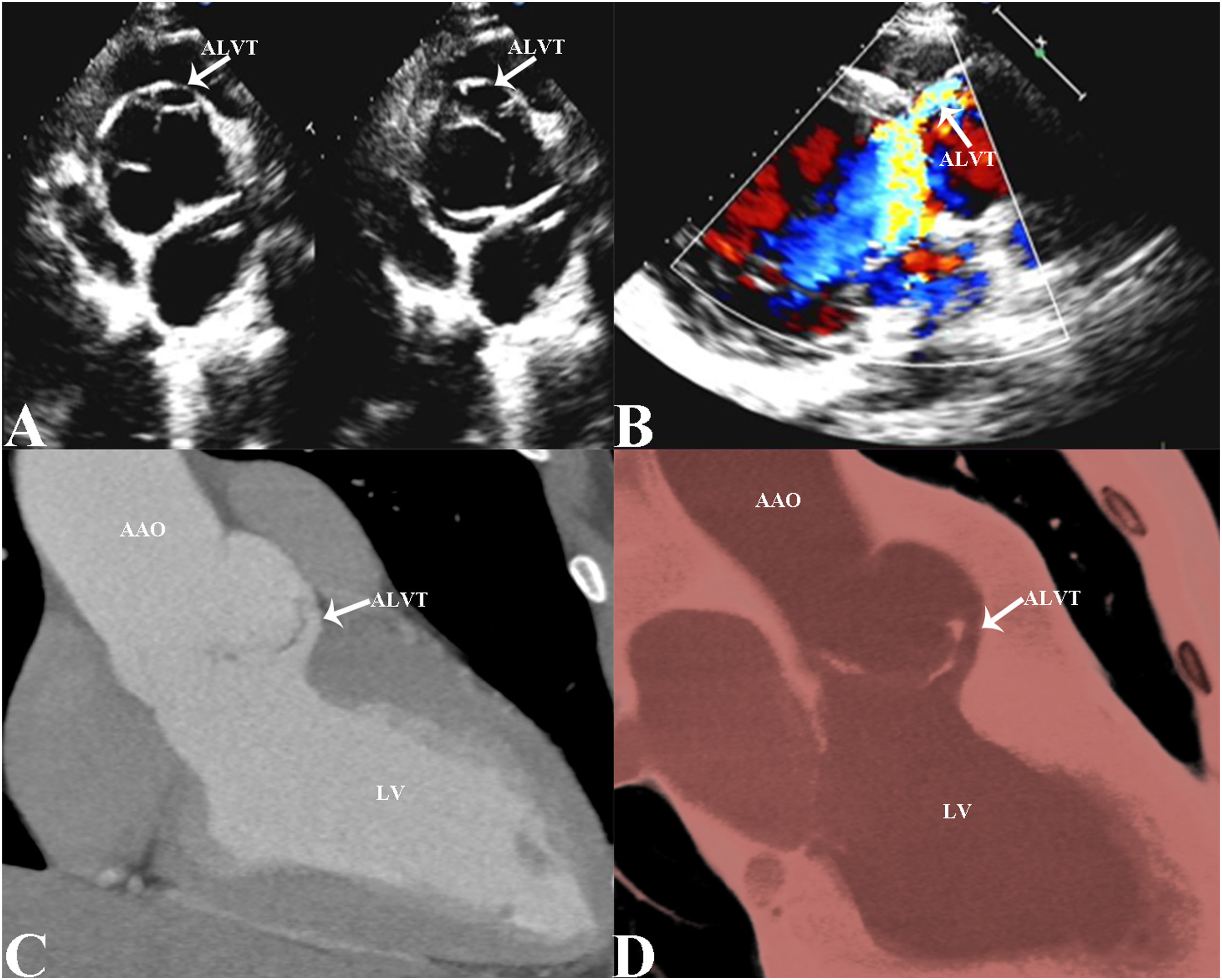
A 26-year-old man was referred to our department for auscultation of a cardiac murmur. Physical examination revealed a 2/6 continuous murmur in the 2nd to 3rd intercostal spaces on the left side of the sternum. Two-dimensional transthoracic echocardiography showed a tunnel-like communication starting above the sinotubular junction in the ascending aorta (AAO), bypassing the aortic annulus, and ending in a dilated left ventricle (LV) (figure 1A). Color flow Doppler imaging showed an abnormal slit-like tunnel structure connecting the aorta to the left ventricle (figure 1B). Contrast-enhanced cardiac computed tomography (CT) showed an anomalous intracardiac communication between the aorta and the left ventricular outflow tract that ran parallel to the commissure between the right and left sinuses, beginning at the height of the aortic ring and ending at the sinotubular junction, which was consistent with an aortico-left ventricular tunnel (ALVT) (figure 1C,D). The patient underwent successful surgical repair of ALVT under cardiopulmonary bypass.

ALVT is a rare congenital aorto-cardiac communication that connects the ascending aorta to the left ventricular cavity. ALVT can be misdiagnosed as a sinus of Valsalva aneurysm, coronary artery to left ventricular fistula, 4-leaflet aortic valve, or paravalvular abscess. It is essential to differentiate this entity from other diagnoses because the treatment options differ significantly, and better outcomes are obtained with this entity. Although echocardiography is the standard imaging modality for identifying ALVT, contrast-enhanced CT can provide valuable information to confirm the diagnosis, delineate the anatomical relationships, classify the ALVT type, and rule out associated cardiovascular anomalies.
FUNDINGThis work is funded by the Wuhan Clinical Medical Research Center for Cardiovascular Imaging (CMRC202307).
ETHICAL CONSIDERATIONSThe patient provided written informed consent for the publication of the clinical details and images associated with his case.
STATEMENT ON THE USE OF ARTIFICIAL INTELLIGENCENo artificial intelligence was used in the preparation of this paper.
AUTHORS’ CONTRIBUTIONSL. Ku and Y. Wang contributed equally to this work. L. Ku and Y. Wang contributed with conceptualization, writing, and editing. X. Ma contributed with conceptualization, reviewing, and supervision.